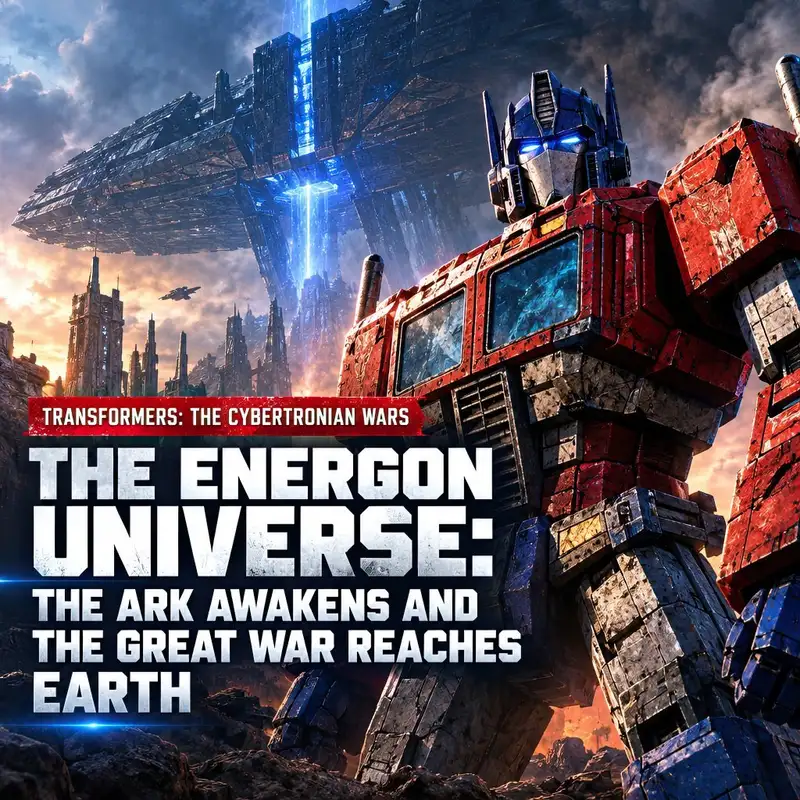
The Energon Universe: The Ark Awakens and the Great War Reaches Earth
Beneath the ground, a machine began to wake. Spike and Carly had found what looked, at first, like wreckage: an impossible metallic structure buried in Earth, filled with bodies that were not dead in any simple human sense, but not alive in any safe one either. Then Teletraan One came online. Its systems began to assess damage, rebuild forms, and reactivate Cybertronians from both sides of a war the two humans did not yet understand. The first consequence was not rescue. It was contact with Starscream.
In the Skybound Energon Universe, that moment marks the Great War’s arrival on Earth. It is not a planned Autobot landing, a negotiated alliance, or a carefully staged Decepticon invasion. Earth receives the debris of a conflict already in motion elsewhere: damaged soldiers, dormant bodies, incomplete records, alien weapons, and a recovery system whose controls are not secure. The crashed vessel commonly identified as the Ark becomes less a sanctuary than a battlefield waiting for enough power to awaken.
That difference changes the stakes. A rescue ship is valuable because it preserves life. A military installation is valuable because it can generate combat power. The Ark is both, and that makes it dangerous. It contains dormant personnel, advanced systems, technical knowledge, and the means to rebuild damaged Cybertronians. Whoever controls those systems can recover allies, deny recovery to enemies, and perhaps turn a handful of survivors into the beginning of a new army.
Spike and Carly enter this crisis with almost no useful framework. They do not know the history of Cybertron’s war, the difference between Autobot and Decepticon politics, or the limits of Cybertronian repair. They cannot know whether an inactive body is a casualty, a prisoner, a weapon, or a future ally. Their discovery is therefore not just first contact. It is an intelligence failure imposed on civilians. Earth has acquired a foreign war before its people have acquired the vocabulary to describe it.
The first restored Decepticon makes ownership of the Ark largely irrelevant. The structure may have carried Autobots, or at least have been associated with their flight from a collapsing situation, but its systems do not recognize political loyalty as a security clearance. Teletraan One can restore whoever it reaches. That is a profound weakness in any recovery architecture. Medical capacity, manufacturing capacity, and personnel recovery are never neutral when enemies can seize the controls.
Starscream understands the opportunity immediately. He does not arrive as the representative of a stable Decepticon government, supported by a secure supply line and a functioning chain of command. He arrives as a commander who has found an opening. He has speed, violence, access to restoration technology, and opponents who are damaged, scattered, or still unconscious. Under those conditions, personal ruthlessness can substitute for institutional authority, at least for a while.
The violence inside and around the Ark establishes the character of the Earth war quickly. Bumblebee is killed in the first chaos of the awakening. Jetfire is badly wounded. These events are not just shocking losses meant to establish that the new continuity has consequences. They reveal the military meaning of a dormant force trapped in unsecured infrastructure. An inactive soldier is not a protected reserve until someone can defend the facility, identify the bodies, control the systems, and keep the enemy from choosing who wakes first.
The Ark’s reactivation also restores figures who will shape the opening struggle, including Optimus Prime, Ratchet, Skywarp, Soundwave, and Ravage. Yet restoration should not be confused with a settled theory of resurrection. The story establishes that damaged Cybertronians can be reactivated and rebuilt under certain conditions. It does not establish that every loss is reversible, that every body can be restored, or that the process is available without cost. The machine can create opportunity. It cannot erase the consequences of war.
Optimus Prime wakes into the worst possible command situation. He has no secure base, no reliable account of his available personnel, no established relationship with the inhabitants of the planet beneath him, and no guarantee that the Ark can remain in friendly hands. A conventional commander might try to hold the installation, organize its defenses, and rebuild strength over time. Optimus does not have time. Every additional activation risks putting another Decepticon into the field.
His decision to destroy Teletraan One is therefore one of the defining choices of this opening campaign. It is not an act of technological ignorance, and it is not a moment of simple sacrifice. It is defensive denial. Optimus destroys the most valuable recovery system available to the Autobots because allowing Starscream to use it would be worse. He chooses to reduce his own force’s chance of rapid recovery in order to prevent the enemy from turning the Ark into a Decepticon force-generation center.
The tactical effect is immediate. The Decepticons lose easy access to a supply of dormant Cybertronians and a system capable of repairing or rebuilding them. But the operational cost is severe. The Autobots also lose their best local source of technical support, medical recovery, and personnel regeneration. Ratchet may possess medical skill, but skill is not a repair bay. A medic needs tools, parts, power, time, and a place where patients can be treated without an enemy arriving through the wall.
This is why the Ark is more than an opening set piece. It defines the war’s first strategic problem. Neither faction has arrived on Earth with an intact expeditionary force. Neither can assume regular resupply from Cybertron. Both must survive in an unfamiliar environment while damaged, understrength, and dependent on systems they do not fully control. The crash has moved the war across worlds, but it has not solved the war’s underlying problem of sustaining armed forces.
Earth is not initially invaded in the usual sense. There is no mass landing force establishing ports, occupying capitals, or issuing demands to governments. There is no formal Autobot mission approved by human authorities. Instead, the planet becomes the involuntary refuge and battlefield of Cybertronian survivors. The distinction is important because it shapes legitimacy. The Autobots may seek to protect Earth, but they did not ask permission to bring their war there. The Decepticons may treat Earth as useful territory, but usefulness does not create a right to exploit it.
The result is a three-sided crisis. The Autobots are fighting to survive, recover their personnel, and stop the Decepticons from gaining a foothold. The Decepticons are seeking power, personnel, and resources sufficient to turn an accidental arrival into an advantage. Human communities are trying to understand an alien conflict that is already damaging lives and infrastructure. Humans are not yet a unified third faction with a common command structure. They are civilians, workers, police officers, military personnel, local authorities, and individuals responding under pressure.
That fragmentation gives both Cybertronian factions room to maneuver. The humans know the terrain. They understand roads, industrial sites, electrical networks, local communications, and emergency response. They possess conventional military forces and the ability to mobilize public institutions. But they do not initially know which giant machine is an ally, which is an enemy, which is damaged, which is pretending to be harmless, or whether an alien promise of protection can be trusted.
The Cybertronians possess superior mobility, transformation capability, weapons, and combat experience. Yet they lack local knowledge, secure infrastructure, and a reliable political foundation. A Cybertronian may transform into a vehicle and move through human spaces, but transformation does not produce legal authority, local fuel, repair facilities, or public trust. It is easier to hide a machine among civilian vehicles than to persuade a frightened population that the machine has brought peace.
Starscream’s opening advantage comes from recognizing that the first contest is not over territory in the conventional sense. It is over momentum. The Autobots have awakened into a defensive emergency. Starscream has awakened into an opportunity to seize initiative. His authority rests on his ability to act quickly, inflict fear, and exploit the enemy’s weakness before anyone can impose order. Skywarp and Ravage support that effort through mobility, pursuit, coercion, and the practical threat of further violence.
This Starscream should not be treated as a borrowed version from another Transformers history. The familiar name does not tell us what kind of officer, ideologue, or subordinate he has been elsewhere. In this opening phase, what matters is what the record shows. He acts as the principal Decepticon commander on Earth because he can command events. His authority is made visible through action, not through a stable constitutional structure, a secure military hierarchy, or broad consent from other Decepticons.
That makes his position powerful and fragile at the same time. Personal command can be highly effective during a crisis. It allows rapid decisions, violent demonstrations, and immediate concentration on a target. But it depends on continued success. A leader who rules through fear must keep proving that fear is justified. A force held together by access to resources, restored personnel, and the expectation of victory can become unstable when those resources are contested or when another commander offers a different path.
The destruction of Teletraan One limits Starscream’s options, but it does not end his campaign. By the time Optimus denies the Ark to both sides, the Decepticons have already escaped the trap of complete dependence on it. They have personnel in the field, weapons, mobility, and a clear incentive to find another source of power. The war’s next phase is therefore shaped not by the question of who owns the crashed vessel, but by the harder question of how a damaged Cybertronian force can remain operational on Earth.
The answer is energon. In this continuity, energon is not treated as a decorative glowing substance or an unlimited fuel supply. It is a strategic requirement. Cybertronian weapons, bodies, repairs, and continued operations demand energy. A force that arrives damaged and isolated cannot simply keep fighting because it possesses impressive armor or advanced technology. It needs a supply system. It needs conversion capacity. It needs secure sites where power can be taken, processed, stored, and defended.
The Decepticons find a way to exploit Earth’s infrastructure. Using technology derived from the Ark, they convert energy from a human power plant into energon. On the surface, the target is an industrial facility. In military terms, it is much more. A power plant provides access to energy generation, transmission networks, workers with specialized knowledge, transportation routes, and a location embedded in civilian life. It is more than a source of power. It is a point where civilian infrastructure can be redirected toward military survival.
That is the moment Earth becomes a sustainment base. The Decepticons are no longer simply fighting on foreign ground. They are attempting to draw strength from the planet itself. This is what makes the conflict more dangerous than a raid or a series of isolated battles. A force that can convert local energy into its own fuel can repair, move, arm, and expand. It can begin to turn an accidental crash site into an operational rear area.
Yet capturing or exploiting a power source is not the same as building a secure logistics network. The Decepticons still need access, security, technical control, and freedom from disruption. They need to protect the conversion process, move energon where it is needed, and prevent the Autobots or human responders from interfering. A power plant can provide a burst of capability, but it also becomes a fixed target. The more dependent a force becomes on a site, the more that site becomes a vulnerability.
For human civilians, the consequences are immediate. The facility is not an empty military depot located safely beyond the edge of society. It has workers. It serves communities. It is connected to responders, police, transportation systems, and a wider electrical grid. When Cybertronian forces make energy infrastructure part of their war, they place civilians inside the operational problem. The Great War reaches Earth not first through a declaration, but through workplaces, emergency calls, damaged facilities, and people caught between armed strangers.
This is also where the moral difference between the early Autobot and Decepticon positions becomes visible, even though neither side has received a human mandate. Optimus treats human lives as lives he must protect. Starscream treats human infrastructure as strategic depth to be exploited. That does not make the Autobots politically sovereign over Earth. It does mean that the two factions are making different practical choices about what the planet is for. One sees a population to defend. The other sees a resource base.
Spike and Carly matter because they stand near the beginning of that political reality. They are not diplomats empowered to speak for humanity. They are not a government, an army, or a treaty organization. But their experiences help establish the first practical relationship between humans and Cybertronians. They see that the war is not a distant legend and not a conflict between simple machines. It involves choices, loyalties, fear, grief, and consequences for people who had no part in starting it.
Their presence also highlights the problem of identification. A human observer may see two transforming machines fighting and have no immediate way to determine which one is attempting to protect civilians, which one is using the fight as cover for an attack, or whether both sides are concealing important facts. Alien armor and faction symbols are not self-explanatory to a population encountering them for the first time. In the first days of contact, trust has to be built through conduct.
Human institutions are not irrelevant simply because they are technologically outmatched in some areas. They possess communications networks, local transportation, industrial knowledge, emergency services, armed personnel, and familiarity with their own terrain. They can observe patterns, secure areas, evacuate civilians, and decide whether to cooperate or resist. At the same time, they cannot immediately reproduce Cybertronian technology simply because they have seen it. Salvage is not the same as understanding. Understanding is not the same as manufacture.
The Autobots therefore face a political problem alongside their military one. Optimus needs human cooperation, or at least human tolerance, to operate effectively on Earth. He needs information, shelter, access, and the ability to move without causing panic. But he cannot demand those things. His promise to protect humanity is morally significant, yet it remains unratified. The people of Earth did not vote for his command, and no individual friendship can substitute for a legitimate relationship between societies.
That makes Optimus’s early campaign a weak-force campaign. He is not leading a fully assembled army. He is the political center of a damaged, incomplete, and vulnerable Autobot force. His priorities are necessarily defensive. He must protect whatever Autobots can still be saved, prevent Decepticon access to key infrastructure, limit harm to humans, and find ways to sustain his own personnel without creating a larger disaster.
The struggle against Skywarp demonstrates the imbalance of this first phase. The Autobots are not operating from a position of comfortable superiority. They are outnumbered, pressured, and forced into reactive fights. Every confrontation carries more weight because a damaged Autobot force cannot afford careless losses. A single wounded soldier may require scarce parts and medical attention. A destroyed vehicle or compromised shelter may remove an entire operational option. A battle won at the street level can still leave the broader position worse than before.
Ratchet’s role becomes essential in this environment. The presence of a capable medic does not mean the Autobots possess unlimited repair. It means they understand the difference between fighting and recovering from a fight. Cybertronian casualties are not solved by willpower. Damaged bodies need diagnosis, compatible components, power, secure work space, and time. The side that can recover its wounded and return them to service will endure longer than the side that merely inflicts dramatic damage.
This is one reason the loss of Teletraan One matters beyond the opening battle. Optimus has denied the Decepticons a dangerous asset, but he has also made Autobot recovery harder. He has chosen a force-preservation strategy that sacrifices force regeneration. That may be the correct decision under the circumstances, but it is not painless. Command often consists of choosing which capability to lose before the enemy takes all of them.
Under that pressure, the Matrix of Leadership becomes more than a symbol. When Optimus seeks to unlock its power in order to save both humans and Transformers, the Matrix functions as a continuity-specific instrument of crisis. It carries political meaning because it is tied to Optimus’s authority. It carries strategic meaning because its power may alter the immediate balance of survival. But it should not be treated as a universal artifact with every ability it has possessed in other Transformer histories.
The Matrix concentrates hope and risk in one place. It offers the possibility that an exceptional object, associated with an exceptional commander, can do what damaged armies and broken supply networks cannot. But that concentration comes at a cost. When an army depends on a unique artifact and the individual able to wield it, its resilience becomes questionable. The Matrix may save lives in a crisis. It cannot by itself create a repair system, secure a power grid, build public consent, or replace a lost organization.
This is the recurring temptation of extraordinary weapons and sacred objects. They promise a shortcut through problems created by politics, logistics, and war. Sometimes they genuinely change the outcome of a battle. Yet their very uniqueness prevents them from becoming a normal basis for security. A civilization cannot rebuild its future around a miracle it cannot manufacture, distribute, or reliably control. The Matrix can strengthen Optimus’s authority, but it cannot remove the need for institutions worthy of that authority.
The Decepticon response takes a different form. Rather than relying on a single figure to unlock a singular object, Starscream seeks to restore a powerful Decepticon asset. The goal is straightforward. Recover enough combat power to overwhelm the Autobots before they can stabilize, build trust with humans, or find reliable sustainment. A restored warrior can alter the local balance, intimidate civilians, force the Autobots onto the defensive, and demonstrate that the Decepticons are still capable of expanding their strength.
But restoration is not immortality. Rebuilding a Cybertronian requires a protected facility, energy, components, technical knowledge, and time. It requires security against attack. It requires the ability to move the restored individual into useful operations. A process that works once under extraordinary circumstances does not prove that either faction can rebuild an army at will. The effort shows that force generation is central to the war. It does not remove the material limits on force generation.
The larger point is that both sides are fighting for the ability to rebuild, not just for the ability to destroy. Terrain matters because it contains energy, industry, shelter, and access to people who can help or hinder operations. The Ark mattered because it held recovery potential. The power plant matters because it offers conversion capacity. Human cooperation matters because no Cybertronian force can operate indefinitely on an inhabited world while treating every local institution as either irrelevant or expendable.
The first major direct confrontations between Autobots and Decepticons do not end this struggle. They establish that the Autobots remain viable and that Decepticon momentum can be contested. That is significant. A weak force that survives the opening blow has preserved the possibility of a longer campaign. But survival is not victory. The Decepticons are still present. Their access to Earth’s resources remains a threat. Their leadership remains dangerous, even when it is divided.
The internal conflict between Starscream and Soundwave makes that division explicit. It is tempting to treat Decepticon rivalry as a simple personality problem, a familiar cycle of one ambitious subordinate challenging another. In this continuity, the more important issue is command. The struggle concerns practical authority: who controls personnel, resources, weapons, restoration opportunities, and the future direction of the Decepticons on Earth. A faction held together by coercion and immediate opportunity will eventually confront the question of who has the right to command.
Internal rivalry can weaken a military organization, but it does not automatically neutralize it. A divided Decepticon force may lose efficiency, coherence, or trust. It may also become more dangerous in the short term if competing leaders attempt bold actions to prove their legitimacy. Rival commanders may seek decisive victories, control of high-value assets, or demonstrations of brutality that bind followers through fear. Fragmentation can reduce strategic unity while increasing local volatility.
Jetfire provides another perspective on the conflict’s instability. His long absence has left him without a current understanding of how the war has changed. He is not ignorant because he lacks intelligence or capability. He is ignorant because information decays. A commander isolated from events may return with assumptions that were once sensible and are now obsolete. In war, advanced technology does not solve the problem of stale knowledge. It can merely make the consequences of stale knowledge more severe.
Humans face a similar, though more immediate, information gap. They do not know the war they have inherited. Cybertronians, meanwhile, may no longer understand the world they have entered or the conflict they left behind. Each side operates with partial maps. The humans do not know which alien claims can be trusted. The Autobots do not know how much support Earth will offer. The Decepticons do not know whether they can convert temporary violence into durable control.
By this stage, the conflict can no longer be treated as two separate stories, one on Cybertron and one on Earth. Events on Cybertron continue to change the larger war, including the return of a Decepticon whose presence alters the balance there. At the same time, Autobots and Decepticons on Earth are fighting for survival, resources, and political space. The two theaters affect one another. Decisions made on one world reshape the options available on the other.
This convergence is the real strategic turning point. Earth is not a detached refuge where a few survivors happen to be fighting. It is becoming part of the system that sustains, redirects, and transforms the Cybertronian war. Its energy can support combatants. Its industry can become contested. Its population can be endangered, recruited, manipulated, or protected. Its political institutions may eventually decide whether the Autobots are treated as allies, unwanted armed guests, or another threat to be contained.
Shockwave’s emerging plan reinforces that the struggle has moved beyond local skirmishes. The significance is not that a familiar name has appeared, or that every version of Shockwave must be assumed to hold the same role. The significance is that another major Decepticon design is brought into a war already spanning two worlds. Plans conceived at that level do not just seek a battlefield win. They seek to shape the conditions under which both planets can survive, fall, or be controlled.
For Optimus, this creates a coalition problem as much as a military one. Saving Earth and serving Cybertron may appear to be identical objectives, but they can compete in practice. Resources are limited. Personnel are scattered. Information is incomplete. Some Autobots may see the defense of Earth as an unavoidable moral duty. Others may see it as a diversion from the struggle for Cybertron itself. A leader cannot resolve that tension by repeating a principle. He must persuade others that the principle can guide viable action.
That is a harder form of command than winning a duel. Optimus must hold together a force that has suffered losses, lacks a secure base, and depends on a human world that never chose to become a front line. He must defend civilians without allowing the Decepticons to use that restraint against him. He must confront enemies who see local infrastructure as fuel. He must lead Autobots who may not agree on how much should be risked for a planet outside their own political community.
The conclusion of this opening phase decides important things without ending the war. The Autobots remain in the fight. The Decepticons have not achieved uncontested control. Earth has become an active front, not just the location of a crash. Decisions made by Autobots and Decepticons now affect two worlds and reach into the wider Energon Universe. Yet none of this produces a stable peace, a settled human alliance, or a final command structure.
In the immediate fight, the Decepticons’ early momentum is checked, and the Autobots prove that they can survive. Operationally, Earth’s energy systems, industrial sites, and safe areas become militarily valuable. Strategically, Cybertron and Earth are now linked. Neither world can be understood in isolation, because each influences the other’s ability to sustain forces, make alliances, and shape the war’s future.
Politically, the crisis remains unresolved. The Decepticons have no legitimate claim to Earth, and their exploitation of civilian infrastructure makes their intentions plain. The Autobots possess a stronger moral case because they try to protect the population caught in the conflict, but moral purpose does not automatically create political authority. Optimus must earn cooperation through restraint, honesty, and action. He cannot assume that a frightened human population will accept alien military operations simply because the alternative is worse.
For civilians, the war begins before any treaty, warning system, or evacuation plan exists. It reaches factories, power systems, roads, homes, and emergency services. People are killed and endangered before they understand the factions involved. That is what makes the Ark’s awakening so consequential. It does not begin Earth’s role as a chosen battlefield. It reveals Earth as the place where a broken Cybertronian war can regenerate itself.
The Ark delivers not an organized rescue mission, but the means by which both factions might recover strength. Its awakening turns dormant bodies into soldiers, alien technology into contested infrastructure, and a hidden crash site into the opening front of a wider conflict. By making human energy, industry, shelter, and political trust part of the struggle, the crash turns survival into occupation risk, protection into an unratified obligation, and a distant civil war into one strategic system spanning two worlds.