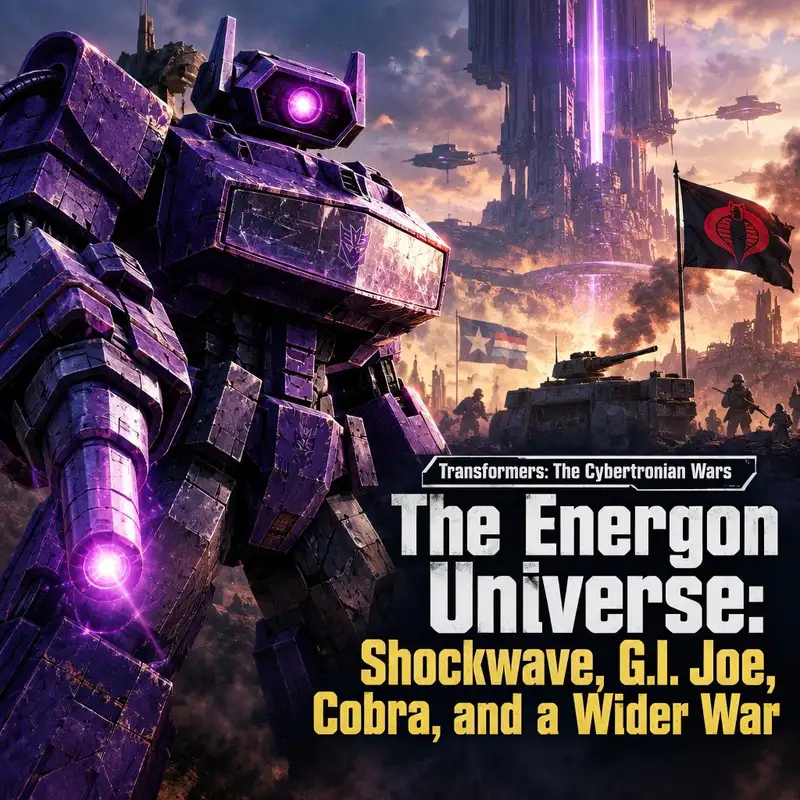
The Energon Universe: Shockwave, G.I. Joe, Cobra, and a Wider War
A pod of whales surfaces in Earth’s ocean, and Shockwave sees not living creatures, not witnesses, and not a boundary he is obliged to respect. He sees feedstock. In the Skybound Energon Universe, his machinery converts organic life into Energon. The scene is horrifying because it is not an accidental consequence of a battle. The destruction of Earth’s biosphere is part of the production process.
That difference changes the stakes. Collateral damage occurs when a military objective harms civilians or ecosystems as an unintended, though often foreseeable, result. Shockwave’s operation is more direct. Earth’s living systems become industrial inputs. The ocean is treated as a supply depot, its creatures as raw material, and the planet’s capacity to sustain life as a resource to be consumed for a distant war.
This is not the Shockwave of the old animated series, the earlier I D W comics, or any film continuity. It belongs to Skybound and Image Comics’ Energon Universe, a shared setting in which Transformers, G.I. Joe, Cobra, Void Rivals, and later M.A.S.K. occupy the same developing political landscape. The question goes beyond whether Autobots can stop Decepticons. It is what happens when an alien civil war decides that an inhabited world is expendable infrastructure.
Shockwave’s campaign begins with cruelty, but cruelty is not its only purpose. His objective is sustainment. The Decepticons do not need one more dramatic battlefield victory if they cannot power their forces, preserve their machinery, and maintain the war effort connected to Cybertron. Earth offers a possible answer. It has life, resources, and a position within reach of a space bridge. That makes it useful. It also makes it vulnerable.
A war can be lost long before a commander loses a duel. Armies fail when they cannot replace damaged equipment, move fuel, maintain vehicles, recover wounded personnel, or keep the systems behind the front functioning. Cybertronians may not eat human food, but they still require energy, repair capacity, transport, and secure access to the infrastructure that makes continued operations possible.
Shockwave’s solution combines those needs into one system. Earth-side extraction turns biological matter into Energon. The Nemesis provides a mobile Decepticon platform for command, processing, and protection. The space bridge reduces the distance between Earth and Cybertron, allowing a local resource operation to serve a much larger strategic problem. It is more than a weapon, a laboratory, or an invasion route. It is a supply line.
That supply line has several links. Material must be harvested. It must be converted. The resulting Energon must be stored safely enough to remain useful. The processing system must be defended from Autobot attack, internal sabotage, and environmental disruption. Then the bridge itself must remain stable and accessible. Remove any one of those links, and the entire scheme becomes much less valuable.
The space bridge gives Shockwave strategic reach, but it also creates dependency. It is a bridge in the military sense as much as the technological one. It connects separated theaters, yet it concentrates risk around a limited route, a limited platform, and a limited set of operators. The Decepticons can reach across worlds, but the system cannot be treated as indestructible simply because it is advanced.
The Nemesis therefore matters less as a collection of weapons than as the center of an extraction network. Its destruction would not just damage a Decepticon ship. It could break the connection that makes Earth valuable to Shockwave’s larger plan. The operation’s strength is its ability to move energy across impossible distance. Its weakness is that so much depends on one vulnerable chain of infrastructure.
Shockwave’s campaign is also not an example of a perfectly disciplined Decepticon machine. His authority appears practical and mission-based. He has the ability to direct assets, impose priorities, and use other Decepticons in service of the extraction project. But the record does not establish a neat constitutional hierarchy in which every subordinate shares his objectives or accepts his methods without friction.
He uses captured Autobots, including Jazz and Cliffjumper, as prisoners and instruments of coercion. Torture is not presented as an unfortunate deviation from an otherwise efficient operation. It is embedded in his method of control. Shockwave wants information, compliance, and advantage. He treats individual autonomy as an obstacle to be overcome, whether the individual is an enemy combatant, a fellow Decepticon, or an inhabitant of Earth.
That approach can create immediate obedience. Fear often does. But it produces a command climate in which loyalty is difficult to distinguish from survival. Subordinates may comply because they agree, because they are trapped, because they fear punishment, or because they believe resistance would endanger someone else. A force organized through terror can move quickly. It can also become brittle when conditions change.
Soundwave and Ravage reveal one of the limits of Shockwave’s utilitarian logic. Soundwave’s effort to preserve Ravage shows that Decepticon priorities are not entirely uniform. Even within a violent military organization, some bonds matter to the people inside it. Shockwave sees an operation in which every asset has a measurable value. Soundwave’s concern suggests that the Decepticons are still made up of individuals with loyalties that cannot always be reduced to calculation.
This does not make the Decepticon campaign less dangerous. It makes it more realistic. Armies rarely act as a single mind. They contain commanders, specialists, prisoners, rivals, believers, opportunists, and people who discover too late that a mission they supported has become something else. Shockwave can impose a plan, but he cannot eliminate every competing priority merely by declaring it inefficient.
The Autobots oppose the extraction operation for military reasons, but their disagreement with Shockwave is also political. The fundamental issue is Earth’s status. Is the planet a neutral refuge, a battlefield, a potential ally, a source of material, or a world whose inhabitants possess rights that Cybertronian forces must respect? Shockwave answers by treating Earth as a reservoir. Optimus Prime reaches a different conclusion.
The Autobot response is complicated by the severity of Cybertron’s own crisis. The energy Shockwave seeks is not imaginary. Cybertronian deprivation is real, and the possibility of restoring their homeworld carries enormous weight for fighters who have already lost so much. A commander can understand that need without accepting the methods chosen to meet it.
Elita One represents the harsher wartime argument. From her perspective, defeating Shockwave and preserving the Energon operation could offer a path toward restoring Cybertron. A planet in crisis does not recover through moral sentiment alone. It needs power, infrastructure, and the means to keep its people alive. Her position recognizes a strategic truth that Optimus cannot simply wish away: refusing Earth’s resources does not solve Cybertron’s deprivation.
Optimus sees another truth. If Cybertron’s restoration requires the destruction of Earth’s ecosystems and the conversion of its living beings into fuel, then recovery becomes indistinguishable from conquest. The Autobots would not be saving their civilization. They would be transferring the cost of its survival to another world that never consented to bear it.
That decision is morally clear in one sense and strategically painful in another. Optimus cannot defeat the underlying resource crisis by refusing to exploit Earth. He cannot instantly rebuild Cybertron, repair every fractured alliance, or bring the Decepticon war to an end. He can only decide what the Autobots will not become in the attempt.
The disagreement between Optimus and Elita One should not be reduced to a contest between compassion and callousness. Both confront a catastrophe. Both understand that Cybertronian survival requires more than battlefield courage. The divide concerns what obligations remain when survival appears to demand sacrifice from people who did not create the crisis.
It is also a test of coalition politics. An alliance can agree on the need to stop an enemy and still fracture over what victory should look like. The Autobot cause has greater moral force if it refuses to turn Earth into a colony or a fuel source. Yet that restraint comes with material costs, and those costs can deepen internal disagreement among people who have endured war, exile, loss, and scarcity.
Optimus chooses to deny both sides the extracted Energon rather than let Earth be consumed. In the immediate struggle, he defeats Shockwave’s active operation. The reserves are destroyed, and the bridge-based connection is severed. The Nemesis no longer provides the same functioning route between Earth and Cybertron.
That is a tactical defeat for Shockwave. His extraction system cannot continue as intended. It is an operational defeat as well, because the larger supply chain is broken. Harvesting, processing, storage, transport, and protection cannot be separated indefinitely. Without the connection that ties them together, Earth’s resources cannot sustain Cybertronian forces in the same way.
But the end of the operation does not return Earth to normal. The destruction sends a fragment of Cybertron into Earth’s atmosphere. The exact long-term consequences of every alteration are not immediately settled, but the political meaning is unmistakable. Earth has become materially entangled with Cybertronian conflict. Alien war is no longer something that arrives, causes damage, and leaves behind a few unanswered reports.
Shockwave loses the campaign, yet his campaign changes the strategic environment. It proves that Energon can be found, exploited, contested, and weaponized on Earth. It demonstrates that the planet’s oceans and ecosystems are vulnerable to systems designed for an entirely different civilization. It also proves that a bridge between worlds can turn local environmental destruction into an interstellar supply operation.
For civilians, the lesson arrives without diplomacy or informed consent. Earth’s people do not first encounter Cybertronian politics through treaties, public debate, or a carefully managed first-contact process. They encounter it through secrecy, disrupted infrastructure, violence, ecological threat, and the discovery that alien machines can treat a living world as a warehouse.
This is the point at which the conflict begins to widen in a second sense. Shockwave expands the battlefield by using Earth as a resource base. But the political expansion comes afterward. Human institutions begin to react. They do not react as one united humanity, because humanity has no single command structure, no shared intelligence system, and no universal agreement about what the Cybertronians represent.
Conrad Hauser, later known as Duke, experiences that problem from the ground level. His early encounter with a Transformer gives him knowledge that should be strategically important. Yet extraordinary claims are difficult to use if the institutions receiving them have no framework for authentication. A witness can be credible and still be ignored when the event he describes does not fit any existing category.
Shape-changing alien combatants create an intelligence problem before they create a military one. How does a human officer prove that a vehicle was sentient? How does a government distinguish an Autobot from a Decepticon, a hostile machine from an ally, or a disguised infiltrator from an ordinary civilian vehicle? What does reliable evidence even look like when the subject can change form and vanish into civilian infrastructure?
Duke’s warning does not fail because the danger is small. It fails because the existing system is not built to receive that kind of information. Conventional agencies have procedures for aircraft, armored vehicles, foreign spies, sabotage, and domestic threats. They do not have doctrine for a conflict in which a truck might be a person, a person might be a combat platform, and a battlefield might be hidden inside ordinary transportation networks.
The formation of the G.I. Joe Initiative is an adaptive response to that gap. It is not evidence that human governments suddenly possess equal capability to the Autobots or Decepticons. G.I. Joe is a specialized force, politically sensitive and mission-focused. It exists because conventional institutions need personnel able to investigate, respond, and operate in a security environment transformed by alien technology.
Duke brings field experience and hard-earned suspicion. Hawk and General Flagg occupy different roles in the senior structure that authorizes, directs, and sustains the organization. The distinction has practical consequences. A field commander sees immediate danger. Senior authorities must decide what resources to provide, what secrecy to maintain, and how far a new organization can act before it creates as many political problems as it solves.
Once Energon exists on Earth, human involvement is no longer optional. The question is not whether people will seek it. The question is who will control it, what they believe it can do, and whether any institution can prevent it from becoming the basis for a new arms race.
Cobra Commander understands the political value of Energon. He is more than a human criminal who has adopted Decepticon language or copied Cybertronian technology. This version of Cobra Commander arrives on Earth from Cobra-La or its associated alien realm, and he pursues Energon as a means of establishing independent power. The exact nature of that origin remains less important here than the strategic fact of his ambition.
Shockwave wants Energon to sustain a war tied to Cybertron. Cobra Commander wants Energon to build authority on Earth. Those objectives can overlap without becoming identical. Shockwave’s logic is extractive and military. Earth is useful because it can feed the Decepticon war effort. Cobra Commander’s logic is political. Energon offers leverage against existing states, institutions, and military hierarchies.
To control Energon is to control more than a source of power. It can mean control over research, access to weapons, the ability to recruit followers, and the ability to make governments fear what they do not understand. A movement built around that leverage does not need to defeat every rival at once. It only needs to make itself indispensable, dangerous, and difficult to contain.
Cobra’s ambitions therefore cannot be understood as a simple extension of Decepticon command. No formal unity erases the distinct goals of the actors involved. Cobra Commander is building Cobra, not serving as a minor officer in someone else’s civil war. His relationship to alien technology is opportunistic, ideological, and personal. He wants a new order in which he controls the terms of power.
That makes the wider conflict more unstable. The arrival of a powerful outside technology does not necessarily unite local elites against the outside threat. It often gives them new reasons to compete. Some will seek containment. Some will seek access. Some will claim that only they can protect the public. Others will see a market, a weapon, or a route to authority they could never have gained through ordinary politics.
Destro and M.A.R.S. represent the industrial dimension of this transformation. Destro is not just Cobra Commander’s supplier or subordinate. He is a weapons producer with his own interests, technical ambitions, and incentives to convert alien material into usable military advantage. In any arms race, the person who can turn an exotic discovery into reliable production becomes politically important.
There is a large gap between possessing Energon and making effective use of it. A sample can be stolen. A device can be captured. A laboratory can produce an experimental result. None of that automatically creates a durable military capability. Weapons require engineering, testing, operators, maintenance, transport, security, and doctrine. They must function outside the controlled conditions in which they were first developed.
Destro’s importance lies in his attempt to cross that gap. He seeks to transform knowledge of Energon into coercive capacity. That does not mean every human actor can now build Cybertronian weapons at will, nor does it mean alien systems have become routine industrial products. It means the effort has begun, and the effort itself changes the balance of power.
The relationship between Cobra Commander and Destro is therefore an alliance of convenience, competition, and procurement. Cobra needs resources, equipment, and technical credibility. Destro needs access, influence, and opportunities to demonstrate the value of his work. Their interests align often enough to cooperate, but they are not the same interests. A supplier who understands the weapon may eventually possess leverage over the leader who orders it.
Shockwave demonstrates that Energon has strategic value. Destro helps demonstrate that humans will attempt to industrialize that revelation. The danger is not only that one villain acquires one powerful device. It is that alien energy becomes embedded in human rivalries among governments, secret organizations, military contractors, insurgents, and ambitious individuals.
The result is not a clean two-sided war. G.I. Joe does not just face Cobra while Autobots face Decepticons on a separate track. The Dreadnok War makes that clear. G.I. Joe, Cobra, and the Dreadnoks enter a conflict in which each faction has different interests, different methods, and different ideas about who should be treated as the primary enemy.
The temporary alignment between Duke and Cobra Commander does not represent reconciliation. It represents threat management. When a third actor creates immediate danger, enemies may cooperate long enough to remove the obstacle. Such arrangements are often militarily sensible. They are rarely politically stable. Shared necessity can suspend conflict, but it does not erase distrust, ideology, or the damage already done.
The Dreadnoks benefit from the wider disorder because the major institutions are still defining their authority. G.I. Joe is developing its mission and rules of engagement. Cobra is seeking power without becoming dependent on any partner. The Cybertronian factions remain dangerous but divided. In such an environment, irregular groups can exploit gaps in intelligence, jurisdiction, and command.
This is how a security crisis becomes multipolar. The important divisions are no longer only Autobot and Decepticon, or Joe and Cobra. They include state institutions and private military industry, formal commands and clandestine networks, people seeking restraint and people seeking access, and groups that view Energon as a danger against groups that view it as an opportunity.
Every new organization brings new capabilities, but it also creates new problems of coordination. Who has authority to seize alien technology? Who decides whether a captured Cybertronian is a prisoner, a witness, an intelligence source, or a potential ally? Who is accountable when a secret operation causes civilian harm? These are not administrative details. They determine whether a response force remains a defense organization or becomes another contender in the struggle for power.
The conflict around Hound brings the question of personhood into the open. Duke discovers that Clutch has been concealing the Autobot Hound from G.I. Joe. On the surface, that is a security breach. A member of a specialized unit has withheld the presence of a powerful alien being from an organization created to deal with exactly such threats.
Yet the problem goes deeper than unauthorized contact. Hound is not a crate of weapons or a damaged aircraft awaiting inspection. He is an autonomous Cybertronian with his own judgment, history, and political identity. The moment human authorities learn of him, they must decide whether they are dealing with an ally, an intelligence asset, an uncontrolled weapon, a detainee, or a person entitled to make choices outside their chain of command.
Duke’s suspicion does not emerge from nowhere. He has seen how dangerous Cybertronians can be. Shockwave’s campaign has shown that alien technology can devastate ecosystems and turn Earth into an extraction zone. Cobra has demonstrated that Energon can become a political weapon. Under those conditions, a hidden Autobot looks less like a private friendship and more like an unknown variable in an already unstable security environment.
But suspicion does not settle the moral question. Real danger does not automatically justify treating every Cybertronian as hostile property. If humans demand that Autobots respect Earth’s sovereignty and the personhood of its inhabitants, they cannot simply deny Cybertronian personhood whenever it becomes inconvenient.
Clutch’s action is specific to Clutch. It does not prove that every member of G.I. Joe opposes cooperation with Cybertronians, nor does it establish that the organization has one settled policy. Instead, it reveals that the institution is still struggling to define its relationship with beings who can be both military assets and independent political actors.
Trust has become expensive. Shockwave did not create all mistrust between humans and Cybertronians, but his operation made it rational for human commanders to fear exploitation. The challenge is whether that fear can be managed through accountable institutions, reliable intelligence, and negotiated relationships, or whether it will harden into indiscriminate hostility.
The appearance of M.A.S.K. and V.E.N.O.M. widens the field further. M.A.S.K., led by Matt Trakker, enters as a specialist human network responding to dangerous technology and the secret conflicts that surround it. V.E.N.O.M., led by Miles Mayhem, seeks technology from Earth and beyond for its own purposes. Their emergence signals that the struggle over alien power no longer belongs solely to established military forces or revolutionary organizations.
These groups matter because proliferation creates demand. Once technology is known to exist, someone will attempt to acquire it, copy it, sell it, hide it, or build a private advantage around it. The relevant question is no longer only whether a dangerous device can be stopped. It is whether the knowledge, materials, and people connected to it can be controlled once they have entered a wider clandestine economy.
M.A.S.K. and V.E.N.O.M. are not signs of a unified Earth defense. They are signs of fragmentation. Each new specialist network may bring expertise that larger institutions lack. It may also create another hidden supply chain, another competing intelligence operation, and another group prepared to act without public oversight. Secrecy can protect a population from panic. It can also protect private agendas from scrutiny.
The strategic problem has changed since Shockwave began converting life into Energon. At first, the urgent task was to stop an extraction system before it consumed the planet’s resources. Later, the challenge becomes managing the consequences of discovery. Energon is now an industrial prize, a security threat, a political symbol, and an invitation to competition.
The broader setting shown in Void Rivals keeps Earth’s crisis in perspective. Earth is not the center of every conflict in the Energon Universe. The Agorrian and Zertonian struggle, along with the appearance of figures such as Jetfire, shows that Energon-linked politics extend into an interstellar environment with its own wars, loyalties, and historical burdens.
That wider setting does not make Earth less important. It makes Earth more exposed. A planet that has become a source of alien energy, a landing point for Cybertronian forces, and a laboratory for human militarization cannot assume that its fate will be decided only by its own governments or its own defenders.
Shockwave fails to secure Earth as a functioning Decepticon supply base. His extraction network is broken, and his immediate campaign is defeated. But in a darker historical sense, he succeeds at changing Earth’s strategic condition. He proves that the planet can be harvested, that its ecosystems can be weaponized against it, and that alien technology can redraw the political map long after a single operation ends.
The wider war is more than a larger roster of factions entering the same fight. It is the conversion of Earth from a refuge and battlefield into a contested political-industrial system. G.I. Joe, Cobra, Destro, M.A.S.K., V.E.N.O.M., and the Cybertronian factions now carry their own motives, fears, technologies, and conflicts into a world that can no longer pretend the war belongs somewhere else.