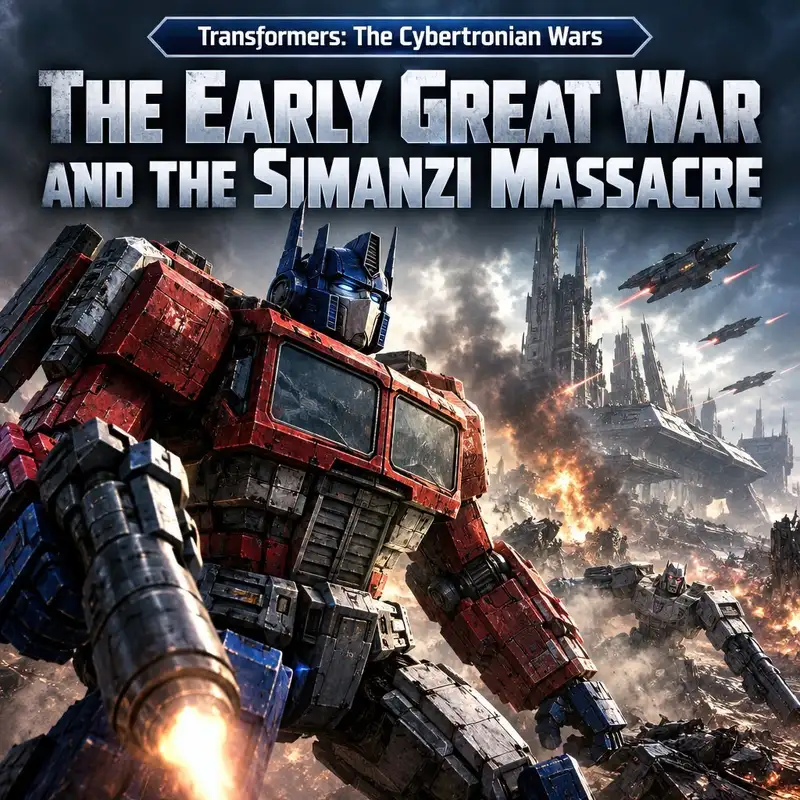
The Early Great War and the Simanzi Massacre
The ground at Simanzi had stopped behaving like ground. Water, mud, and industrial wreckage turned movement into a survival problem. Ultra Magnus and Rotorstorm were moving near the Crucible when enormous Cybernoughts came after them through the flooded terrain. Rotorstorm could transform into a helicopter and take to the air. Magnus could not just rise above the disaster. A machine built for ordinary ground warfare had to find a way through a landscape that warfare itself had made hostile.
This was not a clean engagement between two armies facing one another across a clear front. It was a brief view of a battlefield where terrain, mobility, and immense war machines mattered before anyone could make a speech about justice, revolution, or duty. The scene survives in the 2005 I D W Transformers continuity, in a flashback from More Than Meets the Eye. It gives us only a fragment. But it is a fragment from one of the most consequential disasters of the Great War.
Later accounts describe Simanzi as a catastrophe that killed roughly half of Cybertron’s population and permanently changed the planet’s environment. The statement is immense, and the record does not provide the kind of census, casualty ledger, or operational map that would let historians turn it into a neat number. We do not know how many of the dead were civilians, soldiers, neutrals, or people trapped between the factions. We do not know how long the fighting lasted, or where every line of advance ran.
What we do know is enough to establish the scale. Simanzi was remembered as more than a battle. Decepticon memory could call it a victory. Autobot memory called it a massacre. Neither label is neutral, and each carries a political purpose. Yet both acknowledge that something occurred there which exceeded the normal meaning of a military success. A force may seize ground, break an enemy formation, or gain access to a strategic installation. It cannot claim uncomplicated victory if the result is the destruction of the society that made the objective valuable.
Simanzi matters because it reveals what the early Great War had become. It began in a political order marked by exclusion, inequality, and institutional failure. It became a conflict that could reshape landscapes, manufacture specialists for newly damaged environments, and consume Cybertronian life on a civilization-wide scale. The question is not whether every detail can be reconstructed. It cannot. The question is how a rebellion against an unjust order became a war system capable of producing Simanzi.
The answer begins before the Crucible, before the Flood, and before the Cybernoughts moved through the mud. It begins with a Cybertron whose governing institutions had lost the confidence of many of the people they were supposed to represent. In this continuity, the old Senate did more than face a few dissatisfied troublemakers. It presided over a society in which power, status, opportunity, and recognition were unequally distributed. Those outside the favored structures had reason to believe that the existing order was designed to preserve itself.
That fact matters because it explains why Megatron’s early arguments found an audience. His movement did not emerge from nowhere, and it did not gain support simply because he was a gifted speaker or a formidable fighter. He articulated anger that already existed. He attacked a political class that appeared insulated from the consequences of its own decisions. He gave language to those who felt that Cybertronian society assigned worth according to origin, status, or usefulness, while presenting those arrangements as natural and permanent.
A system can survive criticism when it can reform. It becomes vulnerable when it cannot even convincingly acknowledge the criticism. The Senate’s failure was not that every institution was corrupt in exactly the same way, or that every official was personally cruel. Its deeper failure was political. It did not provide a credible route through which marginalized Cybertronians could seek change without confronting the machinery of the state. Under those conditions, radical language acquires practical force.
That does not mean catastrophe was inevitable. Political exclusion can produce reform movements, labor organizations, dissident publications, local resistance, or negotiated concessions. It can also produce armed revolution. The path from grievance to war depends on choices, organizations, fears, and opportunities. Megatron’s significance lies partly in the way he made one path increasingly likely. He did more than criticize the old order. He built a movement capable of challenging it with force.
In Megatron Origin, his early political development is closely tied to the hard realities of labor, violence, and marginalization. He began as a miner and became a writer and public critic. His opposition to the Senate was not abstract. It was connected to a society that treated many Cybertronians as expendable while limiting their access to power. That experience gave his rhetoric credibility. He could present himself not just as an aspirant to office, but as someone who understood what the ruling order demanded from those beneath it.
Yet his movement also developed within Kaon’s violent networks, among criminal structures, gladiatorial culture, and people for whom state authority was not an impartial guardian. That setting encouraged a different political lesson. It taught that survival could depend on intimidation, loyalty, spectacle, and the willingness to strike before an opponent could organize. Those methods may be understandable in a brutal environment. They are also dangerous foundations for a movement that claims it intends to create a better society.
The change was gradual rather than instantaneous. There was no single switch that turned political dissent into the Great War. But over time, Megatron’s cause became more organized, more militarized, and more willing to define political success in terms of coercive control. The movement acquired a name, a network, and a growing capacity to impose its will. The Decepticons became not only a current of opinion but a military-political force.
That transformation altered the meaning of opposition. In a functioning political system, adversaries may fight over law, office, representation, or policy while still recognizing common institutions. In a civil war, the struggle becomes one over who controls the institutions themselves. Courts, communications, energy systems, transport routes, archives, police forces, and industrial facilities cease to be neutral civic structures. They become objectives, weapons, or prizes.
Once that happens, even leaders who would prefer a limited conflict face pressure to militarize. They need security, intelligence, supply, discipline, and loyal commanders. They need a way to identify enemies and suppress infiltration. They need facilities that can repair damaged bodies, produce equipment, and sustain forces in the field. They need to secure energon, the resource that keeps Cybertronian individuals and military systems functioning. A political movement that cannot meet those requirements risks being destroyed by one that can.
This is where the early Great War became more than a dispute over the Senate. The Decepticons did more than defeat an old political class and inherit its institutions. The conflict expanded into struggles over the machinery of Cybertronian life. Cities, transport systems, industrial sites, and strategic installations became contested. The more each side feared defeat, the more difficult it became to preserve civilian space outside the conflict.
The Autobots changed in response. In the I D W history, they were not a timeless military species opposed to a separate Decepticon species. They emerged from a shifting coalition of defenders, reformers, security personnel, military figures, and civilians who rejected Megatron’s growing use of force. Their identity was forged in crisis. They inherited some links to established institutions, but they also had to become a resistance movement against a revolutionary force that had become increasingly authoritarian.
Orion Pax’s rise to Optimus Prime must be understood in that environment. His authority was more than ceremonial. The collapse of political order created a need for command that could coordinate people with different backgrounds, loyalties, and priorities. A leader in that position had to defend communities, preserve military cohesion, and maintain some claim that the Autobots stood for something more than the replacement of one ruling faction with another.
That was difficult work. The Autobot cause included soldiers, civilians, former officials, reformers, and people who may have agreed on little beyond the belief that Megatron’s methods could not be allowed to prevail. A coalition like that is politically stronger than a narrow personal following because it can draw support from multiple parts of society. It is also harder to command. Every military emergency risks forcing the coalition to choose between its stated principles and immediate survival.
By the time of Simanzi, Optimus Prime was the principal Autobot commander. Ultra Magnus operated as a field commander amid the fighting. That does not tell us every detail of the chain of command, and it should not be used to invent a complete headquarters structure or campaign plan. It does establish that the Autobots had developed a wartime leadership capable of placing experienced personnel in the field against threats of enormous scale.
Civil war erodes the boundary between civic authority and military authority. The Senate had failed to contain the political crisis. The Decepticon movement had become an armed instrument. The Autobots had become a military coalition. Under those circumstances, nearly every major piece of infrastructure acquired military importance. A transport network could move refugees, troops, damaged personnel, or weapons. An energy facility could sustain a city or supply an army. An archive could preserve history or identify political enemies.
The Crucible was one of the places where this wider struggle came to a head. The surviving material establishes that it was a strategically important installation associated with the Simanzi battle. It does not securely establish whether it was a factory, a weapon, a prison, a city, or something else. It would be easy to fill that absence with speculation. It would also be unnecessary. Its importance is demonstrated by the scale of fighting around it and by the consequences attached to its loss or capture.
Strategic infrastructure matters because it concentrates vulnerability. A faction may be able to survive the loss of an isolated outpost. It has much greater difficulty surviving the loss of an installation tied to energy, movement, repair, production, command, or regional control. That is why civil wars so often become battles over places that were not designed to be battlefields. A bridge, refinery, rail hub, archive, or power station becomes militarily decisive precisely because ordinary life depends upon it.
For Cybertronians, the same logic applies with particular force. Their civilization requires energy, repair capacity, manufacturing, and communication on a vast scale. Even if an individual can transform into a vehicle and travel independently, an army cannot operate solely on individual mobility. It needs recovery systems for the damaged, secure routes for supply, facilities for maintenance, and institutions capable of deciding who receives scarce resources first.
At Simanzi, that strategic logic collided with a battlefield that no longer resembled a stable industrial zone. The area was flooded. The conflict was tied to what later came to be called the Forced Flood, an event significant enough to shape the design and construction of specialized soldiers. The source does not tell us exactly how the Flood was caused, whether it was intentional, what system produced it, or which side controlled it. Those are real gaps, not invitations to invent a secret weapon.
The effects, however, are easier to see. Flooded terrain disrupts normal movement. It changes which routes remain open and which positions can be held. It complicates the recovery of wounded personnel. It separates units that might otherwise reinforce one another. It can turn familiar infrastructure into obstacles, expose forces moving through shallow cover, and make ordinary ground vehicles less useful. It creates a battlefield where elevation, aerial mobility, amphibious capacity, and local knowledge become decisive.
Rotorstorm’s escape from the Cybernoughts illustrates that point. His helicopter mode was more than a visual feature or a convenient exit from danger. In a flooded and broken landscape, flight offered a route that the ground could no longer provide. It also offered the possibility of reconnaissance, rapid withdrawal, or movement across terrain made impassable by water and debris. The advantage was real, but it was not absolute. Aircraft still require usable airspace, functioning systems, and a destination where survival is possible.
Ultra Magnus faced the inverse problem. A commander on the ground could not just ignore the condition of the terrain. Heavy armor, courage, and experience do not make mud, water, wreckage, and immense hostile machines disappear. The scene at Simanzi is valuable because it strips away the illusion that transformation solves every military problem. A change of form can improve mobility. It does not guarantee mobility where the environment has been destroyed.
The Flood also demonstrates another feature of the Great War. By this stage, the fighting could alter not just the ownership of territory but the conditions under which territory could support life. Later references connect Simanzi to permanent environmental change on Cybertron. The record does not isolate one cause. It may have involved the Flood, the Crucible, weapons employed around the installation, or the accumulated damage of prolonged operations. The precise mechanism remains unclear.
The strategic meaning is clearer. Environmental destruction is more than collateral scenery. It can make transportation harder, damage energy systems, disrupt production, isolate communities, and permanently alter how a population lives. A battlefield can become an obstacle to reconstruction long after the shooting stops. A destroyed road can be rebuilt. A damaged regional environment may require a far larger recovery effort, assuming anyone possesses the stability and resources to undertake it.
The war adapted to these conditions. One of the most revealing pieces of evidence comes from Riptide, a Cybertronian who was Made To Order for Simanzi. In this continuity, that phrase carries a specific meaning. Riptide was constructed cold, with a preexisting spark placed into a newly built body after the war had begun. His body was designed for a requirement created by the conflict. He was a Hydrobot, built in response to the operational conditions imposed by the Forced Flood.
This was not a simple matter of recruiting another volunteer or transferring a veteran to a different unit. It was an industrial response to a battlefield problem. The war had reached a point where Cybertronian institutions could identify an environmental obstacle, design a body suited to that obstacle, and create personnel to operate within it. That is one of the clearest signs that the conflict had become self-sustaining. It did more than consume existing forces. It reorganized production to create new ones.
Such construction should not be mistaken for the manufacture of disposable equipment. Riptide was not a mindless tool because his body had been designed for a mission. In the I D W continuity, a constructed-cold Cybertronian is still a person. The existence of a spark, a body, and an assigned purpose raises ethical questions rather than resolving them. A state at war may call this efficient adaptation. The individual created for that role may experience it as a life whose first context was military necessity.
That distinction matters because industrial mobilization changes more than output. It changes social expectations. When bodies can be designed around operational requirements, the boundary between personhood and military utility comes under pressure. A Hydrobot may be necessary to rescue others, move through flooded ground, or sustain operations in a transformed environment. But a system that constructs personnel in response to emergency also risks treating emergency as permanent and people as answers to procurement problems.
Simanzi therefore was not just a battle that caused a Flood. It was a battle whose effects altered the way the war produced and organized its fighters. The terrain changed. The force structure changed. The personnel policy changed. The industrial system changed. This is how civil wars grow beyond their original grievances. Each crisis generates a military adaptation. Each adaptation creates new institutions, new dependencies, and new reasons for leaders to continue fighting rather than negotiate.
The Cybernoughts belong within that picture, even though the surviving record tells us frustratingly little about them. They were enormous combat machines active at Simanzi. Their presence transformed the immediate tactical problem faced by Magnus and Rotorstorm. An ordinary unit encountering a system of that scale cannot approach the fight as a routine exchange of fire. The first questions become where to move, how to avoid detection, whether escape is possible, and what terrain can delay or channel the threat.
The visual evidence establishes their battlefield effect. They could overmatch forces trying to move through the flooded area. They forced dispersed personnel into evasion and survival decisions. Beyond that, caution is necessary. The material does not securely establish their manufacturer, number, internal crew arrangement, degree of autonomy, chain of command, or factional ownership. It does not justify treating them as Titans, ordinary armored vehicles, or standard equipment available everywhere in the war.
This is not a weakness in the analysis. It is a useful reminder about historical evidence. A partial record can still establish that a battlefield possessed severe asymmetry. Historians may not know every technical specification of a weapon to understand that it shaped behavior. If one side or another fields a system so large and dangerous that veteran personnel must flee through flooded ground, that tells us something important about the distribution of power at that moment.
It also tells us something about command. A leader does not need to issue every tactical order personally in order to bear responsibility for the kind of war being waged. Simanzi was part of a conflict directed by institutions, commanders, production systems, and political movements. The decisions that made such a battle possible had been accumulating for years. They included decisions to militarize political conflict, to prioritize strategic infrastructure, to develop or deploy heavy combat assets, and to keep fighting after civilian life had become inseparable from the battlefield.
The Decepticons appear to have gained a major advantage at the Crucible. The surviving material supports the broad conclusion that Simanzi was treated as a Decepticon victory. But a conventional victory has several layers, and those layers do not necessarily agree. In the immediate fight, victory might mean surviving contact, forcing an enemy withdrawal, holding a position, or escaping a superior threat. Rotorstorm’s aerial withdrawal and Magnus’s desperate movement through the terrain belong to that level.
For the operation as a whole, success concerns the wider campaign. It involves whether a force can control a strategic area, deny the enemy access, preserve supply routes, or compel a change in deployment. The Crucible appears to have mattered at this level. A fight around it was not important merely because named commanders were present. It mattered because the installation formed part of the infrastructure through which one side or another could sustain a larger war.
For the wider war, Simanzi was catastrophic. A battle associated with the death of roughly half the planetary population and permanent environmental damage cannot be understood solely through the question of who controlled a location afterward. Even if a commander achieved the immediate objective, the cost may have degraded the industrial base, social cohesion, labor force, and physical environment required to sustain any future victory. A state can win a battle and lose the conditions of its own survival.
The civilian consequences are especially important, even though the comics do not give us a complete civilian chronicle of Simanzi. The scale of the reported death toll makes it impossible to treat civilians as incidental. A disaster of that magnitude cannot be imagined as a private duel between leaders or a remote clash involving only professional soldiers. Yet it would be equally irresponsible to state that every victim was a civilian, or that every death occurred at the Crucible itself. The evidence supports the scale of catastrophe, not a complete demographic map.
This lack of detail is part of the horror. Industrialized war often produces victims who disappear from the surviving record. Commanders remember objectives. Veterans remember the terrain, the enemy, and the people beside them. Governments preserve declarations, decorations, and accusations. But ordinary lives may be reduced to an estimate, a damaged district, or a later statement about population loss. The absence of a detailed list does not make those lives less real. It reveals the limits of institutions that failed to protect them.
The survivors carried Simanzi forward in different ways. Rotorstorm survived the battle, but later material makes clear that the experience left deep marks. He is associated with courage and battlefield service, including actions that saved others. Yet survival did not restore him to an uncomplicated version of himself. His later behavior reflects a veteran shaped by fear, loss, and the need to defend against memories that no medal can settle.
This is one reason battle history should not stop at the moment of withdrawal. Military institutions often record valor because valor is legible. It can be named, awarded, and placed within a tradition of service. Trauma is more difficult. It may emerge as bravado, anger, avoidance, detachment, or obsessive loyalty. It can damage relationships and command climates without appearing in an official after-action report. A force that preserves its personnel physically may still lose much of their capacity for trust, judgment, or peace.
Pyro’s connection to Simanzi shows a different kind of afterlife. He was nearly killed at the Crucible and was saved by Optimus Prime. The rescue became central to Pyro’s later understanding of himself and of Optimus. What began as a real act of battlefield courage and leadership became the basis for an unhealthy idealization, later identified as Primus apotheosis. Pyro did more than admire Optimus. He turned him into something beyond criticism, a figure of near-sacred authority.
That development should not be taken as an indictment of the rescue itself. A commander who saves a subordinate in a catastrophe may do exactly what duty requires. What the sequence shows is what war does to memory. Under conditions of extreme danger, survival can become attached to a single person, gesture, or image. Later, that memory may grow into a myth of command. It may provide comfort and coherence. It may also make it harder for a veteran to recognize that even admirable leaders are fallible individuals operating within flawed institutions.
Rotorstorm and Pyro therefore represent two different forms of survival. One carried visible scars of a battle that undermined certainty. The other transformed a rescue into a political and spiritual idealization of command. Both responses show that Simanzi did not end when the immediate fighting ended. The battle entered the minds of those who escaped it. It entered the culture of military units. It entered the stories that later Cybertronians told about courage, leadership, sacrifice, and responsibility.
Megatron’s responsibility must be considered within that larger system. Later in the I D W continuity, he is held accountable for a vast range of wartime crimes. Those proceedings and their surrounding arguments do not give us a complete transcript of Simanzi, nor do they establish that he personally issued every order connected to every death. It would be inaccurate to turn an incomplete battlefield record into a claim of personal authorship for every act committed in a theater of war.
But command responsibility does not disappear because the paperwork is missing. A leader who builds, directs, and sustains a war machine bears responsibility for the consequences of that system. Megatron’s political movement grew out of genuine grievances. The inequality he condemned was real. The Senate’s failures were real. Those facts help explain why people joined him, why some believed the old order could not be reformed, and why his early message carried force.
They do not excuse what the war became. A cause that begins by demanding dignity can become a machine for domination if it comes to regard every critic as an enemy, every neutral as a resource, and every strategic obstacle as something to be destroyed regardless of civilian cost. By Simanzi, the conflict had passed far beyond a demand for representation. It had become a struggle in which military power, territorial control, and survival of the faction could outweigh the survival of Cybertronian society itself.
Autobot participation in the war does not make responsibility automatically symmetrical. The Autobots fought, held territory, conducted operations, and made decisions under severe pressure. Like any wartime coalition, they could make errors, accept risks, and place civilians in danger. But the existence of Autobot military action does not erase the political distinction between resisting an expanding authoritarian war machine and directing that machine. Moral analysis cannot be reduced to the fact that both sides possessed weapons.
The deeper failure was institutional as well as personal. Megatron’s movement became increasingly dependent on centralized coercion, military hierarchy, and the destruction of opposition. That made it capable of extraordinary battlefield action. It also made it difficult to reform from within. A movement organized around one leader’s charisma and authority can mobilize quickly. It can also become unable to accept limits, admit mistakes, or imagine peace without humiliation.
Simanzi was one of the moments when that failure became impossible to ignore. The Decepticons could call the result a victory, but victory itself had become corrupted by the scale of destruction required to obtain it. The Autobots could call it a massacre, but that word did not restore the dead or repair the environment. Neither faction could escape the fact that Cybertron had been altered. The war was no longer simply taking place on the planet. It was changing what the planet could be.
The incompleteness of Simanzi’s record is deliberate. The event was not presented as a fully mapped campaign with every commander, phase line, and order of battle identified. We are not given an exact date, a reliable duration, a complete casualty distribution, or a final explanation of the relationship among the Crucible, the Forced Flood, the Cybernoughts, and the broader environmental damage. That limitation requires discipline. It means we should not pretend to know more than the released story establishes.
It also gives the event a particular historical force. Vast disasters are often remembered unevenly. One survivor recalls flooded ground and a pursuit by giant machines. Another remembers a rescue. A later institution records a population loss. A faction claims triumph. Another preserves accusation. What remains is not a single clean narrative but a field of damaged memory, official language, private trauma, and missing names. That is not unusual for civil war. It is one of civil war’s most enduring injuries.
That is why the massacre cannot be reduced to a terrible statistic or an unfinished flashback. It marks the point at which winning ground around a strategic installation became inseparable from losing the conditions under which Cybertronian society could survive.