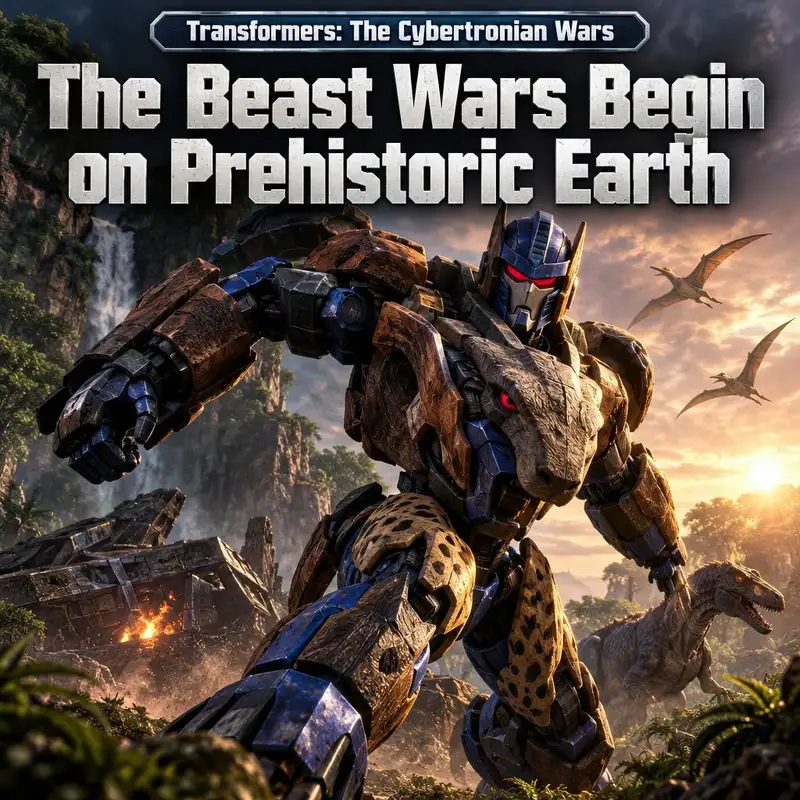
The Beast Wars Begin on Prehistoric Earth
The first battle on this unknown world is not a contest for territory. It is a contest against the environment. The stranded Cybertronians discover that raw Energon saturates the planet in concentrations their normal robot bodies cannot safely endure. Remain exposed too long, and internal systems begin to fail. Weapons, sensors, and mobility all become secondary to a more immediate question. How long can a soldier remain functional before the ground beneath him becomes a source of lethal interference?
In the North American Beast Wars animated history, this crisis follows a pursuit through transwarp space and the crash of two damaged ships. The survivors do not begin with a map, a secure base, or a reliable understanding of where, or when, they have arrived. Later events establish that the world is prehistoric Earth. At the beginning, however, it is simply an alien planet with dangerous Energon fields, unfamiliar animal life, and two moons that make even basic astronomical identification uncertain.
That uncertainty matters. Neither faction has arrived to conquer Earth, because neither faction knows it has reached Earth. There is no invasion plan, no diplomatic mission, no prepared campaign, and no established supply route. There are only Maximals and Predacons, two small successor factions from a later Cybertronian age, carrying their old political conflict into a place where their normal assumptions no longer work.
Their immediate solution is one of the franchise’s most important acts of battlefield adaptation. They scan local animals and take on organic beast forms. Optimus Primal becomes a gorilla. Rhinox takes the form of a rhinoceros. Cheetor becomes a cheetah, and Rattrap a rat. The Predacons adopt their own local forms, including dinosaur and insect bodies. These are not costumes for blending into human civilization. There are no human cities, roads, governments, or witnesses to fool. The beast modes are environmental protection.
The organic outer layers shield Cybertronian systems from the planet’s raw Energon exposure. Beast form allows a Maximal or Predacon to move, observe, hide, and survive for longer periods. Robot mode remains available, but it becomes a constrained combat posture. A warrior can transform to use weapons and tools, yet must remember that the same Energon-rich environment offering strategic opportunity can also disable him. The planet is both a fuel depot and a hazard zone.
That contradiction defines the opening of the Beast Wars. Advanced transformation technology prevents immediate extinction, but it does not solve the larger crisis. It does not repair wrecked ships. It does not restore long-range communications. It does not recover scattered personnel. It does not tell the survivors where they are, how far they are from home, or whether home remains reachable at all. It merely gives them enough time to confront the consequences of the mission that brought them there.
That mission began with the Golden Disk. Megatron, leader of the Predacon force, stole it before the events of the pilot. The disk is not treated as a universal sacred relic or a simple trophy. In this story, it is an intelligence prize. It contains information connected to a major Energon opportunity, and Megatron believes that information can be converted into political and military power. He does not want Energon merely to keep his own crew running.
Megatron’s ambition is larger. He sees a chance to gather the resources necessary to expand Predacon strength and perhaps renew the older conflict from which Maximals and Predacons emerged. The earlier Autobot and Decepticon war belongs to the inherited history of this era. Maximals and Predacons are not separate biological species. They are successor political identities, shaped by the memory and consequences of that older struggle. Megatron intends to use the Golden Disk to make the past politically useful again.
That gives the Predacons a strategic purpose. It does not give them a functioning campaign. A stolen intelligence asset can identify an opportunity, but it cannot by itself produce a base, a refinery, a transport network, a repair facility, or a reliable chain of command. Before the crash, Megatron has a plan. After the crash, he has fragments of a plan, a damaged vessel, a small and difficult force, and an enemy that remains close enough to interfere with every move.
The Maximals understand that the disk matters, even if Megatron has the clearer initial idea of how it might be exploited. Their problem is more than recovering stolen property. If Megatron can use the information to acquire concentrated Energon and rebuild Predacon power, the theft becomes the beginning of a wider conflict. Stopping him is therefore both a security mission and a containment mission. The Maximals cannot afford to let a small raid become the foundation of another war.
Optimus Primal commands the Maximal vessel Axalon and the detachment aboard it. He is not yet the leader of a planet, a government, or a vast army. His authority is much narrower and more practical. He is responsible for his crew, his ship, the mission placed in his care, and the decisions required when a pursuit turns into a survival emergency. The distinction matters because the Beast Wars begin with limited forces and limited authority, not with rival states deploying prepared armies.
The Axalon is associated with exploration. That makes its role in the chase significant. An exploratory vessel can possess weapons, defenses, sensors, and capable personnel, but its institutional purpose differs from that of a force built solely for interception or battle. Optimus Primal is forced to turn an expedition into a security operation. He must pursue an armed fugitive force, protect his own personnel, prevent the escape of the Golden Disk, and do so without evidence that assistance is nearby.
Megatron’s Darksyde is not given a complete technical classification in the pilot, and none is needed to understand the strategic problem. It is the vessel used by a force fleeing with stolen information and prepared to use violence to retain it. The Darksyde has the advantage of initiative. Megatron chose the theft, chose the escape, and chose the risk. Primal’s force must react. In military terms, the Maximals are pursuing an enemy who has already set the first operational problem.
The pursuit is small in scale, but not trivial in consequence. Neither ship represents a fleet. Neither side has an obvious reinforcement system. There is no nearby task force waiting to intervene, no secure port behind them, and no indication that the crews can casually replace losses. A damaged officer, a lost computer system, or a crippled engine matters more under those conditions than it would in a large conventional force with reserves and repair infrastructure.
The chase enters transwarp space. The pilot establishes the result more clearly than the mechanism. Transwarp travel can cross immense distances and can also cross time. It is not portrayed as a routine road between stable locations, nor does the story provide a reliable technical explanation of its navigation, range, or safety margins. More important, the two ships carry their conflict into a system capable of turning mobility into dislocation.
In ordinary strategy, rapid movement can create advantage. It can allow a force to escape interception, reinforce a threatened position, outflank an opponent, or reach a target before defenses are ready. But speed without control can become a liability. The Predacons enter transwarp seeking escape. The Maximals follow because allowing Megatron to vanish with the Golden Disk would be worse. Once both vessels are damaged in the passage, however, neither side controls the destination.
This is the decisive break between the original mission and the war that follows. The pursuit does not end with a clean interception. The Maximals do not recover the disk and return home. Megatron does not escape to a prepared Energon objective. Both forces lose their ability to determine where and when their struggle will continue. Transwarp provides strategic reach, but in this case it provides no strategic control.
The result is an accidental temporal displacement. The survivors are thrown into a distant past without having intended to conduct operations there. That point is easy to lose because later Beast Wars stories reveal how consequential the setting will become. At the beginning, though, the characters possess no completed understanding of the planet’s place in history. They are not carrying out a deliberate operation against the past. They are trying to survive a disaster they did not plan.
For the Axalon, damage control includes a decision with long-term consequences. Before the ship crashes, its stasis pods are ejected. These pods contain additional Maximal personnel, but ejection preserves them only by scattering them. A commander can choose between losing everyone aboard a doomed vessel and accepting dispersal across unknown terrain. The pods create the possibility of survival. They also fracture the force Primal is supposed to command.
This means that the Maximals on the surface are not the entire intended complement of the Axalon. They are the available personnel, the ones who can respond immediately after the crash. Other stasis pods are separated from them, vulnerable to terrain, damage, Predacon discovery, and the planet’s strange conditions. Recovery becomes a central operational problem. A dormant comrade is more than a future reinforcement. In the wrong hands, a pod may become a prisoner, an intelligence source, or a new combatant shaped by the enemy.
The crash therefore changes the character of the conflict. Before transwarp, the Maximals are pursuing the Predacons. Afterward, Primal must protect a damaged command center, locate his scattered personnel, learn enough about the environment to operate, and deny Megatron the freedom to exploit it. The mission has become fragmented. No one can afford to concentrate entirely on offense, because every movement away from the Axalon leaves equipment, records, and repair capacity more exposed.
The damaged ships matter for the same reason. The Axalon and the Darksyde are more than wreckage left behind after a dramatic landing. They are the closest things either faction has to a headquarters, a workshop, a medical facility, a communications center, an archive, and an industrial base. On a world with no established Cybertronian society, a ship is infrastructure. If it remains usable, even partially, it offers shelter, tools, data, and the possibility of eventual escape. If it fails completely, the survivors become far more dependent on whatever they can find around them.
Neither side possesses a factory capable of replacing damaged bodies or building a new fleet. Neither side has a known source of compatible parts. Repair must depend on what can be salvaged, improvised, or recovered from the ships. This is why a damaged vessel can be more strategically important than a single firefight. A warrior can sometimes be repaired. A lost facility may not be replaceable at all.
The planet’s Energon conditions complicate command and control as well. Long-range communication becomes unreliable, making it harder to coordinate reconnaissance, pod recovery, patrols, and mutual support. In a conventional military situation, a small force might compensate for weak numbers through rapid communications and concentrated movement. Here, the environment interferes with that response. The result is a geographically fragmented war almost from the first day.
Optimus Primal must lead within those limits. He has formal command, but formal command is only the beginning of authority. A stranded detachment follows its commander when that commander can set priorities, preserve cohesion, judge risk, and make decisions the group can live with. Primal’s immediate tasks are unglamorous but essential. Adapt to the planet. Protect the Axalon. Find the stasis pods. Keep Megatron away from useful Energon. Preserve enough of the force to discover a route home.
Rhinox, Rattrap, and Cheetor help show the character of that command problem. Rhinox brings technical competence and a steady practical outlook. He understands that survival depends on analysis, repair, and disciplined use of scarce capability. Rattrap is skeptical, wary, and strongly interested in staying alive. That is not a useless instinct. In a damaged expedition, suspicion can identify risks that optimism ignores, though it can also strain trust when the team needs cooperation.
Cheetor brings speed, enthusiasm, and a younger warrior’s appetite for direct action. Those qualities are useful in reconnaissance and rapid response, but they also create pressure on a commander trying to keep a small force from being drawn into reckless engagements. Primal’s team is functional, not flawless. It contains different temperaments and priorities, which is exactly what one would expect from a surviving detachment suddenly deprived of routine support and clear information.
The Maximals’ strength lies in their ability to act as a team even under pressure. Their weakness is that teamwork cannot erase their material limits. They cannot secure every stasis pod at once. They cannot defend the Axalon and investigate every Energon signal with equal strength. They cannot assume that a discovered resource is safe to exploit. Every decision involves opportunity cost. Send personnel to recover a pod, and the ship has fewer defenders. Pursue Megatron, and wounded systems may go unattended.
Megatron faces a different but equally serious command problem. He has more than an external enemy. He has a challenge inside his own force. Dinobot, his first officer, concludes that the mission has failed badly enough to call Megatron’s leadership into question. The challenge is more than an insult exchanged between strong personalities. It raises a practical issue common to small military organizations under extreme stress. What makes a leader legitimate after the plan collapses?
Dinobot treats leadership as something tested through courage, competence, and personal honor. If a commander has led his force into disaster, then, by Dinobot’s reasoning, the commander should answer that failure directly. Megatron sees the matter differently. He does not surrender authority simply because conditions have become dangerous. He understands that command depends on controlling the mission, the information surrounding it, and the violence available to enforce decisions.
Megatron retains power through calculation and coercion. That does not make his position secure. It reveals the nature of his leadership. He is capable of seeing beyond the immediate humiliation of the crash. Even stranded on an unknown world, he recognizes that Energon remains the key to future power and that the Golden Disk still gives him a strategic objective. But his ability to hold the Predacons together depends heavily on personal dominance, not on broad consent or durable institutions.
This is a strength in the short term. A leader who can compel obedience may react quickly in a crisis. It is also a vulnerability. A small force built around highly individualistic specialists can be dangerous, adaptive, and hard to predict. It can also become politically unstable when its leader appears fallible. The Predacons have not become a cohesive occupation army or a functioning government. They are an armed group under pressure, with competing ideas about authority and no outside institution capable of settling the dispute.
Dinobot’s challenge should not be reduced to a familiar story of a subordinate seeking a leader’s chair. His disagreement is more specific. He believes command should answer to conduct. Megatron believes command belongs to the one who can preserve control and seize opportunity. The distinction will shape Dinobot’s later choices. He is not looking simply for a stronger master. He is judging what kind of leadership can be defended when survival and honor no longer point in the same direction.
The adoption of beast modes gives both forces room to continue that argument. In their new organic forms, the Maximals and Predacons can move through the planet’s terrain without immediately succumbing to the Energon fields. The forms offer local mobility. A cheetah can cross open ground quickly. A rat can move through spaces larger bodies might overlook. A rhinoceros or gorilla can navigate difficult terrain with a different balance of strength and access. Dinosaur and insect forms give the Predacons their own advantages.
These adaptations also provide limited concealment. In an environment filled with animal life, a beast form does not announce Cybertronian presence as clearly as a metallic robot body would. Yet concealment is not invisibility. The opposing force knows what kinds of forms its enemy may use. The real advantage is not that a Maximal can fool a human population, because no human population is part of this opening conflict. It is that the new forms allow movement and observation in terrain neither side understands.
The transformation system becomes part of field doctrine. Beast mode is the default condition for travel and endurance. Robot mode is used when weapons, tools, physical reach, or direct combat are necessary. That rhythm imposes risk. A fighter who transforms gains access to a more capable combat posture but exposes internal systems to harmful Energon conditions. The choice to transform is therefore not just a visual flourish. It is a calculation about time, terrain, threat, and the value of the objective.
What beast modes cannot do is more important than what they can. They do not restore the Axalon’s full capability. They do not make the Darksyde safe. They do not recover lost data, reopen a transwarp route, or guarantee that a damaged soldier can be repaired. They do not make raw Energon easy to process or transport. They allow the war to continue, but they do not make it sustainable.
That difference comes into focus when a major Energon deposit is exposed within a mountain. The discovery is immediately significant because both forces need energy. For Megatron, it appears to offer more than survival. It could become the first local foundation for the larger Predacon project envisioned through the Golden Disk. For Primal, it is a threat precisely because Megatron may turn a local resource into operational freedom.
But possessing knowledge of a deposit is not the same as exploiting it. The mountain is not a finished refinery, a defended supply base, or a safe reserve. Its Energon is concentrated and dangerous. Approaching it in robot mode creates exposure. Working around it requires time, technical skill, security, and the ability to keep the enemy away. Neither faction has an established logistics system. Both are trying to convert a hazardous discovery into usable power while under direct threat.
The terrain makes the deposit an operational trap. A mountain concentrates movement. It creates approaches, obstacles, and limited lines of access. For two small forces with damaged communications and few personnel, that concentration encourages direct confrontation. Neither side can quietly develop the site while the other remains nearby. The resource pulls them toward a fight before either has the ability to exploit it responsibly.
Megatron’s intelligence advantage remains real but limited. The Golden Disk gives him strategic direction. It points him toward Energon potential and gives his actions a larger purpose. Yet conditions on the ground prevent him from converting information into control. He cannot simply claim a mountain and declare a new Predacon resource base. He needs protection, technical access, and enough time to use the deposit without being forced into dangerous robot-mode combat.
The Maximals understand the same basic problem from the defensive side. They do not need to build an Energon empire to frustrate Megatron. They only need to deny him one. In a small war, denial can be strategically valuable. A force unable to exploit a resource may still prevent the enemy from exploiting it. That does not solve its own supply problem, but it can stop the other side from gaining the advantage required to turn a local skirmish into a broader campaign.
The fight for the mountain also brings Dinobot’s command question back into focus. Having challenged Megatron, Dinobot now challenges Optimus Primal. This second confrontation is not a repetition of the first. Against Megatron, Dinobot challenges a leader whose mission has failed and whose authority rests heavily on coercion. Against Primal, he tests the legitimacy of a commander who holds formal responsibility for the Maximals but has not yet proven himself to this outsider.
Dinobot’s standards are demanding and personal. He wants to know whether Primal’s authority represents genuine competence or merely an inherited position. Under less urgent conditions, such a contest might have remained a matter of rank and ritual. On this planet, it becomes a test of judgment. The leader of a stranded force must decide what risks are acceptable, who deserves protection, and whether an immediate personal victory is worth weakening the group’s ability to survive.
The confrontation is interrupted by Predacon action. That interruption matters because it forces the abstract dispute into a combat situation. Dinobot cannot judge Primal only by how he fights in a duel. He must judge him by how he responds when the enemy threatens the wider force. Likewise, Primal cannot simply defeat Dinobot and expect that victory to create trust. He has to demonstrate that his command extends beyond personal status.
The resulting realignment is one of the most important outcomes of the pilot. Dinobot does not become a Maximal because all suspicion vanishes. He does not suddenly share every habit, instinct, or political assumption of the group he has opposed. He joins them because Megatron’s methods and Primal’s conduct give him a practical and moral choice. The alliance begins in necessity, but it is also a judgment about leadership.
That judgment becomes decisive when Megatron attacks Optimus Primal near the Energon deposit. Megatron transforms into robot mode despite the environmental danger. It is a calculated risk. Robot form gives him the means to strike directly, but the planet’s Energon conditions make prolonged use hazardous. His decision shows how immediate tactical aggression can override the caution that a hostile environment normally demands.
Dinobot intervenes to save Primal. The action changes more than the outcome of a single attack. It severs Dinobot’s remaining connection to Megatron’s command and confirms that the earlier challenge has become a real political break. The intervention also triggers a chain reaction in the Energon deposit. The prize both sides have sought is destroyed or rendered unusable.
The immediate tactical outcome is clear enough. Primal survives. Megatron fails to eliminate him. Dinobot survives his break with the Predacons and becomes part of the Maximal force. Yet the operational outcome is less satisfying for everyone involved. Neither faction secures a usable Energon position. The mountain no longer offers the quick solution Megatron wanted, and the Maximals gain no new supply base of their own.
This is the distinction between winning a firefight and winning a campaign. Megatron’s attack creates an opportunity to kill or disable a rival commander, but it also contributes to the loss of the resource he needs. Dinobot’s intervention protects Primal and denies Megatron a victory, but it does not restore the Maximals’ ship, recover all their personnel, or send them home. The battle resolves a leadership crisis while deepening the logistical crisis.
Politically, however, the effect is substantial. Megatron loses his first officer. Primal gains a dangerous and untested ally. The balance of the two forces changes, not through mass reinforcement or industrial production, but through one individual’s decision about whom to follow. In small, isolated formations, loyalty can have strategic weight. A single defection changes combat capability, intelligence, morale, and the internal story each faction tells about itself.
Megatron’s original ambition is delayed, not erased. The Golden Disk remains important. The planet remains rich in Energon, even if the mountain deposit no longer provides an immediate solution. The Predacons remain active, armed, and led by someone who can still see a path from local survival to larger power. But the disaster has stripped away the easy version of that plan. Megatron now has to pursue it in a world that punishes direct action and contains an enemy he cannot simply leave behind.
For Optimus Primal, the strategic picture is equally unforgiving. He has prevented Megatron from gaining a decisive early resource advantage, but prevention is not victory. The Axalon remains damaged. Stasis pods remain scattered. The planet’s identity remains uncertain. Long-range communications remain unreliable. His small team now includes Dinobot, whose ability is valuable and whose loyalty is not yet uncomplicated. The Maximals have survived the opening crisis. They have not solved it.
It is at this point that Primal gives the conflict its name. The continuing struggle will be called the Beast Wars. The name reflects the forms the combatants have adopted, but it also captures the character of the war. This is more than the old Cybertronian conflict resumed under a new label. It is a localized struggle shaped by beast-mode survival, scarce resources, damaged infrastructure, contested information, and fragile leadership.
With historical hindsight, the setting becomes even more consequential. The unknown planet is prehistoric Earth, during the era in which the original Ark remains dormant. But that later clarification should not be allowed to erase the uncertainty of the beginning. Primal, Megatron, and their crews do not arrive with a complete understanding of Earth’s future importance. They arrive with two moons overhead, broken ships behind them, and immediate problems that leave little room for grand historical interpretation.
The Beast Wars therefore begin through contingency rather than destiny. Megatron steals the Golden Disk in pursuit of greater Predacon power. Optimus Primal pursues him to prevent that theft from becoming a strategic disaster. Transwarp damage breaks both sides away from their original context. The crash isolates them. Raw Energon makes their normal bodies dangerous to inhabit. Beast modes make survival possible, while making clear that neither side can operate as it once did.
From there, every problem becomes connected. Energon is poison in the ground, protection in the beast forms, a supply requirement for damaged forces, and the object of the first major battle. The ships are wrecks, but also headquarters and workshops. Dinobot is a rival, but also a test of what command means after institutions have failed. The Golden Disk is stolen information, but also the reason neither force can afford to ignore the other.
The first Beast Wars battle does not create a victor. It creates a condition of war. Two small factions, far from support and unable to escape, are forced to compete for survival on a world neither fully understands. Their struggle begins not as a planned war for Earth, but as a strategic pursuit that lost its strategic context and became too dangerous for either side to abandon.