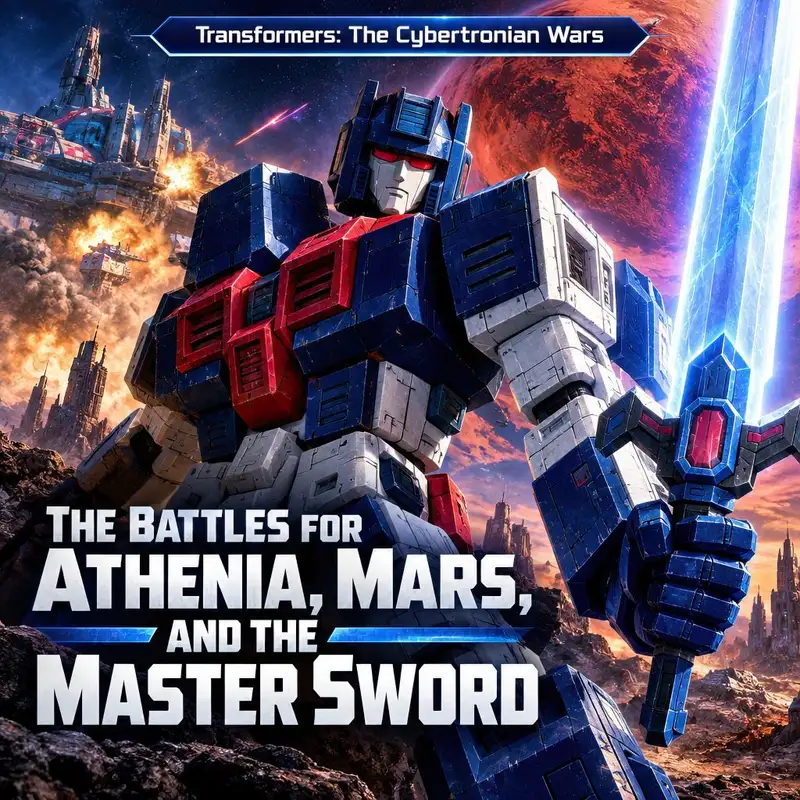
The Battles for Athenia, Mars, and the Master Sword
Fortress stood before the control console of Battleship Maximus with Mars already committed to destruction. Beneath the planet’s surface, Decepticon plasma bombs had been placed near the poles. His Headmaster troops had followed false coordinates into an explosive trap. Daniel and Wheelie had been captured. The enemy was closing. And the one weapon that might have changed the battle, the Master Sword, would not come free. Fortress could reach for it, but he could not draw it. His physical energy and his mental focus were out of balance.
That failure is the proper place to begin. The Master Sword was not a simple weapon that appeared whenever the Autobots needed a larger answer. It was tied to Fortress himself, to Battleship Maximus, and to the difficult transformation that turned that vessel into Fortress Maximus. Its power depended on a narrow condition. Fortress had to be ready in body and mind, his system had to be intact, and there had to be enough time to bring a giant strategic asset into the fight. Mars showed what happened when those conditions did not arrive soon enough.
This is the Japanese animated history of Transformers: The Headmasters, not the American Rebirth story and not the Marvel comic continuity. In this branch, Fortress serves as Autobot Supreme Commander after Rodimus Prime departs on a search for a new home. The Master Sword becomes the central weapon of Fortress Maximus, while Scorponok’s campaign becomes a sustained effort to understand, exhaust, bypass, and finally neutralize it. The struggle moves from Athenia to Mars, then to Planet Master and Earth. At each stage, the question is less about who has the largest weapon than who can make a rare weapon available at the decisive moment.
Athenia mattered because the Autobots could no longer treat Cybertron as their sole secure center of command. After the crises that followed the Hate Plague, the Autobots established Athenia as a major headquarters and refuge. The series provides no detailed census, industrial survey, or defensive map of the place. What it establishes clearly is its strategic role. Athenia was a place from which the Autobots could organize forces, receive reports, dispatch ships, and preserve a measure of continuity while their war remained spread across several worlds.
That dispersal created resilience, but it also created friction. A force with one headquarters can concentrate authority, stores, repair capacity, and communications. It can also be paralyzed if that headquarters falls. A force with several bases can survive attacks in one theater, but it must move information, personnel, and equipment over far greater distances. In The Headmasters, spacecraft and bridge systems make interplanetary movement possible, yet they do not make it effortless. Reinforcements can be delayed, intercepted, deceived, or drawn into a crisis too late to affect the outcome.
Fortress inherited a command problem rather than an uncomplicated throne. Rodimus Prime had left on his own strategic mission, searching for a future home for the Autobots. The Matrix did more than pass to Fortress as a symbol of automatic political authority. Fortress became Supreme Commander because the Autobots needed someone to direct military operations in a dangerous and fragmented environment. His authority was practical. It rested on command responsibility, the confidence of his forces, and his unique relationship with the Battleship Maximus system.
That distinction mattered when the Master Sword appeared. Fortress was more than a leader carrying an ancient emblem. He was the essential operator of a complicated military asset. Battleship Maximus could become Fortress Maximus, a colossal combat form whose capability was inseparable from Fortress and Cerebros, the smaller Headmaster component that formed its head. The Master Sword was built into that larger system. It could not simply be issued to another Autobot battalion, transferred to a supply depot, or carried by a conventional strike team.
The Decepticons understood the value of forcing the Autobots to fight in more than one place at once. Their attack involving carnivorous alien plants demonstrated the method. A plant menace struck San Francisco on Earth, while a related threat endangered Athenia. The weapon was strange, but its military purpose was familiar. It compelled the Autobots to divide attention between distant emergencies. A force that must defend a city, protect a headquarters, and determine whether the attacks are connected is already working under pressure before it fires a shot.
The Autobot Headmasters could not solve the crisis through ordinary combat power. They had mobility, weapons, and experience, but the threat exceeded what their immediate response could contain. That was the moment when Fortress revealed the Master Sword. He drew it from the control area of Battleship Maximus, and the ship transformed into Fortress Maximus. The giant Autobot used the weapon to destroy the plant threat. The immediate effect was dramatic, but the deeper consequence was strategic. The Decepticons had now seen the existence of a weapon that could reverse a losing engagement.
The Master Sword gave the Autobots a form of emergency dominance. When Fortress Maximus entered the field under the right conditions, he could alter the local balance quickly. But emergency dominance is not the same thing as sustained superiority. The weapon relied on a single operator. It relied on a specific transforming fortress. It demanded a state of synchronization that could not be assumed under every battlefield condition. It also announced itself. Once Scorponok understood its importance, the Master Sword ceased to be merely an Autobot advantage. It became a Decepticon intelligence target.
Scorponok’s answer was not to assume that he could simply overwhelm Fortress with brute force. At Mars, he pursued a different model of warfare. He treated a whole planet as an energy resource. The Decepticons planted plasma-energy bombs near the Martian poles and planned to trigger a chain reaction that would destroy the planet. Their stated objective was to release plasma energy for military use. The series establishes the destruction and its energy consequence. It provides no coherent planetary engineering explanation, and none is needed to understand the military intent.
Mars was not attacked merely to deny the Autobots a forward position. It was selected as an object to be consumed. That is what made the operation more than a conventional raid. The Decepticons intended to convert planetary destruction into fuel for their war machine. Whether the target was inhabited by a large population is not established in detail, but the moral and strategic character of the attack is clear. Mars contained survey teams, infrastructure, terrain, and potential future value. Scorponok was willing to erase all of it to acquire energy.
The immediate targets included Spike, Daniel, Wheelie, and the Trainbots, who were conducting a geological survey on Mars. They were not the principal combat force in the theater. They were vulnerable personnel working near a strategic resource target before the full nature of the Decepticon operation became clear. Their presence reveals a recurring problem in interplanetary war. Scientific and logistical missions may appear distant from the front line until an enemy decides that the planet beneath them has become the front line.
The Autobot response began from Athenia. The Headmasters moved toward Mars, while Ultra Magnus attempted to send reinforcements from Earth. On paper, this gave the Autobots several available forces. In practice, availability is not the same as timely concentration. Trypticon and Sixshot prevented the Technobots from reaching Mars. The Decepticons did not have to destroy every Autobot asset in the system. They only had to prevent enough of them from arriving before the bombs detonated.
This was an operational success for Scorponok. He used distance as a weapon. The Autobots had forces on Earth, forces at Athenia, and personnel already on Mars, but these elements could not automatically become one coherent formation. Space travel, interception, and the need to protect multiple points of failure gave the Decepticons room to shape the battle. A reinforced Autobot defense might have changed the immediate contest. A delayed reinforcement became only a reminder that help existed somewhere else.
Daniel and Wheelie were captured during the crisis, but their capture did not completely silence them. They used a concealed emergency beacon to alert the Autobots. That act mattered because it restored a measure of situational awareness. Yet intelligence is not useful merely because it arrives. The enemy can still manipulate how a force interprets it. The Autobots learned enough to search for the Decepticon operation, but Scorponok’s forces provided false coordinates and lured them into an explosive trap.
The trap cost the Autobots more than time. It consumed attention, energy, and momentum at the precise moment when Mars required a rapid, accurate response. This is why deception can be more valuable than direct firepower. A successful ambush destroys or damages forces. A successful deception causes an enemy to deploy those forces in the wrong place, against the wrong threat, under the belief that it is moving toward the solution. Scorponok’s plan did not depend on defeating every Autobot in open battle. It depended on making their relief operation arrive confused and weakened.
Fortress then faced the problem that defines the entire campaign. The Master Sword was available in principle, but not in practice. He tried to draw it and failed because his physical and mental energies were not synchronized. The series presents this as a condition of the weapon system, not as a minor hesitation to be overcome by confidence alone. A commander can possess extraordinary capability and still be unable to employ it if his own system, judgment, or readiness has been pushed beyond its limits.
The danger to his comrades brought Fortress into the necessary balance. He finally drew the Master Sword. But Scorponok’s forces struck before Fortress could complete the transformation into Fortress Maximus. A plasma blast met the power of the sword, and the two energies neutralized one another. Fortress survived, but he was severely depleted. The incident established another limitation. Even once drawn, the weapon was not invulnerable to interruption. It could be countered by timing, by concentrated energy, and by attacking its operator before the larger system was fully deployed.
The Decepticons then detonated the polar bomb clusters. Mars was destroyed. The scale of the visual event should not be mistaken for a precise scientific model, but its strategic meaning is unmistakable. The Autobots had prevented their own immediate destruction, yet they had failed in the larger mission. They had not saved Mars. They had not prevented the Decepticons from gaining plasma energy. And they had not stopped Scorponok from proving that a planetary target could be transformed into a source of military power.
The released plasma energy recharged Battleship Maximus. That recharge gave Fortress the power needed to complete his transformation into Fortress Maximus and reenter the battle at full scale. Here the Master Sword finally achieved the sort of battlefield result that had made it so alarming to the Decepticons. Fortress Maximus confronted Scorponok’s giant Transtector, MegaZarak, and wounded it with the sword. The Decepticons withdrew rather than risk the destruction of their heavy asset.
The terminology matters. In this Japanese Headmasters continuity, Scorponok’s smaller Headmaster component and the giant MegaZarak Transtector are components of one character system. This is not the American arrangement involving Lord Zarak, and it should not be explained through that later and different story. MegaZarak was Scorponok’s great physical answer to Fortress Maximus, but it was not an independent monster dispatched by a separate commander. The contest was between two integrated Headmaster systems, each combining a smaller controlling component with a massive war body.
Fortress won the final engagement over Mars. Scorponok’s withdrawal was real. MegaZarak had been hurt. The Master Sword had demonstrated that it could still defeat even the Decepticons’ most formidable direct combat system. But victory at the end of a battle is not automatically victory in the campaign. Mars had been lost. The Decepticons had harvested the plasma energy they sought. The Autobots had learned that their decisive weapon could arrive too late, fail to activate, and be neutralized before it could alter the strategic situation.
That was the real result of Mars. The Master Sword had not made Fortress Maximus invincible. It had made him important enough to become the center of the war. From that point forward, Scorponok did not need to defeat every Autobot force in every theater. He needed to make the Master Sword unreliable. If he could deny Fortress the information, energy, synchronization, support, or defensive conditions required to use it, then the Autobot emergency weapon would become a burden as much as an advantage.
The next stage of the campaign was therefore an intelligence and industrial effort. Scorponok sought information about the Master Sword’s construction, limits, and operational vulnerabilities. He had already pursued technical knowledge through the scientist Jack. Later, he captured Wheelie and attempted to extract further information. These actions were not side episodes of villainy. They were part of a countermeasure program. The Decepticons were trying to transform scattered clues into a practical defense against the weapon that had injured MegaZarak.
This is the difference between reacting to a battlefield defeat and learning from one. A commander who loses a fight may seek revenge. A commander who understands the source of defeat seeks a way to prevent the enemy from repeating it. Scorponok’s forces studied the Master Sword, acquired materials, and prepared a system designed not merely to survive an impact, but to defeat the sword in direct confrontation. The objective was to alter the conditions under which Fortress Maximus could use his greatest asset.
The crucial material was G-Metal, an exceptionally durable substance found on Planet Master. The Decepticons combined their stolen technical knowledge with this local resource to construct the Zarak Shield. The shield was more than a larger piece of armor. It was a purpose-built counterweapon. It demonstrated that rare capabilities can be challenged through intelligence, material access, and manufacturing. The Decepticons did not have to reproduce the Master Sword. They only had to build something that could deny its effect.
The development of the Zarak Shield also clarified the Master Sword’s own dependence on infrastructure. When the weapon was not in use, it was stored within Battleship Maximus. The sword was therefore part of a physical support system, not an abstract power that Fortress could summon under any condition. Its location, its host platform, and its operator all mattered. A weapon linked to a unique system can be formidable, but that uniqueness creates a bottleneck. There is no reserve stockpile when the only sword is inside one ship-body.
Planet Master became the proving ground for the Decepticon countermeasure. The Autobots assembled a varied force there. Fortress and the Headmasters were present. The Targetmasters brought their own distinct combat capability. The Trainbots provided important support and transport capacity. Young Master warriors from Planet Master also joined the struggle. In theory, such a coalition could have overwhelmed a Decepticon force operating far from its main bases. In practice, coalition warfare requires more than courage and shared symbols.
Chromedome took initiative with the young Master warriors. His impulse was understandable. The Decepticons had seized a strategic material and threatened a weapon that had become central to Autobot survival. Delay could allow Scorponok to consolidate his advantage. The young warriors also had a direct interest in defending their own world. But initiative becomes dangerous when it outruns coordination. Chromedome’s action was more than reckless behavior by an impulsive soldier. It was a response to urgent pressure without a sufficiently integrated plan.
The Targetmasters pursued a separate containment approach. This created divided effort at the very moment when the Autobots needed a shared operational picture. Different units can perform different missions, but they must understand how those missions connect. Who is fixing the enemy in place? Who is covering withdrawal? Who has authority to redirect an advance? What happens if the enemy does not retreat along the expected route? The Autobot operation did not answer those questions well enough.
Chromedome’s force lured the Decepticons toward a mountain region, hoping to shape the ground in the Autobots’ favor. Instead, the terrain became an advantage for the enemy. Clouds concealed Decepticon movement. The mountains limited visibility. The young warriors’ ships were destroyed or disabled, cutting off mobility and exposing the weakness of a plan that had not secured a reliable withdrawal route. A trap intended for the Decepticons became an ambush against the Autobots.
The loss was especially serious because the young Master warriors were not interchangeable equipment. They were inexperienced allies entering a major operation against hardened Decepticon commanders. Their participation represented local resistance and potential future strength for the Autobots. Their defeat showed the cost of committing unseasoned personnel without adequate coordination, support, or escape options. War often turns enthusiasm into a substitute for planning. It is a poor substitute, especially when the enemy controls the terrain and the information.
Pointblank’s criticism of Chromedome afterward should be understood in that institutional context. It was more than an argument between personalities. It was a dispute over command discipline, responsibility, and the use of allied forces. Courage may create an opportunity. It does not by itself establish communications, logistics, or a coherent objective. The Autobot force had fought hard, but it had not converted its numerical variety into unified combat power.
Fortress attempted to restore the situation by confronting Scorponok and the Zarak Shield directly. This was the test the Decepticons had prepared for. The Master Sword struck the shield, and the shield prevailed. The series does not require the shield to be invincible in every imaginable circumstance. It establishes something more important. Under the conditions of that battle, a carefully designed countermeasure could defeat the Master Sword. The Autobot weapon that had wounded MegaZarak could no longer be treated as an uncontested answer.
The consequences extended beyond the immediate fight. Tactically, the Autobots failed to destroy the Decepticon force or secure Planet Master. Operationally, they lost initiative and saw their coalition fracture under pressure. Strategically, Scorponok proved that Fortress Maximus could be contained. The Master Sword had gone from a Decepticon emergency to a manageable problem. That shift encouraged Scorponok to bring the conflict toward Earth, where a protected energy operation could threaten a populated world while MegaZarak and the Zarak Shield held the Autobots at bay.
Scorponok’s command style during the approach to Earth reveals why his forces could remain dangerous even when individual commanders showed independent judgment. Sixshot was separated from the Decepticon force during an asteroid storm and stranded with Daniel. Scorponok was willing to leave him behind. Sixshot was a capable combat commander, but under Scorponok’s system, capability did not guarantee protection. Personal loyalty ran upward, toward the leader’s immediate objectives. Those who became inconvenient could be abandoned.
This was a weakness as well as a method of control. An army that treats every subordinate as expendable may preserve a commander’s freedom of action, but it damages trust and encourages soldiers to make their own moral and practical calculations. Sixshot’s contact with Daniel mattered because it demonstrated that faction identity did not erase individual judgment. He remained a Decepticon warrior, but he could still recognize a human life as something worth protecting when Scorponok’s priorities offered only abandonment.
Scorponok also exploited Chromedome’s vendetta against Sixshot. He allowed their rivalry to draw Autobot attention toward a duel while secretly planting explosives on the asteroid. Personal hatred became a tool of operational delay. The point was not necessarily to win the duel. It was to keep Chromedome and his allies occupied, force them into a dangerous environment, and buy time for the larger Decepticon movement toward Earth. A commander who understands opponents’ emotions can use them as effectively as weapons.
Sixshot ultimately abandoned the duel to save Daniel, while the asteroid was destroyed. That decision did not redeem the Decepticon command structure, nor did it settle the wider war. It did, however, frustrate Scorponok’s effort to turn individual hostility into a clean tactical outcome. The incident also showed the limits of a military system built on coercion. Scorponok could direct fear, exploit rivalry, and discard subordinates, but he could not guarantee that every individual would choose factional orders over personal conscience.
The diversion accomplished enough. By the time the Autobots renewed their pursuit, Scorponok had shifted the center of gravity to Earth. There, the Decepticons deployed the Death Towers. These installations appeared across the planet, including locations such as Washington, Cairo, and the polar regions. Their function was to gather and amplify energy as part of a wider Decepticon system. At the North Pole, Scorponok’s forces also constructed a crysmagnetal-based installation connected to the operation.
The precise technical language is less important than the strategic pattern. Mars had been treated as a source of energy to be violently opened and consumed. Earth was now treated as a planetary system to be exploited through a network of installations. The Death Towers did more than threaten a military base or an Autobot ship. Their energy effects created an atmospheric and environmental danger on a global scale. Earth’s civilians were not spectators standing outside a duel between giant Cybertronians. They were the population living beneath the system Scorponok intended to activate.
A networked threat presents a different problem from a single fortress or weapon. Destroying one tower may not end the operation if the remaining towers continue to function, if the energy system remains connected, or if MegaZarak protects the central mechanism. The Autobots needed to think beyond isolated targets. They had to defeat the system’s defenders, disrupt its energy infrastructure, and prevent a broader planetary catastrophe. Their failure at Planet Master had taught them that relying on Fortress alone would not be enough.
Fortress Maximus confronted MegaZarak again, but the Zarak Shield still denied the Master Sword. The old pattern had returned. The Autobots possessed a powerful asset, but the enemy had developed a specific answer. If Fortress attacked alone, Scorponok could hold him in place while the Death Tower system continued its work. This was the danger of a strategic bottleneck. An enemy does not need to destroy the whole army when one scarce capability carries too much of the army’s hope.
The answer came through Final Formation. Daniel proposed that the Headmasters channel their energy into Fortress and then extend that connection through the wider Autobot force. The idea should not be understood as a routine power-up available to every unit in every battle. It was a collective response to a specific crisis. The Autobots had to compensate for the limits of their singular champion by creating a network of support around him. Fortress would still wield the sword, but he would no longer bear the entire burden alone.
That change in logic was decisive. At Mars, Fortress had struggled to synchronize himself before he could use the Master Sword. On Planet Master, the sword had met a countermeasure it could not overcome by itself. At Earth, the Autobots recognized that the problem was no longer merely Fortress’s strength. It was the relationship between Fortress, his Headmasters, the wider Autobot force, and the energy needed to break the Decepticon defense. Final Formation turned individual capability into collective capacity.
With that combined energy, Fortress Maximus overcame the Zarak Shield. The shield that had defeated the Master Sword on Planet Master was broken. MegaZarak’s Transtector was damaged or destroyed as the battle reached its conclusion, and the Death Tower operation was stopped. The immediate tactical result was clear. Scorponok lost his protective countermeasure, his great heavy combat system was defeated, and the installations threatening Earth could no longer carry out their intended function.
The operational result was equally important. The Decepticon Earth operation collapsed. The network that had gathered and amplified energy no longer had the protection or momentum needed to continue. Scorponok’s forces withdrew rather than convert a failing planetary operation into a battle of attrition against an Autobot coalition that had finally found a way to concentrate its strength. Earth survived the immediate danger. The civilians endangered by the towers were spared the catastrophe Scorponok had been preparing.
But the strategic outcome remained incomplete. The destruction of the Zarak Shield did not restore Mars. The defeat of MegaZarak did not erase the plasma energy the Decepticons had already gained. The Death Towers did not represent the entire Decepticon war effort. Scorponok had lost an operation, not necessarily the capacity to continue fighting elsewhere. The Japanese Generation One conflict continued beyond this campaign, because defeating a particular weapon system and forcing a withdrawal did not resolve the political and military struggle that sustained the war.
The campaign from Athenia to Mars and Earth was therefore a contest over bottlenecks. Athenia represented dispersed command and the difficulty of coordinating a force across worlds. Mars represented energy warfare and the terrible cost of arriving too late. Planet Master represented intelligence, rare materials, industrial adaptation, and the danger of divided command. Earth represented the final proof that a battlefield weapon cannot substitute for a functioning institution.
Scorponok’s greatest achievement was not wounding Fortress in a duel or building a larger body for himself. It was recognizing that the Master Sword depended on conditions. It depended on Fortress’s readiness. It depended on Battleship Maximus. It depended on information that could be stolen, a system that could be interrupted, and a weapon effect that could be studied and countered. The Zarak Shield was the product of that understanding. It was an attempt to turn Decepticon defeat into a permanent change in the balance of power.
The Autobots succeeded only when they learned the corresponding lesson. Fortress Maximus remained essential, and the Master Sword remained decisive, but neither was a complete military system. Mars had shown the danger of relying on the sword too late. Planet Master had shown that even a rare and formidable capability could be neutralized by preparation. Earth showed that the countermeasure could be defeated only when the Autobots made Fortress’s strength the center of a cooperative effort rather than the sole answer to every crisis.
Earth survived because the Autobots turned individual power into collective capacity. Mars remained destroyed, the Decepticon force survived the campaign, and the wider war continued, leaving the Master Sword as a reminder that no single weapon can win a conflict when the political and military system behind it remains at war.