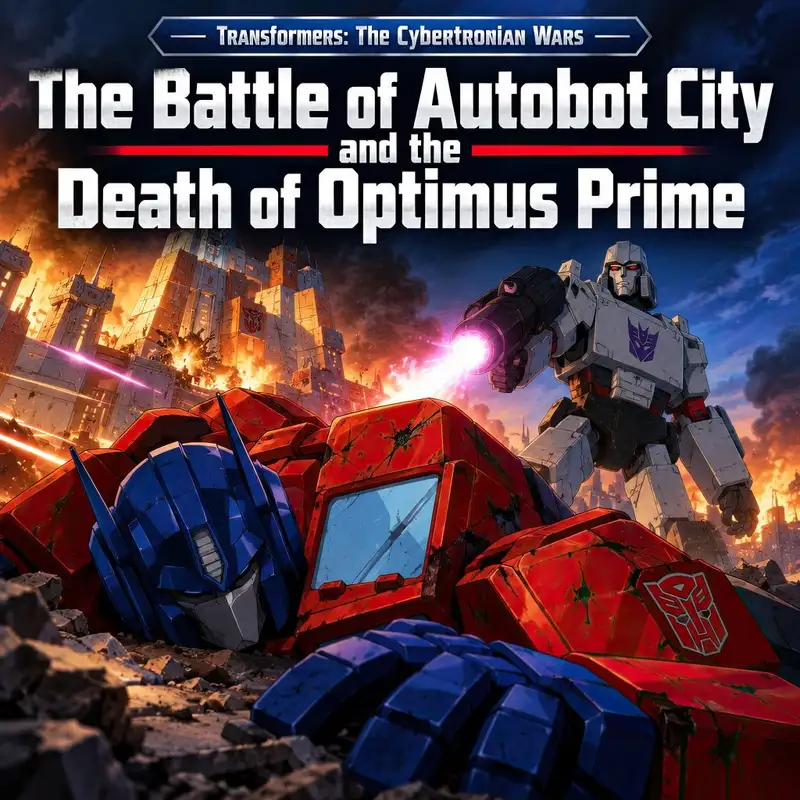
The Battle of Autobot City and the Death of Optimus Prime [Cartoon]
In the year two thousand five, the Autobots had a problem that could not be solved by courage, firepower, or another stirring declaration from command. The Decepticons held Cybertron. The Autobots operated from concealed bases on its moons, preparing for a return to their homeworld. But preparation was not the same as readiness. Optimus Prime made the constraint plain. The Autobots did not possess enough energon to support a full-scale assault.
That shortage shaped everything that followed. Energon was not an abstract concern or a background prop. It was the fuel that sustained Cybertronian bodies, weapons, ships, repairs, and military movement. An army may have a plan to retake a planet, but without energy reserves it has only an aspiration and a collection of increasingly tired equipment. The Autobots needed supplies from Earth before they could attempt a major offensive.
Ironhide’s shuttle mission to Autobot City was therefore a logistical operation. It was meant to connect an Earth-based Autobot stronghold with the larger war effort around Cybertron. The shuttle carried experienced personnel and expected to receive the energon cubes needed for the coming campaign. It was not a grand attack. It was a supply run, which is precisely why it was vulnerable.
Supply lines often look routine until an enemy intelligence service notices them. A convoy, a shuttle, a cargo route, or a scheduled rendezvous can become an invitation when its movement is predictable and its protection assumes that the enemy has not yet found it. The Autobot shuttle left the lunar base as part of a necessary effort to sustain the war. Then Laserbeak saw it.
Laserbeak’s reconnaissance gave Megatron something more useful than a target. It gave him access. The Decepticons had been fighting a dispersed enemy that retained secret bases, Earth allies, and a city stronghold beyond Cybertron. A direct approach toward Autobot City would risk warning the defenders and giving them time to organize. The shuttle offered a route through the warning problem.
Megatron’s decision was not just to destroy one transport. He saw an opportunity to turn a supply movement into a decapitation strike. If the Decepticons could use the shuttle’s route to reach Autobot City without triggering its normal defenses, they could attack the Autobot center on Earth before reinforcements arrived. The immediate objective was destruction. The larger hope was to break the Autobots as an organized force.
The plan rested on surprise, speed, and proximity. Those are often the foundations of a successful raid. They are also fragile advantages. Surprise disappears once defenders understand what is happening. Speed diminishes once attackers become involved in close combat. Proximity becomes a liability if the target survives long enough to bring in reinforcements. Megatron’s operation would succeed or fail before the Decepticons had time to build a more durable position.
The first phase went very well for the Decepticons. They ambushed the Autobot shuttle before it reached the city. The attack did not resemble a distant fleet engagement, with ships exchanging fire across open space. It was an assault conducted at close range against a confined transport. The Decepticons had inserted themselves into the Autobots’ movement corridor, and the shuttle crew had little room to maneuver, evade, or call for help.
The result was devastating. Brawn, Prowl, Ratchet, and Ironhide were killed or fatally disabled in the attack. Each loss mattered for more than sentimental reasons. These were not anonymous combatants drawn from an unlimited reserve. They were experienced Autobots with established roles, institutional memory, and practical value to a force already operating under strain. A long war can absorb losses. It cannot absorb them without consequence.
The shuttle ambush also removed the very personnel assigned to support the wider Autobot effort. The operation was meant to bring energon into the system. Instead, it became a trap that depleted Autobot strength, disrupted resupply, and delivered the Decepticons toward their objective. In military terms, Megatron had achieved a local tactical success before Autobot City even knew it was under threat.
The film never establishes a precise casualty count for the entire battle, and there is no sound basis for calculating one from every damaged body visible in the city. But the effect is clear. The attack stripped the Autobots of several familiar veterans, destroyed the security of their supply route, and created an emergency at the very moment their larger strategic position was already weakened by energon scarcity.
The assault also placed Earth in danger. Autobot City stood on Earth, and its defenders included Cybertronians working alongside human friends. The film never shows a unified human military response, nor does it establish an Earth-wide command structure prepared for this kind of attack. What it does show is enough. A Cybertronian civil war had reached an inhabited human world, and an enemy force was attacking an Autobot installation with human partners nearby.
Hot Rod and Daniel Witwicky discovered the damaged shuttle. Their discovery mattered because it transformed a hidden infiltration into a warning crisis. The defenders now knew that something was wrong, but knowing that an enemy is coming is not the same as knowing its strength, its route, its timetable, or its full purpose. The warning arrived late, and late warning compresses every later decision.
Ultra Magnus took command at Autobot City. At this point, he was the senior commander on site, not yet Optimus Prime’s successor and not the holder of the Matrix of Leadership. His task was immediate and practical. He had to defend the city, organize a response, establish communications with the lunar bases, and prevent the Decepticons from converting surprise into annihilation.
The defenders had capable people, but capability was dispersed. Perceptor could assess the military problem. Springer and Arcee could organize defensive action. Blurr could carry a warning beyond the immediate battle. Blaster could attempt to reach Optimus Prime. Hot Rod, Kup, Daniel, and others would become involved in the fight as the city came under pressure. This was not an army waiting in a neat parade formation. It was a threatened garrison assembling itself under fire.
Perceptor’s assessment was unfavorable. The Decepticons appeared to hold the advantage in numbers. The exact balance is not established, and the film does not provide a reliable order of battle. Still, the defenders understood the essential fact. They were facing a force large enough to threaten the city before help could arrive. In such circumstances, command has to decide what to protect first.
Autobot City’s defenders chose to hold the installation, activate its defenses, and send for Optimus Prime. That sounds obvious from a distance. In the moment, it was a demanding choice. A commander who commits too much to the perimeter may lose the interior. A commander who withdraws too quickly may abandon the city’s weapons, communications, and infrastructure. A commander who waits for reinforcements may find that the enemy has already taken the command center.
The city itself was not just a backdrop for a duel between famous leaders. It was a fortified system. It had gates, barriers, internal defensive positions, launch systems, transforming structures, and enough depth for defenders to maneuver through it. The city gave the Autobots something important: time. A fixed base can absorb an initial blow in ways an isolated shuttle cannot.
But fortifications do not create certainty. They work only if defenders can identify the threat, bring weapons to bear, preserve communications, and prevent attackers from entering the spaces where heavy fire becomes dangerous to friend and foe alike. The Decepticons had bypassed the most valuable part of the defensive system, which was advance warning. The city was armed, but it had not been allowed to prepare on its own terms.
The battle became combined arms warfare in the particular language of this animated future. Decepticon aircraft attacked from above. Ground forces pressed toward the city. Defenders used fixed weapons and mobile firepower. Cybertronians shifted between forms to move, strike, and evade. Large transforming assets entered the struggle. Yet the basic military problem remained familiar. The defenders needed to stop a breach without destroying the position they were trying to save.
The Decepticons did not remain outside the walls and trade fire at a comfortable distance. They penetrated the city’s defenses. Once attackers get inside a defended installation, the advantages of fixed firepower begin to narrow. Internal barriers become contested ground. Corridors, ramps, platforms, and access routes become channels for close fighting. Commanders lose the luxury of treating the battlefield as a map with clean lines.
That penetration mattered because Megatron’s attack was aimed at more than physical destruction. The Decepticons wanted to break Autobot resistance at a place where the Autobots stored matériel, coordinated operations, and maintained their presence on Earth. Taking ground inside the city made the attack more dangerous, but it also required the Decepticons to keep moving. A raid becomes strategically decisive only if it can destroy or control what it has entered.
Communications became the next battlefield. Blaster’s effort to contact Optimus Prime was not an incidental subplot. It was a command-and-control struggle. The defenders needed their supreme field leader to know that Autobot City was under attack. They also needed the wider Autobot network to understand that the Earth base was in danger. Without contact, every defender was forced to act on partial information.
Soundwave recognized the importance of that problem. He deployed Rumble, Frenzy, Ravage, and Ratbat to interfere with Blaster’s transmission. The exact technical method and duration of the disruption are not defined in detail. What matters is the effect. The Decepticons did not rely only on weapons and physical entry. They tried to isolate the city from the command structure that might save it.
Here, Megatron’s assault showed real operational intelligence. The Decepticons had used reconnaissance to find the supply route. They had used deception to approach the city. They had used violence to seize momentum. And they attempted to prevent the defenders from bringing in outside help. A city can survive damage. It is much harder for a city to survive when its defenders cannot communicate, coordinate, or request reinforcement.
For the Autobots, the immediate need was not just more guns. It was restored connection. Blaster’s message to Optimus Prime carried more strategic weight than any one exchange of fire. If Prime could reach the city, the Autobots might regain a coherent center of command. If he could not, Ultra Magnus and the local defenders would have to absorb the full weight of Megatron’s offensive with whatever strength remained.
The Decepticons intensified their assault with specialized heavy forces. The Constructicons combined into Devastator, creating a concentrated breakthrough asset at a moment when the city’s defensive integrity was already under strain. Devastator’s presence did not establish that the Decepticons possessed unlimited heavy units or that any single combiner could decide a war. It did establish that Megatron was willing to commit exceptional force to breach Autobot City.
A combiner changes the local tactical problem. It concentrates power, physical mass, and battlefield attention in one place. Defenders must either engage it with comparable strength, avoid it, or find another way to disrupt its advance. That can pull scarce forces away from other sectors. A heavy asset does not need to destroy everything in sight to be effective. It only needs to force the enemy to reorganize around it.
The Autobots answered with the Dinobots. Their commitment showed that Ultra Magnus and the defenders were allocating specialized strength to an immediate emergency. The Dinobots were not a tidy reserve force operating from a carefully documented doctrine. They were a powerful and unconventional asset committed because the city could not afford to let Devastator move freely through its defenses.
Their engagement was a tactical contest, not a simple contest of labels. The Dinobots could challenge Devastator in a way ordinary defenders could not. Devastator could absorb attention and damage in a way ordinary attackers could not. But neither force automatically settled the battle. While they fought, the wider city remained contested. Heavy units can dominate a sector while command, communications, and the overall initiative are decided elsewhere.
That distinction matters because it explains why the Battle of Autobot City cannot be understood as only a series of memorable fights. The defenders had artillery, mobile combatants, internal barriers, aerial support, and heavy specialists. The Decepticons had surprise, aggressive momentum, infiltration, communications interference, and a commander willing to press the attack. The battle was a system under stress, not just a collection of individual duels.
The system nearly failed. The Decepticons had inflicted severe losses, reached the city, and created confusion among the defenders. They had not, however, destroyed the Autobots’ ability to communicate forever. Blaster’s distress call reached Optimus Prime. That moment changed the battle because it changed what both sides had to expect next.
Prime’s response was immediate. He did not receive a full staff briefing, a complete intelligence assessment, or a leisurely account of the city’s losses. He received an urgent warning that Autobot City was under attack. His decision to go there was not ceremonial. It was a command decision made under conditions of uncertainty, driven by the knowledge that one of the Autobots’ most important positions was in danger of being overrun.
When Optimus Prime arrived, he brought more than another capable fighter. He brought recognized authority. In a force spread between Cybertron’s moons, Earth, and other locations, that authority mattered. Ultra Magnus had held the city together under pressure, but Prime represented the wider Autobot command structure. His arrival told defenders that they were no longer isolated and told the Decepticons that their window of local superiority was closing.
Morale is often misunderstood as a matter of feeling alone. In battle, morale is also an assessment of whether orders will be understood, reinforcements will come, wounded personnel can be recovered, and the organization still possesses a future. Prime’s arrival strengthened that assessment. The Autobots now had additional combat power, but more importantly, they had regained a commander whose authority connected the city battle to the larger war.
Prime’s order to stop Megatron should not be understood as a theatrical invitation to settle everything through personal combat. Megatron was the center of gravity for the Decepticon assault. He had authorized the operation, exploited the intelligence, and driven the attack forward. Disrupting him could disrupt the offensive. In a leader-centered force, the commander’s presence can be a source of momentum. It can also become a vulnerability.
Megatron had built the attack around speed and pressure. That approach was effective while the Autobots were reacting piecemeal. Prime’s arrival created the possibility of a counterstroke. The Decepticons now faced a defender who could coordinate the remaining forces and directly threaten their commander. Their raid had succeeded in reaching the city, but it had not yet achieved the decisive destruction required to make that penetration permanent.
The confrontation between Prime and Megatron became personal because the command crisis had become personal. Yet it remained institutional in its consequences. Both leaders represented more than themselves. Prime’s survival would preserve Autobot command cohesion. Megatron’s survival would preserve the Decepticons’ operational direction. Their fight took place amid the ruins of a battle whose larger outcome was still unsettled.
Megatron gained an early advantage through deception and sudden violence. Hot Rod’s presence created an opening, and Megatron exploited it. The sequence matters because it shows that even at the climax of a battle, commanders remain vulnerable to confusion around them. Prime was not defeated because he lacked courage or skill. He was wounded because battlefields are crowded with incomplete information, exposed allies, and opportunities that appear in seconds.
Prime recovered the initiative and defeated Megatron in close combat. The immediate tactical result was clear. Megatron was disabled. The Decepticon attack lost its central commander at the critical moment. The defenders, who had been pushed into a desperate holding action, now had a chance to regain the city. The Decepticons began to withdraw rather than complete the destruction they had intended.
Autobot City survived. That is the battle’s most visible result. Megatron had not annihilated the defenders. He had not eliminated the Autobot command structure. He had not converted his penetration of the city into lasting control. The Decepticons had inflicted terrible damage and killed experienced Autobots, but they had failed to secure a decisive strategic outcome.
Prime had won the battlefield encounter. He had not survived it. His damage was catastrophic, and the film presents his death as the immediate cost of reversing Megatron’s attack. This is the crucial distinction. A commander can win the fight that saves a position and still be unable to command the consequences. Tactical victory does not guarantee institutional security.
Prime’s death changed the meaning of the battle. Without it, the assault might have been remembered primarily as a failed Decepticon raid against a fortified Autobot base. The city held. Megatron retreated. The Autobots suffered losses but retained their leader. With Prime mortally wounded, however, the battle became a succession crisis fought in the shadow of a larger war.
The dying Prime transferred the Matrix of Leadership to Ultra Magnus. The Matrix was not just a badge of office or a ceremonial relic. Within the film’s wider crisis, it was a unique strategic resource, the only power capable of opposing Unicron. Its custody therefore mattered at several levels at once. It represented Autobot leadership, but it also represented a capability that no ordinary weapon system could replace.
That made the transfer a difficult act of command. Prime was not just selecting someone to occupy a title. He was placing a vital artifact in Ultra Magnus’s care while leaving him with responsibility for a wounded force, a damaged city, and an enemy that had escaped rather than surrendered. The transfer had to occur under battlefield conditions, not through a stable constitutional process or a carefully prepared transition.
Ultra Magnus received the Matrix and the immediate burden of succession. Possession, however, was not the same as mastery. The film makes clear that holding the Matrix did not automatically mean being able to activate its full power. That gap between custody and capability was strategically dangerous. The Autobots now depended on an artifact whose importance had increased, while their new leader faced uncertainty about how to use it.
The political problem was equally serious. Prime had been more than a field commander. He was the recognized center of Autobot authority. His presence linked military command, moral legitimacy, and the larger hope of retaking Cybertron. Ultra Magnus inherited responsibility, but responsibility is not identical to the kind of authority that has been tested over years of war. The Autobots had to continue fighting while adapting to the loss of the leader who had unified them.
This does not mean Ultra Magnus was simply inadequate or undeserving. It means that succession in wartime is hard even when a designated successor exists. A new commander must establish control over scattered units, make decisions with incomplete information, preserve confidence among allies, and carry out duties previously associated with someone else’s reputation. The Matrix gave Magnus a charge. It did not erase the difficulty of assuming it.
The Decepticons also left Autobot City in a damaged and unstable condition. Their retreat aboard Astrotrain was not the picture of a force conducting an orderly redeployment after a completed victory. Astrotrain could not carry everyone. The Decepticons faced a brutal logistical constraint, and damaged personnel were jettisoned in order to reduce the burden on the escaping transport.
That decision revealed the weakness beneath Megatron’s aggressive operation. The Decepticons had planned effectively for infiltration and assault. They had not demonstrated an equally durable plan for withdrawal, casualty evacuation, or command continuity after Megatron’s defeat. A force built around momentum can be formidable. It can also fracture quickly when momentum is broken and transport capacity becomes the limiting factor.
Megatron himself was abandoned in the aftermath. His later encounter with Unicron and reformatting into Galvatron reshaped the next phase of the film’s conflict, but it does not change what happened at Autobot City. The Decepticons escaped, yet their leader had been defeated, their withdrawal had become chaotic, and their future command structure was about to be altered by an outside power with its own agenda.
The battle therefore produced no stable settlement. The Autobots held Autobot City, but they had lost Optimus Prime and several veteran personnel. The Decepticons failed to destroy the city, but they did not cease to exist as a military force. Cybertron remained under Decepticon control at the beginning of this crisis, and the Autobots’ original energon problem had not been solved merely because the city had survived.
On the battlefield, the Autobots prevented annihilation. The city remained standing. The Decepticon attackers withdrew. The defenders had stopped an assault that began with surprise, infiltration, and severe losses. But tactical survival came at a terrible cost. The shuttle crew had been devastated, the city had been damaged, and Prime’s fatal wounds removed the commander whose arrival had restored the battle’s balance.
At campaign scale, Megatron’s decapitation strike failed. He had penetrated the city and disrupted communications, but he had not destroyed the Autobot capacity to organize. Ultra Magnus, Springer, Arcee, Blaster, Perceptor, the Dinobots, and other defenders had held long enough for Prime to arrive. The Autobots retained a base, a chain of command, and the ability to continue operating beyond the immediate battlefield.
In strategic terms, the battle intensified a conflict already shaped by Cybertron’s occupation, Autobot exile, energon scarcity, and the looming threat of Unicron. The Matrix became more urgent because it was now in motion, held by a force that had lost its principal leader. The struggle was no longer only about retaking Cybertron or defeating Megatron. It was also about whether the Autobots could protect the one resource capable of confronting the larger danger.
In political terms, Prime’s death exposed how much Autobot cohesion depended on a single leader. That dependence was not necessarily a sign of weakness before the battle. A long war often requires a recognized figure capable of holding scattered forces together. But the battle proved that any organization built around such a figure must also confront the question of succession. A cause that cannot survive its leader has not built a durable peace.
At the logistical level, the original problem remained. The Autobots had needed energon before the attack, and the battle did not create a new supply base, reopen Cybertronian industry, or guarantee safe transport between Earth and the lunar positions. In fact, the destruction of the shuttle and the strain on Autobot City likely made sustainment more difficult. Winning the field did not refill the reserves.
At the civilian level, Earth had become unmistakably vulnerable. The film gives only limited attention to ordinary human populations, evacuation systems, or political authorities beyond the individuals directly involved. Still, the lesson is clear. A Cybertronian conflict could bring heavy combat into human space with little warning. Autobot City was a military position, but it existed on a living world whose people had not chosen to become the rear area of an interstellar civil war.
The Battle of Autobot City is therefore more than the death of Optimus Prime or a sequence of individual duels. It is a Decepticon operation that succeeds tactically through surprise, infiltration, concentrated violence, and heavy losses imposed on defenders who cannot easily replace them. The city's fortifications, distributed defenders, and successful distress call prevent that tactical success from becoming complete strategic collapse. When Optimus arrives, he restores a center of command at the moment Megatron most needs the Autobot defense to fragment.
Optimus saves the city but cannot save the old command order intact. Autobot City remains standing, its defenders survive, and the Decepticon offensive fails to destroy the institution it targeted. Yet the leader who held scattered Autobot forces together is gone. The battle closes with a paradox that defines everything that follows: the Autobots have preserved the battlefield and lost the person who made that battlefield part of a coherent cause.