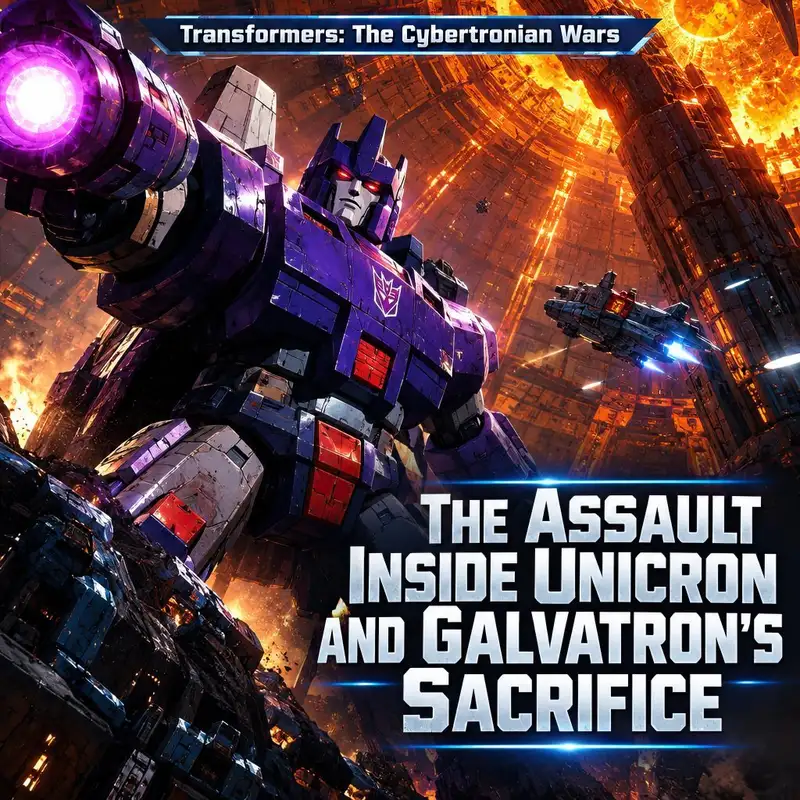
The Assault Inside Unicron and Galvatron’s Sacrifice
On Moon Base Two, the defenders try the most direct answer available. They fire explosives at the approaching body of Unicron, a machine so large that its advance changes the horizon. The blasts register as flashes against his surface. They do not alter his course. They do not slow him. Within moments, the defenders face a fact that conventional military planning is poorly prepared to absorb. Their target is more than armored. It is consuming the battlefield itself.
In the American animated continuity of The Transformers: The Movie, that failure matters more than any estimate of Unicron’s size or firepower. The film provides no reliable engineering specifications, and it does not need them. It establishes the operational reality clearly. Weapons that might destroy a ship, a fortress, or a city have no meaningful effect on this attacker from the outside. Moon Base Two is not defeated in a conventional exchange of fire. It is overwhelmed by a threat that can absorb its defenses along with the installation they protect.
Unicron had already demonstrated the scale of the danger by consuming Lithone. That destruction is more than an opening display of power. It establishes his method. He does not need to occupy a world, negotiate with its government, or hold terrain after a battle. He advances, transforms, devours, and moves on. Against such an enemy, defensive lines have little value if they cannot prevent physical contact. A planet, a moon, and a base can become targets and terrain at the same time.
Cybertron is the strategic objective in this crisis. The Decepticons control the planet at the beginning of the film, while the Autobots have been pushed into scattered positions on Earth and Cybertron’s moons. Under ordinary circumstances, that arrangement would define the war. The Decepticons would seek to consolidate their conquest, while the Autobots would try to rebuild a resistance and recover lost ground. Unicron’s approach makes both projects secondary. A faction cannot govern a planet that no longer exists.
The immediate defense of the moons fails because it is based on the wrong kind of problem. Defenders can fire at Unicron. They can evacuate if they have transport and warning. They can delay panic and preserve some personnel. But they cannot force a conventional kill against a target that treats their entire position as something to be swallowed. The tactical failure is obvious. External weapons do not stop him. The strategic failure is deeper. Defensive locations, evacuation routes, and isolated survivors are all being erased faster than either faction can organize a coherent response.
This is why the final battle has to become an assault from within. Not because anyone begins with an elegant doctrine for fighting a planet-sized transforming enemy, but because every external option has already failed. The eventual penetration of Unicron is improvised, dangerous, and dependent on circumstance. It succeeds because the defenders find access to the interior of an otherwise invulnerable target. That access creates a new battlefield, but it is the only battlefield where the coalition has a meaningful chance to affect the outcome.
Unicron is not a Decepticon weapon. He is not Megatron’s ally, and he is not a force that Decepticon command can direct against the Autobots. He is an independent power with his own objective. He wants the Autobot Matrix of Leadership destroyed, and he wants Cybertron consumed. The distinction is crucial. Decepticon control of Cybertron may look decisive in a civil war, but it offers no protection from an entity that regards the planet itself as fuel, prey, or raw material.
The battle for Autobot City has already weakened both sides before Unicron’s attack reaches its peak. The Autobots have suffered the death of Optimus Prime, their most important leader. The Decepticons have lost Megatron in the aftermath of his duel with Optimus. Their command structure is unstable. Their victory on Cybertron has given them territory, but not security. The war has produced conquerors and refugees, yet neither side is positioned to respond well to a threat that makes ordinary territorial control irrelevant.
Unicron’s arrival exposes the fragility of the Decepticon victory. Holding Cybertron requires troops, communications, transport, repair facilities, and some ability to govern. It also requires a planet that remains intact. The Decepticons have the first set of assets, however unevenly. They do not have the second. Their conquest becomes strategically hollow the moment Unicron begins closing on Cybertron. A leader may seize a capital, declare a new order, and eliminate rivals. None of it matters if an outside force can erase the state beneath him.
For the Autobots, the crisis is equally severe but differently shaped. They are not defending a stable government from invasion. They are scattered survivors operating without their principal commander, with damaged spacecraft, uncertain communications, and no secure base near the decisive theater. Their cause may be the defense of Cybertron, but a cause is not a logistics system. They need transportation, repairs, allies, and some way to reach a target that has already defeated every visible defense.
The parallel story belongs to Megatron, who becomes Galvatron at the moment his apparent defeat turns into a far more dangerous form of survival. After his fight with Optimus Prime, Megatron is abandoned in space by his own followers. That detail matters. He is not rescued by a loyal force conducting a recovery operation. He has lost the immediate contest for Decepticon command, and he is drifting toward destruction when Unicron finds him.
Unicron offers him a bargain that is not really a bargain between equals. Megatron is given a new body, a new name, and a new mission. He becomes Galvatron. Other damaged Decepticons are reformatted into Cyclonus, Scourge, and the Sweeps. The transformation displays Unicron’s ability to reconstruct and repurpose Cybertronian bodies, but it should not be mistaken for a general medical system or a routine form of repair. This is an exceptional act by an exceptional power, carried out for its own strategic purposes.
The price is service. Unicron orders Galvatron to destroy the Autobot Matrix of Leadership. Galvatron accepts because the alternative is annihilation. The new body gives him greater capability and a chance to recover the authority he has lost, but it does not make him free. His creation is therefore both a rescue and a subordination. He survives, yet he survives as an instrument of a superior force that can remake him, command him, and threaten to destroy him again.
Galvatron’s first major act is to interrupt Starscream’s coronation and seize Decepticon leadership. The timing is politically efficient. Megatron’s apparent death has created a vacuum. Starscream moves quickly to claim the position, but his authority is ceremonial and fragile. It rests on the absence of a stronger claimant, not on a durable institutional process. Galvatron’s return ends the dispute through direct violence. He destroys Starscream and makes clear that the old leader has returned in a more formidable form.
For a brief period, Galvatron appears to have recovered everything Megatron lost. He has a new body. He has eliminated the rival most ready to replace him. He commands the Decepticon military. He has been given a mission that places him at the center of a planet-wide crisis. From the outside, it looks like an ascent. Yet the core problem remains untouched. The question is not whether Galvatron commands the Decepticons. The question is whether Galvatron commands himself.
The answer emerges through the Autobot Matrix of Leadership. The Matrix is not an ordinary weapon, even though it becomes central to military survival. It is portable, small enough to be carried by an individual, and of obvious political importance. Optimus Prime transfers it to Ultra Magnus before his death. That transfer identifies Magnus as the immediate bearer of Autobot leadership. But the film soon demonstrates that bearing the Matrix and using it are not the same thing.
Ultra Magnus possesses the Matrix, yet he cannot open it. That failure does not necessarily prove that he lacks courage, competence, or formal authority. It proves only what the film directly shows. The Matrix does not function as equipment that any trained commander can activate on demand. It has conditions of access that remain only partly explained. It is both an artifact of leadership and a strategic resource, but its relationship to leadership is not reduced to rank alone.
Galvatron eventually captures the Matrix after confronting Ultra Magnus. This should have been a decisive victory. He has removed the Autobot leader who held the artifact, and he now possesses the one object Unicron explicitly fears. But possession is not control. Galvatron cannot open the Matrix any more than Magnus could. He has acquired custody of an asset without understanding its operating conditions. In military terms, he has captured the key but not the lock.
The Matrix therefore becomes a source of instability rather than immediate power. The Autobots need it because it may be the only force capable of stopping Unicron. Unicron wants it destroyed because it poses a threat to him. Galvatron wants it because he thinks it can free him from Unicron and perhaps place him above every other power in the war. Each side understands that the object matters. None of them, at first, can fully command its use.
The film does not provide a technical manual for the Matrix. It does not establish a complete religious doctrine explaining why one bearer succeeds and another fails. The safest reading is modest. The Matrix recognizes, enables, or accompanies a transfer of leadership at the decisive moment. It opens for Hot Rod after he becomes Rodimus Prime. Beyond that, the mechanism remains uncertain. The event is clear. The exact rule behind it is not.
While Galvatron pursues the Matrix, the surviving Autobots are dealing with a different form of fragility. Their forces are scattered after the fighting around Autobot City and the subsequent attacks. Their leadership is uncertain. Their ships are damaged. Their personnel are separated across hostile territory and space. Under normal conditions, a force in that position would seek time to regroup, repair, gather intelligence, and establish reliable supply routes. Unicron offers none of those luxuries.
The Planet of Junk becomes essential because it supplies what the Autobot remnant lacks. The Junkions provide a place where damaged survivors can be restored, where the coalition can gather transport, and where fighters can be added to the return mission. Their importance goes beyond their availability in the final battle. They provide repair capacity and mobility at a moment when the Autobots are losing both. In a war of machines, recovery is not a background service. It is combat power preserved.
Ultra Magnus is rebuilt on Junkion after Galvatron destroys him. That restoration changes the immediate balance by returning an important Autobot commander and fighter to the field. It should not be expanded into a claim that death is meaningless or that every damaged Cybertronian can be restored indefinitely. The film shows a specific recovery under unusual circumstances, supported by local expertise and equipment. It establishes the value of repair infrastructure. It does not establish unlimited resurrection.
The Junkions also demonstrate the political value of coalition warfare. The Autobots bring the strategic objective. They have a direct interest in stopping Unicron and preserving Cybertron. They also bring surviving personnel who understand the larger conflict. The Junkions contribute local support, repairs, transportation, and additional combat capability. Neither group alone is well positioned to meet the crisis. Together, they can at least reach the decisive theater.
This is not a carefully prepared expedition. There is no indication of a long-planned joint command, standardized equipment, or a fully secure rear area. The force returning toward Cybertron is improvised and under pressure. Its members have been separated, damaged, ambushed, and forced to adapt to changing leadership. The strength of the coalition is not perfection. It is its ability to convert scattered survivors into a force capable of moving toward a threat that neither side can ignore.
Galvatron, meanwhile, tries to turn the Matrix into leverage against Unicron. The attempt is understandable from his position. He knows Unicron needs the artifact destroyed. He holds it. He believes that possession gives him bargaining power. In effect, he tries to renegotiate the relationship that created him. He no longer wants to be Unicron’s servant. He wants to become a partner, or perhaps a master in his own right.
Unicron’s response exposes the weakness of Galvatron’s position. He does not accept a negotiated settlement. He transforms into robot mode and moves directly against Cybertron. This is more than a display of anger. It is a strategic answer. Unicron demonstrates that he retains the initiative, that he does not need Galvatron’s cooperation to threaten the planet, and that Galvatron’s apparent control of the Matrix has not made him independent.
Galvatron remains Decepticon leader after this confrontation, but he has failed to become autonomous. He has gained power over his former faction while remaining subject to a force outside it. This is the central political irony of his rise. He returns from defeat stronger than before, destroys a rival, captures the Matrix, and claims command. Yet every success rests beneath the shadow of a master he cannot remove. His authority expands sideways, across the Decepticons, but not upward, toward Unicron.
As Unicron attacks Cybertron, the Autobot and Junkion force joins the defense. The clash occurs in the chaos of an assault already underway. Unicron is fighting defenders around the planet while his own massive body functions as weapon, fortress, transport, and target. The coalition has no evidence that it can destroy him through ordinary external fire. It attacks because it must, but the critical opportunity comes not from a planned strike package or a known weak point.
The group’s shuttle is damaged during the battle and crashes through Unicron’s eye. This is an emergency penetration, not a deliberate breach operation. No commander has prepared a detailed interior map. No one has established a reliable extraction route. The eye becomes an entry point because combat damage and desperate maneuver create one. The event is accidental in origin, but its consequences are strategic. At last, the defenders are inside the target.
Internal access changes the nature of the fight. Unicron’s exterior has resisted every conventional effort shown in the film. His interior gives the coalition a chance to bypass that apparent invulnerability. But entering does not mean winning. A fortress can be more dangerous inside its walls than outside them, and Unicron is not even a conventional fortress. His body is a hostile environment with moving structures, corrosive hazards, confined spaces, and no guarantee that the attackers understand where they are going.
The eye should not be treated as a universal weak point for every version of Unicron across the franchise. In this film, it is a breach created by circumstance. It gives the Autobots and their allies access at the moment when access matters most. The lesson is narrower and more useful. Against a target too resilient to defeat externally, an accidental opening can matter more than a carefully applied volume of fire. But exploiting that opening requires survival, improvisation, and a weapon that can affect the enemy from within.
Inside Unicron, the coalition loses the advantages of normal maneuver. There is little room for formation fighting. Personnel become separated. Lines of sight are limited. Movement is constrained by structures that are at once mechanical and organic in appearance. The interior is not a place where troops can reliably establish a perimeter, call for reinforcement, or identify safe routes. The attackers are no longer fighting across terrain. They are moving through the body of the enemy.
The hazards are immediate. Corrosive material threatens those caught in Unicron’s internal systems. Paths shift. The environment can isolate a group before it can coordinate with the rest of the force. In a conventional assault, commanders might rely on maps, radio nets, recognizable corridors, and known objectives. Here, the coalition has none of those assurances. The operation becomes a series of survival problems nested inside a strategic mission.
Spike and Daniel illustrate the human role in this environment. They are not commanding the assault, and the film does not establish that human technology can reproduce or routinely operate Cybertronian systems at the same level. Daniel’s exo-suit gives him limited tactical utility during the effort to save Spike from the dangerous interior. That moment is important because it shows how human allies can matter in a Cybertronian conflict without pretending that friendship alone erases the vast difference in scale and capability.
Daniel’s contribution is practical and immediate. He helps save someone who would otherwise be lost in an environment too dangerous for an unprotected human. The scene is not a declaration that humans have mastered Cybertronian warfare. It is a reminder that an alliance can create small but meaningful forms of capability. In a battle shaped by confusion and separation, preserving one person can affect the survival of a larger group. War is often decided by grand artifacts, but it is lived through by acts of recovery.
The interior also contains survivors from the moon-base attacks. The film presents Autobots including Bumblebee, Jazz, and Cliffjumper among those who have been drawn inside Unicron rather than simply erased by the destruction of the bases. Their presence reinforces the strange nature of the battlefield. Unicron’s victims are not all immediately destroyed. Some are trapped within him, turning the assault into both an attack and an improvised rescue operation.
The group inside Unicron faces a logistical problem as much as a combat problem. There is no secure communications network. There is no established resupply point. There is no dependable route back to the shuttle. If a member is incapacitated, recovery may be impossible. If the force fragments too badly, it may lose the ability to find the Matrix, Galvatron, or any objective capable of ending the attack. The interior assault works only because its participants keep moving through conditions designed to break coordination.
Galvatron is also inside Unicron, but his position is fundamentally different. He is not a prisoner in the ordinary sense, though he has been swallowed along with the Matrix. He is a coerced subordinate operating within the body of the being that remade him. His earlier effort to use the Matrix as a bargaining tool has failed. He has not gained control of Unicron. He has merely brought the object Unicron fears into the place where Unicron can exert the greatest pressure over him.
When Galvatron encounters Hot Rod, he briefly proposes an alliance against their common enemy. The offer has a surface plausibility. Both are trapped inside Unicron. Both have reasons to fear what will happen if Unicron succeeds. Galvatron knows better than almost anyone that Unicron does not regard his servants as partners. Hot Rod knows that the Autobots’ external defense has failed and that survival may require an unexpected opening.
Yet the proposal is unstable from the beginning. Galvatron has spent the film pursuing the Matrix and attacking the Autobots. He has no demonstrated record of placing a shared objective above his own command ambitions. Hot Rod has no reason to trust him beyond the immediate pressure of the situation. Still, the encounter reveals something important. Galvatron does recognize that Unicron is a threat to him as well as to Cybertron. His fear is not imaginary. His dependence is real.
The possibility of cooperation ends when Unicron gives Galvatron a direct order. He must destroy Hot Rod or face obliteration himself. In that moment, the limit of Galvatron’s freedom becomes unmistakable. He cannot negotiate. He cannot claim neutrality. He cannot preserve an alliance of convenience if it conflicts with Unicron’s will. The Decepticon leader is reduced to the status of a controlled asset, valuable only while he performs the task assigned to him.
Galvatron obeys. He attacks Hot Rod and nearly kills him. This is the point at which the language of sacrifice needs to be handled carefully. Galvatron does not voluntarily offer himself to destroy Unicron. He does not make a deliberate last stand to save the Decepticons, Cybertron, or even his own followers. He is forced into danger because refusal would mean destruction. His self-endangerment is real, but it is coerced. That is captivity, not sacrifice.
There is also opportunism in his conduct. Galvatron may fear Unicron, but he still wants to preserve his own authority and eliminate a threat to his plans. Hot Rod is more than an enemy soldier. He is connected to the Matrix, to the Autobot succession crisis, and to the possibility that Galvatron’s control of the artifact will be challenged. By attacking him, Galvatron follows Unicron’s order, but he also acts in ways consistent with his own interest. Coercion and ambition can operate at the same time.
The scene reveals the weakness of leadership built on domination without independence. Galvatron can terrify his subordinates and command a military faction. None of that helps when he confronts a superior power that can compel his actions. His rise to Decepticon leadership gives him prestige and force, but not sovereignty. He has become the ruler of one army while remaining a weapon in another being’s hand.
Hot Rod survives the attack only narrowly. At this point, the succession question that has hovered over the entire crisis reaches its decisive moment. Optimus Prime appears in a posthumous form and identifies Hot Rod as the one who must receive the Matrix. The scene establishes a transfer of leadership under extreme pressure. It does not provide a bureaucratic procedure, a constitutional debate, or a full explanation of how the Matrix makes its judgment. It gives the result. Hot Rod becomes Rodimus Prime.
The transformation changes more than Hot Rod’s name and body. It resolves the immediate leadership crisis among the Autobots. Ultra Magnus had held the Matrix but could not activate it. Galvatron had captured it but could not control it. Rodimus can open it. In the space of a few moments, the artifact moves from disputed custody to effective use. The succession is not calm or institutional in the ordinary sense, but it creates a leader capable of employing the one resource that can alter the battle.
It would be easy to interpret this as proof that the Matrix rewards moral purity or destiny. The film does not establish that rule with enough precision to justify it. Rodimus has shown courage and initiative, but the story does not provide a mechanical or theological checklist explaining why he succeeds. What can be said is simpler. At the moment the Autobots require a leader who can activate the Matrix, Hot Rod becomes Rodimus Prime and does so. The artifact’s power becomes available when the crisis is at its most severe.
Rodimus’s first actions are immediate and practical. He removes Galvatron from the fight by throwing him through Unicron’s hull and into space. That is a tactical decision. Galvatron has just attempted to kill him and remains a direct threat to the Matrix. Removing him prevents further interference at the critical moment. It does not confirm Galvatron’s death, and later American animated episodes establish that he survives. But in the moment, he is no longer able to affect the battle inside Unicron.
The more significant action follows. Rodimus uses the Matrix from within Unicron. This is the decisive convergence of the entire operation. External weapons failed. The coalition found an accidental route inside. Galvatron could not use the Matrix despite possessing it. Rodimus can activate it at the moment when the artifact is physically inside the target. The result is not superior firepower in the usual sense. It is the application of a unique strategic resource at the only point where it can achieve its effect.
In strategic terms, Cybertron survives immediate consumption. That is the achievement that matters most. The Decepticon conquest is not erased in an instant, and the Autobots have not solved every political problem on the planet. But Unicron no longer has the ability to continue his direct assault in the form shown during the battle. The defenders have preserved the possibility of a future. In a crisis of planetary survival, that is an immense victory.
Politically, Rodimus Prime now holds the Matrix and the leadership role associated with it. The Autobots have moved from the death of Optimus Prime, through Ultra Magnus’s unsuccessful tenure as bearer of the artifact, to a new leader who has demonstrated the ability to use it. This is more than symbolic. The Matrix has determined the immediate military outcome, and its activation has made Rodimus’s authority visible to allies and survivors at the moment they most need a center of command.
The coalition still has to escape. Destroying Unicron from within does not guarantee that everyone inside him survives. The route through the eye, once an accidental entry point, becomes the available path out. The Autobots and their allies flee through that opening as Unicron’s active body collapses. Their escape underscores how improvised the operation has been from beginning to end. The force never possessed a secure plan for entering, navigating, striking, and extracting. It survived because it adapted faster than the crisis could close around it.
Unicron’s severed head remains in orbit around Cybertron. The image is a reminder that even a destroyed strategic threat can leave physical and political consequences behind. The film has eliminated his active body as the immediate danger. It has not erased the memory of what he did, the debris of the battle, or the larger questions raised by a force capable of nearly consuming the planet. Victory leaves wreckage, and wreckage has a history.
The film closes with the declaration of a new age. That declaration should be understood as a statement of hope and political intent, not as a complete account of postwar settlement. The story does not show Decepticon disarmament, a negotiated surrender, reconstruction plans, civilian representation, accountability for wartime crimes, or reconciliation between factions. It shows that Cybertron has escaped immediate annihilation and that the Autobots have gained new leadership. Those are necessary conditions for recovery. They are not recovery itself.
Later American season-three episodes confirm that Galvatron survived his expulsion from Unicron and continued to lead Decepticon forces. That continuation matters because it prevents a false reading of the finale. Rodimus removes Galvatron tactically, but he does not solve the Decepticon problem permanently. The destruction of Unicron ends one existential emergency. It does not automatically end the war, dissolve factional identity, or create a durable political order.
The assault inside Unicron succeeds because it converts an impossible external defense into an improvised internal strike at the one moment when Rodimus Prime can activate the Matrix. Galvatron’s role is not sacrifice but captivity. Even after he seizes the Decepticons and the Matrix, he cannot command the force that remade him. Unicron’s destruction saves Cybertron from immediate annihilation, but it does not settle the political war that made Cybertron vulnerable to catastrophe in the first place.