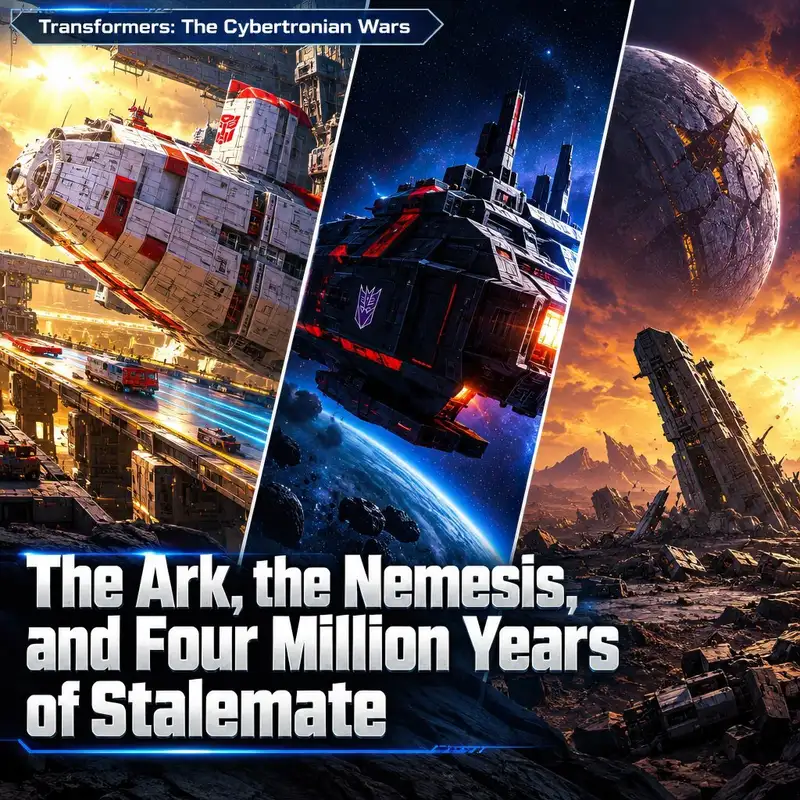
The Ark, the Nemesis, and Four Million Years of Stalemate
The old Decepticon warship rose from prehistoric waters like a weapon recalled from a war that had never quite finished. In Beast Wars, the Predacon leader Megatron, a future namesake of the original Decepticon commander, found and reactivated the vessel later identified as the Nemesis. Above it stood Mount St. Hilary. Beneath that mountain lay the Ark, with the original Autobot and Decepticon crews still in stasis. The immediate danger was not just that an ancient ship could destroy another ancient ship. Damage the Ark, and the future that produced the Maximals and Predacons might be changed beyond recognition.
That made the Nemesis operation a peculiar kind of offensive. The Beast Wars Megatron did not need to conquer Cybertron, defeat the original Optimus Prime, or rebuild the old Decepticon military. He needed only to exploit a vulnerable point in history. The Ark was a dormant transport, a tomb of political and military leadership, and a time-sensitive link between Cybertron’s old war and the society from which the future combatants came.
To understand why those wrecks mattered so much, it is necessary to return to the crisis that launched them. The story begins not with Earth, but with a Cybertron already damaged by a long civil war and an energy emergency severe enough to change the meaning of every military decision.
In the American animated history, Cybertron’s conflict had drained the planet’s energy reserves. The pilot presents the Autobots as close to extinction, and the language is important. This was not just a shortage of ammunition for a few battlefield units. Energon was the resource that allowed Cybertronians to function, travel, repair themselves, and sustain industry. A war fought over political power had become a struggle over whether either side could remain viable at all.
The civilian implications are present even when the early cartoon does not linger on them. A planet losing its energy base is more than a headquarters with poor supply discipline: it is a society facing declining mobility, weakened infrastructure, failing repair capacity, and a narrowing margin between military necessity and basic survival. The series does not give a complete economic history of Cybertron at this point. It never provides population totals, industrial output, or a detailed rationing system. But it establishes the strategic fact that matters most. The war had consumed the conditions needed to sustain the war.
For Optimus Prime and the Autobots, that produced an urgent problem. Remaining on Cybertron meant remaining dependent on a depleted world where the Decepticons held the advantage. A force that cannot fuel itself, repair itself, or replace losses has limited choices. It can surrender, disperse, make peace if peace is available, or seek resources elsewhere. The Ark represented the last of those options.
The mission was therefore not a simple flight from defeat. It was an expedition intended to find new sources of energy and preserve an Autobot force that could no longer rely on Cybertron alone. The Ark was later named explicitly in Beast Wars, though the original pilot does not speak that name on screen. Even without the later label, its purpose is clear. It was a mobile lifeline, carrying personnel, command authority, repair capability, and the possibility of a new logistical base.
That made the ship more than transport. A vessel carrying senior personnel and essential systems becomes a compact version of the society it serves. It contains not only combat power, but technicians, information, medical support, navigation, communications, and the machinery of recovery. If it reaches its destination, it can establish a foothold. If it is lost, the force loses far more than a hull.
The Autobots were gambling on mobility because the strategic environment on Cybertron had become untenable. Yet mobility comes with its own burdens. A ship leaving a damaged home world cannot assume nearby reinforcement. It cannot count on secure repair facilities. It must carry enough energy, equipment, and personnel to survive unforeseen damage. It must also travel through territory where the enemy may know its mission, understand its importance, and calculate that destroying it is cheaper than allowing it to succeed.
The source never provides a reliable ship roster, an exact crew complement, or a formal Autobot order of battle. It would be easy to turn the Ark into a fully documented fleet flagship with defined departments and thousands of embarked troops. The cartoon does not support that level of precision. What it does support is a simpler and more consequential conclusion. The ship carried enough of the Autobot cause that its loss could alter the wider war.
The Ark also carried a strategic contradiction. It was meant to escape the immediate balance of power on Cybertron, but its departure advertised the Autobots’ weakness. A faction that sends a major expedition in search of energy is telling its enemy that local resources are no longer sufficient. It is revealing both desperation and intent.
Megatron understood the threat. Decepticon intelligence learned of the Autobot departure, and he chose to pursue. From the Decepticon perspective, allowing Optimus Prime to establish an independent energy source could have changed the war’s balance. The Autobots might gain the means to rebuild, rearm, or simply survive outside Decepticon pressure. The expedition had to be intercepted before it became a durable alternative to Decepticon control.
Megatron’s decision was strategically understandable. It was also hazardous. Pursuit in deep space moved the contest away from established bases, known supply routes, and dependable repair facilities. An interception force can achieve surprise, but it also risks becoming stranded beside its target. The Decepticons were no longer defending a position on Cybertron. They were committing their leader and a substantial portion of their immediate striking power to an operation where a single navigational failure, collision, or systems breakdown could leave both sides without support.
The Decepticon vessel that later screen history calls the Nemesis was sent after the Ark. Shockwave remained on Cybertron, a detail with larger implications than it first appears to have. It indicates that the Decepticons did not place every element of their authority aboard the pursuit force. Megatron could lead the interception while a significant Decepticon command presence remained behind.
That does not establish a complete political history of Cybertron during the following four million years. The cartoon gives no basis for claiming that Shockwave governed every aspect of the planet, maintained a stable regime without challenge, or directed a continuous war from the moment the ships vanished. It does establish that Decepticon power was not wholly removed from Cybertron by the expedition. The pursuit force was important, but it was not the whole Decepticon state.
For the Autobots, the situation was more severe. Their expedition carried Optimus Prime and a group of key personnel away from a home world already described as near collapse. If the Ark succeeded, it might preserve the Autobot cause. If it failed, the Autobots would lose not just a mission, but a concentration of leadership and capability that Cybertron could ill afford to spare.
The interception did reach the Ark. But reaching the target did not mean controlling the outcome. The two ships encountered an asteroid hazard, and the Ark was forced to expend energy clearing a path. That action mattered because it changed the condition of the vessel before the boarding action began. Energy used to survive navigation is energy unavailable for propulsion, defense, repair, or escape.
In military history, many operations fail because commanders treat movement as a prelude to combat rather than part of combat. The Ark’s encounter with the asteroids demonstrates that problem in its most direct form. Before the Decepticons boarded, the Autobot vessel had already paid a price in power and readiness. It had survived the immediate environmental danger, but it had become more vulnerable to attack.
Megatron’s forces then boarded the Ark. The fight moved from open pursuit to close combat inside a damaged ship, where every weapon discharge, damaged control line, and disrupted system could affect not just the battle but the vessel’s ability to remain under control. Boarding actions are always contests over access, mobility, and systems. On a spacecraft far from support, they are also contests over whether either side can leave alive.
The Decepticon attack disrupted the Autobot mission. In that narrow tactical sense, Megatron achieved his immediate purpose. The Ark no longer continued cleanly toward a new energy source. The Autobots were forced into defense. Their ship was damaged, their movement restricted, and their expedition transformed into a struggle for survival.
But tactical success was not strategic control. The boarding action and the prior asteroid damage created a cascading failure that neither side could manage. The Ark lost control. The pursuing Decepticon vessel was drawn into the same disaster. Both ships crashed on prehistoric Earth.
The crash was not a victory parade for either faction. It did not establish an occupation, secure an energy source, or return a victorious fleet to Cybertron. It removed both vessels from the wider conflict as mobile assets. The Ark ceased to be an expeditionary lifeline. The Nemesis ceased to be a functioning pursuit platform. The combatants who might have continued their struggle were instead immobilized.
The original pilot shows the pursuit, the battle, the crash, and the resulting stasis. It never provides a fully mapped account of each wreck site or a technical explanation for every system failure. Later Beast Wars material identifies the Ark beneath Mount St. Hilary and treats the Nemesis as a wreck recoverable from prehistoric waters. Those later episodes give the ships names and strategic importance, but they do not turn the original crash into a neatly documented naval engagement with known coordinates, losses, or damage assessments.
What can be said with confidence is that the crash ended the campaign as an active operation. The Ark had failed to reach a new energy source. The Nemesis had failed to return to Cybertron with the Autobots defeated. Both sides had been trapped on a world that neither had selected as a deliberate theater of war.
Then came the long silence.
Four million years is often spoken of as though it describes a single uninterrupted Cybertronian battle. It does not. The Ark’s Autobots and Decepticons entered stasis. They were not fighting trenches across a prehistoric continent. They were not maintaining patrols, conducting diplomacy, refining energon, or reinforcing positions. They were dormant.
The phrase stalemate is useful only if used carefully. This was not an evenly balanced front line in which two active armies held each other in check for four million years. It was a strategic suspension. Important leaders, personnel, machines, and information had been removed from the board. The conflict that had launched them remained unresolved, but this particular expedition and interception had frozen in place.
The Ark and Nemesis preserved the possibility of later war because they preserved its participants. The crash did not reconcile Autobots and Decepticons. It did not settle the question of Cybertron’s depleted energy. It did not create a political order accepted by both sides. It simply interrupted a confrontation at the point where both forces became unable to act.
That interruption had political consequences. The Autobots aboard the Ark were absent from Cybertronian society, effectively lost until their return. The Decepticons retained Shockwave on Cybertron, which meant that their political and military presence had not disappeared with Megatron’s pursuit force. Yet the screen record does not show enough of the four-million-year interval to describe the planet as stable, prosperous, or continuously contested in any detailed way.
It would be tempting to fill that silence with a complete account of Decepticon rule, Autobot resistance, underground industry, and shifting front lines. The later episodes do not provide such an account. The more accurate interpretation is narrower. The crash created a gap in the historical record and a gap in the active leadership of the war. It left Cybertron strategically important, but it left the Ark’s crew beyond Cybertronian politics until Earth itself brought them back.
The deadlock ended not through rescue, negotiation, or a planned return expedition. It ended because geology disturbed an old wreck.
Volcanic activity at Mount St. Hilary reactivated the Ark’s systems roughly four million years after the crash. This was not a triumphant relaunch of a preserved warship. It was an emergency recovery by machinery that had endured an interval no normal operational plan could reasonably expect to survive. The Ark’s computer, Teletraan One, became the critical institution at that moment.
Teletraan One was not just a talking computer in a hidden mountain. It functioned as reconnaissance system, repair facility, archive, scanner, and emergency reformatting platform. With the crew dormant and no living command structure able to assess the situation, the ship’s automated systems had to interpret a new planet, identify local conditions, and decide how the damaged Cybertronians could become operational again.
Its vehicle scans changed the war in practical ways. The awakened Cybertronians received Earth-compatible alternate modes. Those modes offered mobility on local roads, access to a world built around human vehicles, and some measure of concealment. They also established the operational identity that would define the early Earth conflict. A vehicle form was not a cosmetic adjustment. It shaped how a Cybertronian could move, scout, transport equipment, approach human infrastructure, and avoid immediate detection.
But the reformatting is not the same as proof that either faction had suddenly acquired a mature industrial base on Earth. Teletraan One provided emergency adaptation. It did not create unlimited spare parts, limitless energon, secure supply networks, or a replacement for Cybertronian production. The Autobots and Decepticons still required repair, engineering, energy, and access to facilities. Their survival depended partly on the Ark’s systems and increasingly on what they could find, build, capture, or negotiate on Earth.
The Decepticons awakened first. That gave them a brief but important initiative. A force that returns from stasis ahead of its enemy can seize equipment, assess terrain, and determine the first terms of contact. Yet their advantage was not complete. Starscream’s attack helped reactivate the Autobots. Once again, a Decepticon tactical action produced consequences beyond the immediate plan.
The Ark’s crash site became the Autobots’ principal early base. Even largely immobilized, the vessel retained strategic value. It offered concealment, repair capacity, information systems, and a defensible center from which the Autobots could operate. A ship that can no longer cross interstellar distances may still be a useful headquarters. Military assets do not become irrelevant merely because they no longer perform their original mission.
Earth did not solve the original Cybertronian crisis. It gave that crisis a new theater. The Decepticons sought energy that could support their own war aims and strengthen their position relative to Cybertron. The Autobots attempted to prevent them from turning an unfamiliar planet into a resource depot, a base, or a victim of an imported civil war.
This was the beginning of a different kind of campaign. On Cybertron, the conflict had been shaped by a depleted industrial world and known political factions. On Earth, the combatants had to operate amid human infrastructure, human civilians, and resources not created for Cybertronian use. Concealment became useful, but concealment did not eliminate the political problem. A hidden alien force can still endanger a population, consume local resources, and provoke fear once its presence becomes visible.
Humanity in these early stories was not one unified military actor. Individual allies such as Sparkplug Witwicky mattered because they could provide practical assistance, local knowledge, and access to human technology. But a friendship with one human family was not a treaty with Earth. The broader civilian population had not chosen to become part of the Autobot-Decepticon war, yet it would bear many of the risks.
The strategic importance of Cybertron also did not vanish simply because the main action had moved to Earth. The Decepticons’ continuing interest in energy and in their home world becomes especially clear in The Ultimate Doom. Megatron used a space-bridge system in an attempt to pull Cybertron into Earth’s vicinity and exploit the resulting planetary crisis.
That operation shows why the Ark and Nemesis story cannot be understood as only two ships marooned in a mountain and an ocean. The war’s geography remained interplanetary. Cybertron was not a lost homeland remembered only in speeches. It remained a source of authority, a strategic object, and a world whose condition could shape events on Earth.
The space-bridge crisis had several levels of consequence. Tactically, it was a superweapon emergency requiring the Autobots to stop a catastrophic mechanism. Operationally, it demonstrated that control of rapid movement between worlds could bypass ordinary distance and create sudden access to a target planet. Strategically, Megatron was attempting to restore or expand Decepticon advantage by turning planetary movement itself into an energy and power problem.
The political and civilian consequences were equally important. Earth was placed at risk by a conflict it had not started. Human cities, infrastructure, and ordinary lives became exposed to the effects of Cybertronian strategy. The fact that Megatron could pursue a larger goal involving Cybertron did not make the danger to Earth incidental. It demonstrated the central moral fact of the Earth war. The planet was not just a convenient battlefield. It was a society being drawn into a conflict whose origins lay far beyond it.
The Ark had therefore done more than preserve a group of dormant warriors. Its reactivation opened a route by which Cybertron’s unresolved war could return in transformed form. The original expedition had sought energy beyond Cybertron. The crash had frozen that mission. The awakening gave the struggle a new resource base, new terrain, and new civilians to endanger.
Then, millions of years after the crash but before the Ark’s eventual awakening in nineteen eighty-four, the wreck site became important in another war. This was the Beast Wars, fought by Maximals and Predacons who inherited a future shaped by the older Autobot-Decepticon conflict.
The Maximals and Predacons were not just the original Autobots and Decepticons under different faction names. They belonged to a later political and historical order. Their presence on prehistoric Earth came through transwarp displacement and a conflict involving the future’s own rivalries. But their struggle became entangled with the old war because they discovered where and when they had landed.
The Ark beneath Mount St. Hilary was no longer just a buried vessel. It was a causality-sensitive strategic asset. Inside were the dormant original crews. Their later awakening was part of the historical sequence that produced the world from which the Maximals and Predacons had come. Alter the Ark’s fate, and the consequences might reach forward across millions of years.
That gave intelligence extraordinary value. In a conventional campaign, locating an old wreck may offer salvage, shelter, or a battlefield advantage. In this situation, knowledge of the wreck’s identity transformed it into a point of historical leverage. The combatants did not need a complete map of all future events. They needed to understand that the Ark’s survival and its scheduled awakening mattered.
The Beast Wars Megatron understood this well. He was not the original Megatron who had pursued Optimus Prime from Cybertron. He was a future Predacon leader who used the legacy of that older war for his own purposes. His name, ambitions, and interest in the original Decepticon leader’s history made the distinction especially necessary. He was exploiting the past, not reliving it as the same individual.
His discovery of the Nemesis gave him a means to do so. The ancient Decepticon vessel could be raised, reactivated, and turned against the Ark. In the context of prehistoric Earth, its return carried enormous shock value. The Maximals had no equivalent heavy asset ready for immediate use. Their problem was not just to defeat an enemy ship in open combat. They had to protect the Ark, preserve the timeline, survive the attack, and find a way home.
The Nemesis was dangerous because it combined mobility, heavy armament, and psychological effect. A recovered warship can dominate a battlefield when its opponents lack the means to match it directly. It could threaten the mountain containing the Ark and strike across a wide area. Its reappearance also gave the Beast Wars Megatron a temporary command platform more formidable than the resources normally available to his opponents.
Yet the Nemesis was not a restored fleet. Recovering one ancient vessel did not mean the Decepticons had maintained interstellar naval power throughout the four-million-year interval. It did not demonstrate a standing armada waiting beneath the oceans. It showed that one wreck could be made dangerous again under exceptional circumstances.
The ship’s limits mattered. It had endured immense time and damage. Its energon was finite. Its systems were not in ideal condition. Its effectiveness depended on a vulnerable command arrangement. A warship can possess overwhelming firepower and still remain operationally fragile if it lacks sustainment, reliable systems, secure control, and a way to recover from damage.
This is one of the episode’s central lessons. Preservation is not readiness. The Ark and Nemesis survived the passage of time, but survival did not mean either ship had remained prepared for service. The Nemesis could be awakened into a brief and terrifying return to relevance. That did not erase the accumulated effects of age, damage, and long dormancy.
The Maximals initially faced a severe mismatch. Direct fire had limited effect against the Nemesis. The defenders could not just stand in the open and trade shots until one side ran out of resolve. They needed a plan based on mobility, improvisation, and the preservation of the historical asset beneath them.
Their first hope was the Ark itself. If it could be reactivated and flown, it might provide escape, protection, or at least a way to move the original crew beyond immediate danger. But the Ark’s engines failed almost at once. Four million years of inactivity had imposed a cost that no heroic intention could reverse on command.
That failure is a logistical fact disguised as drama. A ship can remain intact enough to shelter a crew and operate some internal systems while still being unable to resume its original mission. Engines, power systems, control lines, and other components require maintenance, testing, parts, and energy. The Ark had been dormant, not preserved in a functioning dockyard with technicians servicing every critical system.
The failed launch also clarified the Maximals’ objective. They were not trying to seize the Ark as a new flagship or rewrite history to suit themselves. Their aim was to preserve the original crew’s future and escape the danger they had brought to the site. In a time-sensitive conflict, restraint can be as important as destructive power. The defenders could not casually alter the wreck, awaken its occupants at the wrong moment, or turn the old ship into a convenient weapon without risking consequences they could not fully predict.
Dinobot Two provided crucial information about an Autobot shuttle stored aboard the Ark. This was a smaller, more practical asset than the dormant ship itself. The shuttle offered a route out when the Ark could not fly. The Maximals combined that opportunity with a transwarp cell, using available technology not to dominate the battlefield but to escape it.
Their action against the Nemesis ended the immediate threat, and the Beast Wars Megatron was captured. That was mission success. The old warship had been prevented from destroying the Ark or permanently altering the historical sequence the Maximals needed to preserve. But it was not conquest in the traditional sense. No one had solved the larger causes of Cybertronian conflict. No one had rebuilt either ancient faction’s political order. The goal was containment.
The Beast Wars conclusion closes the loop around the Ark and Nemesis without turning the old crash into a different event. The original crew remains in stasis, positioned for the later awakening that begins the nineteen eighty-four Earth war. The future intruders leave the past largely intact. History survives not because it was invulnerable, but because the people who depended on it recognized how fragile it was.
For that reason, the phrase four million years of stalemate must be understood as an analytical description rather than a literal account of continuous combat. The Ark and Nemesis did not carry a living front line through four million years. Their crews slept. Their ships decayed. Cybertron’s full history during that interval remains largely outside the screen record.
What they preserved was an unresolved conflict in suspended form. The Ark preserved Optimus Prime, the Autobots, Teletraan One, and the machinery needed to adapt to Earth. The Nemesis preserved the possibility that an old Decepticon weapon could be recovered and used again. The crash stranded both sides outside the politics of Cybertron, but it did not remove the political causes or military consequences of the war.
In direct combat terms, the crash allowed the original crews to survive in stasis rather than perish outright. Across the campaign, it removed both ships from their intended roles as expeditionary and pursuit assets. For the larger war, it turned Earth into the future theater where the interrupted conflict would resume.
Politically, the disappearance of the Ark’s personnel removed an important Autobot group from Cybertron, while Shockwave’s continued presence meant the Decepticons retained at least part of their command structure on the home world. The exact shape of that political balance is not established. What matters most is that the crash did not create peace. It created absence, uncertainty, and a war whose decisive participants had been displaced.
The consequences of the Ark and Nemesis stretch far beyond the crews sealed inside them. Earth becomes exposed to resource extraction, planetary schemes, and a conflict whose origins precede human civilization. Millions of years later, the Maximals and Predacons discover a different danger. Their own future depends on the old crash, the long stasis, and the eventual awakening of those original combatants. The wrecks beneath prehistoric Earth are not museums. They are active points of leverage inside history itself.
The crash did not create an uninterrupted four-million-year battle, and it did not create peace. It removed a decisive expedition from Cybertron's immediate war, stranded its leaders outside normal politics, and preserved the conditions for the conflict to erupt again on Earth. By the time the Beast Wars generation reaches those ships, the danger is no longer simply the weapons they contain. It is that an unresolved civil war has left its commanders, technology, and causal chain buried in the past, waiting for someone with enough ambition to use them against the future.