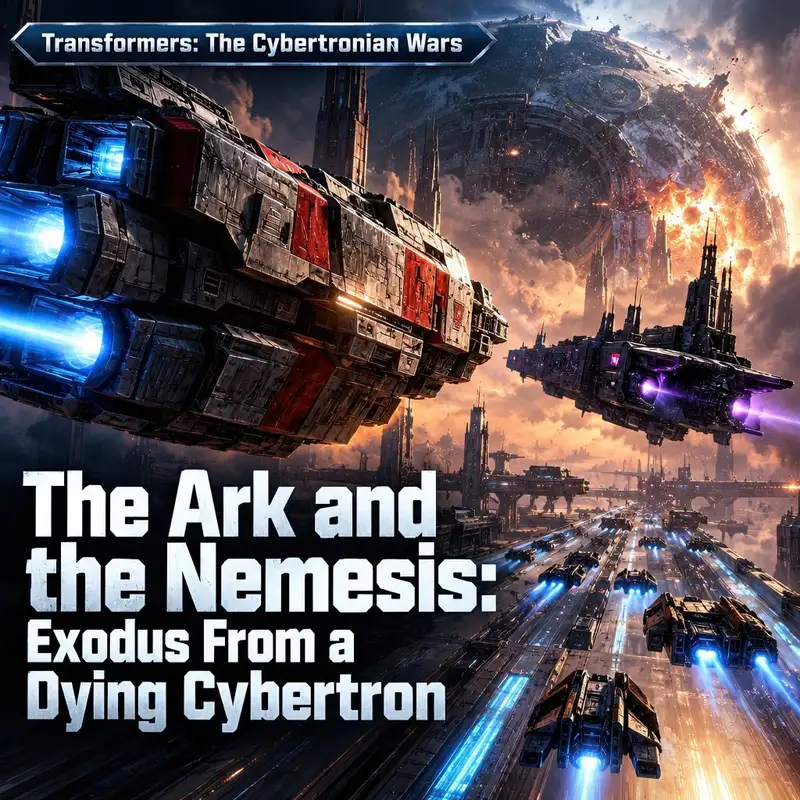
The Ark and the Nemesis: Exodus From a Dying Cybertron
Cybertron’s crisis was not just that its armies were tired of war. The problem was more immediate and more dangerous. The planet’s energy sources had been devastated by a long conflict between Autobots and Decepticons, and the Autobots were approaching extinction. They still possessed weapons, leaders, technicians, and at least one functioning spacecraft. But every one of those assets depended on energy that Cybertron could no longer provide in reliable abundance. A civilization can endure political division for a long time. It cannot sustain military operations, repair damaged personnel, or launch an interstellar mission after its energy system has begun to fail.
In this American Generation One animated history, “dying Cybertron” is useful shorthand, but it needs care. The opening story establishes a world ravaged by war and drained of once-rich energy reserves. It does not establish that Cybertron itself is a living being about to perish, nor does it provide a complete inventory of the planet’s remaining industry or population. What it does show is a strategic emergency. The Autobots have reached the point where remaining on Cybertron offers little prospect of recovery. Their problem is no longer merely how to defeat the Decepticons. It is how to remain operational long enough to have a future at all.
The difference matters because energy was not an abstract prize. It was the condition that made every other choice possible. An army without power cannot move, communicate, repair itself, operate weapons, or maintain bases. A spacecraft without reserves is not a route to safety. It is an expensive shelter drifting toward a new disaster. The Autobots’ later departure from Cybertron therefore should not be understood as a triumphal expedition. It was an attempt to use the last useful mobility available to them before scarcity turned defeat into disappearance.
The first practical evidence of that decline comes not from a great battle or a speech by a commander, but from scavenging. Wheeljack and Bumblebee are sent out to recover energy conductors, remnants of the infrastructure that once sustained Cybertronian life and war. The mission is revealing precisely because its yield is so modest. They are not seizing a refinery, opening a new energy field, or escorting a major convoy. They are searching through the remains of a damaged world for something still usable.
That is what a broken supply system looks like at the field level. Forces that once managed production, transport, storage, and distribution now spend combat-capable personnel hunting for leftovers. Such work is slow, exposed, and uncertain. It also places a premium on information. Anyone who learns where a scavenging team is operating can attack not only the personnel involved, but the small stream of material keeping a larger force alive. Scarcity concentrates risk. A minor recovery operation becomes important because there are no longer many alternatives.
Wheeljack and Bumblebee do find the conductors, but their return is interrupted by a Decepticon patrol. The episode does not provide a full map of the battlefield, a formal order of battle, or a precise account of how much energy either side possesses. It does not need to. The encounter establishes the operational condition clearly enough. Even the act of gathering remnants is contested. The Autobots cannot treat a discovered resource as secure until it reaches their own lines, and they cannot move through Cybertron without being detected and challenged.
The importance of the mission lies less in its tactical action than in what it says about the war’s final phase on Cybertron. The Autobots can still fight. Bumblebee and Wheeljack are not helpless civilians. Yet their ability to continue fighting rests on a fragile logistical chain that has become increasingly improvised. Their resource problem has reached the level of routine patrols and repair work. A military organization in that condition may still win a local engagement, but it is losing the capacity to choose where and when to operate.
The Decepticons, meanwhile, remain dangerous enough to contest those scraps. Their survival problems may not be identical to the Autobots’ problems, but they are operating on the same damaged planet, within the same exhausted energy environment. This is important because the coming exodus is not the story of one well-supplied army chasing a collapsing enemy across space. It is the story of two factions trying to escape, exploit, or dominate a crisis neither one has solved.
At Iacon, the Autobot center of operations, Optimus Prime confronts that reality with his senior personnel. Jazz, Prowl, and Trailbreaker are part of the discussion as the Autobots consider leaving Cybertron to locate energy elsewhere. The decision is often remembered as the first step in the familiar war on Earth. At the moment it is made, however, Earth is not the point. The Autobots do not have a documented plan to settle there, govern it, or make it their permanent home. Their objective is more basic. They need to find an external source of energy before the remaining resources on Cybertron fail them completely.
That makes the mission an emergency sustainment operation. The Autobots are using a spacecraft to search for the means to continue existing as an organized force. Such a choice carries obvious risks. A ship can move personnel away from a collapsing theater, but it also concentrates valuable leaders, technical specialists, and surviving fighters in a single vulnerable platform. If the mission succeeds, it might open a route to recovery. If it fails, the Autobots could lose both their expeditionary force and much of their capacity to shape events back on Cybertron.
Optimus Prime’s decision also reflects a difficult command balance. Staying on Cybertron means remaining close to familiar territory, whatever remains of Autobot infrastructure, and the immediate struggle against Decepticon power. Leaving means accepting uncertainty, distance, and the possibility that the force may not return. Yet a commander cannot preserve a position merely because it is familiar when that position no longer sustains those defending it. The Autobots are not departing because they have won. They are departing because the existing strategic situation offers no reliable path to survival.
An energy search was therefore not a clean evacuation. It was a gamble made under pressure. The Autobots needed a destination, but the opening story gives little reason to believe they possessed detailed intelligence about a prepared source of supply. Their ship offered reach, not certainty. It could carry them away from Cybertron’s immediate deprivation, but it could not guarantee that another world would be suitable, accessible, or defensible. The mission sought options. It did not solve the underlying war.
The plan becomes more dangerous because it is observed before launch. Soundwave and Laserbeak obtain the information that the Autobots intend to leave Cybertron in search of energy. This is the hinge of the entire episode. Until that moment, the Autobots are preparing a hazardous but potentially independent operation. Once Megatron learns of it, the mission is no longer a search conducted on Autobot terms. It becomes an interception problem.
The intelligence success should not be exaggerated into proof that Decepticon surveillance was flawless or that the Autobots were uniquely careless. The episode shows a specific vulnerability, not an omniscient intelligence apparatus. Still, the effect is decisive. Advance warning allows Megatron to act before the Autobots secure supplies, establish a refuge, or disperse into a wider area of space. He does not need to wait for them to discover a resource-rich world and then attempt to take it away. He can attack the mission at its most concentrated and fragile point: before departure.
That advantage is more important than a simple comparison of firepower. A force that knows an opponent’s intended movement can choose the time, place, and form of contact. It can prepare pursuit, select personnel, and frame the operation around denial rather than response. Megatron does not need a grand planetary campaign. He needs to prevent the Autobots from acquiring a new source of endurance. If the Autobots cannot sustain themselves, their political and military resistance may collapse without the Decepticons having to win every battle on Cybertron.
Megatron’s decision is direct. He will pursue the Autobot vessel and stop the mission. In the Sunbow pilot, the Decepticons are presented as an aggressive force seeking domination and resources. The story does not offer the later revolutionary biographies or complex prewar political narratives that other continuities would attach to the Decepticon name. Here, Megatron’s strategic calculation is visible in action. The Autobots are attempting to escape an energy crisis. He sees an opportunity to deny them a lifeline, seize whatever resources they discover, and potentially remove Optimus Prime and the Autobot command structure in a single operation.
This is a sound tactical instinct, but it also contains strategic risk. Megatron personally takes the pursuit force away from Cybertron. He leaves Shockwave in charge of the Decepticon position on the home planet. That delegation indicates that the Decepticons still have a presence worth maintaining, even amid the wider crisis. It also means that Megatron is choosing immediate opportunity over direct control of the home theater. He may destroy the Autobots’ best chance of survival, but he cannot be in two places at once.
The choice reveals how scarcity narrows leadership. When resources are abundant, commanders can send subordinate formations on distant missions and retain reserves for unforeseen problems. When resources are scarce, every capable ship, officer, and energy reserve becomes politically consequential. Megatron’s presence gives the pursuit force authority and aggression. It also removes him from the larger problem of what to do with Cybertron after years of devastation. Defeating or crippling the Autobots might strengthen Decepticon dominance, but it would not by itself restore the world both factions have exhausted.
For listener clarity, the Autobot ship is commonly called the Ark, and the pursuing Decepticon cruiser is commonly called the Nemesis. Those names became standard in later Transformers history, but the original nineteen eighty-four episode itself refers more simply to the Autobot spaceship and the Decepticon cruiser. Using Ark and Nemesis helps distinguish the vessels, as long as it does not conceal the limited evidence available about them. The pilot does not establish their exact size, crew complement, weapons fit, fuel capacity, or technical class.
What is clear is their strategic function. They are mobility assets of extraordinary importance because Cybertronian alternate modes alone do not carry armies between worlds. The Ark gives the Autobots a way to search beyond their damaged planet. The Nemesis gives Megatron a means to extend Decepticon power beyond the same failing environment. Both ships are products of a civilization still capable of interstellar movement. Neither ship is independent of the energy crisis that made the journey necessary in the first place.
The two vessels leave Cybertron carrying different immediate purposes, but they are tied to the same underlying dependency. Optimus Prime’s force seeks energy as a means of survival. Megatron’s force seeks to block that survival and gain the advantage for itself. Both require enough power to travel, navigate hazards, maintain their personnel, and fight if contact occurs. The pursuit is therefore not a simple chase across empty space. It is a contest between two forces spending the very resource that brought them into space.
The first major pressure comes from an asteroid field or meteor obstruction in the flight path. The scene is easy to remember as a piece of early action animation, but its operational meaning is more significant. The Ark must clear a route through the danger, and that effort consumes energy. The exact mechanics are not explained. The story does not provide an engineering account of propulsion, shields, weapon output, or navigation systems. It does establish the essential point: movement through hostile space has a cost, and an already depleted force can be weakened simply by reaching the next stage of its mission.
This is one of the oldest problems in military history, translated into a science-fiction setting. A pursuing force does not always need to destroy its target in open battle. It may only need to make the target spend what it cannot replace. A retreating army burns food, fuel, ammunition, and time. A fleet consumes propellant and power. A damaged convoy slows itself by avoiding hazards and protecting its vulnerable elements. The Ark’s difficulty in clearing the obstruction makes it more vulnerable before the Decepticons ever reach its interior.
The obstacle field also strips away the illusion that escape is a single decision. Launching from Cybertron is only the beginning. Every subsequent choice depends on reserves. The Ark cannot simply travel indefinitely until it finds a better world. It must survive the route, retain enough capacity to respond to threats, and arrive in a condition that permits further action. Megatron’s pursuit exploits that pressure. He does not need to solve the Decepticons’ energy shortage before attacking. He only needs to ensure that the Autobots spend theirs first.
As the ships close, the conflict moves from pursuit to boarding action. Decepticon forces cross onto the Ark, and the struggle becomes a close-quarters fight inside the very vessel the Autobots require for survival. This is the decisive tactical shift. In open space, the Ark’s main concern is evasion and navigation. Once enemy personnel are inside, the problem becomes internal security, command continuity, and physical control of a damaged platform.
Boarding combat is especially dangerous because the ship is not merely transport. It is the Autobots’ refuge, their command post, their means of reaching a new source of energy, and their only evident route away from Cybertron. The Decepticons are also operating far from their own secure base. Neither side can safely treat the Ark as expendable. Heavy destruction may hurt the enemy, but it can also turn the battlefield into a common grave or strand the victor without a usable ship.
The pilot does not provide a complete deck plan, boarding route, casualty report, or system failure analysis. It would be a mistake to invent them. What matters is that the Decepticon assault disrupts the Autobot mission at the point where its vulnerability is greatest. The Ark is forced to contend with enemy fighters while already stressed by the journey and the obstacle field. Under those conditions, even a limited breach can have effects far larger than the number of combatants involved.
Megatron’s operation achieves a tactical success. He prevents the Autobots from continuing a controlled energy search. Yet tactical disruption is not the same thing as strategic victory. The Decepticons do not emerge with a secure external resource base. They do not return to Cybertron carrying captured supplies. They do not eliminate Optimus Prime or the Autobot force. Instead, the clash destabilizes both sides’ mobility and destroys the possibility of a clean withdrawal for either one.
The Ark crashes on Earth. The Decepticon cruiser crashes as well. The Autobot vessel comes to rest buried in a volcano, becoming an accidental time capsule beneath a world that has no knowledge of the war above it. The crash is the decisive operational failure of the entire expedition. A mission intended to find energy beyond Cybertron becomes an uncontrolled descent onto an unknown inhabited planet. The Decepticon pursuit, intended to deny the Autobots a future, leaves the Decepticons equally stranded.
Neither faction has achieved its original objective. Cybertron has received no relief. The Autobots have not located and secured a stable energy source. The Decepticons have not destroyed their opponents or returned home in command of new resources. The ships that represented each side’s strategic mobility have instead become wrecks. The war has not ended. It has merely been suspended in an unintended theater.
The suspension lasts four million years. That interval is one of the defining facts of the original animated story, but it should not be misunderstood. It does not mean that the Cybertronian war continued in exactly the same form during those four million years, nor does the pilot provide a detailed account of events on Cybertron during the absence of the crash survivors. For the forces trapped on Earth, however, the conflict stops abruptly. Their bodies, weapons, command structures, and rivalries are locked in place beneath a planet still developing its own history.
The long dormancy changes the meaning of the crash. In the immediate sense, it is a catastrophe. In historical terms, it is also an interruption so complete that the later Earth war begins almost as a second opening. When the Autobots and Decepticons awaken, they carry the unfinished objectives of the old conflict into a radically different environment. The planet around them has changed. Its dominant civilization is organic, industrial, and politically unaware of Cybertronian affairs. Its energy sources are not organized for Cybertronian needs, yet they may be exploitable.
The return begins not with a commander’s plan, but with geology. Volcanic activity reactivates Teletraan One, the Ark’s computer system. The fact that Teletraan One can function after such a long burial demonstrates the resilience of the Ark as a technological system, but the episode leaves many details unstated. It does not explain the full extent of the ship’s repairs, whether every subsystem has survived intact, or how the computer determines its sequence of priorities. What it shows is enough: the Ark still contains the capacity to observe its environment, adapt its dormant occupants, and restart the conflict.
Teletraan One sends out the Sky Spy reconnaissance device to examine the new world. This is a small but crucial act of intelligence. The computer does not just awaken Cybertronians in bodies suited to a vanished Cybertronian battlefield. It gathers information about Earth’s vehicles and infrastructure. The scan establishes the basis for the new alternate modes that will define how both factions move, hide, and operate on the planet.
The resulting reformatting gives the Cybertronians practical access to Earth. Vehicle forms permit movement through roads, cities, industrial sites, and terrain shaped for human machines. They also provide a degree of concealment. A truck, car, aircraft, or other familiar vehicle can move through human spaces with less immediate alarm than a towering alien robot. Yet disguise is not political control. A vehicle mode does not grant legal authority, local knowledge, supply networks, or public consent. It merely helps a stranded force begin operating inside an unfamiliar environment.
Teletraan One’s actions also underline a central feature of the Ark’s role. It is not just a ship that happened to carry famous Autobots to Earth. It becomes an improvised base, reconnaissance platform, repair facility, and adaptation system. That does not make it invulnerable or infinitely capable. Its services remain tied to damage, location, available power, and the circumstances of the story. But without it, the crashed Autobots would have had far fewer means to reenter the world around them.
The Decepticons awaken first. Skywarp is among the first restored, and his reactivation helps bring Megatron and the other Decepticons back into operation. That sequence gives Megatron an immediate advantage. The Decepticons emerge into a new world before the Autobots can organize an effective response. The result is not a carefully prepared occupation plan. It is an opportunity created by accident, seized by a faction still thinking in terms of energy, mobility, and military advantage.
Megatron rapidly recognizes Earth as a resource theater. This is the crucial strategic conversion. The planet is no longer merely the place where two ships happened to crash. It becomes a source of material that may restore Decepticon operational capacity. The Decepticons begin extracting energy from local infrastructure and look toward constructing a new cruiser. Their effort is an example of expeditionary adaptation. Stranded far from Cybertron, they try to turn an unfamiliar industrial environment into a supply base.
That adaptation should not be mistaken for effortless self-sufficiency. The Decepticons do not demonstrate that any Earth fuel is universally interchangeable with Cybertronian energy, or that they can reproduce unlimited Cybertronian equipment from local materials without constraint. What the pilot shows is more limited and more interesting. They can exploit a particular industrial system, convert resources into usable energon, and begin building a replacement means of mobility. That is enough to change the balance on Earth, but it does not erase the risks of operating far from their original support network.
The new cruiser the Decepticons plan to construct on Earth must also be distinguished from the original crashed Decepticon vessel, conventionally called the Nemesis. The Earth-built craft is a later improvised project. It is not evidence that the original cruiser survived intact or simply resumed service. The distinction matters because it shows the Decepticons trying to rebuild strategic mobility after losing it. Their larger aim remains escape, reach, and renewed freedom of action, not merely the accumulation of energy at one site.
The Decepticons’ first extraction efforts immediately expose the human cost of their new strategy. Earth is not an empty depot. It is inhabited, industrialized, and full of people who do not know that an ancient interstellar civil war has arrived beneath their feet. Spike Witwicky and his father Sparkplug become involved almost at once, not because humanity has chosen an alliance or signed a treaty, but because the struggle touches their work, their community, and their safety.
The oil-rig incident makes that reality unmistakable. Decepticon energy theft places human workers and industrial infrastructure in danger. The extraction operation is not a distant raid on an uninhabited resource field. It threatens people at the site, creates fire and destruction, and turns ordinary labor into a battlefield condition. This is how wars spread. They do not arrive only when armies formally declare a new front. They arrive when competing forces decide that someone else’s fuel, roads, factories, or communications are now militarily useful.
Starscream’s attack unintentionally helps awaken the Autobots. This is another example of a tactical action producing an outcome that does not serve the wider plan. The Decepticons have gained the initiative, but their aggression also triggers the restoration of the force they hoped to neutralize. Optimus Prime returns to command, followed by the other Autobots, and the old conflict resumes under completely new circumstances.
The Autobots’ immediate role on Earth is shaped by what they find. They are no longer conducting an independent search for energy beyond Cybertron. They are responding to Decepticon extraction and trying to prevent the new resource theater from becoming a secure enemy base. Their mission changes from expeditionary survival to containment and defense. They must protect themselves, understand the planet, and stop Megatron from turning Earth’s industry into the foundation for renewed Decepticon mobility.
Their response at the burning oil rig establishes a moral and operational distinction. The Autobots act to save endangered human workers and contain the immediate damage, while the Decepticons prioritize withdrawal with the energy they have taken. This does not prove that every Autobot in every situation will make the right choice, nor does it reduce every Decepticon to one identical motive. It does establish the character of this opening conflict. The Autobots’ claim to protect others becomes meaningful because they accept risk to protect civilians who are not part of their own force.
For the humans involved, however, that protection does not make the situation simple. They have been drawn into a conflict they did not create and do not understand. Their world contains resources both factions need. Their infrastructure can be used, damaged, defended, or exploited. Their knowledge of local terrain and industry becomes valuable. Their vulnerability becomes equally valuable to anyone willing to use it. From the first encounter, Earth is not just a hiding place for alien machines. It is a society forced to absorb the consequences of Cybertronian strategic failure.
The Ark and the Nemesis are therefore more than famous vessels from the beginning of Transformers history. They are the last instruments of mobility available to two factions trapped by the same energy collapse. Optimus Prime uses the Ark to seek survival beyond Cybertron. Megatron uses pursuit to deny that survival and to break an opposing command before it can recover. Neither commander gets what he intended.
The result is not a clean victory, a successful evacuation, or a solved resource crisis. It is strategic displacement. Two exhausted armies become stranded on a resource-rich inhabited world. Their ships become wrecks, their expedition becomes an accident, and their unresolved civil war becomes Earth’s problem.