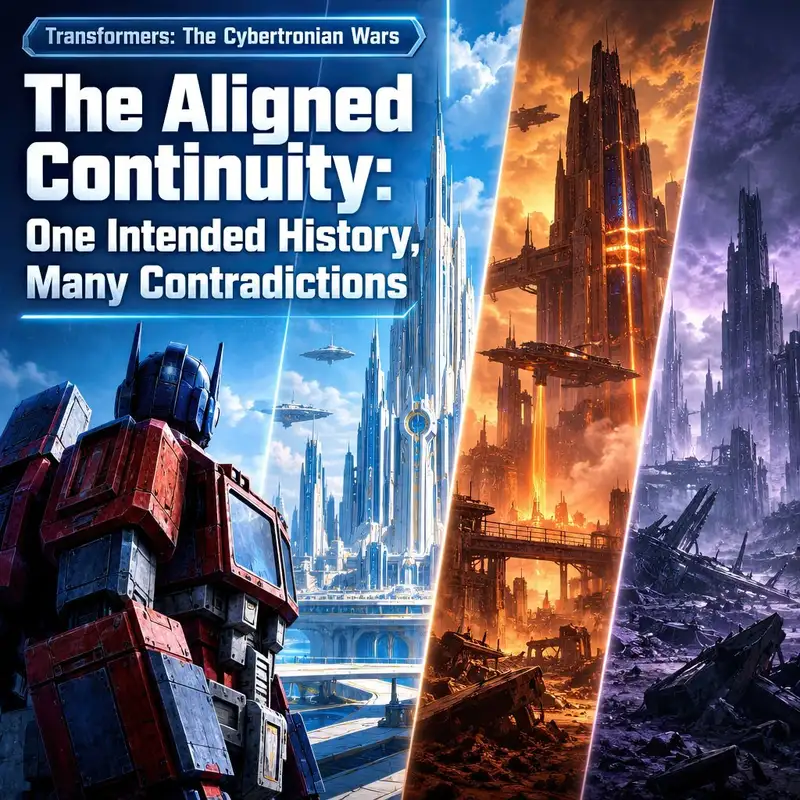
The Aligned Continuity: One Intended History, Many Contradictions
The Ark does not leave Cybertron as the victor’s flagship. In Fall of Cybertron, it departs because the war has stripped the planet of the conditions needed to sustain either victory or defeat. Cities are damaged, energy systems are failing, strategic infrastructure is contested, and the Autobots can no longer treat territory as security. The launch is an evacuation under fire. It carries soldiers, technicians, archives, and the possibility that Cybertronian society might survive somewhere beyond its homeworld.
That image became one of the clearest landmarks in the cluster now called the Aligned continuity. The war begins on Cybertron. Megatron rises as a revolutionary challenger and becomes the commander of the Decepticons. Orion Pax becomes Optimus Prime and leads the Autobots. Cybertron declines. The conflict spreads into space. Earth becomes a refuge and a battlefield. Cybertron is eventually restored, but peace proves more difficult than winning the last major campaign.
At that broad level, the alignment is real. War for Cybertron, Fall of Cybertron, the novels Exodus, Exiles, and Retribution, Transformers Prime, Predacons Rising, Rescue Bots, and Robots in Disguise from twenty fifteen all work with related premises, recurring figures, and a recognizable historical direction. Hasbro and its partners presented several of these works as connected parts of a larger story. The question is not whether that intention existed. It did.
The harder question is what kind of connection it created. Were these stories separate records of one detailed history, with every scene expected to fit beside every other scene? Or were they related interpretations built around a common set of historical milestones? The answer matters because the Aligned project is often described either as one flawless timeline or as a complete failure of continuity. Neither description is very useful.
The better model is a continuity family. It has strategic alignment, but not always narrative identity. Strategic alignment means that the stories share a broad history, major political relationships, and a sequence of defining crises. Narrative identity would mean that a mission in a game, a chapter in a novel, and a flashback in an animated series all describe precisely the same event, with the same participants, motives, equipment, and result. Aligned rarely sustains that stricter standard.
There is also a third category, production reality. These stories were made by different teams, in different media, for different audiences, and under different schedules. A video game needs combat spaces, a clear mission structure, and enough immediate action to keep the player engaged. A novel can spend time inside political institutions, private conversations, and historical memory. Television needs recurring relationships, accessible exposition, and self-contained episodes that work for viewers who may never have played a game or read a book.
That does not make the shared framework meaningless. It explains why the framework was more durable than its details. The Aligned project could tell the same long war as a military campaign, a political tragedy, a spacefaring quest, a covert conflict on Earth, a family-oriented emergency-response story, and a postwar police drama. The cost was that the borders between those accounts were never fully surveyed, marked, and defended.
The prewar crisis is the best place to see both the project’s strengths and its limits. Across the major works, Cybertron is not presented as a society that simply wakes up one morning divided between Autobots and Decepticons. It is already under pressure. Political authority is brittle. Social grievances are real. The planet’s resources and institutions are failing people who have little confidence that established leaders can solve the problem.
The novels, especially Exodus, offer the fullest account of this political world. They place Megatron’s emergence within a society that has elevated hierarchy, tradition, and formal authority while leaving many Cybertronians alienated from the system that governs them. Orion Pax is connected to archives, political legitimacy, and the older institutions of Cybertron. Megatron comes from a very different social position and turns personal grievance into a wider challenge to the existing order.
Transformers Prime presents a more selective version of that past. Its flashbacks and conversations preserve the broad relationship between Orion and Megatron without lingering over every institution that shaped them. The emphasis is less on the machinery of prewar governance and more on the personal and moral rupture between two figures who once imagined that Cybertron could change. That is compatible with the novel’s central political premise. It is not a complete duplicate of the novel’s account.
The difference is important. In Exodus, political detail is part of the engine of the story. The reader needs to understand why an established system could lose legitimacy and why Megatron’s arguments could find an audience. In Prime, the past is usually relevant because it explains a current choice, a warning, or a wound that has never healed. One medium examines the road to war. The other uses the road to explain why the war’s leaders cannot easily escape it.
Megatron’s grievance should not be dismissed merely because his later rule is brutal. A society that excludes people, restricts meaningful political participation, or allows prestige to substitute for accountability creates the conditions in which radical movements can grow. The Aligned version of Megatron is not compelling because he is correct about everything. He is compelling because he identifies failures that the old order could not or would not repair.
But a valid criticism of injustice is not a license for conquest. Megatron’s movement becomes something more than a reform campaign. It becomes an armed political organization built around his charisma, his command authority, and increasingly coercive methods. As the conflict expands, the movement’s original critique is crowded out by military necessity, factional loyalty, and the personal authority of its leader. The cause begins by challenging a system. It ends by seeking control over everyone inside it.
Orion Pax follows the opposite path, though not a simple one. His rise to the role of Optimus Prime gives the Autobots a source of legitimacy, but legitimacy is not the same as power. A title, a Matrix, or recognition from established institutions can provide moral authority. It does not automatically produce fuel, soldiers, repair facilities, secure communications, or a population willing to endure a civil war. Optimus has to turn an ideal of common survival into an actual coalition.
War for Cybertron presents this transformation from the military side. Its Cybertron is a planet of fortified cities, damaged industrial districts, contested transit routes, and escalating battles for strategic infrastructure. The game’s campaign gives the Aligned family much of its wartime vocabulary. Here, the civil war is not an abstraction. It is fought through ruined urban spaces, military installations, energy systems, and command networks that both sides need in order to continue operating.
That perspective has real historical value. It shows that a Cybertronian civil war is not only a dispute between famous leaders. It is a contest for industrial capacity. Whoever controls energon production, repair facilities, communications, transport nodes, weapons stockpiles, and defensible urban territory gains more than a tactical advantage. That side gains the ability to keep damaged personnel in the field and to replace losses faster than its enemy can.
The game also depicts the struggle over Dark Energon. For Megatron, Dark Energon is not just another weapon to add to an arsenal. It is a strategic gamble. Cybertron is under strain, and ordinary military resources are not enough to deliver the decisive advantage he wants. Dark Energon promises power, resilience, and a means to break the existing balance. It is attractive for the same reason dangerous weapons often are in a failing war: it appears to offer a shortcut around political and industrial weakness.
The cost of such shortcuts is rarely confined to the battlefield. A force that depends on an unstable or poorly understood resource becomes dependent on the people who control it, the facilities that process it, and the assumptions that made its use seem necessary. Megatron’s pursuit of Dark Energon reflects a larger pattern in his command. He seeks decisive instruments that can overcome resistance quickly, rather than institutions capable of reconciling a divided society after the fighting stops.
War for Cybertron gives us the broad outline of that military escalation. It does not give us a precise military ledger. The game’s repeated enemy formations, weapon pickups, upgrade systems, and multiplayer classes belong to gameplay. They establish the atmosphere and vocabulary of a large mechanized war, but they do not establish exact troop numbers, universal equipment standards, or the literal repetition of every encounter faced by a player.
The campaign does, however, make one point unmistakable. Cybertron is not a stable home front behind the war. It is the battlefield itself. Every damaged city, compromised energy system, and lost transit route weakens the society both factions claim to represent. The Autobots and Decepticons are not fighting over a neutral prize. They are consuming the industrial base, cultural memory, and civilian shelter on which any future Cybertron must depend.
Exodus enters much of the same historical space from another direction. It was designed to connect with War for Cybertron, and it shares major figures, political tensions, and the sense that Cybertron is moving toward catastrophe. Yet it does not read like a prose transcript of game cutscenes. It slows down where the game accelerates. It investigates institutions where the game emphasizes missions. It asks how a political argument became an armed movement and how that movement changed the people who joined it.
The result is a related but not identical record. Characterization can differ. The sequence of events can differ. The practical authority of political bodies and military leaders can be presented differently. These are not minor annoyances to be wished away with increasingly complicated fan diagrams. They reveal the different jobs each work was built to perform. A novel needs room for political causation. A military game needs momentum, objectives, and visible conflict.
The Aligned version of the war becomes more than a familiar struggle between heroic Autobots and villainous Decepticons at this point. The Autobots represent a defense of Cybertronian freedom and survival, but they are also forced to build a military coalition under extreme pressure. The Decepticons begin with an intelligible challenge to a failing order, but their answer becomes authoritarian control. Neither side can avoid the damage caused by civil war. Only one side makes domination the basis of its political future.
The contradictions between Exodus and War for Cybertron should therefore be read with some discipline. A difference in scene-level detail does not automatically destroy the shared premise. It may show that one account is concerned with political explanation while another is concerned with operational experience. But a difference also should not be buried under the claim that everything must fit somehow. The project was designed for connection, not for perfect synchronization.
Fall of Cybertron carries the game-based war into its final planetary phase. By this point, the issue is no longer whether either faction can seize a district, capture an installation, or destroy an enemy strongpoint. The question is whether Cybertron can remain a functioning strategic base at all. The war has reached the stage at which holding ground does not preserve national survival. The planet is being lost as an operating environment.
The game presents late-war escalation through exceptional military assets. Grimlock and the Dinobots undertake a distinct campaign shaped by their own wartime history. Metroplex emerges as a massive strategic resource, more than a conventional vehicle or fortification. Bruticus represents the Decepticons’ ability to concentrate destructive power through a combiner system. These assets matter because they alter the immediate battlefield. They should not be treated as proof that every Autobot or Decepticon formation possessed comparable capabilities.
Titans and combiners are difficult to sustain even when a continuity does not spell out every maintenance requirement. They require energy, command arrangements, coordination, and some form of technical support. Their presence signals desperation as much as strength. A faction turns to a city-sized defender or a combined super-heavy formation when ordinary forces cannot reliably secure the objective. The spectacle is real, but the military meaning lies in what it says about the war’s scale and exhaustion.
The Dinobots serve a similar purpose in the game’s narrative. Their campaign shows a force operating under extraordinary conditions and with methods not necessarily suited to routine command. Grimlock’s wartime role is specific to this version of the conflict. Later stories may use the same character in a different capacity, but that does not require every detail of his game history to transfer unchanged. Shared name and broad affiliation are not enough to create a single uninterrupted biography.
The decisive fact of Fall of Cybertron is not a particular duel or the survival of a particular weapon. It is the exodus. The Ark and the Nemesis convert a planetary civil war into a dispersed interstellar conflict. Ships become more valuable than territory because they carry the personnel and knowledge needed to continue the struggle. They are transport, command post, refuge, repair facility, archive, and political symbol at once.
For the Autobots, leaving Cybertron is not a clean victory over Megatron. It is an acknowledgment that the homeworld can no longer support the force needed to defend it. For the Decepticons, pursuit does not produce the stable conquest they seek. The enemy has escaped, and the prize itself is deteriorating. Both sides are displaced from the industrial system that created them. The war survives, but the society that began it is shattered.
That loss has consequences beyond fuel. Cybertron’s collapse means the loss or abandonment of repair infrastructure, skilled labor, manufacturing systems, historic archives, civilian communities, and dependable access to energon. A damaged soldier can be patched in the field, but a war cannot be sustained indefinitely without facilities that manufacture parts, stabilize the severely wounded, and train replacements. The exodus is therefore an industrial disaster as well as a military withdrawal.
It also transforms command. On Cybertron, a faction can imagine controlling cities, mines, and transportation networks. In deep space, leaders must worry about navigation, ship reliability, crew cohesion, fuel, intelligence, and the availability of secure worlds. A commander who could dominate a city through force may find that coercion alone cannot keep a dispersed fleet functioning. The logistical problem becomes inseparable from the political one.
Exiles and Retribution explore this diaspora more fully than the television series usually does. Their stories extend the search for the AllSpark, confront ancient technologies and dangerous historical inheritances, and keep the Autobot-Decepticon conflict alive beyond Cybertron. They show why exile is not merely a change of scenery. A displaced people need a destination, but they also need a reason to remain organized while moving through a hostile and uncertain galaxy.
The AllSpark becomes important in this context because it represents more than a valuable object. It is tied to the possibility of restoration, continuity, and a future beyond survival from one engagement to the next. But possession is not the same as understanding. Finding an artifact does not automatically solve the problems of transport, security, activation, political legitimacy, or reconstruction. Ancient technology can change the available options without making the hard choices disappear.
The novels deepen the strategic framework, but they should not be used as a master key that forces every later television event into a detailed novel-derived chronology. Prime does not function as a serialized adaptation of Exiles or Retribution. It inherits the broad condition of diaspora and war. It does not always preserve every route, encounter, or historical emphasis found in prose. That distinction is not an insult to either medium. It is the practical boundary of the continuity family.
Transformers Prime shifts the scale of the conflict dramatically. Cybertron has been abandoned. The vast planetary battlefields of the games are gone, at least from the daily experience of the central characters. The Autobots operate from a concealed Earth base with a small team. The Decepticons have their own hidden facilities, their own sources of intelligence, and their own efforts to exploit rare technologies. The war has become covert, dispersed, and dependent on small groups.
This shift makes strategic sense after an evacuation, even if the precise route from the game campaigns to Prime is not perfectly mapped. A force in exile cannot always mass armies or openly occupy territory. It needs concealment. It needs local fuel and repair options. It needs intelligence. It needs secure communications and mobility. It also needs allies who understand the terrain, the institutions, and the risks of operating on a populated world that did not ask to become part of an alien war.
Prime turns transformation and disguise into political as well as tactical tools. A vehicle mode can help an Autobot move through human infrastructure, avoid attention, and reach an emergency quickly. It does not make that Autobot invisible to law enforcement, intelligence services, cameras, or civilians who notice something very unusual about the vehicle parked outside their home. Concealment buys operational freedom, but it also prevents open political consent.
The Autobots’ human partners are central to this condition. They are not representatives of all humanity, and their trust is not a treaty between Earth and Cybertron. They provide local knowledge, personal loyalty, and access to human society. Their presence also reveals the limits of secrecy. A few families and officials may understand the danger, while most civilians remain unprepared for a war that could reach their town, their airspace, or their power grid with very little warning.
The Earth war in Prime is therefore not just the games reduced to a smaller animation budget. It is a different form of conflict. The games emphasize massed forces, territorial battles, and the collapse of a homeworld. Prime emphasizes relic hunts, infiltration, sabotage, intelligence failures, unstable alliances, and the danger of rare technologies. The strategic objective is not always to hold a city. It may be to deny the enemy one artifact, secure one ally, or prevent one opening that could expose Earth to a wider invasion.
Dark Energon illustrates the need for caution. In War for Cybertron, it is presented in the context of Megatron’s campaign for military advantage amid Cybertron’s collapse. In Prime, Dark Energon is bound more explicitly to Unicron and to a broader metaphysical threat. These two portrayals share a name and a general sense of dangerous power. They should not be flattened into a single technical manual with every property assumed to apply equally in both settings.
Prime also makes the war’s human consequences harder to ignore. A Cybertronian relic hidden beneath a human landscape is not just a prize for Autobots and Decepticons. It can disrupt local communities, invite government intervention, and turn civilians into targets or witnesses. The Autobots often act to protect Earth, but their presence also imports risks that Earth cannot fully evaluate because so much of the conflict remains classified or deliberately concealed.
This is a recurring problem in human-Cybertronian relations. Cooperation can be morally necessary and strategically effective without being politically complete. A small circle of human allies may make better decisions than a frightened public responding to incomplete information. Yet secrecy also creates a democratic deficit. Governments, communities, and civilians cannot prepare for hazards they are not told exist. The Autobots gain maneuver room, but Earth accepts danger without meaningful consent.
Rescue Bots offers another perspective within the same broad family. Its setting is smaller, its tone is more focused on emergency response, and its Cybertronian characters are defined by relationships with a human family and a local community. That should not be mistaken for proof that the wider Aligned world is peaceful or that the Cybertronian war has become unimportant. It is evidence that conflict affects society at more than one level.
The Rescue Bots are not a front-line army. Their role is to save lives, manage disasters, and work with local institutions. That role gives the continuity family something the games cannot provide as easily. It shows what Cybertronian presence on Earth might mean when the immediate task is not destroying an enemy stronghold but helping a town survive a fire, a storm, a collapse, or the consequences of technology beyond human experience.
This civilian scale matters. War is not only decided by commanders and rare artifacts. It is also measured in whether communities can trust the people protecting them, whether first responders can work across cultural boundaries, and whether powerful outsiders understand the obligations created by their presence. Rescue Bots does not establish the entire military or political state of Earth. It does show that coexistence requires more than battlefield victory.
Predacons Rising brings the central Prime conflict to a conclusion without pretending that every danger has vanished. Cybertron is restored, the Autobots return to their homeworld, and Megatron abandons command of the Decepticons. Those are major strategic and political developments. The return reverses the defining trauma of the exodus. Cybertronians are no longer only refugees scattered across space. They again possess a world that can serve as a home, a government center, and a base for recovery.
Restoration is not the same thing as settlement. Bringing Cybertron back online does not automatically rebuild trust, restore every lost archive, return the displaced, or resolve responsibility for the war. It does not tell former combatants who they are supposed to become when faction identity has shaped their entire adult existence. It does not determine whether prisoners receive justice, whether defectors receive amnesty, or whether civilians will accept old enemies back into public life.
Megatron’s departure is equally significant and incomplete. A leader leaving command can weaken a faction, but it does not erase the organization’s networks, symbols, veterans, ambitions, or resentments. The Decepticons are not all identical extensions of Megatron’s will. Some may remain committed to domination. Some may be criminals, opportunists, or soldiers who have nowhere else to go. Some may reject the old cause without knowing how to live outside it.
Robots in Disguise from twenty fifteen examines this postwar problem through Bumblebee’s law-enforcement mission. Its central concern is not the survival of an Autobot resistance on a dying world. It is the pursuit of Decepticon fugitives, the maintenance of public order, and the effort to prevent the old war from reappearing through dispersed threats. That is a different kind of conflict, but it follows logically from a society attempting to emerge from civil war.
Bumblebee’s role matters because it reflects an institutional shift. During the war, the Autobots are a military coalition struggling to survive. After restoration, they must become something closer to a governing and security structure. That requires rules, detention practices, investigative authority, coordination with civilians, and decisions about when former enemies are criminals, prisoners, political opponents, or possible reintegration candidates. These are difficult questions in any postwar society. Cybertronian transformation technology does not simplify them.
The larger continuity still requires discipline. Similarity establishes connection at the level the stories support. It does not compel the listener to treat every depiction as one perfectly continuous camera angle. The Ark’s departure can be a shared historical landmark. Megatron and Orion can share a prewar political relationship. Cybertron can fall, Earth can become a theater of war, and Cybertron can be restored. Those facts do not settle every disagreement over sequence, character role, or technology.
Why did these contradictions emerge? The short answer is that the project’s architecture was looser than its promotional language sometimes suggested. Public statements could establish an intended direction. They could say that a game was an origins story, that a novel connected to that game, or that a television series followed the wider history. But no public claim of alignment can substitute for the labor of maintaining one tightly synchronized record across years of production.
That labor is unusually difficult in Transformers. The franchise works through recurring names, body designs, factions, artifacts, and broad narrative roles. A creative team can recognize the value of a shared history while still needing a character to have a different vehicle mode, a different emotional emphasis, or a different role in the plot. An animation team may need a smaller cast and clear episode premises. A game studio may need a spectacular battlefield. A novelist may need a political conversation that no action sequence can provide.
This is why visual redesigns, altered flashbacks, absent characters, and scene-level differences should not be given invented in-universe explanations unless a released story actually provides one. A changed design may be a production choice. A character’s absence may reflect cast limits. A different version of an event may exist because the new story needs a different dramatic entry point. Not every discrepancy conceals a secret upgrade, memory alteration, time-travel event, or classified mission.
The same caution applies to later material that merely shares a title. The Netflix War for Cybertron Trilogy is not the High Moon game history continued under a new presentation. It is a separate animated continuity with its own war, characters, and sequence of events. Rise of the Dark Spark is likewise not a clean bridge that can merge the Aligned games with the live-action films. A crossover premise is not proof that two large continuities have become one history.
The Aligned project achieved something real, even if it did not achieve perfect harmony. It gave Transformers a reusable historical frame. It allowed Cybertron’s war to begin with political failure rather than simple villainy. It treated the fall of the planet as an industrial and humanitarian catastrophe. It turned exile into a strategic problem. It brought the conflict to Earth in forms ranging from covert operations to local emergency response. And it recognized that restoration would create a policing and reconstruction problem rather than a simple ending.
The Ark leaving Cybertron remains the clearest symbol of that achievement. Every major Aligned account does not agree on the exact road to that launch, the exact command structure behind it, or every event that followed. But they understand what it means. A civilization has allowed its political crisis to become a war so destructive that survival requires abandoning the world both sides claimed to save.
That is why Aligned should be read as a family of related historical accounts rather than a single flawless archive. Its games provide the experience of planetary war and evacuation. Its novels provide political depth and interstellar consequence. Prime turns the diaspora into a covert Earth conflict. Rescue Bots reveals the civilian obligations of life among humans. Predacons Rising restores the homeworld, and Robots in Disguise tests whether victory can become public order.
The contradictions do not prove that the connection was empty. They show what the project chose to prioritize. Aligned favored a shared framework broad enough to support several kinds of Transformers story over strict synchronization of every scene, body, flashback, and technical rule. Its Cybertronian war could therefore be told as battlefield epic, revolutionary tragedy, refugee odyssey, intelligence conflict, emergency-response drama, and postwar reconstruction story, all connected by the same ambition and separated by the limits of the records that ambition produced.