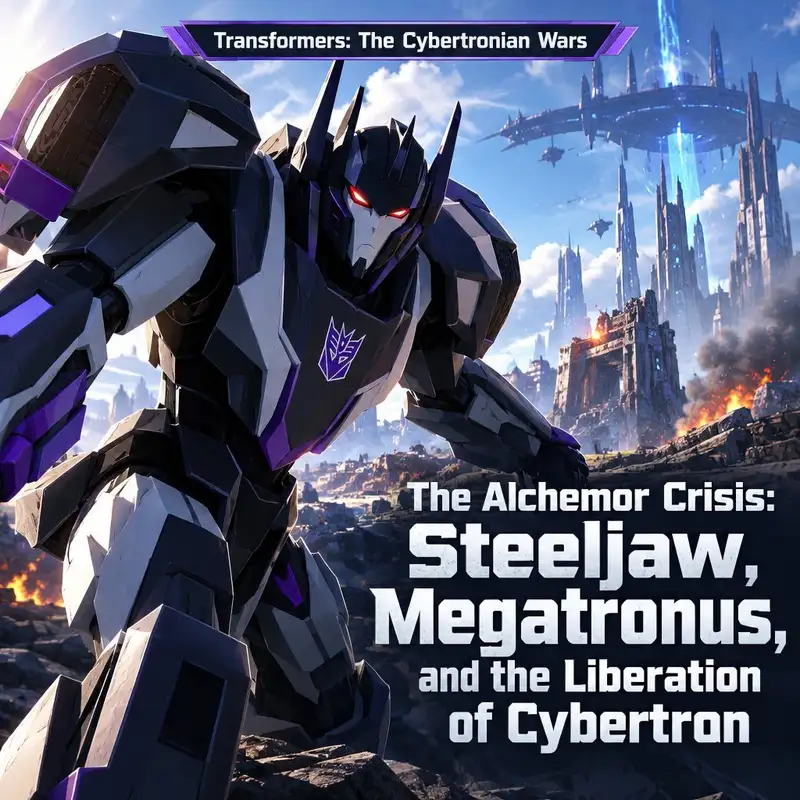
The Alchemor Crisis: Steeljaw, Megatronus, and the Liberation of Cybertron
At Crown City, the immediate problem appeared to be three captured Autobots and a criminal gang with access to construction materials. Sideswipe, Strongarm, and Windblade were chained to the Crown City Colossus while Steeljaw’s pack assembled a towering metal arch beneath them. The monument was human, not Cybertronian, and it had no military purpose of its own. Yet it had become the center of a battlefield because Steeljaw believed the structure would open a future for his followers.
That future was a lie. Steeljaw thought he was building the entrance to a Decepticon homeland on Earth. The being who directed him intended to use the gateway for something much larger and much more destructive. The promised refuge was not meant to be governed. It was meant to become part of the wreckage.
This is the crisis depicted in the English-language Transformers: Robots in Disguise series from twenty fifteen, part of the Aligned continuity family and set after Cybertron’s restoration. It is not the history of the two thousand one Robots in Disguise series, and its Megatronus is not the same figure as similarly named characters in other Transformers stories. Here, the danger emerged during a nominally prosperous postwar period, when Cybertron had survived a terrible conflict but had not necessarily solved every political problem that conflict left behind.
The title calls this a liberation of Cybertron, but that description requires caution. Cybertron was not occupied during the Alchemor crisis, and it did not need to be liberated in the literal military sense. The real struggle concerned who could claim to speak for Cybertronian freedom after the war. Steeljaw presented Earth as a place where Decepticons could escape prison, establish control, and build a future beyond Autobot authority. Megatronus turned that language of refuge into cover for a plan that would destroy both Earth and Cybertron.
The scale of the threat did not come from Steeljaw commanding a conventional army. He did not. It came from the collision of three failures. First, a postwar prisoner system broke apart far from Cybertron. Second, Steeljaw transformed a fugitive network into a small separatist movement. Third, Megatronus exploited Steeljaw’s limited ambitions through deception so complete that the pack leader did not understand the operation he was helping to build.
The first failure began with the Alchemor, a maximum-security prison transport carrying Decepticon prisoners in stasis. The ship crashed on Earth, releasing what the series describes only in broad terms as a couple hundred fugitives. That estimate should not be read as a precise census. The important fact is that the escape was large enough to overwhelm the small Autobot team sent to manage it, while still remaining too dispersed and disorganized to become a single coherent force.
Before the crash, the Alchemor concentrated several essential functions in one mobile system. It held prisoners, monitored them, transported them, and provided the technical structure through which their custody could be managed. Once the ship was stranded and damaged, that centralized system became an improvised base. Its cells, records, sensors, and communications remained useful, but they no longer provided secure planetary detention. Earth became the place where the prison population had escaped, not the place designed to contain it.
That changed the mission immediately. The Autobots were no longer escorting prisoners between established facilities. They were conducting a dispersed recovery operation on an unfamiliar world. Every escaped Decepticon could seek cover, acquire a local disguise, recruit allies, exploit human infrastructure, or simply disappear into the vastness of a populated planet. The problem was not just finding fugitives. It was determining which fugitives were dangerous, which could organize others, and which had found a purpose beyond personal escape.
The series establishes that Cybertron had been restored to life and had entered a new age of prosperity. What it does not establish is a detailed postwar settlement. We are not shown a full system of Decepticon political reintegration, rehabilitation, amnesty, transparent detention review, or civilian reconciliation. That absence does not prove that none of those things existed. It does mean the Alchemor appears to represent one visible answer to the postwar problem of dangerous Decepticons: incarceration and transport.
Incarceration did not cause every later danger. Most prisoners do not become the servants of an ancient force bent on planetary destruction. But the Alchemor’s failure created vulnerability. It scattered people already defined by the postwar order as threats, placed them on a strategically valuable planet, and forced a small Autobot team to manage a mass-security problem without a larger Earth-Cybertronian institution behind it.
Bumblebee became the practical commander of that emergency. His team included Strongarm, a by-the-book cadet with a strong commitment to law and procedure, Sideswipe, whose confidence sometimes exceeded his caution, Fixit, the Alchemor’s Mini-Con steward, and Grimlock, a powerful but often difficult ally. They operated from Denny Clay’s scrapyard, supported by Denny and his son Russell. It was a capable team, but it was not a full occupation force, a planetary police service, or a properly resourced prison-recovery command.
Their original mission had clear limits. They were to protect civilians, locate escaped prisoners, and return those prisoners to the damaged Alchemor. The work demanded surveillance, pursuit, restraint, repair, and concealment. It also demanded judgment. A fugitive could be an immediate threat, an opportunist, a frightened escapee, or someone with a plan for power. Treating all of them as identical would have been operationally convenient, but strategically unwise.
Fixit was central to this work. His damaged wiring and anxious personality often gave the team’s daily life a comic edge, but his institutional role was serious. He was the surviving steward of the prison system, the keeper of records, the operator of damaged systems, and a crucial source of technical knowledge. Without Fixit, Bumblebee’s team would have had far less ability to identify prisoners, track threats, or make use of the Alchemor at all.
Denny and Russell mattered for a different reason. They provided local knowledge, shelter, practical assistance, and a human perspective on the danger spreading through their community. But they were not representatives of the United States government, nor were they evidence of a formal alliance between humanity and Cybertron. Their support was personal and improvised. The difference matters because personal trust can sustain a small team, but it cannot substitute for public policy when a crisis reaches an entire city.
Among the escaped prisoners, Steeljaw understood that a mass escape could be more than a chance to flee. He had been imprisoned after attempting to incite rebellion. That history gave him a political vocabulary. He could speak of Decepticon freedom, grievance, and escape from Autobot control. He could also offer fellow fugitives something practical: protection through association, access to stolen resources, and a leader willing to challenge the authorities who had confined them.
Steeljaw’s ambition, however, was not a completed political program. He wanted Earth to become a Decepticon refuge, and eventually a territory under Decepticon control. The distinction between refuge and dominion is important. A refuge implies security for a displaced population. Dominion implies command over land, resources, and the people already living there. Steeljaw’s language could suggest liberation to those who felt excluded, but his methods pointed toward coercive rule.
His pack was not a government in exile. It was not a Cybertronian legislature, a military formation, or a movement with a demonstrated mandate from the people of Cybertron. It was a loose coalition of fugitives, criminals, opportunists, and followers bound together by immediate interests. Such a force could raid facilities, intimidate civilians, seize hostages, and disrupt local security. It could not easily build durable institutions, resolve internal rivalries, or defend a political claim against a stronger enemy.
That did not make Steeljaw harmless. Small armed groups can create strategic effects when they choose the right target, exploit a weak system, or gain access to information that larger organizations overlook. Steeljaw’s force did not need to conquer Cybertron. It only needed to create the conditions for someone else to threaten it.
Steeljaw’s weakness was not simply a shortage of firepower. It was a shortage of intelligence. He believed he had found a powerful patron who would reward his work. In reality, he had accepted direction from an actor whose objectives were hidden from him. The arrangement was built on secrecy from the beginning.
In the episode called Lockout, Steeljaw receives contact from a mysterious figure who calls himself the First Decepticon. The voice tells Steeljaw that the Alchemor crash has created an opportunity. A potential collaborator is now available on Earth, and Steeljaw is ordered to construct a gateway. In exchange, he is promised authority over the planet and over the freed Decepticons who would live there.
For Steeljaw, this was an attractive bargain. He lacked legitimacy, heavy industry, and a secure base. The First Decepticon appeared to offer all three in concentrated form. The promise transformed Steeljaw from the leader of a pack into the possible founder of a Decepticon state. It also appealed to the resentment already present among fugitives who had every reason to distrust the system that imprisoned them.
But the bargain depended on compartmentalized knowledge. Steeljaw knew the political reward he was being offered. He did not know the strategic end state. He understood that a gateway would bring power to Earth. He did not understand that the arriving power had no intention of preserving Earth as a place worth ruling.
This does not make Steeljaw innocent. He was prepared to seize a human world without consent, to use criminal force against those who opposed him, and to build a hierarchy centered on his own authority. Yet he was not the architect of the two-world destruction plan. His responsibility lies in accepting coercive power and pursuing territorial control. Megatronus’s responsibility lies in designing the larger betrayal and concealing it until resistance became difficult.
The gateway also demonstrates a basic truth of Cybertronian warfare. Even an extradimensional threat needs logistics. Megatronus could not just will himself into the physical universe without assistance. Steeljaw’s pack had to gather electronics, metal, labor, and a site where construction could proceed. The project required theft from Earth’s industrial environment, including material taken from a steel mill.
The metal mattered because the gateway needed a massive anchor capable of dissipating the energy involved in Megatronus’s transition from confinement into the material universe. The exact engineering is not explained, and there is no reason to invent it. What the story establishes is enough. Megatronus needed substantial physical infrastructure. Steeljaw’s followers had to build it. And their ability to do so rested on access to Earth’s industry.
This was not ordinary portal travel. The gateway was a singular, purpose-built system built for one strategic purpose. Its existence does not mean every Decepticon, Autobot, or escaped prisoner could open an interdimensional route at will. It was difficult enough to require a dedicated construction effort, specialized knowledge held by Megatronus, and an anchor assembled through repeated raids.
That dependence on local material created an opportunity for the defenders. A threat that must steal components can be tracked. A force that requires a construction site can be disrupted. A gateway that needs an anchor can be destroyed. Yet those opportunities only matter if the defenders understand what the enemy is building before the final system is activated. In this case, Steeljaw’s compartmentalized operation concealed the purpose of the construction long enough for the plan to advance.
By the time the confrontation moved to Crown City, Steeljaw had shifted from raiding to open coercion. He captured Sideswipe, Strongarm, and Windblade and chained them to the Crown City Colossus. Hostage-taking served more than one purpose. It delayed the Autobots, restricted their ability to interfere with the gateway, and demonstrated that Steeljaw could control the immediate battlefield through fear.
The choice of the Colossus was tactically useful precisely because it was not a military asset. It was a large human monument in a visible civic space. The prisoners could be restrained there, the gateway could be built nearby, and the enemy could force the Autobots to choose between immediate rescue and stopping the larger operation. Later, the monument would become a weapon against Megatronus, but at this stage it was simply terrain seized by the attackers.
Crown City’s civilians faced a danger they could neither identify nor understand. They were not trained for Cybertronian prisoner recovery operations, extradimensional incursions, or fights between beings large enough to turn public landmarks into battlefield tools. The response was improvised. Denny and Russell attempted to move people away by presenting the chaos as an out-of-control film production.
It was an inventive cover story, and it may have reduced immediate panic. It was not a mature civilian-protection doctrine. It depended on local trust, speed, and the hope that people would leave before asking too many questions. The episode presents an emergency managed by a small group of Autobots and civilians, not by a fully prepared public authority with evacuation plans, clear jurisdiction, or established methods for explaining alien combat in a crowded city.
Bumblebee’s command problem had now exceeded the scale of his original assignment. He had begun with a fugitive recovery mission. He now faced hostages, a hostile construction project, a civilian population at risk, and an enemy whose true nature was only beginning to emerge. At the same time, another commander was confronting a separate test of readiness far from Earth.
Optimus Prime was in the Realm of the Primes, undergoing training after his return. His position carried immense symbolic weight. Optimus represented historical continuity, moral authority, and the memory of the war that had preceded Cybertron’s restoration. But the Primes did not treat that authority as proof that he was ready for every new crisis. They judged his preparation incomplete.
That judgment matters. A leader’s past accomplishments do not automatically solve a present emergency. Optimus had experience, power, and the legitimacy associated with being a Prime. Bumblebee had current knowledge of the Earth theater, familiarity with the fugitives, and responsibility for the people already under threat. The difference was not a personal rivalry. It was a command problem common to postwar institutions: how to combine senior authority with local expertise without reducing either to ceremony.
The Primes chose to send Optimus back because the situation had become immediate. They granted him additional power, but they also made clear that this was dangerous and exceptional. It should not be understood as a repeatable force-generation program. Cybertron had not discovered a way to turn every soldier into a Prime-level combatant. The power was tied to Optimus’s training, his connection to the Primes, and an emergency that could not wait for ideal preparation.
Optimus’s arrival gave the defenders a chance to strike the gateway directly. He destroyed the structure, but the timing was wrong. The gateway had already served its essential function. Megatronus crossed into the physical universe before its destruction could prevent his arrival.
That was the crisis’s central operational turning point. Until then, the conflict had been a struggle against escaped prisoners and a separatist gang. After Megatronus arrived, the defenders faced a uniquely powerful hostile actor with a plan extending far beyond Crown City. The category of war changed. Prison recovery and local counterinsurgency gave way to emergency planetary defense.
Fixit identified the newcomer as Megatronus, one of the original Thirteen Primes in this continuity’s relevant account of ancient Cybertronian history. He had turned against the others and had killed Solus Prime. The series also makes a distinction that is easy to blur if one carries assumptions from other Transformers histories. Megatronus was not Megatron. Megatron took his name from Megatronus. The shared name signified influence and historical resonance, not personal identity.
Megatronus’s authority did not come from a Decepticon government, an elected mandate, or a functioning military command. He called himself the First Decepticon, but his actual power rested on ancient status, personal force, and the ability to intimidate or manipulate those around him. He did not arrive to lead Steeljaw’s movement toward a better future. He arrived to use that movement as disposable infrastructure.
The true objective centered on the Spark Fuser. Megatronus intended to use this device to draw the remnants of Unicron’s Anti-Spark from Earth’s core while summoning the AllSpark from Cybertron. The story does not provide a complete cosmological engineering explanation for these energies, and none is needed to understand the strategic danger. Megatronus intended to merge them. The result would destroy both Earth and Cybertron.
On the battlefield, the Spark Fuser was a device located in and around Crown City. Across the operation, it allowed Megatronus to control the flow of forces and energy at a decisive point. At the largest scale, it threatened the destruction of two worlds. The human population of Earth and the restored civilization of Cybertron would both lose the foundations on which any political future depended.
For Megatronus, this was revenge elevated beyond conquest. Conquest requires a population, territory, industry, and an order worth controlling. Megatronus sought annihilation. He did not need a functioning Decepticon society afterward. He did not need Steeljaw’s pack to govern. He needed them only long enough to build the gateway and secure the conditions for his operation.
Steeljaw finally understood the scale of the deception when Megatronus explained what the Spark Fuser would do. His objection was not a sudden conversion to the defense of Earth’s civilians. He had wanted the planet for himself. But he recognized that control over a dead world was meaningless. A territory with no population, no functioning infrastructure, and no future cannot fulfill the political ambition that drove his rebellion.
Megatronus’s answer exposed the nature of the bargain. He had technically promised Steeljaw control of Earth. He had simply withheld the fact that almost nothing would remain to control. This was authoritarian literalism at its most destructive. The subordinate receives the words of a promise while the superior reserves the right to define what those words are worth.
The exchange also shows why Steeljaw’s movement was so vulnerable. It had no independent intelligence structure capable of evaluating its patron. It had no institutional process for challenging a leader’s secret commitments. It had no strategic depth beyond Steeljaw’s personal confidence. A pack held together by coercion and immediate reward can be dangerous, but it is easily manipulated by someone who offers greater power and keeps the real plan hidden.
The Autobots initially tried the most direct answer available: fight Megatronus and stop him by force. That approach failed. Megatronus possessed armor, strength, energy manipulation, and telekinetic ability that exceeded the conventional capacity of the assembled team. The failure was not proof that the Autobots lacked courage. It was proof that courage is not a substitute for a workable method.
The immediate battlefield did not favor them. The enemy had already established the site, activated the strategic device, and demonstrated the ability to overpower individual defenders. The Autobots needed to do more than damage Megatronus. They had to separate him from the mechanism that made the broader plan possible. Destroying the attacker without stopping the Spark Fuser would leave the central danger unresolved. Stopping the device without containing Megatronus could leave him free to rebuild or retaliate.
Under that pressure, Bumblebee, Sideswipe, and Strongarm discovered that their Decepticon Hunters could combine into a more powerful weapon configuration. This was battlefield adaptation, not the application of a mature doctrine. The team did not arrive at Crown City with a standardized combined-weapons plan, trained units, or a warehouse full of interchangeable systems. The capability depended on particular personnel, particular equipment, and the urgent need to find an answer before the crisis became irreversible.
That distinction prevents the victory from becoming a simplistic technological lesson. The combined Hunters were effective because the right people recognized a possibility and used it at the right moment. They were not evidence that every Autobot force possessed the same capability. Exceptional equipment can save a battle without solving the larger institutional problems that created the battle in the first place.
The defenders’ solution required two linked actions. First, the Spark Fuser had to be destroyed before it completed the merger of the AllSpark and the Anti-Spark. Second, Megatronus had to be immobilized long enough for the Autobots to concentrate their newly discovered firepower. The plan worked because it connected tactical action to strategic necessity. The enemy’s body and the enemy’s mechanism had to be treated as separate but related targets.
Optimus destroyed the Spark Fuser before the two energies could merge. The AllSpark and Anti-Spark returned to their respective locations. Earth and Cybertron were not saved by a general victory over every escaped Decepticon, nor by a sweeping political settlement. They were saved because the one device capable of completing Megatronus’s plan was disabled before it could produce its intended result.
Megatronus still had to be stopped. Here the Crown City Colossus, initially a site of humiliation and restraint for the captured Autobots, became a tactical instrument against the attacker. The defenders used the monument to immobilize him. Then the combined Decepticon Hunter energy was directed against the trapped Megatronus.
The immediate result was decisive. Megatronus’s physical form was destroyed, and his energy signature disappeared. The episode presents that as the end of the battle. It does not provide a wider, permanent metaphysical ruling applicable to every version of Megatronus, every Prime, or every ancient Cybertronian being in the franchise. The reliable conclusion is narrower. The threat he represented at Crown City was defeated, and his plan to destroy Earth and Cybertron was stopped.
Steeljaw escaped the final confrontation. Other members of his pack were apprehended, but their leader remained at large. That outcome matters because it preserves the distinction between defeating Megatronus and resolving the Alchemor crisis. The ancient adversary’s plot had been eliminated. The underlying fugitive problem had not. Steeljaw’s escape meant that Decepticon separatist ambition, criminal organization, and resentment toward the postwar order remained active dangers.
The Alchemor itself was too damaged to return to service. That left a practical consequence often overshadowed by the planetary stakes. The original detention and transport system could not simply resume its mission as though the crisis had been an interruption. The Autobots still faced escaped prisoners, damaged infrastructure, and the challenge of managing security on Earth without an easy path back to the system that had failed.
The command consequences were equally important. Bumblebee had led through a crisis far beyond his original assignment. He coordinated a team of Autobots with different strengths and temperaments, relied on Fixit’s technical knowledge, worked with civilian allies, responded to hostage-taking, and adapted when the enemy’s plan changed. He did not do this alone, and the arrival of Optimus was essential. But Bumblebee’s leadership was no longer provisional simply because he was not Optimus Prime.
Optimus recognized that fact. Rather than resume direct control and reduce Bumblebee to a subordinate, he chose to remain as an equal. This was not a rejection of Optimus’s authority. It was a recognition that postwar leadership cannot rest solely on restored titles or memories of earlier command. Experience in the current theater matters. Trust has to be earned in the conditions where people are actually fighting, protecting civilians, and making decisions with incomplete information.
That choice also offered a better answer to the weakness that had enabled Steeljaw. Steeljaw’s movement depended on personal domination. Megatronus’s plan depended on secrecy and manipulation. Bumblebee’s team survived because it could share responsibility, adapt across differences, and allow authority to become more distributed when the situation demanded it. The team was imperfect, improvised, and often under-resourced, but it was not built around one leader’s private ambition.
The Alchemor crisis was therefore not the liberation of Cybertron. It was a warning about an unfinished peace. Steeljaw’s demand for a Decepticon homeland exposed a real postwar question of belonging, but his pack had neither the mandate nor the institutions to answer it. Megatronus exploited that weakness, turning the language of refuge into a cover for annihilation. Earth and Cybertron survived because Bumblebee’s improvised command adapted quickly, Optimus accepted partnership rather than the simple restoration of old hierarchy, and the attackers’ hidden objective was exposed before it became irreversible.