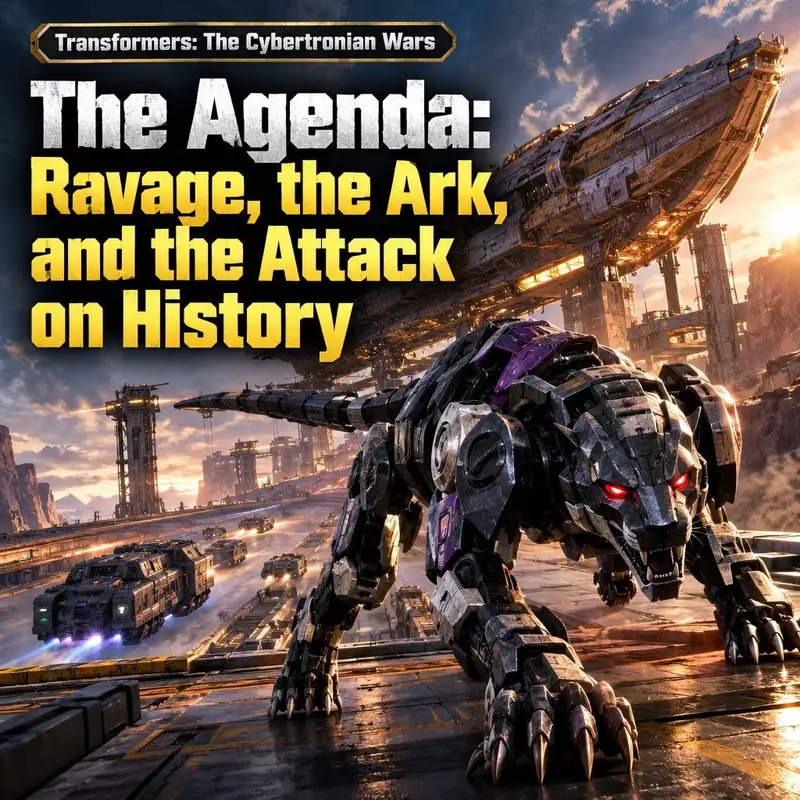
The Agenda: Ravage, the Ark, and the Attack on History
A Maximal begins to disappear. Not fall, not shut down, not suffer battle damage. The edges of his body lose definition as if the world itself has decided he no longer belongs in it. Across prehistoric Earth, the future is coming apart because, deep inside a buried starship, Megatron has fired on the dormant head of Optimus Prime.
The target is not Optimus Primal, the Maximal commander fighting Megatron in the present. It is the original Optimus Prime, preserved within the Ark for roughly four million years before his awakening on Earth. Megatron’s shot is therefore not an ordinary assassination. It is an attack on the event chain that produced the political world of Maximals and Predacons.
The temporal storm that follows is never given a clean scientific explanation. Beast Wars shows the effect rather than pretending to supply a complete theory. The Maximals begin to fade because the history that led to their existence is being damaged at one of its decisive points. More important, Megatron has found a way to turn a small, stranded conflict on prehistoric Earth into a campaign against history itself.
That transformation did not come from superior numbers. Megatron’s Predacons are a small force, separated from one another, operating from damaged positions, and dependent on limited energon. Their war against Optimus Primal’s Maximals has been shaped by survival, local resources, alien technology, and the constant problem of being marooned far from Cybertron.
Megatron’s real advantage is that he arrived with a plan concealed inside the Golden Disk. The plan required a route through time, an old Decepticon secret, access to the Ark, and someone who could be persuaded to place an unfinished war above his present allegiance. That someone was Ravage.
In this North American Beast Wars history, the Maximals and Predacons inherit a future shaped by an earlier Autobot-Decepticon war. They are more than Autobots and Decepticons with different body styles. They belong to later political orders, with their own institutions, loyalties, and assumptions about a peace established after the old war ended.
Optimus Primal commands a Maximal exploration force aboard the Axalon. Megatron commands Predacons who intercepted that mission while pursuing the Golden Disk, an artifact carrying information of exceptional value. Their chase through transwarp space stranded both forces on prehistoric Earth. The result is a frontier war fought far from reinforcement, formal government, and dependable supply.
The Axalon and the Darksyde are not functioning capitals or secure military bases. They are damaged vessels supporting small groups of Cybertronians in an unfamiliar environment. Their commanders can improvise repairs, conduct raids, and exploit local terrain, but neither side can simply request a fleet, replenish a depot, or rotate exhausted personnel home.
Energon remains a constant constraint. It powers bodies, weapons, systems, and transportation. Finding it matters, but securing and refining it matters more. A hidden energon source can sustain a raiding force for a short period without solving its long-term military position. The difference between a cache and a supply system is the difference between surviving a week and holding a war.
By the end of the second season, both sides have also learned that prehistoric Earth contains more than energon. Alien devices, transwarp phenomena, and the Golden Disk itself suggest that this world is connected to much larger historical forces. The planet is more than an inconvenient place to be stranded. It is a battlefield positioned near the foundations of Cybertronian history.
When alien technology is destroyed, it produces a transwarp wave powerful enough to be noticed across immense distance and time. Rhinox detects the signal and sees a possibility. The Maximals have spent much of the war trying to survive and eventually return home. A transwarp event might provide the opening they need.
That is the Maximal reading of the signal. It is a mobility problem, perhaps a route out of exile. Megatron sees something else. He has never treated the Golden Disk as a simple navigation aid or a source of tactical intelligence. He sees it as a weapon against the settlement that defines the future.
The transwarp wave also reaches Cybertron. There, the response comes not from an Autobot government or a distant Maximal expedition, but from the Tripredacus Council, a Predacon authority within the future political order. Its reaction matters because it demonstrates that Megatron is not acting as the accepted voice of Predacon society.
The Council regards him as a dangerous rogue. It does not celebrate his campaign as a renewed liberation struggle. It moves to contain him. The Council destroys a satellite that might allow Maximal authorities to trace the signal, then dispatches an operative through transwarp space to apprehend Megatron before the incident becomes a larger political crisis.
That choice reveals a great deal about the postwar order. The Pax Cybertronia, the peace enforced after the Great War, is more than an absence of fighting. It has intelligence systems, covert enforcement, jurisdictional boundaries, and officials prepared to act outside public view. The future Predacon establishment is not an underground remnant waiting for Megatron to lead it. It is an institution trying to stop him.
The operative it sends is Ravage. His arrival carries the weight of an older war. Ravage is a former Decepticon, a veteran of the conflict that ended with the Autobots’ victory. In the later order, he has been rebuilt and reprogrammed as a Predacon agent working for the Tripredacus Council.
The series does not fully explain what that rebuilding and reprogramming meant to Ravage’s inner life. It does not establish whether he accepted the process, resisted it, or came to identify genuinely with his new role. What it does establish is that his formal authority now comes from the Predacon Alliance, while his past belongs to the Decepticon cause.
That makes Ravage an unusually risky choice for the mission. He is experienced, capable, and clearly trusted with sensitive work. But he is also living evidence that political settlements do not erase memory. A state can change symbols, restructure institutions, and place former enemies in new uniforms. It cannot assume that the old loyalties have vanished merely because they are no longer officially useful.
Ravage reaches prehistoric Earth aboard a transwarp cruiser. The ship changes the local balance of power immediately. It provides long-range mobility, surveillance, detention space, and heavy fire support. Against the damaged Axalon and the scattered Predacon force, it is not just another vehicle. It is a mobile command platform.
Its presence also exposes the difference between tactical strength and strategic security. A cruiser can arrive suddenly, deliver troops, threaten a base, and carry prisoners away. But it still requires energon, functioning weapons, internal security, and a commander who understands the conflict he has entered. Ravage arrives with powerful equipment and incomplete intelligence.
At first, he appears to succeed. Ravage cooperates with the Maximals, helps capture Megatron, and scatters the Predacon force. The immediate result is striking. Megatron, who has spent the Beast Wars directing raids and manipulating subordinates from the Darksyde, is now a prisoner aboard an enemy ship.
Tactically, this is a Maximal victory. Their most dangerous opponent has been removed from the field. Operationally, however, the situation has become more complicated. Ravage is neither a Maximal subordinate nor a local ally committed to Optimus Primal’s command. He is an agent of another government with his own mandate, his own ship, and his own view of the law.
Politically, the capture is even more ambiguous. Ravage is enforcing the Pax Cybertronia, but the Council’s effort to seize Megatron does not resolve the questions that made him dangerous. It merely assumes that a fugitive can be removed from the battlefield before his political project takes shape.
Megatron understands that he cannot overpower Ravage in a straightforward contest. He is confined, guarded, and separated from much of his force. So he uses the weakness that exists inside Ravage’s apparent strength. The cruiser is running short of energon, and its available supply includes unstable energon that can become a danger if mishandled.
This is more than a prison-break trick. It is a lesson in sustainment. A warship may carry formidable weapons, but when energy reserves are low, every choice becomes constrained. The crew must decide whether to power defenses, weapons, propulsion, life-supporting systems, or containment measures. A shortage turns technical management into command pressure.
Megatron exploits that pressure by converting information into leverage. Ravage knows that the Golden Disk matters, but he does not know why it matters as much as Megatron does. He knows his arrest mandate. He knows the rogue Predacon leader is dangerous. What he does not understand is that the disk contains a message directed toward exactly the kind of former Decepticon he used to be.
Megatron’s bargaining position rests on asymmetry. Ravage possesses a prison, a cruiser, and legal authority. Megatron possesses the secret. In an intelligence contest, the more heavily armed side does not always hold the decisive advantage. It may simply have more machinery with which to protect the wrong assumption.
The cruiser’s problems are compounded by the concentration of its systems. Its fuel, weapons, internal security, and command functions all depend on a limited platform. That does not make it useless. It makes it vulnerable to sabotage, overload, and miscalculation. A powerful asset can become a liability when the campaign depends too heavily on one ship and one chain of decisions.
Megatron then reveals the deeper purpose of the Golden Disk. The disk contains information about prehistoric Earth, but it also carries a secret message from the original Decepticon leader, the earlier Megatron of the Great War. The Beast Wars Megatron has not merely stolen a valuable artifact. He has inherited a contingency plan from a defeated political tradition.
This is an important distinction. The message does not make every earlier Autobot-Decepticon story automatically part of one seamless record. Beast Wars presents its own inherited version of the old war. Within that history, the original Megatron anticipated defeat and prepared a means by which future Decepticons might reach the distant past and alter the outcome.
The message is aimed at an imagined future audience. If the Decepticon cause failed, if the Autobots prevailed, and if the political order that followed excluded or subordinated Decepticon successors, then someone might use transwarp technology to intervene before the decisive history was fixed. It is less a battlefield order than a delayed political weapon.
Megatron’s claim is clear. The Autobots won the Great War. Maximals inherited the dominant position in the peace that followed. Predacons, in his account, live beneath an order built by the victors. His plan is not to negotiate better terms within that order. It is to destroy the historical event that made the order possible.
The trilogy supports the existence of Predacon subordination and Megatron’s hostility toward it. It provides no complete social history of every Predacon, every Maximal, or every postwar institution. We should not turn his speech into proof that all Predacons experienced the same conditions or shared his conclusions. A grievance can be real without making every proposed remedy wise, just, or survivable.
Megatron’s proposal is radical because it does not seek power in the present. It seeks to deny the legitimacy of the present by changing the past. If Optimus Prime dies before awakening, then perhaps the Autobot victory never occurs. If that victory never occurs, then perhaps the Maximal order never emerges. The word perhaps is doing a great deal of work.
Time travel offers no guarantee that the beneficiaries of a changed history will remain the people who initiated the change. Megatron speaks as though an Autobot defeat will naturally produce a Predacon triumph. The evidence does not establish that. A Decepticon victory might produce another dictatorship, another civil war, a shattered Cybertron, or a future in which neither Megatron nor Ravage exists.
That uncertainty is the central recklessness of the Agenda. Megatron understands the political importance of history. He does not demonstrate that he understands the full consequences of rewriting it. He knows how to identify a historical pivot. He cannot know with confidence what institutions, populations, identities, and loyalties will survive the alteration.
Ravage hears the recording of his former commander, and the arrest operation begins to collapse. He does more than decide that the Beast Wars Megatron is personally more impressive than the Tripredacus Council. His response is rooted in the older Decepticon cause and the voice that once commanded his loyalty.
Ravage defects to an unfinished war, not merely to a new commander. The Beast Wars Megatron offers him a bridge between his present role and his former identity. The Council believed that rebuilding and reprogramming had placed Ravage safely inside the Predacon state. Megatron proves that buried political memory can become operationally decisive when it finds a practical means of expression.
The irony is sharp. The Council sends a former Decepticon to arrest a rogue invoking Decepticon history. The mission thereby delivers to Megatron exactly the kind of experienced agent, advanced transport, and inherited loyalty his plan requires. The state’s containment operation becomes a force multiplier for the threat it was designed to eliminate.
The Pax Cybertronia appears durable until the past becomes actionable. Ravage has lived in the peace, served its institutions, and carried out its orders. But the old Decepticon command structure still possesses emotional and political force. Peace has not erased the war. It has stored the war in archives, bodies, memories, and unresolved grievances.
Once Ravage frees Megatron, the local conflict becomes far more dangerous. Ravage brings firepower and transport. Megatron brings strategic intent. Neither asset alone would have been enough. Megatron’s original force lacked the reach to execute the plan quickly. Ravage’s cruiser lacked a reason to abandon its official mission. Together, they create a temporary coalition around an old promise.
That coalition is never as stable as it appears. Ravage’s loyalty is to the older Decepticon cause, not necessarily to every ambition of the Beast Wars Megatron. Megatron is using the legacy of the original Decepticon leader, but he is also pursuing authority for himself. The difference may not matter in the moment of defection. It matters if the campaign succeeds and someone must govern the future it creates.
Another participant further complicates the picture. Tarantulas operates within Megatron’s organization, but he is not safely understood as a loyal subordinate. During this trilogy, his connection to the Predacon Secret Police becomes visible. That connection explains some of his access and his clandestine role, but it does not fully reveal his long-term aims.
Tarantulas is useful because he possesses technical skill, secrecy, and a willingness to work outside ordinary command relationships. He is dangerous for the same reason. Megatron can employ him, but cannot treat him as a simple instrument. Ravage, meanwhile, is a defector motivated by old allegiance. Tarantulas is a covert actor whose allegiance remains partly obscured. Their roles should not be collapsed into one generic category of villainy.
The campaign also depends on Blackarachnia and Silverbolt, who are pursuing a different set of priorities. Their relationship is personal and politically awkward. Silverbolt, a Maximal, sees moral possibility in Blackarachnia despite her Predacon status. Blackarachnia, more practical and less trusting, sees both risk and leverage in the connection.
At this point, Blackarachnia has not completed a clear ideological defection to the Maximals. Her actions are shaped by survival, independence, concern for Silverbolt, and the desire to avoid being crushed by stronger players. That makes her important. In fragmented wars, individuals do not need to become saints or loyal converts to alter the strategic situation. They only need to control information someone else requires.
Blackarachnia and Silverbolt discover the buried Ark beneath a volcanic mountain. The location is familiar in broad outline to viewers who know the earlier Earth war, but the episode does not need a precise geographic label to establish its importance. More important, the Ark is here, dormant beneath the surface, carrying the future inside it.
The Ark is more than a relic. It is a crashed military vessel containing dormant Autobots and Decepticons, including the original Optimus Prime. In the historical sequence inherited by the Beast Wars, these occupants will eventually awaken and begin the Earth phase of the Great War. Their survival is therefore part of the chain that leads toward the later Maximal-Predacon age.
This makes the Ark a historical chokepoint. A chokepoint is not always a narrow road, a bridge, or a mountain pass. It can also be a place where many possible futures pass through a single vulnerable system. The Ark is one such place. Whoever gains access to its passengers and command systems can interfere with events far beyond the immediate battlefield.
The Ark also presents an authentication problem. Its defenses are automated. Its systems are not designed to welcome any Cybertronian who happens to find the ship four million years early. Brute force alone is not enough. A force entering the Ark must contend with security systems, internal controls, and the old command architecture associated with Teletraan One.
That is why Blackarachnia’s access information becomes so valuable. Megatron’s concept requires more than knowing where the Ark lies. He must penetrate it. He needs codes, systems knowledge, and a means of defeating or bypassing defenses before the Maximals can organize a proper response. Blackarachnia’s knowledge provides the enabling capability.
The campaign thus turns on intelligence rather than raw force. Megatron has a strategic objective. Ravage supplies mobility and firepower. Tarantulas contributes covert capability. Blackarachnia possesses access information. Silverbolt’s actions help reveal the site. None of these participants fully controls the whole operation, yet each holds a piece without which it could fail.
Optimus Primal recognizes the danger once the Ark is found. The difficulty is that recognition arrives during a period of dispersion. The Maximals are spread across the planet. Their base is under threat. Their opponents have gained a cruiser and a new initiative. Primal cannot simply occupy the Ark with a prepared security force because he has neither the time nor the available concentration of personnel.
This is where the Agenda differs from an ordinary race to a superweapon. The Ark is not a weapon that can be claimed and fired. It is a historical installation whose importance lies in who and what it contains. The objective is not to seize a machine for present firepower. It is to preserve, or destroy, the people whose future actions create a political order.
Ravage and Tarantulas support the assault against the Axalon while Megatron moves toward the Ark. This division of effort is sound in one narrow sense. The attack on the Maximal base forces Optimus Primal to defend his surviving force and infrastructure. It threatens shields, weapons, communications, and the personnel required to mount any response.
The Axalon’s defenders are outmatched in conventional terms. They rely on defensive shields, automated guns, familiarity with the terrain, and rapid improvisation. The cruiser can bring powerful weapons to bear from a position the local Predacons never possessed. Ravage’s arrival has converted a scattered raiding war into an assault backed by a mobile platform.
Yet the Axalon battle is not the decisive operation. It is the supporting effort. Its purpose is to fix the Maximals in place, divide their attention, and prevent them from securing the Ark. The distinction is crucial. A commander can win a dramatic engagement and still lose the campaign if the enemy’s real objective lies elsewhere.
Rattrap understands enough of the problem to attack the cruiser’s weapons system with magnetic explosives. His sabotage is an example of a smaller force finding a weakness in a larger platform. He does not need to defeat the cruiser in a symmetrical duel. He needs to disrupt the systems that make its concentrated firepower useful.
The result is catastrophic for Ravage’s force. The cruiser is destroyed. Ravage is killed. Tarantulas is killed. Rampage is damaged in the destruction. Tactically, the Maximals have eliminated a major threat and removed two highly dangerous specialists from the immediate fight.
At campaign scale, Rattrap’s sabotage deprives Megatron of the cruiser’s mobility, weapons, and sustainment capacity. That loss matters. A transwarp vessel cannot be replaced casually by a stranded force operating with limited energon and damaged infrastructure. The destruction narrows Megatron’s future options even as it solves the present emergency.
Strategically, the sabotage comes too late. Megatron has already moved beyond the battle around the Axalon. He no longer needs the cruiser to reach his immediate objective. The supporting force has been destroyed, yet the principal operation continues inside the Ark.
This is one of the trilogy’s most useful military lessons. Destroying an enemy’s visible force does not necessarily stop the enemy’s decisive action. If the operation depends on a hidden objective, a dispersed force, or a single infiltrator already inside the target, then battlefield success may arrive after the point at which it can change the larger outcome.
Megatron enters the Ark using Blackarachnia’s access codes. The moment is less about physical strength than about access control. The Ark’s defenses are formidable because they can distinguish authorized entry from intrusion. Once the required authentication is compromised, the ship’s own protective architecture can no longer be assumed to serve its original purpose.
Blackarachnia’s role remains morally and politically complicated. Her information enables Megatron’s advance, but she is not presented as an uncomplicated conspirator in his final objective. Her priorities are survival and Silverbolt’s safety, and she has been operating in a conflict where stronger commanders repeatedly attempt to use her knowledge for their own ends.
Megatron, by contrast, knows exactly what he wants inside the Ark. He seeks the dormant Optimus Prime. The original Prime is not important because he is merely a famous warrior. He is important because his survival anchors a historical sequence in which the Autobots awaken, fight, win the war, and become ancestors of the later Maximal order.
The assassination attempt therefore combines political violence with historical calculation. Megatron is trying to remove one pivotal individual before that individual can perform the actions that make later institutions possible. It is a targeted strike against a person, but its intended effects are planetary and civilizational.
There is a temptation to call such a plan precise. It is not. It is focused, but focus is not the same as control. Megatron can identify Optimus Prime as a historical pivot. He cannot model every consequence of damaging him. The Ark contains other dormant figures, other systems, and other possible sources of disruption. The future he hopes to create may not be orderly, Predacon, or even survivable.
Optimus Primal and the Maximals reach the crisis without the time needed to secure the installation properly. They know that the Ark matters. They know that Prime must survive. But knowledge does not instantly create access, manpower, or command unity. The Maximals have spent the preceding battle defending their own base, losing contact, reacting to sabotage, and trying to recover from an assault.
Megatron reaches his target first. He fires on the dormant Optimus Prime. The effect is immediate. The Maximal future begins to dissolve. The time storm does not politely wait for everyone to debate causality. It manifests as a progressive erasure, a warning that the attack has reached beyond one body and into the conditions of the present.
In the immediate fight, Megatron has damaged his target. Operationally, he has transformed the Ark into an emergency site where every surviving participant must act under extreme time pressure. Strategically, he has come close to eliminating the future that produced his enemies.
Politically, the attack exposes the fragility beneath the Pax Cybertronia. The peace endured not because the old war had become irrelevant, but because its most dangerous memories lacked the means to act. The Golden Disk, Ravage’s loyalty, transwarp travel, and the Ark’s vulnerability reconnect those memories to military capability.
The Tripredacus Council failed to anticipate that danger. Its leaders understood Megatron as a rogue criminal, which he certainly was within their legal order. But they underestimated the extent to which the old Decepticon cause could still command loyalty. They also underestimated the danger of hidden archives. A secret message preserved from an earlier war can become more dangerous than an active army if it reaches the right listener at the right moment.
The Council also reveals the limits of coercive stabilization. Ravage’s assignment suggests that the postwar government could rebuild former Decepticons and place them in new institutional roles. It could not guarantee that the political meaning of those former identities had been erased. A stable peace requires more than captured weapons and revised loyalties. It requires a settlement that can survive contact with its own past.
Megatron’s success, however, is incomplete even before the timeline is repaired. Ravage is gone. The cruiser is gone. Tarantulas is gone from the immediate field. Rampage is damaged. The coalition that made the Agenda executable has suffered severe losses. Even if Megatron had achieved his historical objective, he would have faced the problem of sustaining power without the assets he had just sacrificed.
That problem exposes the contradiction within retroactive strategy. It promises a clean solution to a complicated political order. Instead of building a movement, reforming institutions, winning allies, or governing a divided society, Megatron attempts to erase the circumstances in which those problems emerged. But history is not a single switch hidden inside a ship.
The immediate continuation establishes that the timeline is contested rather than simply ended. Blackarachnia uses the Ark’s systems to assist the effort to preserve Optimus Prime, and Optimus Primal makes the extraordinary decision to merge his own spark with Prime’s. The action stabilizes the historical pivot long enough to prevent the Maximal future from disappearing.
That response has costs and risks of its own. A spark is more than a replaceable power cell. In Beast Wars, it is bound to identity and life. Optimus Primal’s decision is therefore not a routine repair procedure. It is an act of command in which preserving the future requires placing his own existence and autonomy at risk.
The Maximals save the timeline, but they do not erase what the Agenda revealed. Megatron was correct about one important point. The Beast Wars are not governed only by present-day firepower. They are shaped by inherited political settlements, ancient defeats, buried grievances, and the stories each faction tells about who won the right to rule.
He was wrong to believe that destroying one historical figure would give him mastery over all those forces. The original Optimus Prime may be a critical pivot, but the war that followed involved armies, civilians, institutions, allies, resources, leadership choices, and countless events that no single gunshot could reliably redesign.
Megatron’s Agenda is strategically audacious because it recognizes that political power rests on history as much as on weapons. It is also profoundly reckless because he can wound a historical pivot without knowing what will survive the altered timeline, who would rule its ruins, or whether the Predacons in whose name he acts would exist at all.