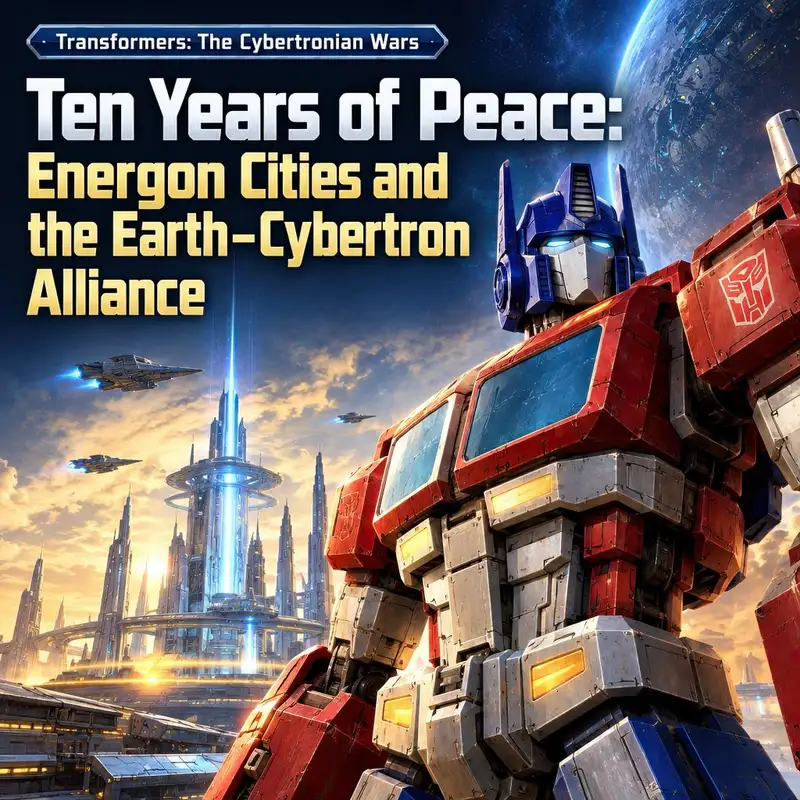
Ten Years of Peace: Energon Cities and the Earth–Cybertron Alliance
Ocean City rises out of the water like a promise that requires armed guards. Its towers, platforms, tunnels, and industrial spaces are built around energon, the resource that Cybertronian society needs to function and, in this period, to restore Cybertron itself. Human workers and Cybertronian personnel operate in the same complex. Autobots and surviving Decepticons are said to be cooperating. Ten years have passed since Megatron disappeared in the aftermath of the Unicron crisis. On the surface, this is a remarkable peace. Look more closely, and it is a fortified extraction site with several possible enemies.
In the English-language Transformers: Energon continuity, Ocean City is more than a futuristic skyline placed on Earth for visual effect. It is evidence that Earth has become part of Cybertron’s recovery. The city combines research, mining, transport, defense, and human habitation. Its value lies in the systems connected through it: energon deposits, Cybertronian equipment, personnel, supply routes, and the technology needed to move resources and forces between worlds. A city like that cannot exist without a measure of trust. It also cannot exist without making its population a target.
That contradiction defines the first phase of Energon. The stated ten-year interval was real. The immediate conflict between Autobots and Decepticons had eased enough for former enemies to work beside one another. Humans had entered the arrangement as more than frightened bystanders or temporary allies. They helped operate the machinery of recovery. No detailed constitutional settlement, clear peace treaty, or completed political union between Earth and Cybertron is shown. What it shows is cooperation under pressure.
The practical question was simple. Cybertron needed energon. The political question was much harder. Could shared work become shared legitimacy? Could former enemies build institutions capable of surviving the return of old leaders, old loyalties, and new threats? Or had the alliance merely postponed another war while everyone concentrated on the immediate problem of energy?
Cybertronian war is rarely only about territory. A faction can seize a city, win a duel, or control an artifact and still fail if it cannot fuel its forces, repair its personnel, move supplies, and sustain civilian life. In Energon, the resource problem is placed in the open. Energon is not decorative fuel. It is the foundation of Cybertronian activity and a requirement for restoring a damaged homeworld. That makes extraction a strategic enterprise rather than a commercial side project.
Finding energon is only the beginning. Deposits must be identified, reached, mined, processed, stored, moved, and protected. Equipment needs maintenance. Workers need security. Routes between facilities must remain open. If the resource is intended for Cybertronian recovery, then somebody must also decide where it goes first: to damaged cities, military forces, research facilities, space travel, or the systems required to re-energize Cybertron. Precise production figures are never supplied. The strategic dependence is clear enough.
Earth mattered because it offered accessible energon and because human society could participate in the construction of the infrastructure needed to exploit it. That did not make Earth the only relevant source in the wider theater, nor did it make the planet a subordinate possession of Cybertron. It made Earth useful, exposed, and increasingly entangled in an off-world recovery effort. For Cybertronians, the arrangement offered resources and technical support. For humans, it offered access to extraordinary technology, new industrial capacity, and an alliance with beings whose war had already threatened more than one world.
That bargain was reciprocal, but it was not automatically equal. Cybertronians brought transformation technology, space travel, advanced engineering, and firsthand knowledge of the larger conflict. Human personnel brought local access, scientific support, facilities, labor, and a world on which energon could be developed. Each side needed the other. Dependence can create cooperation. It can also create resentment, fear, and arguments over who accepts the greatest danger.
Ocean City makes those dangers visible. It is built around the assumption that a mixed human-Cybertronian project can operate on Earth. Yet its function means that any hostile force seeking energon, hostages, intelligence, or a spectacular attack has a reason to strike there. Peace had brought development, but development had placed valuable infrastructure near civilian life. The alliance was not hiding from war. It was trying to build through it.
The same pattern appears across the city network. Ocean City is joined by locations such as Lunar City, Mars City, Desert City, and Jungle City. They should not be treated as identical metropolitan centers. Their roles vary. Some are associated with mining. Others serve as research, distribution, defense, or staging sites. What matters is that they transform a collection of separate energon operations into a strategic geography extending across Earth and nearby space.
A dispersed network has obvious advantages. It reduces dependence on any one mine, one city, or one transport route. If a deposit is exhausted, damaged, or attacked, other nodes may continue to function. It also places energon work closer to different environments and potential sources. A lunar installation has different access and security conditions from an ocean facility. A desert base has different vulnerabilities from a jungle site. Diversification can make a supply system more resilient.
It also creates a defense problem. Every additional installation needs communications, maintenance, personnel, and some means of warning or reinforcement. Every mine shaft, storage area, tower, or bridge connection is another point an enemy can observe, infiltrate, sabotage, or raid. The alliance could not reasonably protect every site with the same concentration of force. Commanders had to decide which locations were indispensable, which could be evacuated, and which risks had to be accepted.
That is the difference between a map and a network. A map shows places. A network shows dependencies. Ocean City, Lunar City, Mars City, and the other installations were linked by energon requirements, transport, technical support, and security obligations. Damage at one site could create pressure elsewhere. A disrupted mine could affect the distribution system. A failed communications link could slow reinforcement. A threat approaching one facility could draw defenders away from another.
The civilian consequence was equally important. These were not empty battlefield markers. Human life existed in and around the facilities. Workers, researchers, families, and local communities lived with the consequences of turning Earth into part of a Cybertronian recovery program. Municipal government and daily life in every city remain only partially shown, so these sites should not be treated as fully documented independent societies. But it does establish that the installations were connected to people who could not simply transform, fly away, or cross a space bridge when danger arrived.
Kicker Jones embodies some of the tension built into this partnership. His unusual ability to sense energon gives the alliance a valuable practical advantage. He can help locate what others cannot easily detect. In a conflict centered on a strategic resource, that is not a minor talent. It makes him useful to scientists, military forces, and anyone trying to find or protect energon before an enemy does.
It also puts him under pressure. Kicker’s distrust of Cybertronians and his difficult relationship with his father, Doctor Jones, prevent the human role from becoming a simple story of enthusiastic cooperation. He is part of the alliance, but not always comfortable within it. That discomfort matters. A partnership can be operationally necessary even when the individuals inside it carry fear, anger, or doubts about the people they are expected to trust.
The presence of former Decepticons makes the problem sharper. During the ten-year interval, surviving Decepticons work alongside Autobots and humans. Demolishor and Tidal Wave are among the familiar figures associated with that period of cooperation. Their participation is significant because it shows that the end of immediate fighting was more than a pause between battles. Former enemies could be assigned work, included in common missions, and placed inside the energon recovery system.
But cooperation is not the same thing as political integration. The series confirms that former Decepticons are working with the alliance. It does not lay out the legal terms under which they do so. There is no fully described amnesty law, no detailed disarmament program, no tribunal process, no shared civilian constitution, and no clear account of whether every former Decepticon accepted Autobot command as legitimate. The absence of those details is not a flaw that needs to be repaired with speculation. It is part of what makes the peace fragile.
Optimus Prime remains the leading Autobot commander. His forces protect Earth, defend installations, secure energon, and confront the dangers connected to Unicron. Yet military command over Autobots is not the same as uncontested authority over every individual who once fought under Decepticon colors. A coalition can coordinate labor and defense without resolving the deeper questions of allegiance, accountability, and sovereignty.
Former Decepticons also retained an identity that could not be erased merely by assigning them to a mine, a patrol, or a joint defense mission. Some may have found practical reasons to cooperate. Others may have had nowhere else to go. Some may have accepted the changed circumstances more fully than others. Nothing supports treating all former Decepticons as either secret traitors or instantly reformed citizens. What it does show is a coalition operating before its members had necessarily become one political community.
That arrangement can work as long as the immediate incentives remain stronger than the old divisions. Shared danger is often a powerful adhesive. So is scarcity. If Cybertron requires energon, if Earth contains it, and if hostile forces threaten everyone involved, then cooperation becomes rational even for people with very different histories. The danger comes when a figure returns who can reactivate old command relationships and turn a dormant factional identity back into a military force.
Before Megatron’s return produces that shock, the alliance faces another test. The Terrorcons begin attacking energon sites. Their raids are not just isolated fights designed to interrupt construction. They are attacks on the foundation of the entire Earth-Cybertron working arrangement. A mine is valuable because of what it can supply. A city is valuable because of the systems it supports. A successful strike against either can have effects beyond the immediate damage.
The Terrorcons operate under Alpha Q, who works from the remains of Unicron. At this stage, the full purpose behind his energon gathering develops gradually across the season. It would be misleading to reduce him immediately to a simple conqueror or to assign him a settled political role that the early episodes have not yet established. What matters for the alliance is more immediate. Alpha Q has forces capable of striking the energon network, and those attacks expose the weakness of a coalition still learning how to defend a distributed economy.
The raids create an intelligence problem as much as a combat problem. A defender cannot respond effectively without warning. It must identify where an attack is coming, what the enemy wants, how much force is involved, and whether the visible raid is a distraction for another operation. A network with many sites creates many possible targets. The enemy does not need to defeat every defender. It only needs to find a weak point, seize energon, disrupt operations, or force the alliance to scatter its response.
Kicker’s sensitivity gives the defenders a specialized advantage in this contest. He can detect energon concentrations and help locate activity that might otherwise remain concealed. Yet a security system dependent on one unusual individual also has a weakness. If that individual is isolated, injured, deceived, or simply sent to the wrong place, the advantage narrows. The alliance gains valuable information, but it does not gain omniscience.
That need leads to the energon towers. These structures are more than tall pieces of advanced machinery. They are an attempt to turn separate extraction and defense sites into a linked planetary system. The towers connect the energy project to Earth’s security. They make it possible to imagine the alliance not as scattered crews protecting isolated mines, but as a coordinated defense capable of responding to threats on a much larger scale.
The strategic logic is sound. A network can produce effects that no individual site can create alone. Separate positions become mutually supporting. Information can be shared. Energy can be directed through a larger system. A threat approaching Earth can be met by more than whichever team happens to be nearest. In military terms, the towers offer the possibility of area defense. In political terms, they make the alliance visible in steel, circuitry, labor, and shared risk.
Building such a system requires more than a blueprint. It requires construction crews, technical expertise, reliable materials, maintenance, communications, and agreement about who has access to the system. It requires human and Cybertronian specialists to work together. The towers therefore demonstrate genuine interdependence. They are not a symbolic partnership. They are infrastructure that neither side appears able to establish alone with the same speed or reach.
At the same time, networks create shared vulnerabilities. A local base can fail locally. A linked grid can fail across a much wider area if a critical node malfunctions. The more the alliance relies on common systems, the more a technical fault, enemy intrusion, or damaged tower can become a strategic problem. Centralization improves coordination, but it also raises the stakes of maintenance.
That is why the energon grid crisis matters. Megatron launches three artificial comets, or meteors, toward Earth before the grid is fully ready. The comets’ precise yield, trajectory, and construction are unspecified; their purpose is obvious from the attack. Their purpose is plain. They are large incoming threats directed at a planet whose new defense system is still incomplete. Megatron is testing whether the alliance can turn construction into protection before impact.
This is more than an attempt to destroy targets. It is an attack on confidence. If the grid fails, then the human-Cybertronian partnership loses more than equipment. It loses the claim that shared infrastructure can protect the world it has transformed into an energon hub. The cities become exposed. The alliance becomes vulnerable to panic, blame, and renewed doubts about whether cooperation has made Earth safer or merely placed it in the path of a larger war.
The malfunction at one tower shows how narrow the margin can be. A defense grid is only as useful as its ability to detect problems, isolate faults, and restore function under pressure. Kicker and the Autobots must locate and correct the failure while the larger threat continues to close in. Their task is not glamorous, but it is decisive. A networked defense does not survive on firepower alone. It survives on diagnosis, repair, and the ability to make the right information reach the right people in time.
The crisis gives the alliance a practical lesson in command and control. Warning is not enough if commanders do not understand the condition of their own system. A powerful weapon or defensive network can become irrelevant if a single damaged or compromised component prevents it from functioning as designed. The ability to find the fault matters as much as the ability to shoot at the incoming threat.
When the grid functions, it gives Earth a defensive capacity that isolated installations could not have provided. The tactical result is the interception of an immediate danger. The operational result is more significant. Earth now possesses a linked system capable of defending a wider area against major incoming threats. The planet is no longer merely a place where Cybertronians hide, mine, or seek temporary refuge. It has become an active theater with defenses tied to the broader Cybertronian war.
That does not mean Earth is invulnerable. The same event that proves the grid’s value also proves its dependence on functioning towers, technical coordination, and people able to act under pressure. A defense network can discourage or defeat certain attacks without solving every problem of infiltration, sabotage, internal loyalty, or strategic surprise. The grid is a major achievement. It is not a peace settlement.
Megatron’s return makes that distinction impossible to ignore. His reappearance is not only the return of a dangerous commander. It is a political shock to a coalition that had formed during his absence. For former Decepticons, Megatron is more than another battlefield opponent. He is a focal point for a prior identity, a command culture, and a history that had never been fully settled through public institutions.
A leader-centered faction can appear integrated when its leader is gone. Personnel may cooperate, adapt, or find new roles within a changed environment. Yet the return of the figure around whom loyalty once formed can expose how much of that apparent integration was conditional. The issue is not that every former Decepticon immediately makes the same choice. That simplification is unsupported. The issue is that the old Decepticon identity once again has a center of gravity.
Megatron’s presence forces the alliance to reconsider trust, access, and command. Who can be trusted with infrastructure? Who holds sensitive information? Which former enemies are committed partners, and which remain vulnerable to old loyalties or coercion? Those are not questions that can be answered by checking a faction insignia. They require institutions, relationships, intelligence, and time. The ten-year period had created cooperation, but it had not necessarily created the procedures needed to manage renewed division.
This is one reason the peace should be understood as conditional rather than imaginary. It was real enough to build cities, mine energon, and create a planetary defense grid. Those are substantial achievements. But it had not yet transformed former enemies into a fully reconciled political order. Megatron’s return did not create every weakness in the alliance. It revealed weaknesses that had been contained by his absence.
The revived conflict also places new weight on the question of Unicron. The remains of the planet-eater are more than ancient wreckage. They are connected to Alpha Q, energon gathering, and a wider strategic struggle. For Optimus Prime and the Autobots, the danger posed by Unicron and those seeking to use its power cannot be separated from the defense of Earth. The alliance must now think beyond mines and towers toward threats moving across worlds.
That broader campaign brings Rodimus and his group into the picture. Rodimus represents an alternative Autobot political and military network, not merely a subordinate unit waiting for instructions from Optimus Prime. His disagreement with Optimus over Unicron is strategically important because it concerns the use of a catastrophic asset. The question is whether Unicron should be destroyed or whether its power might be used to restore worlds devastated by the planet-eater.
Both positions respond to a real problem. Worlds damaged by Unicron cannot be restored by rhetoric or good intentions. They require energy, technology, and a means of rebuilding what was lost. Rodimus’s position recognizes the scale of that humanitarian and strategic need. But using an asset connected to Unicron also raises questions of control, risk, and unintended consequence. A system capable of restoring worlds may also create new dependencies or provide an enemy with an opportunity too dangerous to ignore.
Optimus Prime’s caution cannot be reduced to generic moral authority. The strategic issue is whether anyone can reliably control the means being proposed. Destroying a dangerous system may prevent its misuse, but it can also foreclose a chance to repair profound damage. Using it may promise recovery, but it risks repeating the history that made recovery necessary. The disagreement is not proof that one side cares and the other does not. It is a dispute over method, command, and acceptable risk.
This matters because common enemies do not automatically create common strategy. The anti-Megatron coalition may share a desire to prevent disaster, but it does not follow that every commander agrees on how to use Unicron’s remains, who should decide, or what risks Earth and other worlds should bear. Alliances often fail not because participants disagree about the danger, but because they disagree about what victory should look like.
The Earth-Cybertron partnership therefore expands from local defense into a wider campaign. Space bridges are central to that expansion. They reduce the time required to move people, equipment, and information between separated locations. They help connect mining sites, command centers, and off-world operations. In a dispersed theater, that mobility is strategically transformative.
But a space bridge does not make distance meaningless. It depends on functioning endpoints, power, technical control, coordinates, security, and a route that has not been compromised by the enemy. A bridge can move a force quickly, but it does not guarantee that the force arrives with the right intelligence, enough support, or a safe withdrawal route. It reduces one problem while making the infrastructure behind it more valuable and more vulnerable.
Doctor Jones is associated with much of the scientific and technical work that enables the alliance to function at this scale. His role illustrates that human participation is not limited to political symbolism. The joint effort requires people who understand systems, build connections, manage research, and make advanced equipment usable in the conditions of Earth and nearby space. The alliance depends on expertise as much as it depends on courage.
The Miranda Two extends that reach further. As a large allied vessel connected to Doctor Jones and the broader effort, it represents an expeditionary capability beyond static cities and fixed towers. It allows the coalition to move into the larger struggle surrounding Unicron and Megatron. Exact crew numbers, dimensions, and performance figures for the Miranda Two are not given. Its significance is operational. It helps turn a defensive network into a force capable of acting beyond its original resource sites.
Mining, defense, and space operations are now inseparable. Energon supports movement, repairs, technology, and sustained missions. Mobility helps defend the sources of energon and reach threats before they arrive at Earth. A ship such as the Miranda Two cannot be understood apart from the infrastructure that supports it. Nor can an energon city be understood apart from the wider campaign that makes its output strategically necessary.
By this point, the meaning of Earth has changed. Earth is a partner in Cybertronian recovery, a forward base in a larger conflict, and a target for any enemy who understands the importance of energon. It is more than “allied with Cybertron” in the sense of one unified planet joining one unified foreign government. The record is more specific than that. Particular humans, particular facilities, and particular joint projects support the common effort.
Doctor Jones, Alexis, Carlos, Sally, and Kicker each show a different aspect of that human involvement. Some contribute technical knowledge. Some bring experience from the previous conflict. Some are drawn into field operations because the alliance requires people who understand both local conditions and Cybertronian dangers. Kicker’s role is especially revealing because his value comes from a personal capability that cannot simply be replaced by a larger bureaucracy.
None of these individuals should be mistaken for humanity as a whole. No single Earth government is shown directing the alliance, and the story does not map every national military or civilian response. The partnership is real, but it is built through people and projects rather than a fully described planet-wide political union.
That distinction matters for sovereignty and civilian safety. Shared construction can be a sign of trust, but it can also place extraordinary power inside or beside human communities without fully answering who governs it, who authorizes its use, and who bears the consequences if it fails. The energon cities improve Earth’s connection to Cybertron. They also militarize locations that are close to human life.
When Terrorcons attack, evacuation becomes a necessity rather than an abstraction. Civilians and workers cannot be treated as incidental to the conflict because the infrastructure itself depends on them. A mine without labor, a research center without specialists, or a city without a population worth protecting is not an alliance project. It is merely an empty military position. The human presence gives the partnership legitimacy and capacity. It also gives hostile forces a means of applying pressure.
Earth’s position is therefore both stronger and more dangerous than it was before. The planet gains access to a defensive grid, space-bridge mobility, Cybertronian engineering, and allies with experience in an interstellar war. Yet it also becomes harder to separate Earth’s future from that war. Energon deposits and infrastructure make the planet strategically relevant. Once that happens, neutrality becomes difficult to preserve.
Return, then, to Ocean City rising from the sea. At first glance, it appears to represent a successful future: humans and Cybertronians building together after a decade without open factional war. That image is genuine. The city would not exist without collaboration, technical trust, and a willingness to make Earth part of Cybertron’s restoration. Its construction proves that the ten years of peace achieved something substantial.
But Ocean City also shows the limits of that achievement. It is built around a scarce and valuable resource. It needs defenses because it is vulnerable. It depends on links to other installations because no single city can sustain the larger project alone. Its mixed population must function amid uncertainty about Decepticon loyalties, incoming threats, and the wider danger represented by Unicron’s remains. It is a city of peace, but not a city beyond war.
The ten years did reduce immediate conflict. They enabled former enemies to work in the same system. They produced shared mining operations, research efforts, space-bridge connections, defensive towers, and a planetary grid that could protect Earth against threats no isolated base could manage. They created the basis for a broader campaign against the Terrorcons, Megatron, and the forces surrounding Unicron.
The political result was less complete. Cooperation had advanced faster than reconciliation. Former Decepticons could work within the alliance, but old identities, loyalties, and grievances had not simply disappeared. Megatron’s return exposed the danger of a settlement built without clearly documented mechanisms for disarmament, accountability, shared authority, or long-term legitimacy. Infrastructure can connect cities. It cannot, by itself, settle a civil war.
The human cost was equally mixed. Earth gained development, defensive capacity, and an active role in a larger community of worlds. Yet the same facilities that made that role possible also made human spaces vulnerable. Mines, towers, laboratories, and transport routes became targets. The alliance offered protection, but it also ensured that Earth could no longer stand outside Cybertronian conflict.
The ten years of peace were not an illusion. They produced real cooperation, real infrastructure, and real defensive capacity. But they were not yet a durable peace settlement. In Energon, the cities and towers show that humans and Cybertronians could build a common future; Megatron’s return shows they had not yet built the political institutions, trust, or shared legitimacy needed to protect it.