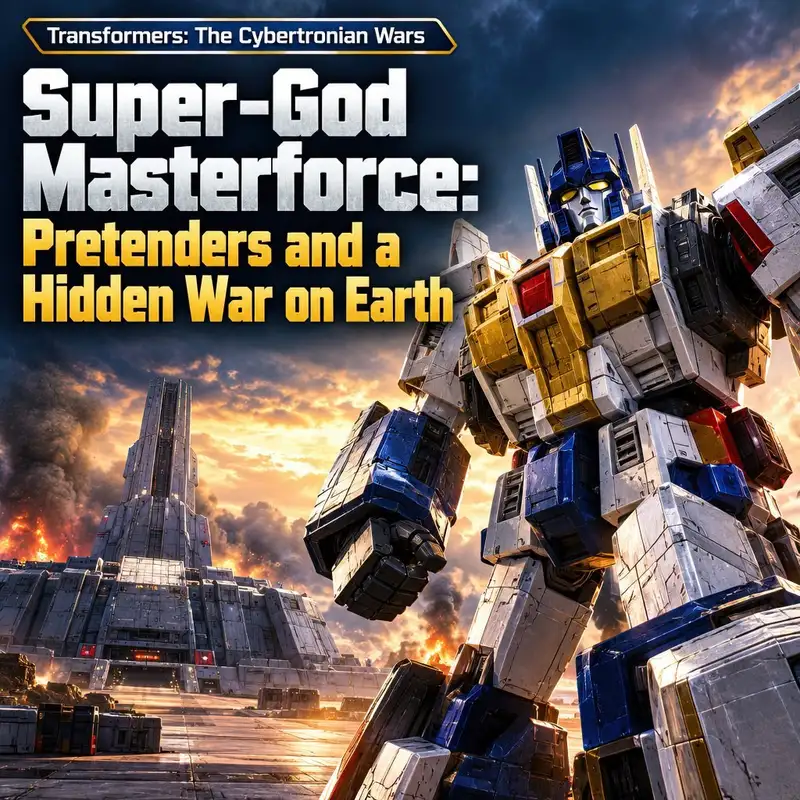
Super-God Masterforce: Pretenders and a Hidden War on Earth
For centuries, Hawk has lived as a human being. He moves through human society, understands its habits, and shares its daily risks. Yet Hawk is also Metalhawk, an Autobot Pretender, a Cybertronian defender concealed behind a human identity. His disguise is not the usual wartime trick of hiding a military vehicle in traffic. It is a long-term commitment to life on Earth. That arrangement works only while the old war remains buried. When ancient enemies return and civilians begin to suffer, Metalhawk faces a hard reality. A guardian who stays hidden may preserve secrecy, but cannot organize a defense against a threat that has begun to spread through the society he is trying to protect.
In the Japanese animated continuity of Super-God Masterforce, set after the Headmasters conflict but built around a largely new Earth-based cast, that dilemma defines the war from the beginning. The series is not mainly concerned with a conventional Autobot expedition arriving from Cybertron to fight a clearly marked enemy army. Its first defenders are already on Earth. They have been there so long that their presence has entered human memory in distorted form. They are protectors without public authority, soldiers without a visible army, and aliens whose strongest connection to Earth comes from the fact that they have chosen to live inside its communities.
The first military problem is therefore not how to invade a planet or seize a fortress. It is how to respond when a concealed threat becomes impossible to conceal. Metalhawk can reveal himself, summon allies, and fight. But every open battle changes the political environment. Civilians see evidence of something extraordinary and dangerous. Local authorities confront attacks they cannot explain. Fear spreads faster than reliable information. The enemy benefits from that confusion. A secret defense network may know far more about Earth than an invading force does, yet it has no easy way to tell the population why it is fighting without also exposing the wider danger.
Metalhawk is joined by the other Autobot Pretenders, Lander, Diver, and Phoenix. Their English toy-market names are familiar to some listeners as Landmine, Waverider, and Cloudburst, but in this story they are the same four defenders, not separate versions. Together, they are a very small force. Their importance does not come from numbers. It comes from time, familiarity, and access. They have spent long enough among humans to understand that Earth is not an empty strategic location. It is a living world with families, public institutions, transportation routes, fears, stories, and people who will bear the cost of every Cybertronian decision made above their heads.
The series presents that relationship through an ancient conflict remembered imperfectly as myth. Long before the modern events of Masterforce, Autobot and Decepticon Pretenders reached Earth and fought there. Human witnesses did not possess the vocabulary to describe Cybertronian factions, transformation systems, or alien civil wars. What they retained were images. Some beings seemed like gods. Others appeared as demons, monsters, or creatures out of nightmare. The surviving stories preserved emotional truth more reliably than technical detail. Something powerful had arrived. It had fought. It had terrified people. And it had left an imprint on human memory long after the original participants disappeared from public view.
That does not make every old legend a precise historical record. Myth is not a battlefield report, and Masterforce does not establish a dependable Earth calendar for the first Pretender war. The key point is simpler. The conflict was old enough that human culture had absorbed it without understanding it. Earth had already experienced Cybertronian violence before the modern crisis began, but the memory had been fragmented into folklore. That gave the returning Decepticons a useful advantage. They did not arrive as entirely new horrors. In a sense, they returned wearing the shapes that human fear had already prepared for them.
The distinction between Autobot and Decepticon Pretenders is more than cosmetic. The Autobot Pretenders choose human forms because they admire humanity and wish to live among humans. Their disguise becomes a social identity. They can observe without frightening people. They can build familiarity. They can learn language, customs, and local conditions. They can see the warning signs of a developing crisis before a military force arriving from orbit would even know where to begin looking. Their human forms make them more than hidden combatants. They become residents.
The Decepticon Pretenders adopt the opposite approach. Blood, Dauros, and Gilmer appear through monstrous forms associated with demons and terror. Their presentation turns fear itself into a weapon. A monster does not need to persuade a victim that it belongs. It needs only to create panic, isolation, and helplessness. The Decepticons’ forms announce that they have no interest in living alongside humanity as equals. Their relationship with Earth is extractive. Humans are a source of fear, leverage, labor, experimentation, and potential military utility. The contrast is morally clear, but it is also operationally significant. One side depends on trust. The other depends on coercion.
In the ancient struggle, the Autobot Pretenders defeated and sealed away their enemies. That outcome created the conditions for a long period of quiet guardianship. The Autobots could remain on Earth without conducting an open occupation or building a visible military state. They did not need to govern human societies. They only needed to watch, to remain available, and to prevent the old threat from returning. It was a sustainable arrangement precisely because the conflict was limited. The enemy was contained. The defenders were few. Earth remained, for most people, an ordinary human world.
That balance is broken by Devil Z. Devil Z is more than another Pretender or a local Decepticon commander seeking revenge for an old defeat. The entity’s intervention releases or revives the Decepticon Pretenders and places their return within a broader hostile project. The full meaning of that project emerges gradually, and the series does not give the audience a neat early briefing on every motive, resource, or command relationship. What is clear from the beginning is that Blood, Dauros, and Gilmer are no longer isolated remnants of an ancient war. They are the opening instrument of a renewed campaign.
For Metalhawk and his companions, the return of the Decepticons creates a dispersed security crisis. There is no single front line. No declared battlefield. No stable zone where civilians can be separated from combat. Threats appear around people, institutions, transport routes, and places that had never been built to withstand Cybertronian violence. The Autobot Pretenders can respond quickly in individual emergencies, but speed is not the same as coverage. A few defenders can rush to an attack. They cannot be present everywhere that the enemy may choose to strike.
This is where the value of Pretender concealment becomes easier to understand. Their human identities allow the Autobots to move through civilian spaces without requiring an armed convoy, a military base in every city, or a public alliance with a national government. They can observe ordinary life. They can hear rumors. They can recognize when an event does not fit the usual pattern of accident or crime. They can intervene before an attack becomes a larger disaster. In an era before the war fully escalates, this is a formidable form of early warning.
It also gives them cultural intelligence. The Autobot Pretenders know that saving Earth is not just a matter of preventing physical destruction. A community can be damaged by terror even when its buildings remain standing. A person who is abducted, manipulated, or forced to witness violence is more than a strategic statistic. A city whose people no longer trust its streets, hospitals, transportation, or public authorities has suffered a real defeat. Metalhawk’s long life among humans gives him an understanding of that danger. He is defending people whose world he knows from the inside.
But concealment cannot create political control. The Pretenders do not command Earth’s governments. They do not operate a public emergency system. They cannot issue evacuation orders, investigate every disappearance, secure every laboratory, or explain every strange attack without exposing themselves. Their disguise lets them enter society. It does not give them the legitimacy to direct it. That difference becomes decisive once the Decepticons stop behaving like a small hidden enemy and begin using human society itself as the terrain of war.
The first Decepticon operations make that intention unmistakable. Their violence is not confined to clashes with Autobot Pretenders. They use human suffering as a resource. Early attacks involve the reanimation of corpses into Destroids, turning the dead into instruments of further violence. When that method proves inadequate for their purposes, the Decepticons turn toward living captives. The progression matters. It shows that the enemy is testing methods, adapting to failure, and treating human bodies as material to be exploited rather than lives to be respected.
That conduct gives the conflict a character closer to internal security warfare than to a clean contest between two military formations. The Decepticons target people who cannot defend themselves. They create fear around civilian spaces. They take hostages. They exploit scientific knowledge and attack sites connected to aviation, research, and public movement. The practical purpose is not only to harm individuals. It is to convince everyone else that ordinary life is no longer safe. A population that is frightened, confused, and unsure whom to trust becomes easier to manipulate.
Karin’s danger in the early conflict is part of that larger pattern. So are attacks connected to aircraft and the targeting of a biologist whose knowledge can be exploited. None of these incidents need to be treated as isolated adventures. Together, they show a campaign designed to force the Autobots into a permanent reaction cycle. Every raid demands a rescue. Every abduction requires a search. Every attack on a public site creates another possible catastrophe. The Decepticons choose targets that compel a small defense force to divide its attention.
The Decepticon method is therefore not merely theatrical villainy. Terror has a military purpose. It consumes the defender’s time, creates uncertainty, and makes the enemy appear larger than its visible numbers. A team like Metalhawk’s can win a direct fight and still lose ground politically if civilians believe that no one can protect them. It can stop one operation and still face three more emergencies elsewhere. Tactical victories are useful. They are not sufficient when the enemy has made social fear the main battlefield.
The use of monstrous forms strengthens that effect. The Decepticons do more than hide in human society. They exploit humanity’s old memory of monsters. Their appearances turn an ancient cultural wound into a contemporary weapon. The result is psychological as well as physical. A civilian cannot easily distinguish rumor from reality when the threat resembles something out of folklore. That uncertainty gives the Decepticons room to operate. It also forces the Autobot Pretenders into a difficult position. To defeat a visible monster, they may have to reveal a truth that many people are not prepared to hear.
Metalhawk’s force is not helpless. The Pretenders can fight effectively, rescue civilians, and disrupt Decepticon plans. Their transformation abilities and combat experience give them a significant advantage over ordinary human attackers. Yet the series makes clear that individual strength does not solve every operational problem. The Autobots are few. They require secure places to regroup, communications they can trust, repair support after combat, and rapid ways to reach new crises. A hidden team can survive by remaining dispersed. A defense force must sometimes concentrate. Those are different requirements.
The more often the Pretenders reveal themselves, the more their original model begins to break down. Concealment remains useful for reconnaissance and access, but it no longer defines the war. The Autobots need people who understand Earth from the human side and can act where Cybertronian defenders cannot always be present. They also need allies who can help interpret the crisis to a population that has suddenly become entangled in an alien conflict. The response goes beyond trying to bring in more Autobots. It is to create a new kind of partnership.
That partnership first takes shape through the Headmaster Juniors. Shūta, Cab, and Minerva receive Masterforce equipment and Transtectors, the Cybertronian bodies and systems that allow them to take part directly in combat. In this continuity, they are not ordinary human pilots operating vehicles at a safe distance. Their participation places them inside a military relationship with Cybertronian technology. They become active defenders in a war that began before they were born and whose full strategic meaning is often beyond their control.
The advantages are real. Shūta, Cab, and Minerva possess local knowledge that the Autobots cannot replicate through sensors alone. They understand human spaces, human fears, and human priorities. They can move through the world in ways that make sense to local people. They also provide the Autobots with a stronger connection to the society they are defending. The Pretenders had lived among humanity in secret. The Headmaster Juniors make human participation visible. Earth is no longer merely the place where a Cybertronian conflict happens. Humans become participants in the defense of their own world.
That does not remove the moral difficulty. A young human partner may volunteer, show courage, and exercise meaningful agency. Yet courage does not erase the imbalance between a human teenager and an ancient Cybertronian war. The Autobots bring equipment, knowledge, and authority. They also bring enemies. Once Shūta, Cab, and Minerva enter the conflict, they become targets for Decepticon coercion and violence. Their training, protection, recovery, and extraction become part of the Autobot burden. A partnership cannot be judged only by whether it increases battlefield capability.
There is also a question of consent that the series leaves partly unresolved in formal terms. The Headmaster Juniors are not drafted by a public Earth government after a transparent political decision. Their involvement grows from personal relationships, immediate danger, and the opportunities created by Masterforce technology. That may make their commitment sincere, but it does not automatically create a clear legal framework. The Autobots are trying to protect Earth, but protecting a population does not grant unlimited authority to transform selected members of that population into military assets.
The Headmaster Junior system changes the character of Autobot defense. It adds flexibility and creates a bridge between humans and Cybertronians. It also makes the conflict more intimate. An attack is no longer just an assault on an Autobot base or a clash between alien combatants. It may threaten a human partner’s family, school, community, or sense of identity. The Decepticons understand that vulnerability. They do not see human involvement as an unfortunate complication. They see it as an opportunity.
The Decepticon answer to Autobot partnership is not to leave humanity outside the war. It is to compete for human agency. If humans can strengthen the Autobots, they can also be manipulated, recruited, deceived, or coerced by the Decepticons. That is one of Masterforce’s most important political ideas. The question is not whether humans should matter in a Cybertronian conflict. They already do. The question is who will define the terms of their participation, what information they will receive, and whether their role will serve defense, domination, or someone else’s hidden agenda.
Later Decepticon leadership makes this even clearer. Giga and Mega appear in human-presenting forms and become important figures in the expanding campaign. Their use of human appearance resembles Autobot concealment only at the most superficial level. The Autobot Pretenders adopt human identities in order to live among the people they protect. Giga and Mega use human forms as instruments of command, influence, and manipulation. The difference is more than one of costume. It is a difference in political relationship. One approach seeks coexistence. The other treats human society as a system to be penetrated and controlled.
That does not mean the Autobots are free from all ambiguity. Their human allies are still drawn into danger by Cybertronian decisions. They still depend on equipment and knowledge that only the Autobots can provide. They still operate inside a conflict where the balance of power is unequal. But Masterforce does draw a meaningful line between partnership and exploitation. The Decepticons do more than accept human help. They convert human vulnerability into leverage. They treat fear, captivity, and emotional pressure as tools of command.
The Godmasters expand this contest dramatically. They are human-linked fighters bonded to Transtectors through the series’ distinctive combination of cosmic energy, Earth energy, and human energy. This is not a general rule for every Powermaster or human-Cybertronian bond elsewhere in the franchise. It belongs to the particular world of Masterforce. What matters strategically is that the system produces combatants whose effectiveness depends on more than machinery. Human will, emotional condition, trust, and connection to Earth become active elements in military power.
That changes the scale of the war without requiring a conventional mass army. A small number of Godmasters can have influence far beyond what their numbers would suggest because each bond combines rare technology with a human participant. The strength of such a system is concentration. A capable partner and a powerful Transtector can produce a formidable defender. Its weakness is the same. If the human partner is injured, deceived, captured, demoralized, or divided from the Cybertronian system, the military effect may collapse quickly.
The Godmaster model therefore creates a command problem as much as a combat capability. A commander cannot treat these fighters like interchangeable equipment. They require trust. They require training. They need secure facilities, repair support, and time to understand the systems they are using. They also require protection against intelligence operations. An enemy who cannot defeat a Godmaster directly may try to isolate the human participant, exploit personal relationships, or attack the support network that makes the partnership possible.
The series never establishes that these systems can be manufactured and fielded at unlimited scale. They depend on specialized Transtectors, unusual human partners, and knowledge that cannot simply be assumed to exist in every workshop. The strategic problem is not mass production. It is stewardship. A force built around rare individuals and rare systems must decide where to deploy them, how much risk to accept, and how to avoid becoming dependent on a handful of irreplaceable defenders.
Ginrai embodies that transition. He is a human Godmaster bonded to a Transtector, and he becomes central to the expanding Earth conflict. His design and toy-market history may remind Western audiences of Powermaster Optimus Prime, but Ginrai is not Optimus Prime in this continuity. Treating him as though he were would erase the point of his role. Ginrai is a human participant whose authority and significance emerge from the Masterforce system itself, not from an imported biography belonging to another branch of Transformers history.
Ginrai’s Super Ginrai configuration, created through the combination of the truck and its container, represents the increasing specialization of Earth-based defense. The added capability is important, but the strategic meaning matters more than the visual transformation. The war is moving away from the original model of a handful of hidden Pretenders responding to isolated attacks. It is becoming a conflict in which powerful linked systems, dedicated support structures, and elite human-Cybertronian partnerships are necessary to answer larger threats.
That shift does not make the Pretenders irrelevant. On the contrary, their experience explains why the newer system is needed. Metalhawk and his companions established the first line of defense because they understood Earth before the war became public. They recognized that humanity could not be treated as scenery around a Cybertronian battlefield. The Godmasters build on that insight, but under far more dangerous conditions. What began as shared life and quiet guardianship becomes organized military cooperation.
As the conflict escalates, the Decepticon campaign grows beyond the immediate actions of Blood, Dauros, and Gilmer. Covert attacks reach Autobot facilities. Sabotage and infiltration become more prominent. Clouder’s emergence adds another layer to the Godmaster struggle. Overlord brings a level of Decepticon threat that cannot be answered simply by locating a monster and driving it away. BlackZarak’s arrival marks an even larger escalation, introducing an asset whose presence changes the scale of the danger around it. Devil Z’s plan increasingly threatens humanity itself, not merely the small Autobot force defending Earth.
The pattern is significant because it shows the collapse of the hidden-war model. At the beginning, the central challenge is identifying and stopping an enemy that operates from secrecy. Later, the enemy is capable of attacking bases, corrupting alliances, exploiting specialized technology, and fielding forces too large to be dismissed as isolated raids. Concealment still has value. It remains useful for infiltration, intelligence, and survival. But it cannot carry the full burden of planetary defense once the enemy has made the war overt.
The Autobot response becomes broader, but broader does not mean uncomplicated. A larger defense network can protect more people and respond to more threats. It can connect Pretenders, Headmaster Juniors, Godmasters, and other allies. It can build experience and create a more resilient response to sabotage. Yet it also increases the number of people exposed to the war. More human partners mean more capable defenders, but also more possible hostages, more families at risk, and more lives tied to the success or failure of Cybertronian command decisions.
In the immediate fight, the defenders can interrupt attacks, rescue captives, defeat particular enemies, and prevent immediate disasters. Those successes matter. Across the campaign, they gradually create a wider Earth defense system able to respond to threats that a few Pretenders could never manage alone. Strategically, however, Earth has become openly contested. The planet is no longer protected by its obscurity. It has become a theater in a larger conflict, with its people, institutions, and technologies drawn into the struggle.
The political consequences are just as important. Humanity can no longer remain merely a population under secret protection. Human beings become allies, partners, targets, witnesses, and participants. That gives them agency, but it also burdens them with knowledge and danger they did not choose at the start of the story. The Autobots must learn that good intentions are not enough. If they ask humans to share the risks of war, they also owe them honesty, protection, respect, and a meaningful role in the decisions that affect their lives.
Masterforce is especially interested in the way hidden identities can serve radically different purposes. Metalhawk’s human life gives him access to Earth because he values the people around him. Decepticon human forms can provide access as well, but without empathy they become instruments of deception. A disguise is not morally neutral simply because it conceals a body. Its meaning depends on what the concealed person intends to do with the trust that concealment creates.
The Pretenders also reveal the limits of treating security as a purely technical problem. Better weapons, stronger Transtectors, and larger combined forms can stop threats that ordinary defenders cannot. But none of them resolve the deeper question of how a hidden war affects the society in which it is fought. Terror can be countered by force, yet it also requires trust. Sabotage can be repaired, yet it also requires institutions capable of responding. Human partnership can improve defense, yet it requires safeguards against turning people into expendable parts of an alien military system.
That is why the original Autobot Pretenders remain central even after the story’s military center of gravity shifts toward Godmasters and larger threats. They represent a different idea of defense. Their first achievement is not the ability to transform or fight. It is their decision to share human life long enough to understand what they are defending. They know that Earth is not valuable only because it offers terrain, resources, or a place to hide from Decepticons. It is valuable because people live there.
Their weakness is structural rather than personal. A small clandestine network can provide warning, conduct local rescues, and defeat limited threats. It cannot indefinitely protect every community against an enemy that attacks infrastructure, kidnaps civilians, recruits local agents, and turns human bodies and relationships into instruments of war. Once Devil Z and the Decepticons break the condition of secrecy, the Autobots cannot simply return to the old arrangement. Hiding becomes inadequate because the crisis now requires a wider human and Cybertronian response.
The Godmaster conflict answers that problem by giving humans a direct role in their planet’s defense. It recognizes that Earth cannot be protected forever by outsiders acting alone. But it also creates new dangers. Human partners gain real agency, while becoming valuable military assets. Their courage matters, but so do the pressures placed upon them. Their bonds can strengthen the defense, but those bonds can also be exploited by an enemy that understands fear, coercion, and divided loyalties.
In Super-God Masterforce, the Pretenders’ hidden life on Earth is a strategically intelligent form of early warning and local defense, but it depends on the conflict remaining limited. Devil Z and the Decepticons destroy that condition by making human fear, bodies, relationships, and institutions part of the war. The Pretenders’ greatest achievement is not their disguises, but their decision to treat humanity as a society worth living within, even when defending it requires exposing the war they had tried to keep away.