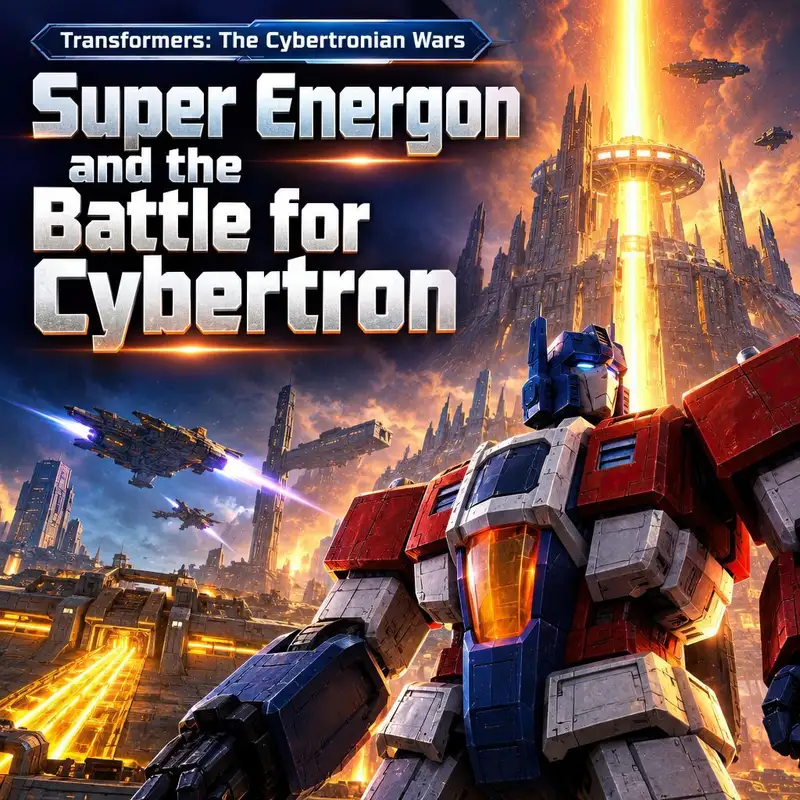
Super Energon and the Battle for Cybertron
Cybertron was moving. Not through the action of a conventional fleet, or through a space bridge opened between fixed coordinates, but through its own Energon grid. The planet had become a strategic object in motion, drawn toward the region of space where Alpha Q’s reconstructed worlds depended on a fragile new beginning. At the same time, poisonous Energon gas spread across Cybertron’s surface, denying the Autobots an easy return to their own homeworld. Galvatron possessed the planet, its power network, and the initiative. Yet his victory depended on an infrastructure system already beginning to break under the pressure of his plans.
This is the English-language Transformers: Energon history, the middle chapter of the Unicron Trilogy. In this version of the war, Cybertron is more than the symbolic homeland of the Autobots and Decepticons. It is an energy system, industrial base, command center, and political prize. Whoever controls it can shape the war far beyond its surface. But controlling a planet is not the same thing as governing it, and moving a planet does not make its problems disappear. It simply carries those problems into a larger theater.
Galvatron’s campaign revealed that distinction with unusual clarity. Super Energon gave him extraordinary power. It strengthened his body, transformed his authority over the Decepticons, and allowed him to turn Cybertron’s own systems into instruments of coercion. But it also tied him ever more closely to Unicron’s destructive influence, to a damaged planetary grid, and to a form of command centered almost entirely on one leader. His rise made the Decepticons more dangerous. It did not make them more stable.
The immediate crisis had begun after an earlier battle seemed to promise the opposite result. Unicron, the immense threat that had shaped the latter stages of the conflict, had been confronted with the combined efforts of the Autobots and their allies. Energon Towers and power connected to Primus became central to that struggle. Optimus Prime reached a giant-scale combat state, often called Optimus Supreme, because the war had moved beyond ordinary battlefield formations. The question was no longer whether a city could be defended or a fleet could be driven off. It was whether Cybertron itself could survive an enemy capable of threatening the entire planetary system.
The Autobots succeeded in destroying Unicron’s physical body. That achievement mattered. It ended the immediate assault and prevented Unicron from continuing as a visible, mobile instrument of destruction. Yet the apparent victory left behind a more difficult problem. Megatron survived. More importantly, the series establishes that some connection between Megatron and Unicron survived as well.
The exact nature of that connection is not explained with the consistency of a technical manual. It can appear as influence, command, temptation, or a deeper entanglement of will and identity. The record does not support a simple claim that Megatron became a passive puppet, nor does it support the idea that Unicron’s destruction left him wholly untouched. What it does establish is that Megatron remained vulnerable to a force associated with Unicron, and that this force continued to direct his attention toward power beyond ordinary Decepticon weapons and ordinary Energon supplies.
The distinction matters because defeated commanders are not necessarily harmless commanders. A force can destroy an enemy fortress, vessel, or superweapon and still leave behind the political structures, ambitions, resentments, and personal loyalties that made the threat dangerous in the first place. Unicron’s body was gone. Megatron’s movement had not collapsed. In fact, the destruction of Unicron created an opening in which Megatron could seek a new source of authority, one no longer shared with the wider Decepticon command.
His path led beneath Cybertron’s surface, into a deep reserve of Super Energon. The substance was not presented as ordinary Energon found in a larger stockpile. It was treated as unusually concentrated, dangerous, and bound to an older level of Cybertronian history. Ancient guardians protected the reservoir and warned Megatron away from it. Their presence signaled that this was more than an abandoned fuel depot waiting for the first army capable of reaching it.
Megatron ignored the warning. That decision was strategically revealing. He did not arrive with a demonstrated understanding of the reservoir’s origin, safe use, limits, or wider effects. He had found access. He had not acquired control. In military and political history, those are very different things. An army can seize an arsenal without understanding its maintenance. A government can capture a power plant without knowing how to keep it running. A commander can gain possession of a weapon before learning whether the weapon will serve his purpose or reshape the purpose itself.
Megatron chose immersion in Super Energon because it offered what a defeated leader most urgently needed: survival, superiority, and a renewed claim to command. He had just emerged from a war in which conventional strength had not been enough. The reserve offered a way to return not as a recovered Decepticon leader, but as something visibly beyond the old balance of power.
The transformation produced Galvatron. In this continuity, Galvatron is the transformed Megatron, not an unrelated successor who happened to inherit the same ambitions. His identity continues through the change. But the continuing influence associated with Unicron makes it misleading to describe him as merely Megatron in improved armor. The transformation amplifies not only his physical capabilities, but the instability already present in his strategic outlook.
Galvatron’s new body gives him a substantial advantage in direct confrontation. The series depicts armor and power beyond what conventional Autobot firepower can readily overcome in the relevant battles. That does not mean he is invulnerable in every circumstance, against every weapon, or under every condition. It means that the established methods of opposing him no longer work reliably. A commander who had once been dangerous because of his Decepticon forces became dangerous because he could personally upset the balance of a battle.
That kind of superiority has political value. It produces fear among enemies, but it can also produce obedience among allies. Galvatron no longer needed to persuade every Decepticon that he represented the best path to victory. He could demonstrate that defiance carried immediate costs. His transformation became a spectacle of authority. In a faction already accustomed to personal command and military hierarchy, proof of overwhelming strength could bind uncertain followers more quickly than a negotiated program or a stable chain of institutions.
But authority built on exceptional personal power has a weakness. It becomes tied to the judgment, emotional condition, and continued survival of the exceptional individual. A military organization may look stronger because its leader can defeat any rival in a duel. It may also become less capable of independent action. Subordinates learn to wait for orders. Rivals compete for favor rather than build dependable command systems. Strategy narrows until the leader’s immediate will becomes the faction’s only purpose.
Galvatron’s rise therefore changed the command problem on both sides. The Autobots could no longer assume that direct battle would contain the Decepticon leader. The Decepticons, meanwhile, became more dependent on him precisely because no ordinary commander could match the authority that Super Energon appeared to provide. He was stronger than Megatron had been. He was also more isolated.
The reservoir’s effects extended beyond Galvatron himself. Super Energon awakened or empowered formidable combiner forces, including Constructicon Maximus and Bruticus Maximus. These formations mattered because they showed that the resource could alter the military balance at more than one level. It was not only a personal enhancement for one warlord. It could affect the ability of forces to combine, maneuver, and impose shock on an opponent who lacked equivalent assets.
Yet the appearance of powerful combiners should not be mistaken for proof of a durable military-industrial system. The story does not establish that Galvatron possessed a production process capable of creating unlimited equivalents. It does not provide a complete order of battle, a supply structure, or a training system that could turn every Decepticon unit into a Super Energon formation. The difference between an extraordinary asset and a sustainable force structure remains important.
Superion Maximus also does not remain securely under Galvatron’s control. That fact exposed another limitation. Power obtained through ancient energy and sudden transformation may create tactical shock, but it does not automatically generate loyalty, discipline, or a common operational doctrine. A combiner is more than a larger weapon. It is a command and coordination problem. If its allegiance is uncertain, then its presence can complicate a campaign as much as it strengthens one.
Galvatron’s real opportunity came not only from his new strength, but from timing. The Autobots had survived the confrontation with Unicron, but survival had dispersed them. Their forces were operating aboard the Miranda II and in other locations, dealing with the aftermath of the larger crisis. Cybertron had been defended, but its defenders were not all in place. The war’s center of gravity had shifted outward, and the homeworld’s rear-area security had weakened at exactly the moment Galvatron returned.
Decepticon forces exploited that opening. The attack on Cybertron was more than another clash between rival patrols. It was a seizure of the central planet during a period of transition. The Decepticons overran the principal Autobot position and established control before the Autobots could bring their dispersed strength back into the fight. In operational terms, Galvatron converted an enemy’s temporary absence into a political and military fact on the ground.
The Decepticon force was not a perfectly unified army moving with mechanical precision. Starscream, Shockblast, Six Shot, Scorponok, and the various combiner formations represented different capabilities, ambitions, and command relationships. Some were field commanders. Some were specialists. Some were dangerous precisely because they possessed their own agendas. Galvatron’s personal authority held these elements together, but the campaign did not erase the rivalries and uneven loyalties that had long complicated Decepticon command.
Even so, seizing Cybertron gave Galvatron an immense advantage. It offered symbolic legitimacy. A faction that controls the homeworld can claim to represent the future of the species, even when that claim rests on coercion rather than consent. It also offered industrial access, energy infrastructure, communication networks, and the ability to deny those resources to the enemy. The Autobots were more than excluded from a city or base. They were locked out of the political and material center of the conflict.
But occupation is not legitimacy. The Decepticons had taken Cybertron through superior force and through the operational mistakes of an enemy stretched across multiple missions. Nothing shown establishes a broad civilian mandate for Galvatron’s rule or a functioning Decepticon government able to replace the institutions Cybertron required. He had the ability to seize the capital system. He did not demonstrate the ability to build a durable political order around it.
His next decision made that difference impossible to ignore. Galvatron used Cybertron’s Energon grid to move the planet toward Alpha Q’s reconstructed worlds. The grid became more than a distribution network. It became the mechanism through which Cybertron itself could be repositioned. A homeworld that had long functioned as a fixed strategic center was transformed into a mobile planetary asset.
That innovation changed the geometry of the war. Ordinary front lines matter less when an entire planet can be brought toward an enemy or a vulnerable region. Distance, defensive depth, and the protection offered by a remote location all become less reliable. Galvatron did not need to send a conventional invasion force across every intervening route if he could move the source of his power and the seat of his command toward the objective.
The move also gave his campaign a broader and more troubling purpose. Galvatron was no longer fighting only to restore Decepticon supremacy on Cybertron. He was using Cybertron itself as leverage against Alpha Q’s worlds. The exact political status of those reconstructed worlds remains limited in the series, but their strategic importance is clear. They represented a fragile area of renewal after destruction. Moving Cybertron toward them turned the planet into a threat whose mere approach could destabilize the region.
A movable planet is a remarkable instrument of force. It is also a remarkable concentration of risk. Galvatron’s plan depended on a single planetary grid functioning under wartime conditions. That meant the same infrastructure responsible for powering Cybertron, supporting its systems, and enabling its movement also became a critical vulnerability. If the grid failed, the campaign could fail. If it were sabotaged, Galvatron’s strategic mobility could become a trap.
The weakness did not remain theoretical. Damage to the Energon grid released hazardous Energon gas across Cybertron’s surface. The contamination created an immediate barrier to Autobot operations. The main force could not simply return to the planet, launch an assault, and rely on superior courage to solve the problem. Access itself had become contested.
This was the point at which logistics returned to the center of the war. The struggle was no longer only about who possessed the strongest leader or the largest combined form. It was about who could operate in a contaminated environment, who could reach damaged systems, who understood the network, and who could reopen a route for larger forces. The most important mission was not necessarily a frontal attack. It was repair, containment, and technical access.
Kicker, Arcee, and the Omnicons became essential because the crisis demanded capabilities that the main Autobot force did not possess in the same combination. The story establishes that they could function in the contaminated environment where others could not readily operate. Their assignment was therefore not an auxiliary errand. It was a mission that determined whether Cybertron could be reclaimed at all.
The Omnicons represented a form of specialized manpower often overlooked in stories centered on commanders and duels. Their value came from operating under difficult conditions, supporting repair work, and sustaining a mission in an environment that denied access to more powerful units. A war machine can be formidable in open battle and still fail if it cannot seal a damaged conduit, restore a power route, or recover access to a contaminated installation.
Arcee’s role carried a similar operational meaning. She was more than present as another combatant. The situation required mobility, coordination, and the ability to protect technical personnel while the larger strategic problem was addressed. In a contaminated and damaged environment, protection and repair become inseparable. A team that reaches the right location but cannot hold it long enough to complete the work has not solved the problem.
The civilian consequences of the gas crisis are harder to define. The series makes clear that Cybertron and its infrastructure are in danger. It does not establish precise casualty totals, evacuation plans, or the full experience of ordinary Cybertronian residents under occupation and contamination. It would be easy to fill that silence with assumptions. The stronger conclusion is narrower. Galvatron’s use of Cybertron as a weapon placed the planet’s systems under strain, and that strain endangered far more than the armies fighting for control of them.
The gas crisis exposed a basic flaw in Galvatron’s conquest model. He could take territory by force. He could compel subordinates through fear. He could use the grid for strategic movement. But a homeworld is not a weapon platform with no internal needs. It must continue to distribute energy, support repair, maintain movement corridors, and preserve enough order for its population and institutions to function. The more he treated Cybertron as an expendable instrument, the more he damaged the basis of his own control.
Technical access became the decisive form of power. Dr. Jones, Kicker’s father, played a role in disrupting the grid from within and helping create an opening for the Autobots. The exact sequence of these events can be described differently across episode listings, but the strategic meaning is clear. An insider with knowledge of the system can produce effects that an external attacking force may not be able to achieve.
This did not make human personnel the commanders of the Cybertronian war. Optimus Prime remained the central Autobot leader, and the larger campaign remained a struggle between Cybertronian factions. But the involvement of Dr. Jones and Kicker showed that human-Cybertronian cooperation had become materially important. Knowledge of infrastructure, access to technical systems, and the ability to operate alongside Cybertronian specialists created options that neither side could obtain through brute strength alone.
It also demonstrated the value of distributed command. Galvatron’s strength lay in concentration. He was the transformed leader, the source of awe, and the figure whose will drove the Decepticon campaign. The Autobots, by contrast, had to operate through a network of commanders, specialists, and field teams. Optimus coordinated the larger effort, but Kicker, Arcee, the Omnicons, Rodimus, Prowl, technical personnel, and other Autobot units each addressed different parts of the crisis.
Distributed command can look untidy when compared with the apparent simplicity of one supreme leader issuing orders. It is often slower. It requires trust, communication, and delegation. But it can also be more resilient. When the battlefield splits into a contaminated surface, an occupied planet, a damaged grid, a dispersed fleet, and an approaching strategic threat, no single commander can physically solve every problem. A force that has trained specialists and can let them act has an advantage over one that depends on a leader’s presence for every major decision.
The opening created by sabotage and repair did not make Galvatron easy to defeat. His direct combat power remained formidable. When Optimus and the Autobots fought their way back toward Cybertron, they faced a leader whose Super Energon-enhanced condition made conventional attacks insufficient. The confrontation between Optimus and Galvatron mattered, but it was not the whole campaign.
A duel can decide immediate leadership, delay an enemy advance, or create time for another mission. It does not automatically restore a planet’s infrastructure, clear a contaminated surface, or break a system of occupation. Galvatron’s strength made him capable of dominating direct engagements. Optimus could not simply solve the crisis by proving himself the better fighter. The campaign required the Autobots to separate Galvatron’s personal battlefield superiority from the planetary system that sustained his larger strategy.
That distinction is one of the more important lessons of the battle for Cybertron. Tactical success and strategic success are not interchangeable. Galvatron could win exchanges of fire and still lose the ability to move Cybertron. He could overpower individual Autobots and still fail to secure the grid. Optimus could be unable to destroy Galvatron through ordinary direct action and still coordinate a campaign that undermined the conditions making Galvatron’s conquest possible.
Optimus’s effectiveness came from that coordination. He did not prevail because moral confidence alone defeated a stronger opponent. His advantage came from recognizing that the war had become an infrastructure conflict. The Autobots needed access to the planet. They needed the grid disrupted. They needed teams able to operate in the gas. They needed technical knowledge, local action, and sufficient battlefield pressure to keep Galvatron from concentrating entirely on one threat.
Galvatron’s own transformation eventually revealed the limits of personal invulnerability. As his power increased, he grew in scale and became physically connected to Cybertron through strands or conduits of Super Energon. The image was dramatic, but its military significance was even more important. Galvatron had become stronger by drawing upon a larger system. He had also become less independent of that system.
Kicker and the Omnicons worked to sever those connections. Their task was not to prove that they could defeat Galvatron in a contest of raw strength. It was to attack the relationship between the leader and the infrastructure sustaining him. This was the kind of vulnerability that no amount of personal armor could fully remove. A commander may be nearly impossible to damage directly, yet still depend on power, communications, transport, repair, or control systems that can be reached by smaller and less powerful opponents.
Galvatron’s tethers to Cybertron turned his strength into a liability. The more fully he treated the planet as an extension of himself, the more clearly the planet’s vulnerable systems became extensions of him as well. Concentration of power produced concentration of risk. The decisive target was no longer only Galvatron’s body. It was the network that allowed him to turn an entire homeworld into an instrument of war.
In the immediate fight, he remained dangerous. Severing conduits did not make him harmless. Across the operation, however, the Autobot effort disrupted the system that allowed him to sustain his planetary-scale plan. At the scale of the conflict, the campaign proved that Cybertron could not remain a stable homeland while being treated as an endlessly expendable weapon platform. And at the political level, it showed that coercive possession could not substitute for institutions capable of maintaining energy, infrastructure, and social order.
The final confrontation moved beyond ordinary infrastructure warfare into the mythic language that Energon had used throughout its Unicron crisis. The Autobots contributed their combination sparks to Optimus, while Primus used Super Energon in the larger struggle against Galvatron and Unicron’s lingering destructive force. The series presents these events as a cosmic resolution, and it is better understood as such than as a reproducible engineering procedure.
The mechanism is not something a later government could simply copy. The story does not establish a standard process by which combination sparks can be assembled, Super Energon can be safely directed, and a planetary crisis can be transformed into a new source of life. Primus’s intervention belongs to the exceptional circumstances of this conflict. It changes the outcome, but it does not eliminate the political and military lessons that led to the crisis.
Galvatron’s final fate is one of the strangest and most consequential reversals in the series. His renewed connection to Unicron culminates in his merging with, or sacrifice into, Super Energon. He becomes the sun that sustains Alpha Q’s recreated worlds. The leader who sought power through the manipulation of planetary energy ends as part of an energy system supporting life elsewhere.
The outcome has a mythic symmetry, but it should not be reduced to a simple redemption story. Galvatron’s final transformation does not erase the occupation of Cybertron, the coercion of his own forces, the contamination crisis, or the instability created by his campaign. It does not prove that destruction was secretly benevolent. Rather, it transforms the destructive force he had tried to master into something that supports the worlds he threatened.
Nor does the ending provide a detailed political settlement for Alpha Q’s reconstructed worlds. The series establishes their survival and the importance of the new sun. It does not offer a complete account of their government, population, long-term security, or relationship with Cybertron after the crisis. The immediate danger has been resolved. The broader work of peace, reconstruction, and political legitimacy remains larger than any single cosmic intervention.
That is why the battle for Cybertron is more than a story of a stronger Megatron becoming Galvatron, or of Optimus Prime eventually meeting an enemy escalation with one of his own. Super Energon changed the scale of the war. It gave Galvatron exceptional personal superiority. It empowered unusual military assets. It allowed Cybertron’s own grid to make the planet mobile, turning a homeworld into an instrument capable of threatening an entire region of space.
Yet none of those advantages became a durable victory. Galvatron’s power depended on forces he did not fully control. His connection to Unicron deepened the destructive logic of his campaign. His movement of Cybertron depended on a damaged and vulnerable grid. His growing strength depended on conduits that smaller specialist teams could attack. And his command system depended too heavily on one leader whose objectives had moved beyond conquest into something closer to annihilation.
The Autobots did not solve the crisis by ignoring Galvatron’s strength. They solved it by refusing to fight only on the terms that strength seemed to dictate. They restored access, used technical knowledge, delegated authority, protected specialist missions, disrupted the grid, and separated the Decepticon leader from the infrastructure that made his strategy possible. Their victory was more than a battlefield result. It was an argument that systems matter as much as spectacle.
Cybertron’s fate makes the larger point. A homeworld is more than territory to seize. It is energy distribution, repair capacity, memory, industry, political identity, and the foundation from which any future government must operate. A leader may gain initiative by turning that world into a weapon. But if the weaponization destroys the systems required for ordinary life and durable rule, possession becomes temporary, brittle, and self-defeating.
Galvatron’s greatest source of power never became a stable instrument of government. It consumed the boundary between conquest and annihilation, until the force he sought to command carried him beyond both.