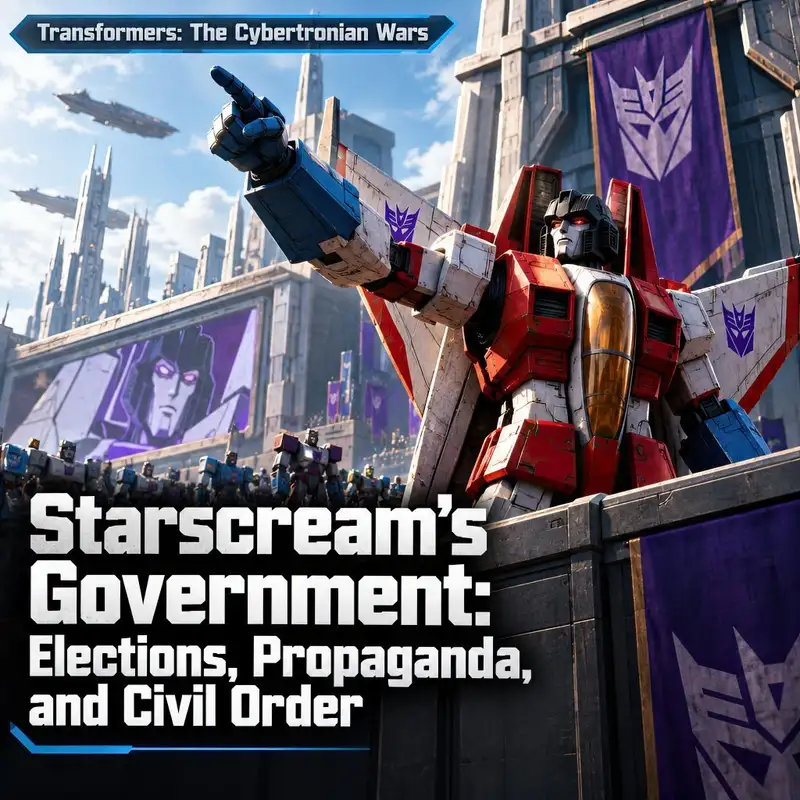
Starscream’s Government: Elections, Propaganda, and Civil Order
The final debate placed Starscream in an unfamiliar kind of kill zone. There were no null rays, no air wing waiting on his signal, and no fortress wall between him and his enemies. There was only a public platform, two rival candidates, and evidence that could destroy the political identity he had spent years constructing. Windblade stood for a broader, more accountable civilian order. Elita One offered security through military strength. And Starscream, ruler of Cybertron, possessed enough skill in evasion, spectacle, and intimidation to survive almost any ordinary scandal.
The question before Cybertron was larger than the election itself. Could its government expose the crimes of its leader without collapsing into factional violence? Could a society emerging from civil war punish a former Decepticon commander without making every former Decepticon a permanent suspect? And could Starscream accept a state that did not need him at its center?
This is the political history of Starscream in I D W’s 2005 continuity, not the familiar Starscream of the old animated series, the films, or any other version. Here, he became the central figure in Cybertron’s postwar government. He helped restore a damaged world, built institutions that reached beyond the old Autobot and Decepticon divide, and directed the planet’s defense during moments of genuine emergency. He depended on secrecy, coercive policing, political mythmaking, and the careful management of public memory.
His final confession did not make him innocent. It did something more limited, and perhaps more important. It tested whether Cybertron’s new political order could survive the removal of the warlord who had made himself indispensable.
To understand why that moment mattered, it is necessary to return to the peace that preceded Starscream’s rule. It was not a settlement in the conventional sense. The shooting had diminished. The great military commands had fractured. Cybertron itself was beginning to revive. But the political causes and human, or rather Cybertronian, consequences of war remained embedded in every institution that was supposed to manage the peace.
Optimus Prime’s departure and apparent death left a vacuum that no title could easily fill. He had been a military commander, a moral symbol, and for many Autobots the recognizable face of resistance to Decepticon rule. Yet wartime authority did not automatically become civilian legitimacy. A commander can lead a coalition against a common enemy. Governing requires persuading former allies, former enemies, civilians, refugees, and distant colonies that the rules will apply to all of them.
Bumblebee inherited that problem. His provisional administration faced a world returning to life after long devastation, but it lacked a mandate broad enough to speak for all Cybertronians. The Autobots had won political influence through sacrifice and survival. That did not mean they owned Cybertron. Many returning Cybertronians had spent the war outside the Autobot-Decepticon struggle. They came to be known as NAILs, an abbreviation for Non-Affiliated Indigenous Lifeforms.
The name could sound bureaucratic, but the political reality was not. NAILs were not an empty category called “civilians” for the convenience of former soldiers. They had their own grievances, leaders, experiences of displacement, and suspicions about a government dominated by veterans of one side of a civil war. Some had avoided the conflict at considerable personal cost. Others had been excluded from decisions made in their absence. Many saw little reason to accept an Autobot administration simply because it had defeated Megatron.
Metalhawk emerged as an important representative of that distrust. He was more than an alternative candidate in a future contest. His presence demonstrated the central weakness of the postwar order. The Autobot and Decepticon symbols had organized Cybertronian politics for so long that both factions could mistake themselves for the whole population. Metalhawk represented those who believed neither side had earned that claim.
The Decepticons, meanwhile, were not a single defeated army waiting to be disarmed. Their command structures were damaged, their loyalties divided, and their political future uncertain. Some remained committed to the old cause. Some were criminals, opportunists, or veterans with no place in civilian life. Some had joined the Decepticons because of real social exclusion and now found that the end of war had not necessarily ended their exclusion. Others simply feared retribution from an Autobot-led state.
Cybertron’s material condition made these tensions sharper. A planet returning from decline required energon, functioning power systems, repair facilities, transportation routes, housing, and some way to reconnect communities scattered by war. A damaged city cannot be stabilized by a speech. A former combatant does not become a civilian because a government issues a declaration. And no political system can endure if access to repair, energy, work, and security appears to depend on the faction one served under during the war.
Bumblebee’s failure was therefore institutional before it was personal. He was not defeated because he lacked courage or goodwill. He was defeated because a provisional authority, built from the prestige of wartime resistance, could not reconcile a returning population, armed former enemies, restless allies, and a political culture that had not yet learned how to settle disputes without military leverage.
The first election crisis emerged from that failure. Riots, Decepticon unrest, and collapsing public confidence forced Cybertron’s leaders toward an immediate political solution. Elections offered something the provisional government could not provide on its own: a claim to broader consent. They would allow the population to decide whether Autobots, Decepticons, NAILs, or some new alignment would shape the future.
It was a necessary step, but also a dangerous one. Elections do not create political trust merely by being announced. They require basic security, a recognized electorate, credible procedures, and enough confidence that losing a contest will not mean imprisonment, dispossession, or revenge. Cybertron possessed little of that confidence. The institutions were new, the factions were armed, and the meaning of citizenship remained unsettled.
Metalhawk appeared well placed to benefit from that moment. The NAIL population had numbers, resentment, and a reason to reject both old military establishments. Starscream, for his part, understood the opportunity with characteristic clarity. He believed the Decepticons might achieve through political victory what they could no longer safely claim through open conquest. That calculation was not necessarily democratic in spirit, but it was politically significant. It recognized that force alone no longer offered a stable path to power.
Then Megatron escaped, and the fragile opening narrowed almost immediately. His return demonstrated the weakness of the emerging system. A single charismatic commander, backed by military networks and the emotional residue of war, could still seize the initiative from civilian institutions that had barely begun to form. The election was overtaken by violence before it could establish itself as the accepted means of deciding Cybertron’s future.
That disruption revealed a harsh truth about demobilization. A civil war does not end when the old leader is removed from the field. It ends when armed organizations lose the ability, or the will, to impose political outcomes outside the law. Cybertron had not reached that point. Its elections were vulnerable because the weapons, loyalties, and myths of the old war remained available to those prepared to use them.
Starscream learned from that failure. He did not become ruler of Cybertron through a simple military coup, and his accession should not be described as a straightforward popular presidential victory. The constitutional mechanism was never cleanly defined. His authority emerged from a wider collapse of alternatives. Bumblebee’s provisional order had failed. The Decepticons were divided. The NAILs had not secured an uncontested political center. Megatron’s return proved that disorder could quickly become catastrophic.
In that environment, Starscream presented himself as the workable broker. He knew Decepticon networks and their resentments. He understood the fears of Autobots who did not trust a former enemy. He had survived long enough to recognize where power actually resided, which was often not in official titles but in access to information, armed supporters, strategic infrastructure, and public attention. He was willing to operate in uncertainty, where more principled leaders might wait for a constitution that did not yet exist.
That made him effective. It also made him dangerous. The same skills that enable a political survivor to build coalitions can enable him to manipulate them. A leader who thrives in ambiguity may have little incentive to clarify the limits of his own authority. Starscream’s government began with real necessity, but necessity is fertile ground for personal rule. The public needs someone to make decisions. The leader learns that each crisis confirms the argument for keeping power concentrated.
Authority, however, was easier to acquire than to turn into government. Starscream could not sustain Cybertron through fear alone. The war had already proved what a militarized, factional state could do to the planet. If he wanted durable power, he needed to make daily life work. That meant reconstruction.
The strongest case for Starscream’s government lies in the material problems it addressed. Cybertron needed energon production restored. It needed damaged systems repaired. It needed infrastructure capable of supporting returning populations. It needed ships, routes, and institutions that could reconnect a world which had been politically and physically fragmented for ages. These were not glamorous tasks. They required engineers, workers, administrators, medics, transport crews, and planners. A ruler could claim a throne, but someone still had to keep the energon moving.
This was the practical foundation of postwar legitimacy. Citizens can endure imperfect rhetoric if the power grid functions, if repair facilities are accessible, if transport resumes, and if the government appears capable of protecting them from the next emergency. Conversely, even an ideal constitution will struggle to survive when neighborhoods remain damaged, displaced populations are left in temporary settlements, and ordinary Cybertronians believe that recovery belongs only to the well connected.
Starscream understood enough of this to make reconstruction central to his rule. He was never merely a Decepticon commander wearing civilian authority as a disguise. He wanted Cybertron to function. He wanted it restored as a center of political and economic life. He wanted its return to demonstrate that he had become more than a survivor of the war. In his own mind, perhaps, the restoration of the planet would also restore him.
Yet reconstruction was uneven. Shanty settlements, displacement, factional distrust, and unequal access to security remained visible beneath official success. The return of life to Cybertron did not mean every Cybertronian returned to the same city, the same work, or the same social standing. A former soldier with connections could find a role more easily than a civilian whose home, records, or community had been destroyed. A returning colonist could be treated as a partner, a foreigner, or a threat, depending on who needed their support.
The government’s answer was more than centralization. It also involved the Council of Worlds, an intercolonial political structure that gave Cybertron’s lost and returning colonies a place in the postwar order. This was not an Autobot cabinet decorated with foreign delegates. The colony worlds possessed their own histories, institutions, religious traditions, and political interests. They could provide trade, mobility, alliances, and strategic depth. They could also refuse Cybertron’s assumptions.
That distinction mattered. A world that has survived separately for ages does not automatically accept instructions from Iacon merely because Cybertron is the ancestral homeworld. Reconnection required diplomacy, not annexation. It required officials capable of listening to communities that had learned to govern without Cybertronian supervision. It required an understanding that unity could not just mean obedience to the center.
Starscream’s administration gained real support when it dealt with those realities. It had a record of reconstruction, diplomacy, and emergency coordination. That record should not be dismissed because he was corrupt in other ways. Political legitimacy is often mixed. A government can achieve things its people genuinely need while still using methods that damage the trust required for long-term stability.
The clearest example of that contradiction was the security system. Postwar Cybertron faced a genuine public order problem. Former combatants remained armed. Rival factions retained networks of loyalty. Old Decepticon cells, criminal groups, political extremists, and opportunists could exploit a government still struggling to establish authority. The planet also contained advanced technology, strategic sites, and civilian populations vulnerable to violence. A state that could not investigate attacks, protect transport, secure facilities, or prevent armed intimidation would not remain a state for long.
Starscream relied on the Cybertronian Security Force to meet that need. But the security structure carried the legacy of emergency rule. The Badgeless, a controversial and secretive organization associated with domestic coercion, became a symbol of the government’s authoritarian tendencies. Their exact legal status and complete chain of command were not always clear. The available record does not support the claim that Starscream personally ordered every abuse attributed to them. It does establish that they operated in a political environment where intimidation, arrests, and opaque authority could flourish.
That ambiguity was itself part of the problem. Secret policing is most useful to leaders when responsibility is blurred. The government can benefit from fear while denying direct control over those who produce it. Victims have difficulty seeking redress when they do not know who has authority, which rule has been violated, or where the appeal process leads. A security organization without clear oversight may still be efficient in the narrow sense. It can detain, threaten, monitor, and disrupt. But efficiency is not legitimacy.
Starscream’s government needed order. The Badgeless offered a shortcut to it. They could suppress violence, protect sensitive information, and intimidate opponents who might otherwise exploit the postwar vacuum. Yet every use of unaccountable force deepened the suspicion that the new government differed from the old only in faction symbol and public language.
Ironhide’s placement over the security force suggested an attempt at professionalization or stabilization. Ironhide had the experience and credibility to impose some discipline on an institution that could otherwise become a private instrument of political survival. But assigning a respected commander to oversee security did not solve the structural problem. The question was not only whether individual officers were honorable. It was whether the force had lawful limits, transparent authority, and a relationship with the public based on something more durable than fear.
This is where postwar governments often fail. They mistake the reduction of visible violence for the creation of civil order. Violence can be suppressed. Consent must be built. A population that obeys because surveillance is pervasive, because detention is arbitrary, or because armed officials cannot be challenged may look peaceful from the command center. It is not reconciled. It is waiting, withdrawing, or learning to speak in private.
Starscream also understood that force was not enough. A government needs a story. It needs an account of where the society came from, why its present institutions deserve obedience, and what future sacrifices are supposed to accomplish. In a state recovering from civil war, that story is especially powerful because the past is still contested. Every faction has veterans. Every city has losses. Every political claim has a memory of betrayal attached to it.
Starscream studied The Birth of Cybertron, a historical film about the Thirteen Primes. The work presented a grand and useful version of the past, one in which political order could be linked to ancient authority, mythic founders, and the appearance of destiny. He was more than watching entertainment. He was studying how a civilization represented power to itself.
His response was to commission Starscream: The Movie, made by Thundercracker. The title alone made the ambition difficult to miss. This was not just a campaign advertisement. It was an effort to transform Starscream’s life into a founding narrative for the new Cybertron. The former Decepticon commander would become the leader who survived chaos, rebuilt the world, and gave divided citizens a common future.
Propaganda is often misunderstood as simple falsehood. It is more effective than that. It selects truths, arranges them, omits victims, simplifies contradictions, and gives the public a story in which power appears natural or necessary. Starscream had genuinely survived the war. He had genuinely helped hold postwar Cybertron together. But a film centered on his heroism could also exclude the coercion, opportunism, and suffering that had accompanied his rise.
The political purpose was clear. If Starscream could become the protagonist of Cybertron’s recovery, criticism of him could be made to look like criticism of recovery itself. If he could embody unity, then opposition might appear divisive by definition. This was the old logic of personal rule, polished for a society that had begun to demand elections and representation.
The Chosen One narrative added another layer. Scoop and Metrotitan interpreted a prophecy as identifying Starscream as the figure destined to unite Cybertron. Their belief drew on religious and historical traditions that could not be treated as objective intelligence reports. Prophecy, especially in a political crisis, is not self-interpreting. It depends on who reads it, who repeats it, and what they need the public to believe.
Starscream did not need to prove the prophecy in order to benefit from it. The suggestion that history, faith, and destiny had selected him could make ordinary political opposition seem smaller than it was. It could turn a former commander into a necessary figure. It could make the survival of his government feel like the fulfillment of a cosmic design rather than the contingent result of negotiation, force, and institutional weakness.
But myths create obligations as well as authority. A leader who claims, directly or indirectly, to embody the future becomes vulnerable when public memory refuses to cooperate. The more completely Starscream placed himself at the center of Cybertron’s story, the more difficult it became for Cybertron to separate its own recovery from his personal reputation.
That reputation was contested because the grievances of the old war survived the peace. Former Decepticons remained politically divided and socially insecure. Some saw a system that had changed its language without changing the distribution of respect or power. They could look at alliances with colonies associated with Prime traditions and conclude that the old Autobot order had simply been widened, not replaced. They could see security abuses and believe that the losers of the war were still subject to special suspicion.
The stories around figures such as Needlenose and Tracks show why broad faction labels were inadequate. Former Decepticons were not a unified bloc of villains, nor were they automatically reconciled citizens once the war ended. Some carried legitimate complaints about exclusion, police behavior, and public contempt. Some remained capable of violence. Some did both. A government that treated every Decepticon grievance as treason would deepen alienation. A government that treated every grievance as proof of innocence would ignore the crimes and coercive structures of the old regime.
Public anger also grew around deaths, mnemosurgical attacks, and the use of memory as a political weapon. In this continuity, memory was more than private recollection. It could be altered, violated, or weaponized. That made accountability especially difficult. Citizens could fear not only arrest or violence, but the manipulation of the records by which they understood themselves and one another.
A society emerging from war depends on public confidence that its archives, courts, investigators, and security institutions will not just manufacture the truth convenient to whoever holds power. Starscream’s government struggled with that requirement because it so often treated information as an instrument of survival. Secrecy could protect Cybertron from genuine threats. It could also protect leaders from consequences.
Factional memory became a form of political geography. An Autobot symbol, a Decepticon past, a colony’s religious tradition, or a city’s wartime experience could shape who received trust, who expected discrimination, and who believed the new state belonged to them. Formal peace had reduced open warfare. It had not dissolved the categories through which Cybertronians interpreted danger and privilege.
This was why colony diplomacy mattered so much. Windblade’s significance was not that she was simply more virtuous than Starscream. Her authority came from a different model of legitimacy. As a Caminian Cityspeaker, she stood within a civic and religious-political tradition that Cybertron could not command by decree. She became a diplomat and Council figure because she could translate among societies that had not shared the same history of war.
Caminus did not need Cybertron to explain its own identity. Neither did Velocitron or the other worlds brought into the Council’s orbit. Velocitron’s alliance, for example, required local approval. It could not be treated as a military acquisition. That was strategically inconvenient for any ruler who preferred direct control, but it was politically necessary. An alliance secured through local consent would be slower to create, yet more durable than one imposed through fear.
The Council of Worlds therefore represented both an opportunity and a constraint. It gave Cybertron access to trade, routes, knowledge, and allies. It also diluted the idea that Cybertron’s ruler could decide the future alone. A confederated order requires patience. It forces leaders to accept that other communities possess legitimate interests even when those interests complicate central plans.
Starscream could work within that structure, and at times he did. But his political style remained personal and centralizing. He wanted the state to function through institutions, yet he also wanted those institutions to confirm his exceptional role. Windblade represented a more dispersed form of authority. Her legitimacy depended less on being indispensable and more on making representation possible among groups that did not naturally trust one another.
The limits of Starscream’s government became especially visible during military crises. The end of civil war had not made Cybertron safe. The planet still faced threats beyond the capacity of ordinary police forces or local civilian institutions. Combiners, Titans, hostile forces, and ancient dangers could place entire cities at risk. In such moments, a government needs command arrangements capable of moving from debate to action without surrendering every civil protection in the process.
Starscream sought access to combiners, including a rebuilt Superion, because Cybertron lacked dependable strategic deterrence. A combiner was more than an impressive battlefield asset. In the context of a recovering planet, it represented concentrated defensive power against threats too large for normal security units. But it also raised questions of command, consent, and political control. A government that could direct such an asset possessed an enormous advantage. A government that depended on it could become even more vulnerable to whoever controlled its components.
The Titan crises placed these issues under extreme pressure. When Cybertron faced an undead Titan invasion, the planet’s available spacecraft had to serve competing missions. Some were needed for combat. Others were needed to evacuate civilians and move vulnerable populations away from danger. This was not a simple choice between courage and cowardice. Every ship assigned to the battle line was a ship unavailable for evacuation. Every ship held back for evacuation reduced the force available to stop the threat before it reached more civilians.
Starscream directed Cybertron’s defense during this emergency, and this was perhaps the clearest demonstration that he could function as a wartime leader rather than merely a political manipulator. A divided system temporarily spoke with one command voice. The government coordinated forces, confronted a threat beyond routine law enforcement, and kept the planet from being overwhelmed.
But military competence did not settle the deeper question of legitimacy. A leader can defend a population in a crisis and still govern it through methods that corrode trust. Emergency success often strengthens central authority because citizens remember who acted when systems failed. It can also make later accountability harder, because criticism begins to sound ungrateful or dangerous.
The evidence accumulated by Rattrap brought that weakness into focus. Rattrap possessed information about Starscream’s criminal conduct, and he hesitated before making it public. That hesitation was more than a personal dilemma or a piece of political blackmail. It was an intelligence problem with constitutional consequences.
Information can destabilize a fragile state. Releasing evidence against a sitting ruler may trigger retaliation, factional violence, or a succession struggle. But suppressing that evidence creates a different danger. It teaches the political class that accountability is negotiable whenever exposure appears inconvenient. It transforms the law into a weapon used against weak enemies while powerful figures remain protected by the argument that the system cannot endure without them.
Rattrap’s files forced Cybertron to confront that choice. Did the government exist to preserve order at any cost, including the concealment of its leader’s crimes? Or did order mean something more demanding: a public system capable of exposing wrongdoing, removing compromised officials, and continuing without collapse?
The alternative candidates made the decision more difficult. Elita One was not a caricature or an empty threat invented to make Starscream appear reasonable. She represented a real political appeal. In a world traumatized by war, police failure, conspiracies, and external attack, military strength could look like clarity. A force-centered conception of order promised decisiveness where civilian institutions appeared slow and compromised.
But that promise carried its own risk. Cybertron had already seen what happened when security, command, and factional identity overwhelmed public life. A militarized response to postwar disorder might provide immediate discipline. It could also reduce political disagreement to a threat requiring suppression. The society that emerged might be orderly in the narrowest sense and unfree in every other.
Windblade offered a different path, though not an easy one. Her campaign was not the triumph of innocence over corruption in a simple morality play. She operated in a political field shaped by assassination plots, foreign threats, security failures, colonial tensions, and the accumulated damage of war. Her advantage was not that she could erase those problems. It was that she could make a credible case for confronting them without treating any single commander as the embodiment of the state.
When the final campaign debate arrived, Starscream had options. He could deny the allegations. He could challenge the evidence. He could redirect public anger toward his opponents. He could invoke the dangers facing Cybertron and argue that investigation must wait until the crisis passed. He could use every skill that had carried him through the war and through the unstable years of reconstruction.
Instead, he confessed.
The confession was calculated, but calculation does not make it meaningless. Starscream recognized that holding power through denial would deepen the damage to Cybertron’s political system. He also recognized the danger posed by Elita One’s militarized alternative. By disqualifying himself, he created space for Windblade to defeat Elita One. In the cruel irony of the Chosen One narrative, Starscream did help unite Cybertron. He united it, at least in part, against his own continued rule.
That choice was morally consequential because it placed the survival of civilian political order above his personal office. It was not pure selflessness. Starscream remained Starscream. He could still shape the narrative of his downfall by choosing the moment and form of his confession. He could still imagine himself as the leader who sacrificed power for the greater good. The instinct to become the hero of his own story did not vanish simply because he told the truth.
Starscream’s confession mattered because it accepted, however late and however imperfectly, that Cybertron’s future could not rest on another indispensable warlord.