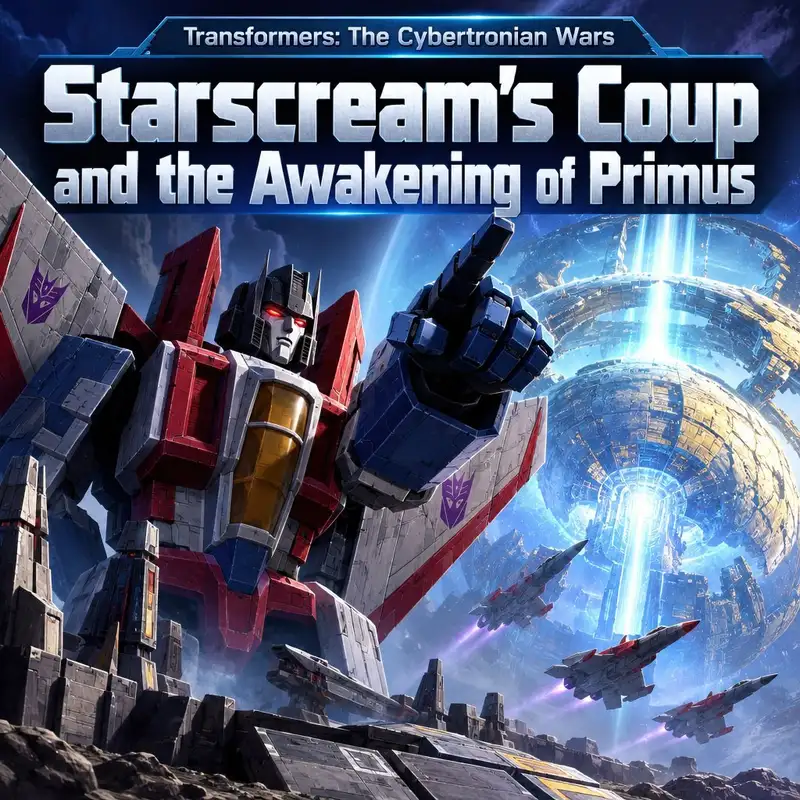
Starscream’s Coup and the Awakening of Primus
Starscream places Earth’s Cyber Planet Key into the Omega Lock, and the consequences reach far beyond a duel for Decepticon command. An ancient mechanism answers. A space bridge opens. The black hole menacing Cybertron’s universe becomes an immediate presence in Earth’s sky. In the English-language history of Transformers: Cybertron, this is the moment when a factional power struggle becomes a system-wide emergency.
The Omega Lock is more than a weapon with a large blast radius. It is strategic infrastructure. Linked to the Cyber Planet Keys, it can connect worlds, activate ancient systems, and shape the movement of forces across distances that ordinary travel cannot quickly cross. Whoever controls it does more than possess a powerful object. They can influence where the war happens, who can reach the next objective, and which leaders are forced to react.
That made the Lock more valuable than an ordinary command post, warship, or elite strike force. A commander can lose troops and still retain an army. A faction can lose a city and continue a war elsewhere. But the Omega Lock concentrated mobility, information, and access in one irreplaceable system. It created an enormous opportunity, and an equally dangerous single point of failure.
The crisis surrounding the Lock began with the black hole. Its growth threatened Cybertron and the wider region of space, but the danger was not understood in full at the beginning. Vector Prime, the ancient Autobot with unusual knowledge of time and space, directed the Autobots toward the Cyber Planet Keys. These keys had been hidden on distant worlds, including Velocitron, the Jungle Planet, Earth, and later the Giant Planet.
The Autobots understood that the keys and the Omega Lock were necessary to confront the black hole. What they did not yet understand was how completely those objects were tied to Cybertron itself. Their knowledge was practical before it was historical. They knew they needed the system to avert disaster. They did not yet know that activating it would expose the true nature of the planet they were trying to save.
This uncertainty created an opening for Starscream. He did not begin this phase as the unquestioned master of the Decepticons. Megatron remained the recognized leader of the faction, backed by fear, combat power, and a long record of forcing subordinates into obedience. Yet Megatron’s command was personal rather than institutional. It depended on his ability to dominate the people around him and to remain at the center of every important decision.
That system worked while Megatron knew where the decisive battle was taking place. It worked when subordinates needed his protection, his orders, or his willingness to destroy rivals. It worked less well when information could be compartmentalized. A command structure built around one intimidating leader can be swift in a crisis. It can also be blind when its leader receives filtered intelligence.
Starscream recognized that weakness. His ambition was not limited to taking Megatron’s title in a ceremonial sense. He wanted the source of power that could make titles secondary. If he controlled the Omega Lock and the keys linked to it, he could dictate the pace of the campaign. Megatron might remain dangerous, but danger is not the same as control.
Sideways became essential to that effort. Starscream’s coup did not rest on a broad political coalition or on a clearly organized movement within the Decepticons. It rested on a small network capable of deception, mobility, surveillance, and extraction. Sideways helped Starscream hide information, misdirect opponents, and exploit moments when larger forces were looking elsewhere.
That distinction matters. Starscream did not overthrow a government with a disciplined army and a program for rule. He created a gap between formal authority and practical control. Megatron still had followers. He still had weapons. He still had the instinct to seize any advantage by force. But Starscream increasingly controlled the information that told Megatron where the advantage was.
The Earth Cyber Planet Key became the immediate prize. Earth was already important because it contained Autobots, human allies, concealed Cybertronian history, and access to infrastructure that could support the next phase of the search. But it was not an Autobot rear area in the conventional military sense. The Autobots had friends there. They did not have uncontested sovereignty.
Human military authorities remained suspicious of Cybertronians, including the Autobots. Their concern was understandable. Earth had become a battleground for powerful alien factions whose motives, technology, and internal politics were only partly visible to human officials. The Autobots could describe themselves as defenders, but a human commander still had to consider the risk posed by every giant armed machine operating near civilian communities.
Colonel Franklin’s military structure represented one important human authority, not a unified government for the entire planet. That distinction shaped the crisis. The Autobots could cooperate with individual human partners and still face military scrutiny. They could save lives in one engagement and remain politically suspect in the next. Trust had been built through personal experience, not secured through a settled treaty.
Starscream understood how useful that uncertainty could be. A divided Earth response complicated Autobot operations without requiring him to defeat the Autobots outright. If human forces fired on Cybertronians they did not understand, Starscream gained time. If civilian families had to be protected, evacuated, or moved away from danger, the Autobots had fewer forces available for direct pursuit.
Earth’s hidden ancient Decepticon forces added another layer to the problem. These were not the same as the Scrapmetal drones that would later swarm Cybertron. The forces beneath the North Pole were connected to Earth’s buried Cybertronian past and could be awakened into the contest for the key. Their appearance widened the theater and made the struggle look, from a human perspective, even more like an uncontrolled alien invasion.
The Autobots were therefore fighting under several constraints at once. They had to stop Starscream. They had to prevent Megatron from exploiting the confusion. They had to protect human allies and nearby civilians. They had to work around human military suspicion. And they had to do all of this while the black hole made every delay more dangerous.
Starscream’s advantage came from recognizing that he did not need to solve every problem. He only needed to seize the decisive instrument before his rivals could coordinate. A leader with limited forces can still win initiative when opponents are dispersed, uncertain, and committed to protecting more than one objective at a time.
The decisive seizure came during the struggle over the Omega Lock. Leobreaker temporarily demonstrated that Starscream was not invulnerable. In Savage Claw Mode, he struck with enough force to defeat Starscream in the immediate encounter. For a moment, the Decepticon’s plan appeared to have failed. The Autobots had resisted, and Starscream had paid for his audacity.
But a temporary battlefield success is not always a strategic success. Starscream recovered. Then he watched for the moment when Optimus Prime’s attention was divided by the wider fight. Rather than seeking a clean and honorable victory, Starscream exploited distraction. He struck when the Lock was insufficiently protected and took it for himself.
That was the true turning point of the coup. Starscream had not formally replaced Megatron as Decepticon leader. No assembly acknowledged him. No stable chain of command transferred its loyalty. He had done something more immediately useful. He had seized the device that every major faction needed in order to address the central strategic crisis.
Tactically, he had stolen an artifact. Operationally, he had taken control of the campaign’s mobility and activation system. Politically, he had bypassed Megatron without abolishing Megatron’s authority. The distinction explains why Starscream could dominate events for a time but could not establish a durable regime.
Possession of the Omega Lock gave Starscream reach. It did not give him understanding. When he inserted Earth’s Cyber Planet Key into the Lock, he activated a process larger than his own plans. The space bridge that opened did more than create a private road for Decepticon forces. It exposed the black-hole threat and made the stakes visible to everyone watching.
The bridge transformed the political situation as well as the physical one. Earth could no longer be treated as a distant battlefield insulated from Cybertron’s crisis. Human witnesses saw the scale of the danger. The Autobots understood that delay could become catastrophic. Megatron saw that Starscream had acquired a power source he could not ignore. Even Starscream’s own success forced him into a larger contest than he had intended.
The Autobots then received a transmission directing them to bring the Omega Lock and the Planet Keys to Cybertron. It was a command, or perhaps an appeal, from an ancient system whose full purpose remained unclear. The message gave the Autobots a destination. It did not provide a complete manual for what would happen once they arrived.
This was an intelligence failure shared by every side. The Autobots possessed fragments of the truth. Vector Prime could interpret more than most, but even he did not command perfect knowledge. Starscream had the Lock but lacked its history. Megatron had brute force and ambition but no special insight into the system. Sideways could observe and intercept, but observation is not the same as comprehension.
Ancient technology is often most dangerous when it appears to answer an urgent need. The Omega Lock could open paths across space, but it also forced its users to make decisions before they understood the consequences. It rewarded initiative while punishing overconfidence. Starscream treated it as a tool for domination. The Autobots treated it as a means of survival. Neither interpretation was yet complete.
The fighting at Niagara Falls showed how quickly the contest could become personal again. Megatron had lost the initiative to Starscream, but he had not become irrelevant. He used Earth’s Cyber Planet Key to obtain a new weapon and brought his own destructive power back into the conflict. Megatron’s response was characteristic. When control slipped away from him, he did not build a new coalition. He escalated.
Hot Shot, Red Alert, and Scattershot were caught in that escalation. Megatron’s attack apparently destroyed them. The scene demonstrated that, despite Starscream’s maneuvering, Megatron remained a battlefield threat of the first order. A rival may seize the strategic system, but an established warlord can still inflict severe losses if he retains the means and the will to fight.
Their recovery and reformatting into the Cybertron Defense Team changed the immediate balance. They returned with new bodies and new capabilities, able to rejoin the struggle in a more powerful form. Yet this should not be mistaken for routine Cybertronian medicine. The event was tied to the extraordinary energies surrounding the Omega Lock and the ancient systems connected to Primus.
Nothing establishes a scalable industry capable of restoring any fallen Cybertronian on demand. There is no evidence that every battlefield casualty can be rebuilt, reactivated, or reformatted by ordinary repair facilities. The restoration of Hot Shot, Red Alert, and Scattershot was exceptional. It revealed possibilities within Cybertronian life and technology, but it did not remove the cost of loss.
It also reinforced a broader lesson. The Omega Lock was changing more than geography. It was affecting bodies, command roles, and the distribution of military capability. A system built to address a cosmic crisis had become entangled with a civil war. Every faction wanted to use its power, and every use risked creating consequences that none of them could fully manage.
The Autobot response depended on a very different kind of strength from Starscream’s. Starscream relied on a compact network, secrecy, and intimidation. Optimus Prime had to coordinate a coalition that included veterans from multiple worlds, the Mini-Cons, human allies, Vector Prime, and commanders who did not always agree with him or trust his judgment.
Wing Saber’s arrival made that problem visible. He answered the signal associated with the Omega Lock, bringing substantial combat capability at a moment when the Autobots badly needed it. But he was not a simple reinforcement who would automatically obey every order. His history with Optimus included conflict, disobedience, and a record of testing the limits of command.
That history mattered because battlefield integration is not achieved by placing two powerful units in the same area. Wing Saber had to decide whether Optimus’s leadership deserved his cooperation. Optimus had to decide whether he could rely on a commander who had challenged him before. Their disagreement was more than a personality clash. It was a question of whether an alliance could function under pressure.
The Autobots were slower than Starscream because coalition warfare requires consultation, trust, and an effort to keep independent actors moving toward a common purpose. It is rarely elegant. It can involve conflicting priorities, unclear authority, and the constant danger that a partner will withdraw at the worst moment.
Yet coalitions can combine strengths that a lone warlord cannot command. The Mini-Cons could help connect the Autobots to ancient systems. Vector Prime brought rare knowledge. Human partners provided local awareness and a stake in Earth’s defense. Planetary allies brought forces and experience from different theaters. Wing Saber offered an additional level of firepower and mobility.
Optimus’s task was more than to defeat Starscream in a duel. It was to turn this collection of allies into a force capable of recovering the Omega Lock without causing further disaster. That required protecting Earth, preserving working relationships with human authorities, and keeping the black-hole crisis from becoming a pretext for Decepticon control.
Starscream, meanwhile, chose spectacle. With the Omega Lock and the keys under his control, he enlarged himself to an immense scale and proclaimed himself Emperor of the Universe. The declaration was dramatic. It was also politically revealing. He did not claim authority because a population had accepted his rule or because a stable state had recognized him. He claimed it because he could make the claim while towering over his enemies.
His transformation was a demonstrated effect of the Omega Lock and the Cyber Planet Keys under exceptional circumstances. It was not an ordinary ability available to Cybertronians. Starscream had not discovered a universal technique for changing size at will, and his temporary power did not prove that every Transformer could become a planetary-scale combatant.
The giant form did provide real advantages. It amplified intimidation. It made Starscream difficult to confront with ordinary weapons. It allowed him to project power over a vast area and to turn the battle itself into a declaration of supremacy. For forces already uncertain about the Lock’s capabilities, the spectacle could make resistance seem futile.
But intimidation is not administration. A giant body does not provide secure communications, reliable supply, a bureaucracy, a civilian government, or a system for commanding distant forces that may have their own ambitions. Starscream had no durable political settlement behind his imperial title. He had a weaponized moment of dominance.
His assault on Cybertron made that weakness more dangerous. Starscream deployed Scrapmetal drones against the homeworld while he confronted the Autobots elsewhere. This was more than another fight. It was an attempt to create simultaneous pressure in separate theaters. If the Autobots focused on Starscream near Earth, Cybertron could suffer. If they rushed to defend Cybertron, Starscream could exploit the resulting gaps.
The Scrapmetal drones should not be confused with the ancient Decepticon forces awakened on Earth. The earlier forces were tied to the hidden history beneath the North Pole. The Scrapmetal units functioned as a swarm-like combat threat directed at Cybertron. Starscream used each force according to its role, not as a single homogeneous army.
The operation showed that Starscream understood the value of dispersing an opponent’s attention. He could not command every theater through stable institutions, but he could make his enemies choose among urgent threats. That is often enough to create temporary operational advantage. A force under pressure in two places may be stronger overall and still fail to concentrate where it matters most.
Yet Starscream’s immense size also made him conspicuous and increasingly dependent on the same system that had empowered him. He traded concealment for display. Earlier, his strength had come from moving through the gaps in Megatron’s command structure. Now he made himself impossible to ignore. The larger he became, the more clearly the entire conflict centered on defeating him.
His attacks included a devastating rock storm, using debris and long-range pressure to make direct approach hazardous. This was not a simple test of who possessed the larger weapon. The Autobots had to solve a maneuver problem. They needed to survive an enemy who could attack from above, reshape the immediate battlefield, and force defenders to react under constant pressure.
The answer came from experience and trust. Optimus and Wing Saber had survived the Chaar asteroid belt before this crisis. That experience gave them a practical understanding of how to move through a chaotic field of dangerous objects without allowing every incoming threat to dictate their course. In a war full of ancient artifacts, accumulated operational knowledge still mattered.
Their combination into Sonic Wing Mode represented more than an increase in firepower. It required the integration of two commanders who had not always worked well together. A combined form can be tactically impressive, but its real value depends on coordination. If its components distrust one another, then greater power can simply magnify confusion.
Optimus and Wing Saber succeeded because they turned previous friction into usable experience. Wing Saber’s independence did not disappear. Optimus did not suddenly become an unquestioned master of every allied commander. But they found a way to align their strengths against the immediate threat. In military terms, they achieved unity of effort even without perfect unity of command.
Their counterattack defeated Starscream in the immediate battle. His temporary superiority proved vulnerable once the Autobots stopped treating his giant form as proof that resistance was impossible. His scale gave him reach and terror. It also gave the coalition a clear center of gravity. If Starscream could be isolated from the power he had seized, his claim to empire would collapse with it.
The victory was incomplete. Sideways opened a warp and extracted Starscream before the Autobots could secure a final capture. This preserved the Decepticon intelligence network that had made the coup possible in the first place. The Autobots had won a tactical engagement. They had not eliminated the adversary’s capacity for future interference.
That distinction is important because it prevents the story from becoming a simple sequence of larger victories. Starscream lost his immediate bid for dominance, but he remained alive, mobile, and connected to an agent capable of gathering information. The Omega Lock crisis had already taught him that ancient power could be exploited. Defeat did not necessarily produce humility.
Megatron then returned to the center of the conflict. His attempt to take the Omega Lock demonstrated both his resilience and his limitations. Starscream had displaced him by seizing the initiative. Megatron tried to restore himself through direct possession. He did not solve the political weakness that had allowed Starscream to maneuver around him. He simply sought to reclaim the object at the heart of the crisis.
The confrontation with Optimus showed that Megatron’s capabilities had changed as well. His armor, enhanced through power connected to Unicron, allowed him to resist the dimensional seal the Autobots attempted to use against him. This made him exceptionally difficult to remove by ordinary means. It also reinforced the pattern that had driven the whole crisis. Every claimant to the Lock sought a technical solution to a political problem.
The Autobots ultimately used the Omega Lock together with Vector Prime’s sword to destroy Megatron’s current body and remove him from immediate command. It was a necessary battlefield result, but it should not be described as Megatron’s permanent death. Later events restore him through dark Unicron-derived power. At this point in the campaign, the Autobots had ended his present intervention. They had not solved the larger problem of his return.
The Lock had now destabilized Starscream and Megatron alike. It magnified their power but could not turn either into a legitimate ruler. Starscream used it to claim universal authority without a state. Megatron used it to recover personal dominance without repairing his command structure. Both treated control of the machine as equivalent to control of the future.
Optimus approached the Lock differently. His goal was not to own it as a private source of power. He needed to return it to the system it belonged to and learn what that system was meant to do. That did not make the Autobots automatically certain or morally flawless. It did place them closer to the strategic problem. The black hole could not be defeated through factional possession alone.
When the Omega Lock was brought to Cybertron’s core and joined with the Autobot Matrix of Leadership, the planet appeared to begin tearing itself apart. For those watching, the event looked at first like destruction. The ground shifted. The familiar world seemed to break open. A civilization already facing a black hole now appeared to be losing its homeworld from within.
But Cybertron was not being replaced by a god arriving from elsewhere. The transformation revealed that Cybertron itself was the dormant body of Primus. The planet’s apparent disintegration was a reconfiguration. Infrastructure, landscape, and planetary identity were being exposed as parts of something larger and alive.
This revelation changed the meaning of everything that had happened. The Omega Lock was more than a strategic device hidden on a vulnerable world. The Planet Keys were more than prizes in a race among factions. They were connected to Primus’s power and to the mechanisms by which Cybertron could awaken.
Starscream had been correct about one thing. The Lock mattered more than any ordinary weapon. He had been profoundly wrong about why it mattered. He thought it was the foundation of his personal empire. In fact, it was part of a system whose real purpose reached beyond Decepticon hierarchy, Autobot command, and even the immediate defense of Earth.
Primus communicated through Jolt, with the Mini-Cons serving as an essential interface. Their role was not incidental. The ancient system could not simply be activated and then understood by whoever stood nearest to it. Communication required intermediaries. Knowledge had to pass through beings capable of connecting the past to the present.
Primus explained that Unicron’s destruction had ruptured time and space, producing the black hole that now threatened the universe. This gave the crisis a deeper cause, but it did not provide an easy solution. Knowing why the black hole existed did not automatically reveal how to close it. The revelation clarified the stakes while also making clear how much remained unresolved.
Primus had awakened, but not completely. His power had been depleted, in part because Starscream had absorbed a substantial portion during his attempt to dominate the Omega Lock. The exact quantity remains unspecified, which does not change the strategic result. Primus was active enough to communicate. He was not restored enough to end the crisis alone.
A fourth key was still required. The search now pointed toward Gigantion, later known as the Giant Planet. That discovery opened the next phase of the campaign, but it did not bring final security. Sideways overheard the information. Once again, revelation did not remain private. The Autobots had gained vital intelligence, but their enemy had gained it as well.
This was the enduring vulnerability of the entire operation. Ancient power could be found. It could be activated. It could even reveal truths buried beneath a planet’s surface. But none of that guaranteed secure control. Information could be intercepted. Artifacts could be stolen. Allies could disagree. A black hole did not pause while rival factions competed to weaponize the means of stopping it.
Starscream’s coup therefore succeeded in the narrow sense that mattered most at the beginning. A subordinate outran a stronger leader by controlling information, timing, and access to unique strategic infrastructure. He turned Megatron’s command weakness into an opening and forced Autobots, Decepticons, and human authorities to react on his schedule.
But possession of the Omega Lock did not make Starscream sovereign. He had no durable legitimacy, no stable governing apparatus, and no genuine understanding of the system he had seized. His power depended on spectacle, coercion, and a machine whose deeper purpose he mistook for personal entitlement.
The awakening of Primus revealed the final irony. Starscream’s attempt to dominate the crisis helped activate the planetary being whose recovery required cooperation, restraint, and a purpose greater than conquest. The Omega Lock gave Starscream the power to disrupt the war, but Primus’s awakening showed that no faction could govern the consequences of that power alone.