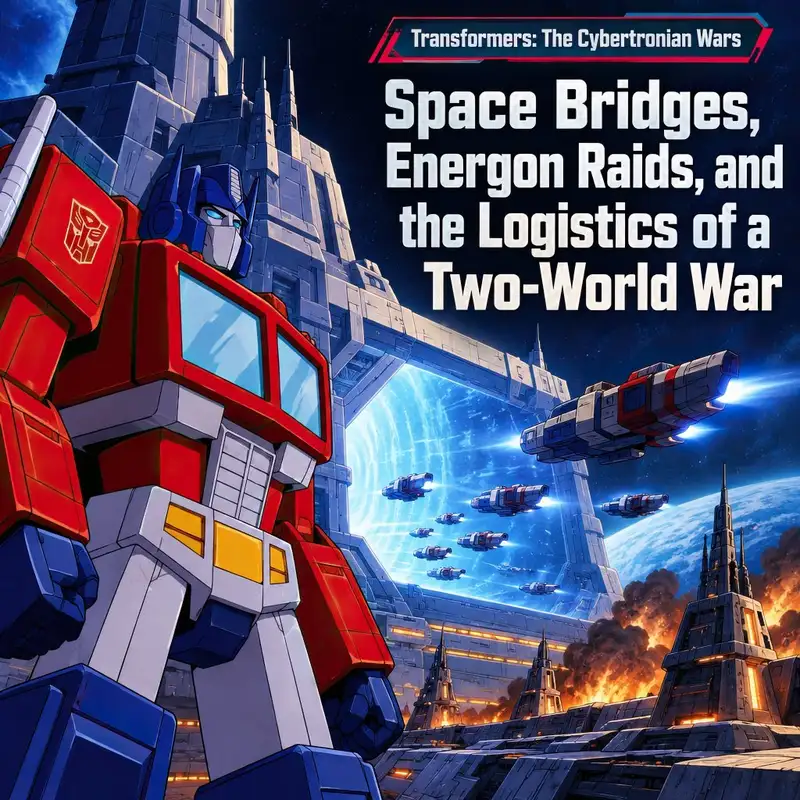
Space Bridges, Energon Raids, and the Logistics of a Two-World War
An oil platform off the American coast becomes a battlefield within hours of the Transformers’ awakening. Decepticons descend on the facility, seize its energy resources, and convert what they take into energon cubes. On the surface, it looks like a raid. There are guards to overcome, equipment to wreck, and a cargo of alien fuel to carry away. But the oil is not the final objective. The real objective lies on another world.
In this American Generation One animated history, Earth’s energy is valuable because Cybertron has been drained by a long civil war. The Decepticons do not need oil simply to keep a few soldiers moving through a local campaign. They need a flow of usable energon that can support a wider struggle, restore access to their homeworld, and strengthen their position against the Autobots wherever the war is fought next.
That distinction changes the meaning of nearly every early Decepticon operation. A successful ambush may destroy an Autobot vehicle or drive a human security force from a facility. An energon raid can do more. It can feed damaged troops, support weapons and repairs, supply a bridge between worlds, and reinforce Decepticon power on Cybertron. The local fight matters because it belongs to a supply system.
The workers at the oil platform have no reason to understand any of this. They see an attack on their workplace by machines from another planet. Yet they are immediately drawn into an interplanetary war economy. Their infrastructure, their labor, and their safety have become military inputs for a conflict that began long before Earth knew Cybertron existed.
That is the essential problem of the early Earth war. The Autobots and Decepticons are not just fighting over hiding places, weapons, or territory. They are fighting over the means to remain operational. The space bridge turns that contest into a two-world war, joining Earth’s industrial resources to Cybertron’s survival and making energy theft as strategically important as any battlefield victory.
Cybertron’s condition explains why Earth becomes so important. By the time the Autobots launch the Ark, their homeworld has suffered through a prolonged conflict between the two factions. The series gives no reliable accounting of total production, reserves, or population, and it does not need one. The political and military fact is clear enough. Energy scarcity has become severe enough that the Autobots seek new sources beyond Cybertron.
The Ark is therefore not just an exploratory vessel. It is a strategic response to exhaustion. Its mission is tied to energy, mobility, and survival. The Autobots need access to resources that Cybertron can no longer provide easily. Megatron’s pursuit shows that the Decepticons understand the same problem. Whatever ideological and political origins lay behind the war, its continuation now depends on fuel.
The pursuit ends badly for both sides. The Autobot ship and the Decepticon vessel crash on prehistoric Earth. Their crews remain inactive for roughly four million years, buried far from Cybertron and far from any organized supply system. That dormancy is important. It is not four million years of continuous combat, but a long interruption in which neither faction can exploit Earth nor influence events on Cybertron directly.
When the Transformers awaken in nineteen eighty-four, they do not begin a new conflict from a position of abundance. They resume an old conflict under new conditions. Earth has energy sources, industrial facilities, roads, aircraft, communications networks, and a large organic population that did not choose to become part of the war. The planet is not Cybertron. It has its own infrastructure, its own geography, and its own people. But to the Decepticons, it is immediately useful.
Cybertron remains the larger political objective even while the visible fighting shifts to Earth. It is the homeworld whose depletion made the search necessary. It is the place whose resources, installations, and strategic future still matter. Earth may be the active theater, but it is not automatically the center of the war. At first, it is the place from which one side hopes to rebuild power elsewhere.
Teletraan I’s scans give the awakened Transformers Earth-compatible alternate modes. That adaptation improves their ability to move through the new environment. A truck can use roads. A jet can cross long distances quickly. A cassette deck, car, aircraft, or construction vehicle can approach human infrastructure without immediately appearing to be alien. But alternate modes do not solve the logistical problem. They only change how the problem is approached.
A Decepticon force still has to find an energy source. It has to seize or control the site long enough to extract energy. It has to convert that energy into energon. It must protect the result from Autobot interference, store it, move it, and eventually deliver it to the point where it can be used. A disguise may help a raiding force approach an oil platform or power facility. It does not refine fuel, secure a shipment, or make the local population accept being used.
The Decepticons initially treat Earth largely as an extraction zone. Its energy is useful. Its installations can be seized. Its people can be intimidated, manipulated, or forced into service. Megatron’s Earth-based command pursues these advantages with a practical ruthlessness. The objective is not always to occupy territory permanently. Often it is to take what is needed, deny it to the Autobots, and convert a local resource into Decepticon military power.
The Autobots develop a different relationship with Earth. Their alliance with humans is not just sentimental. It gives them local knowledge, access to information, and a measure of political legitimacy. Spike Witwicky, Sparkplug Witwicky, and Chip Chase are not substitutes for an Autobot command structure. They are human participants whose knowledge of Earth matters because the war is now taking place inside their society.
Sparkplug understands machinery and industrial work. Chip brings technical curiosity and analytical skill. Spike moves between the Autobots and ordinary human life. Their presence reminds us that Earth is inhabited terrain. A refinery is not an abstract fuel icon. A weapons facility has personnel. A power installation has workers and surrounding communities. A coastal disaster threatens people who have no faction badge and no vote in Cybertronian politics.
The cartoon never presents a detailed unified governmental response to the Transformers’ arrival. It does not follow cabinet meetings, international law, or a complete human command structure. That absence is not the same as evidence that human institutions do not exist. It simply means the series keeps its attention on local crises, military encounters, and a small group of human allies. What it does establish is that civilians and workers repeatedly bear the risks of Decepticon resource operations.
Earth is therefore both rear area and frontline. It is a rear area because its energy and industry can sustain forces fighting for Cybertronian objectives. It is a frontline because the Autobots are present, human resistance exists, and every raid can trigger direct combat. The Decepticons cannot simply harvest energy without opposition. The Autobots cannot defend Earth without confronting the larger problem of where that stolen energy is going.
That final question becomes decisive with the space bridge. Before such a system is available, Earth is rich in potential resources but distant from Cybertron. A raiding force can collect energon locally, but the strategic value of that energy is constrained by the problem of interplanetary transport. The bridge changes that relationship. It does not create energy. It makes Earth’s energy accessible to a war whose political center remains elsewhere.
In the early animated series, the space bridge is a linked Earth-to-Cybertron system associated with Decepticon infrastructure and with Shockwave’s continued presence on Cybertron. Its purpose is initially logistical. It provides a route through which energon can move from Earth to the homeworld. Later, personnel can move through it as well. The network turns a distant planet into a reachable destination and an extraction site into part of a larger supply chain.
That is an immense strategic change. Distance had protected Cybertron from immediate Earth-based interference and had limited the value of Earth’s captured resources. Once a bridge links the two worlds, the Decepticons can attempt to support Cybertron directly. Energy collected at an Earth facility can become part of the Decepticon effort to sustain operations on their own planet. The war no longer has a clear front and rear. It has connected theaters.
Still, the bridge should not be read as magic that removes every problem of war. It removes much of the transit problem. It does not remove extraction, conversion, storage, security, maintenance, command, or intelligence. Someone must operate the system. There must be functioning endpoints. Cargo has to reach the bridge. The receiving end has to remain secure. A route that can move energon can also become a route through which enemies enter.
The early episodes suggest particular operating constraints and procedures, but the series does not apply them consistently afterward. That is common in this animated branch. The durable historical point is not a precise engineering rule. It is the bridge’s demonstrated effect. It creates interplanetary access. It permits resources and personnel to cross between Earth and Cybertron. It makes control of infrastructure more important than simply holding the ground around a single battle.
Shockwave’s position on Cybertron matters in this context. He is not just a remote scientist receiving reports from Megatron. He is associated with the Cybertronian end of Decepticon power, with technical capacity, and with the continued management of a homeworld that the Earth-based Decepticons are trying to sustain. Megatron commands the main Decepticon force on Earth, but Shockwave’s role gives him practical importance over the network that makes Earth’s raids strategically meaningful.
This division of responsibility also reveals a limit on Megatron’s personal authority. He may issue orders and dominate the Earth campaign, but the Decepticon war effort depends on people, systems, and facilities beyond his immediate presence. The bridge links commands as well as planets. It gives Megatron access to Cybertron, but it also makes him dependent on Cybertron-side engineering, communications, and resource management.
For the Autobots, the bridge is initially an enemy advantage. It allows stolen energon to leave Earth and contributes to Decepticon access to their homeworld. But the same route creates an opportunity. If the Autobots can locate it, understand it, and use it, then Cybertron is no longer an unreachable Decepticon rear area. It becomes a place that can be raided, infiltrated, and contested.
That possibility becomes urgent in “Divide and Conquer.” Optimus Prime is critically damaged during the conflict, and the crisis reveals that sustaining an army is not only a matter of fuel. It is also a matter of repair. A commander’s body can be damaged beyond what immediate field treatment can resolve. Recovery depends on expertise, facilities, components, and time. Even a force with a skilled medic cannot assume that every necessary part exists in every theater.
Ratchet and Wheeljack represent this often overlooked side of the war. They are not just convenient repair specialists who can restore any casualty whenever the plot requires it. In this case, Prime’s survival depends on a component that cannot be obtained easily on Earth. The repair problem becomes a logistical mission. The Autobots need access to Cybertronian resources, and they need it before the loss of their commander becomes permanent.
The stakes are personal because Prime is their leader. They are also operational. Losing him would affect command, morale, coordination, and the Autobot ability to respond to Megatron. Yet the solution is not found in a duel. It lies in supply, technical knowledge, and mobility. The Autobots must reach a location where the needed resource exists. In a war spread across worlds, medicine and transport become matters of command survival.
Finding the space bridge is therefore a decisive intelligence achievement. The Autobots know that the Decepticons possess a route to Cybertron, but knowledge of a capability is not the same as knowledge of its location. The bridge is infrastructure. It has to exist somewhere in physical space, be operated through some system, and be reached by cargo and personnel. Those dependencies make it vulnerable to discovery.
Chip Chase assists the Autobots through technical analysis with Teletraan I. The significance of his role is easy to miss amid the action. He does not defeat the Decepticons through superior firepower. He helps turn scattered information into a usable assessment. He contributes to locating the route that the Autobots need. In military terms, analysis creates mobility. Information opens a path that weapons alone could not reveal.
The resulting Autobot mission is small in scale but large in meaning. Bumblebee, Bluestreak, Trailbreaker, and Ironhide use the bridge to reach Cybertron and seek the component needed for Prime’s repair. They are not launching a planetary invasion. The series provides no basis for imagining an enormous Autobot offensive. They are a limited team conducting a high-risk penetration into an enemy-controlled strategic area.
Tactically, the mission proves that a small Autobot group can cross to Cybertron and survive long enough to pursue its objective. Operationally, it proves something larger. The Decepticons’ logistical system can be used against them. A bridge designed to move resources toward Decepticon-held Cybertron also gives the Autobots access to that world. Once a route exists, its owner must defend both ends and consider every user who may seize, exploit, or sabotage it.
For that reason, bridge control is more complicated than possession. A Decepticon installation can be powerful without being perfectly secure. The bridge has strategic value because it connects worlds, but connection creates exposure. It creates a route for resupply, infiltration, rescue, intelligence gathering, and escape. The same system that reduces distance also expands the number of places where a commander can be surprised.
“Divide and Conquer” also demonstrates why human participation matters. Chip’s contribution is not an ornamental side story. Earth knowledge and access to Earth-based systems help the Autobots solve an interplanetary problem. The war may have begun on Cybertron, but its new theater changes who can influence it. Humans do not need to command an Autobot army to shape the outcome. They need only provide capabilities the Cybertronians lack in that moment.
The operation saves more than one life. It changes the strategic map. Before the Autobots use the bridge, Cybertron is largely a distant objective connected to Earth by Decepticon power. Afterward, it is an active theater that the Autobots can reach. This does not make the two sides equal. The Decepticons still possess major advantages in their infrastructure and in Shockwave’s presence on Cybertron. But the idea of a secure Decepticon rear area has been damaged.
The space bridge now sits at the center of a more complicated command problem. Megatron directs raids, extraction, and combat on Earth. Shockwave retains influence over Cybertron-side resources and technical systems. Starscream serves as a capable participant in Decepticon operations, but his ambition also exposes the weakness of a hierarchy built heavily around Megatron’s personal dominance. Access to two worlds gives the Decepticons more opportunities, but also more friction.
A leader cannot be in every theater at once. Megatron may have a clear strategic objective, but Earth-based extraction, Cybertron-side management, technical infrastructure, and internal loyalty all require separate attention. A bridge makes movement faster. It does not make command effortless. Rapid access can create rapid crises. It can multiply the number of decisions that must be made before the enemy exploits a vulnerable node.
Optimus Prime faces a related problem from the opposite position. The Autobots must protect Earth’s population, keep their small force operational, recover damaged personnel, and prevent the Decepticons from using Earth’s resources to consolidate power on Cybertron. Their moral commitments and their strategic needs are connected. Defending civilians is not separate from the war. It is part of denying the Decepticons a stable extraction zone.
But that commitment also creates a burden. The Autobots cannot simply abandon Earth to strike Cybertron. They cannot treat human communities as expendable terrain. Every Decepticon raid forces them to decide how much strength to keep close to civilians and how much to send against the larger supply network. The space bridge makes Cybertron accessible, but it does not make Earth less vulnerable.
Megatron’s plan in “The Ultimate Doom” pushes this logic to its most dangerous extreme. Instead of using a space bridge only as a route for cargo and personnel, he seeks to use bridge technology to bring Cybertron itself toward Earth. This goes beyond moving another shipment of energon. It is an effort to change the physical and political relationship between the two planets.
The Decepticons’ use of Doctor Arkeville and human prisoners is central to the operation. Arkeville is a human collaborator with technical value to Megatron’s campaign. Other humans, including Sparkplug Witwicky, are subjected to coercive control through the hypno-chip system. Their forced labor and manipulated expertise reveal an important limit on Decepticon power. The invaders are formidable, but they still need local knowledge, labor, and technical assistance.
That need does not make the Decepticon occupation less threatening. It makes its coercive nature clearer. Earth’s people are not treated as allies with political agency. They are treated as resources to be directed, tools to be used, or obstacles to be removed. The hypno-chips are not just a villain’s gimmick. They are a means of converting unwilling civilians into components of a military project.
The project itself escalates the meaning of the bridge. Megatron is no longer satisfied with transporting energon away from Earth. He attempts to alter the strategic geography of the war by drawing Cybertron into Earth’s vicinity. What follows at once is catastrophic disruption. The changing proximity of Cybertron produces severe tidal and weather effects, threatening communities and infrastructure on a planetary scale.
The series never provides a rigorous astronomical account of Cybertron’s position, energy requirements, or final orbital status. It would be a mistake to invent one. What the visual and narrative evidence establishes is the human consequence. Earth experiences a widening environmental emergency. The Decepticon bridge project turns a contest over energy into a crisis affecting the entire planet.
In the immediate fight, Megatron seeks to break Autobot resistance and keep his enemies off balance. Across the wider operation, he seeks control over the Earth-Cybertron connection and over the human labor needed to sustain it. Strategically, he seeks a position in which Earth can be subordinated to Decepticon needs and Cybertron can regain access to the resources required for recovery and continued war.
This is an ambitious plan, but it has a political weakness built into it. A world treated solely as a fuel reserve and labor pool becomes a source of resistance. The Decepticons may compel individual humans, seize facilities, and trigger panic. They do not create consent. Their methods give the Autobots a stronger claim to be defenders rather than merely another armed Cybertronian faction fighting on foreign ground.
The environmental crisis also exposes a hard truth about resource warfare. A campaign can achieve its narrow technical aim while damaging the very theater it depends upon. If Earth is valuable because of its energy infrastructure and population, then destabilizing its environment risks destroying or alienating the base from which that value is drawn. Megatron’s plan produces leverage, but it does not produce a durable political settlement.
The Autobot response demonstrates the operational burden of a two-world war. The crisis cannot be solved in one location. Earth needs immediate protection from the consequences of Cybertron’s approach and from continuing Decepticon operations. Even so, Sparkplug must be rescued, the hypno-chip system must be countered, and Decepticon control arrangements on Cybertron must be disrupted.
The Autobots have to divide their effort. One group cannot simply concentrate every available fighter against Megatron while another emergency continues elsewhere. A force remains tied to the Earth theater because civilians face immediate danger. Another effort must travel to Cybertron because the system enabling the crisis cannot be neutralized entirely from Earth. The bridge creates reach for both sides, but it also compels both sides to think across linked theaters.
This is more than a dramatic split between parallel adventures. It is a problem of command and allocation. Every Autobot sent through the bridge is one less Autobot available to defend Earth. Every defender kept on Earth is one less specialist available to strike the Decepticon system at its source. In an army with limited personnel and specialized capabilities, that choice has real consequences.
Optimus Prime’s command is tested by this division. He cannot treat the defense of Earth as a distraction from Cybertronian affairs, because Earth’s survival has become strategically and morally inseparable from the war. Nor can he ignore Cybertron, because Decepticon control there would give Megatron greater access to the infrastructure and political center that the Autobots still hope to preserve.
The human stakes make concentration even harder. Defending Earth means more than defeating visible Decepticon units. It means preventing a population from being subjected to environmental disaster, forced labor, and manipulation. It means recognizing that the people around the Autobots are not just allies of convenience. They are civilians whose world has been transformed by an external civil war.
The Decepticons’ bridge strategy thus creates a paradox. It gives them mobility and leverage, but it also creates targets that the Autobots can identify and attack. It lets Megatron reach toward Cybertron, but it binds his Earth operations more tightly to a vulnerable network of human collaborators, prisoners, installations, and technical systems. The larger the scheme becomes, the more places there are where control can fail.
Even after the immediate crisis of “The Ultimate Doom” is resolved, the early series does not treat energy as a solved problem. “Desertion of the Dinobots” returns to the question of specialized fuel needs and resupply. The episode involves the depletion of Cybertonium, a substance connected to the Dinobots’ continued condition, and it includes a shipment from Cybertron through the space bridge.
The details should not be generalized beyond this story. Cybertonium is not a universal explanation for every Cybertronian fuel requirement, and the episode does not establish a complete scientific model of energon, repair, or biology. Its significance is logistical. Access to energy in one form does not guarantee that every force is sustained in every circumstance. Compatibility, quality, location, and delivery all matter.
An army can know where fuel exists and still lack what it needs at the point of use. A supply may be on Cybertron while the troops who require it are on Earth. A shipment may be available only through a route that must be operated and defended. A specialized component may not be replaceable with whatever energy source happens to be nearby. Abundance in theory is not readiness in practice.
For that reason, the early war cannot be understood through combat alone. The Decepticons often possess the initiative because they can choose an extraction target and turn a civilian facility into a military objective. The Autobots can win an encounter and still face a strategic loss if energon has already been converted, stored, and sent toward Cybertron. A destroyed raiding party may matter less than a successful shipment.
Conversely, an Autobot operation that appears small can have major consequences if it interrupts the chain between extraction and use. Discovering a bridge, rescuing a technical specialist, recovering a repair component, or preventing a forced-labor project may not look as spectacular as destroying a fortress. Yet such actions can deny the Decepticons the ability to sustain their wider campaign.
The distinction is one of level. Tactically, an energon raid is a fight over a platform, refinery, factory, or shipment. Operationally, it is a contest over access to facilities, routes, storage, and rear areas. Strategically, it concerns whether Cybertron can be supplied and whether the Decepticons can convert Earth’s resources into durable power. Politically, it concerns whether either faction can claim legitimacy while Earth’s people are made to pay for Cybertron’s survival.
Megatron understands the strategic value of resources. His campaigns are not limited to proving that Decepticons can defeat Autobots in battle. He wants energon because energy allows the Decepticons to act beyond the immediate encounter. It supports mobility, weapons, repair, construction, and access to Cybertron. In that sense, his raids are part of a larger effort to transform military success into political control.
But resource control is not the same as governance. The Decepticons can seize, threaten, and compel. They can use human expertise without recognizing human sovereignty. They can attempt to relocate Cybertron and impose their needs upon Earth. What they cannot achieve through coercion is stable consent. Their system can extract, but extraction deepens resistance and makes every industrial site a potential point of conflict.
The Autobots gain an advantage by treating Earth as more than a depot. Their defense of human allies and communities gives them a political relationship that the Decepticons cannot easily replicate. Yet that advantage comes with obligations. The Autobots inherit a responsibility to protect a world outside their original civil war. They must spend strength on rescue, disaster prevention, and local defense even when those tasks do not offer an immediate route back to Cybertron.
For that reason, the two-world war is harder for the Autobots than a simple campaign of pursuit. They are not only trying to stop theft. They are trying to deny an enemy the ability to build an interplanetary war economy while preserving the safety and autonomy of the planet being exploited. Their military choices are constrained by civilians, alliances, and the need to prevent the conflict from consuming its new host world.
The space bridge is the mechanism that makes this problem unavoidable. It links Earth’s energy to Cybertron’s unfinished civil war. It allows the Decepticons to treat terrestrial infrastructure as a source of strategic recovery. It gives Shockwave’s Cybertron-side command practical importance. It allows the Autobots to reach a world that had seemed distant and inaccessible. And it ensures that neither planet can remain safely outside the conflict once the network is active.
The space bridge does not erase distance. It links distant problems. Security, loyalty, repair skill, supply quality, political control, and civilian resistance still have to be managed on both sides of the route. Yet once Earth and Cybertron can exchange resources, personnel, and consequences, a raid on one world can alter the military balance on the other. The bridge turns geography from a barrier into a contested system of access.
That is why energon raids matter beyond the amount of fuel captured in any one attack. They sustain armies, maintain technical systems, keep routes open, and determine which faction can continue shaping Cybertron's future. Earth becomes part of the civil war because its resources can now be converted into Cybertronian military power. The deeper question is sovereignty: whether a damaged Cybertron will survive by treating another world as a supply depot, or whether the people living beside those resources can remain something more than the fuel line of a war they never chose.