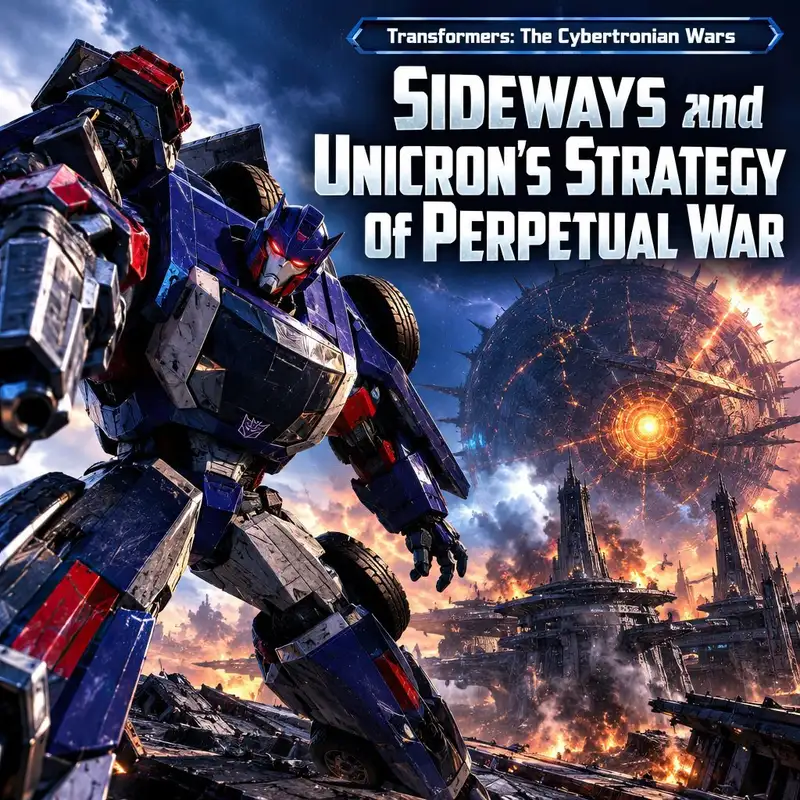
Sideways and Unicron’s Strategy of Perpetual War
The Hydra Cannon gave Megatron a weapon that seemed to settle the war on Earth in a single stroke. Built from the combined power of the Star Saber, the Skyboom Shield, and the Requiem Blaster, it could reach far beyond an ordinary duel between Autobots and Decepticons. The target was the Autobot base. The danger was the planet beneath it. As the weapon charged, the intended victory became difficult to separate from catastrophe. Earth was no longer just terrain where two Cybertronian armies pursued their quarrel. It was home to the human children who had become essential to the Mini-Cons, a refuge for both factions, and a world that could not absorb unlimited alien escalation.
Optimus Prime’s response was not a conventional counterattack. He absorbed the blast himself, apparently sacrificing his life to prevent the weapon from destroying Earth. The scene matters because it reveals the strategic absurdity at the heart of the late Armada war. The Decepticons had assembled a capability powerful enough to threaten their enemies, but its use endangered the political and physical environment on which the entire conflict now depended. A weapon can be tactically formidable and strategically irrational at the same time.
That contradiction did not begin with the Hydra Cannon. The cannon was the result of a war already organized around the pursuit of decisive advantage. In the English-language Armada continuity, the Mini-Cons sit at the center of that contest. They are smaller Cybertronians whose partnerships can amplify the capabilities of larger Transformers. Their importance makes them military assets in the eyes of both sides. Yet they are also sentient beings, with loyalties, fears, and eventually political choices of their own.
The late Armada story asks a harsher question than which faction can gather the most Mini-Cons. It asks what happens when a war becomes useful to a third power precisely because neither side can imagine living without victory over the other. Unicron’s strategy does not depend on personally directing every battle or issuing every order. He does not need to invent the Autobot-Decepticon conflict from nothing. He benefits from its continuation, from its bitterness, and from the way each side turns fear of the other into a reason to seek more destructive tools.
Sideways is the operative who keeps that system functioning. He is not introduced as an openly overwhelming commander. His value lies elsewhere. He is an infiltrator, provocateur, and source of selective information. He moves through the conflict without offering either faction a stable answer to a basic intelligence question: whose side is he on? That uncertainty is not a flaw in his operation. It is the operation.
In Armada, Sideways appears with Mini-Con partners named Rook and Crosswise, and their shifting associations help reinforce the impression that his loyalties can be read in more than one direction. To Autobots and Decepticons already accustomed to espionage, betrayal, and concealed agendas, he can look like an opportunity. A commander may believe he is using Sideways as a source, a guide, or a temporary ally. Sideways needs only enough access to influence decisions. He does not need universal trust.
That is an important distinction in intelligence work. Deception rarely requires every target to believe the same falsehood. It is often enough that each target interprets incomplete information according to an existing fear. Autobots can see another Decepticon trick. Decepticons can see an Autobot manipulation. Rivals can see a chance to strengthen themselves against their own commander. Sideways prospers because the war has trained everyone to suspect one another before they investigate the larger pattern.
His most effective intervention comes not through direct force, but through a damaged command relationship. Megatron’s treatment of Starscream creates an opening that Sideways can exploit. Starscream is more than a familiar ambitious subordinate waiting to make an inevitable betrayal. In this story, he is an officer whose frustration has accumulated inside a coercive hierarchy. He wants recognition, autonomy, and a role larger than obedience under humiliation. Sideways recognizes that grievance and turns it toward fracture.
Megatron’s authority is formidable, but it is not frictionless. A leader can compel loyalty through fear, rank, and personal strength, yet still weaken the institution he commands. Subordinates may obey while withholding initiative. They may compete for protection rather than cooperate. They may interpret every setback as evidence that the commander values obedience over competence. Such a force can remain dangerous in battle, but its internal cohesion becomes increasingly fragile.
Sideways does not create Megatron’s mistreatment of Starscream. He does not have to. His talent is escalation. He applies pressure to an existing fault line until private resentment becomes political rebellion. In the episode called “Rebellion,” the result is not a clean transfer of power. It is a deeper failure of trust within Decepticon command. Megatron loses the benefit of a subordinate’s confidence. Starscream gains a reason to act outside the chain of command. Sideways gains a new channel through which instability can spread.
This is how a war of perpetual conflict sustains itself. It does not require one side to collapse completely. In fact, complete collapse may be undesirable. A defeated faction can no longer provide rivalry, fear, or an arms race. What serves Unicron better is a balance in which neither Autobots nor Decepticons can settle the war, and where internal disputes make each faction more dependent on desperate measures.
The Decepticons are not alone in treating the Mini-Cons as a source of military advantage. The Autobots also pursue them because leaving them in Decepticon hands could shift the balance of power. The Mini-Con hunt is therefore a distributed arms race. It requires search operations, intelligence, transport, temporary alliances, and denial of access to the enemy. A Mini-Con found in a remote location is not yet useful. It must be reached, persuaded or captured, protected, and brought into a larger system of command.
Exact force sizes, fuel consumption, and production capacity remain unspecified. It does establish that mobility matters. Autobots and Decepticons move between Earth, Cybertron, bases, ships, and hidden routes. They depend on access to infrastructure, information, and the ability to keep valuable allies out of enemy hands. The Mini-Cons become the prize around which this logistical and political competition turns.
At first, the military logic is easy to understand. If Mini-Cons amplify larger Transformers, then allowing the enemy to control them appears reckless. But the logic has a moral cost. Treating sentient partners as equipment encourages both factions to overlook the most important fact about them: the Mini-Cons can decide. They are more than batteries, ammunition, or keys waiting for the proper holder. Their choices become decisive precisely because the larger combatants repeatedly underestimate them.
The human children on Earth help make that agency visible. Rad, Carlos, and Alexis do not matter because they possess a secret technical ability to out-hack Cybertronian systems. Their importance is more political and more difficult for the armed factions to understand. They meet Mini-Cons as individuals. They form relationships before they calculate military utility. In a conflict dominated by possession and control, that is a different model of cooperation.
Sideways recognizes that the visible battlefield is only part of the system he serves. His intrusion into the children’s computer environment draws them into cyberspace and exposes them to signs of something far larger and more dangerous than the immediate Autobot-Decepticon war. The encounter provides a warning, but not a usable intelligence picture. The children see enough to know that something is wrong. They do not yet have the context to identify the threat, its location, its objective, or the means by which it can be stopped.
Warnings without interpretation can be almost as dangerous as no warning at all. They may create fear, but fear does not automatically produce sound policy. A vague image of a hidden enemy can be dismissed as deception, misunderstood as an enemy trick, or absorbed into existing rivalries. In a long civil war, every piece of evidence arrives through a filter of suspicion. Information that should expand a commander’s understanding may instead reinforce what that commander already believes.
Sideways depends on that failure of interpretation. He does not need to keep the truth perfectly hidden. He needs it to remain politically unusable. The Autobots and Decepticons are so accustomed to seeing each other as the primary danger that they struggle to recognize a threat whose purpose is to keep their rivalry alive. By the time Unicron becomes visible, the underlying mechanism has already been operating for much of the late conflict.
The Mini-Con weapons demonstrate how that mechanism turns scattered resources into escalating force. The Star Saber, the Skyboom Shield, and the Requiem Blaster are more than three more battlefield devices. Each is formed through the cooperation of a separate Mini-Con team. Individually, they have formidable roles. Together, they can be integrated into the Hydra Cannon. The transformation from separate artifacts into a combined weapon is strategically important because it converts dispersed capabilities into a system with far greater reach.
That integration is more than a matter of collecting powerful objects. It requires someone to understand their relationship, bring the components together, and employ them toward a political objective. Sideways helps Thrust understand the possibility. Thrust, a Decepticon tactician with his own ambitions and calculations, becomes connected to Sideways’s larger agenda. The alliance is concealed beneath his formal place within Decepticon operations.
Thrust’s role shows that infiltration does not always look like a disguised stranger entering an enemy base. It can also mean an apparently loyal officer pursuing a different strategic purpose inside his own faction. The Decepticon command structure gives Thrust access to plans, resources, and decision-makers. Sideways gives him knowledge that ordinary Decepticon leaders do not possess. Together, they can steer a faction’s existing appetite for superiority toward a result that serves Unicron.
Megatron’s planned use of the Hydra Cannon against the Autobot base follows the immediate logic of war. Destroy the enemy’s position. Break its ability to resist. Demonstrate a decisive advantage. In individual engagements, the weapon promises destruction on a scale that ordinary combat cannot match. For the campaign as a whole, it could give the Decepticons coercive leverage over the Earth theater. An Autobot force deprived of its base, its coordination, and perhaps its confidence would be far easier to pressure.
But strategy is more than the accumulation of tactical effects. The employment of the cannon threatens Earth itself. That changes the calculation. The Decepticons are not fighting on an empty proving ground. Their pursuit of victory risks destroying a world that has become central to the Mini-Con conflict and to their own ability to operate. Even if the target is Autobot, the collateral danger is no longer a side effect that can be ignored.
For Earth’s human population, the distinction between Autobot target and Decepticon objective offers little comfort. A weapon that imperils the planet turns an alien civil war into a civilian survival crisis. No casualty projection or complete technical yield is given; the visible threat is enough to establish the stakes. The visible danger is sufficient. The cannon is powerful enough that its use cannot be treated as a contained military action.
Optimus Prime’s decision to absorb the blast is therefore more than an act of personal courage. It is an attempt to deny the Decepticons a victory that would become self-defeating. His apparent sacrifice protects Earth, but it does not resolve the system that produced the weapon. The arms race remains. The distrust remains. Sideways remains at work. Removing one leader, even temporarily, does not end a war built from institutions, fears, and rivalries larger than any single commander.
The episode also complicates the idea that the Decepticons alone are responsible for escalation. Megatron authorizes the weapon’s use, and the political responsibility for that decision belongs to his command. Yet the Hydra Cannon exists because the entire conflict has made Mini-Con power the standard by which security is measured. The Autobots pursue Mini-Cons because they fear Decepticon control. The Decepticons seek them because they believe superiority will bring victory. Sideways’s achievement is to make those reciprocal fears productive for Unicron.
Optimus returns, but the war does not become clearer. The conflict moves back toward Cybertron, and Megatron becomes Galvatron. The new name marks a significant stage in the series’ final confrontation, but it should not be treated as proof of a fully explained ideological conversion or a simple replacement of one personality with another. What matters strategically is that Galvatron remains shaped by the habits of the war he has fought for so long.
The Mini-Cons attempt to warn of an approaching danger. Galvatron initially receives the warning through the same interpretive frame that Sideways has helped cultivate. If the Autobots say there is a larger enemy, then perhaps the Autobots are manipulating him. If the Mini-Cons urge caution, perhaps they are serving Autobot interests. This is not stupidity. It is strategic blindness produced by experience. A commander who has survived repeated deception may begin to treat accurate intelligence as another form of deception.
Long war has that effect on political communities as well as individuals. Each side develops a language in which the other side’s motives explain every event. An enemy cannot simply be mistaken, frightened, or responding to a real threat. The enemy must be plotting. Under those conditions, cooperation becomes difficult even when survival depends upon it. Evidence is abundant, but trust is scarce.
The real enemy’s infrastructure remains concealed in plain sight. Underground portals and hidden access routes provide Sideways and Thrust with operational depth. These routes do not need to be explained as unlimited transportation systems to matter. The series establishes their essential military value: they allow movement through spaces that ordinary front lines do not control. They connect the visible war to a hidden theater.
A portal network changes the meaning of geography. Forces that believe they are guarding a position may discover that the decisive route lies beneath, behind, or beyond their defenses. A concealed access point can bypass a fortified approach, move agents to unexpected locations, and preserve a secret installation from ordinary reconnaissance. Its value is not necessarily mass transport. It may be secrecy, timing, and the ability to place the right people at the right point in the conflict.
Through these hidden routes, the revelation comes into focus. The Cybertronian moon is more than a moon. It is Unicron in dormant form. The discovery transforms the strategic picture. The war has not just occurred beneath the shadow of a vast external threat. It has helped sustain that threat. Unicron has remained concealed while the Autobots and Decepticons exhausted themselves, armed themselves, and deepened the hatred on which his plan depends.
The revelation is an intelligence failure, but it is more than a matter of poor sensors. The warning signs existed. Sideways’s behavior was suspicious. The children encountered evidence of a larger presence. The Mini-Cons carried knowledge and fear that the larger factions did not fully understand. Yet none of this could become effective action until the factions revised their assumptions about what kind of war they were fighting.
Across multiple engagements, Unicron’s hidden infrastructure means that the visible Autobot-Decepticon front was never the whole battlefield. For the survival of the larger campaign, Unicron has avoided the costs of overt conquest. He has not needed to seize Cybertron’s cities one by one, defeat every army in direct battle, or establish a conventional occupation. Instead, he has cultivated conditions in which the combatants strengthen the danger themselves.
Proof, however, does not automatically create a coalition. Galvatron has spent too long fighting Optimus Prime to accept Autobot warnings without a decisive change in the political situation. That change comes through Starscream. The same officer whose alienation Sideways once used to destabilize the Decepticons becomes the figure who makes denial impossible.
Starscream’s sacrifice is not important merely because it is tragic. It is a political and informational turning point. He acts in the face of a danger that cannot be reduced to an Autobot trick or a Decepticon rivalry. His decision demonstrates that the threat is real and immediate. For Galvatron, it forces a reassessment that abstract warning could not achieve. The cost of disbelief has become visible in the loss of someone whose relationship to Decepticon command was deeply personal.
There is an irony here. Sideways had treated Starscream’s discontent as fuel for division. He assumed that a fractured command would serve the larger strategy of perpetual war. But discontent does not always remain available for manipulation. Starscream’s experience of betrayal, humiliation, and conflict gives him an understanding of the war’s costs that helps him act against the system that exploited him. His earlier break from Megatron does not make him an uncomplicated hero. It does make his final decision politically meaningful.
The alliance that follows is temporary, functional, and incomplete. Autobots and Decepticons do not abandon their symbols, memories, or competing claims overnight. Armada shows no carefully negotiated peace treaty, unified command doctrine, or developed system of postwar justice. What it does show is a recognition that unilateral victory has become meaningless if Unicron awakens fully. An Autobot triumph over the Decepticons would not save Cybertron. A Decepticon triumph over the Autobots would not save it either.
Coalition warfare often begins with that realization. Participants do not have to trust one another in every matter. They must recognize that a shared danger is more urgent than the dispute they have brought into the alliance. The combined assault on Unicron is therefore not reconciliation in the fullest sense. It is a survival arrangement made under conditions of extreme pressure.
Even that arrangement requires a different kind of operation. Unicron cannot be defeated solely by attacking his exterior, and he cannot be defeated solely by sending a small party into his interior. The threat has both an external military presence and an internal command center. The episode “Union” presents a two-sided assault. Combined Autobot and Decepticon forces attack from outside while the Mini-Cons and the human children enter Unicron through a portal.
The operational logic is sound even within the extraordinary scale of the setting. External pressure can distract, damage, and limit the enemy’s freedom of action. It can create the conditions under which an internal team reaches a critical objective. Internal penetration can strike at the mechanisms that exterior firepower cannot reliably reach. Neither effort is sufficient by itself. The outside force needs the internal mission to produce a decisive effect. The internal mission needs the outside force to create time and opportunity.
The assault has no detailed troop count, formal joint-command chart, or complete order of battle. It would be misleading to invent one. The important point is that both factions contribute to a common operation after spending the series treating each other as the principal enemy. Their cooperation is not born from sentiment. It is born from an altered strategic reality.
The Mini-Cons are essential to that operation, but not as weapons carried by larger heroes. Their role has changed because their agency has become undeniable. Earlier in the war, the question was which side would control Mini-Con power. During the assault on Unicron, the question becomes whether the Mini-Cons themselves will resist the purpose for which they were drawn into the conflict. The answer determines more than battlefield advantage. It determines whether Unicron’s system can continue to use them.
The children remain unusual participants in this struggle. They are not conventional soldiers, and Armada never turns them into a human special-operations unit. Their contribution is relational. They have helped the Mini-Cons experience loyalty not based on ownership or coercion. That bond matters inside Unicron because it offers the Mini-Cons a political identity separate from being instruments of larger factions.
This is one of the late story’s most consequential ideas. A weapon cannot reject its user. A person can. The Mini-Cons become strategically decisive because they are more than an energy source or a collection of artifacts. Their ability to choose breaks the assumption that power belongs automatically to whoever possesses the strongest body, the largest army, or the most dangerous device.
Inside Unicron, Sideways finally becomes legible. He is revealed not as an independent Autobot or Decepticon operative with an obscure private agenda, but as an extension or creation of Unicron. No complete biography is given for Sideways before his service to Unicron. His identity is functional. He is Unicron’s interface with the war, the agent who can move among factions and convert their choices into progress toward his master’s awakening.
Sideways explains the hidden relationship between Unicron and the conflict. Unicron has encouraged the continuing war and feeds on the hatred it generates. The series establishes that this relationship is real and decisive. It does not provide a precise physical formula by which anger becomes usable energy, nor should the story be forced into one. The important fact is political as much as metaphysical. Hostility is not just an emotion in this system. It is a strategic resource.
That makes Unicron’s method more disturbing than direct conquest. A conventional invader takes territory by force. Unicron encourages his enemies to preserve the conditions that empower him. He benefits when leaders refuse compromise because compromise looks like weakness. He benefits when military competition turns every Mini-Con into a prize. He benefits when officers are humiliated into rebellion, when intelligence is dismissed as enemy deception, and when commanders believe a larger weapon will solve a political conflict.
Sideways is the embodiment of that method. He does not need to command an army in public. He only needs to make conflict more likely, mistrust more durable, and escalation more attractive. He works through partial truths, hidden affiliations, and opportunities already present in the war. The Autobots and Decepticons provide the labor. They build the rivalries, pursue the weapons, and interpret every warning through the language of factional struggle.
The Mini-Cons’ connection to Unicron is central, though the details should be handled with care. The late series links them to his origin or substance and indicates that they were meant to amplify the conflict he required. Yet the story also shows that they are not fixed tools without will. Their ties to the children help them develop or express an independence that Unicron and Sideways cannot fully control. The very beings meant to make war more potent become the source of resistance.
Sideways attempts to regain control by absorbing or dominating Optimus, Galvatron, the children, and the Mini-Cons. The attempt reflects the logic of his entire mission. If every relationship can be reduced to command and every being can be reduced to a usable resource, then resistance is only a technical problem. But that assumption fails. The Mini-Cons resist him.
Their resistance gives Optimus Prime the opening to destroy Sideways with the Requiem Blaster. The weapon had earlier been part of the arms race that produced the Hydra Cannon. Here it is used against the agent who turned weapon accumulation into a system of perpetual conflict. That reversal matters, but it should not be overstated. The Requiem Blaster does not solve the problem by itself. Its effectiveness depends on the Mini-Cons’ choice to resist and on the coalition that has made resistance possible.
Sideways fails because manipulation has limits. An agent can exploit fear, grievance, and rivalry. He can encourage factions to treat others as instruments. What he cannot fully predict is the emergence of relationships that change how people understand themselves. The Mini-Cons are no longer merely the objects of an arms race. Starscream is no longer merely a subordinate grievance to be weaponized. Galvatron is no longer only a rival seeking victory over Optimus. Each becomes capable of a decision Unicron’s system did not want.
Still, defeating Sideways and apparently defeating Unicron’s immediate form does not eliminate the condition that made the strategy work. The old conflict remains embedded in the relationship between Optimus and Galvatron. Their rivalry has survived weapons, defections, temporary alliances, and revelations large enough to reshape the fate of Cybertron. When the immediate pressure appears to lift, they return to the personal and political contest that has defined them.
In “Mortal Combat,” Optimus and Galvatron resume fighting after Unicron seems defeated. The result is immediate and decisive. Their renewed hatred reactivates Unicron. The revelation clarifies the earlier warning. Unicron’s strength is not only his enormous body, hidden infrastructure, or ability to manipulate agents such as Sideways. His strength is the willingness of his enemies to continue providing the conflict he needs.
This is the final proof that superior firepower cannot secure the victory on its own. The combined armies can attack Unicron. The Mini-Cons can resist Sideways. Optimus can destroy the agent inside the enemy’s core. Yet none of those achievements are sufficient if the principal leaders return at once to the rivalry that fed the threat. A war can outlive its weapons because it has become part of political identity.
Galvatron’s final decision must be understood in that light. He recognizes that continuing the fight with Optimus would give Unicron exactly what he requires. The decisive resource is no longer a Mini-Con weapon, a portal, a ship, or a fortified position. It is the consent to keep fighting. Unicron can provoke, tempt, and manipulate, but he cannot fully seize that consent by force. It must be given through the choices of those caught in the cycle.
Galvatron’s sacrifice denies Unicron that resource. On the battlefield, the immediate confrontation ends. In the wider theater, Unicron’s reactivation mechanism is interrupted. At the level of grand strategy, the existential danger is neutralized. Politically, the act opens the possibility of peace because it demonstrates that the rivalry need not continue simply because it has existed for so long.
The institutions required to secure that peace remain largely offscreen. It does not show every former combatant disarming, every grievance being reconciled, or every damaged relationship repaired. Galvatron’s death is not a magical guarantee that future conflict becomes impossible. What it accomplishes is narrower and more important. It breaks the mechanism by which Unicron turned endless war into power.
Sideways embodies Unicron’s real strategy. He is not the commander of a conventional invasion force. He is the cultivator of a political environment in which fear, ambition, humiliation, and the desire for decisive weapons make each faction an unpaid auxiliary of its own destroyer. The late Armada war is not ended by discovering a larger gun. It is ended when the people caught inside the system recognize that their enemy has made their rivalry useful.
Galvatron’s final act matters because it reaches the point no weapon can reach: the decision to continue fighting.