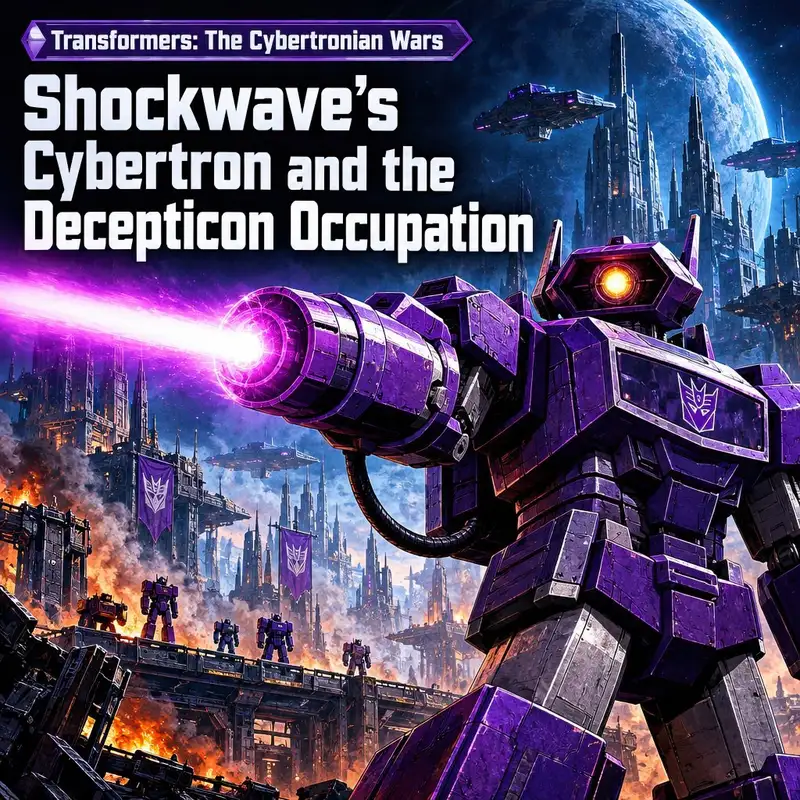
Shockwave’s Cybertron and the Decepticon Occupation [Marvel]
Beneath Darkmount, the Decepticon regime in Marvel’s Transformers comics does not just imprison its enemies. It sends them to the smelting pool. Captured Autobots, neutrals, and other inconvenient Cybertronians are reduced to raw material. The process serves several purposes at once. It removes opponents, recovers metal, denies the resistance its personnel, and warns everyone else what happens when a government recognizes a person only as a useful object.
This is not Shockwave’s Cybertron in the narrow administrative sense. The ruler shown in Polyhex is Lord High Governor Straxus, operating from Darkmount. The comics never establish Shockwave as the governor of all Cybertron, or even as Straxus’s direct superior. But the occupation Straxus administers expresses the same political logic Shockwave demonstrates on Earth. Power belongs to the commander who can seize assets, impose obedience, and make opposition materially impossible.
Marvel’s Decepticons are therefore not a settled state with an accepted constitution, a reliable succession process, or a shared idea of lawful authority. They are a militarized movement whose leaders repeatedly test one another through force, results, and control of strategic infrastructure. A ruler may command because he wins a duel, holds a fortress, controls fuel, or appears less incompetent than his rival. That arrangement can be efficient. It can also be remarkably fragile.
The smelting pool reveals the territorial side of that fragility. An occupation that turns prisoners into scrap is no longer merely defending public order. It is destroying the human, or Cybertronian, material from which resistance can be rebuilt. Darkmount does not govern through consent. It governs through surveillance, industrial control, detention, exemplary punishment, and the knowledge that neutrality offers no guaranteed protection.
Shockwave’s contribution to this history begins far from Darkmount, on Earth, during the early phase of the Marvel comic’s war. His rise does not depend on administering a city or holding a public office. It depends on recognizing an opportunity in the collapse of both armies. He appears not as Megatron’s loyal custodian, as he often does in the American animated series, but as a rival commander prepared to decide that Megatron has failed.
The distinction matters. In this Marvel continuity, Shockwave’s defining loyalty is not personal devotion to a leader. Supplementary profile material describes him as a military operations commander committed to logic. Yet logic, in his hands, is not political neutrality. It is a claim that he is qualified to judge other leaders, remove them when they fail, and replace them with a more efficient command arrangement.
That belief gains force because Megatron’s position is already vulnerable. The Decepticons on Earth are far from Cybertron, operating with limited resources and no secure political base. Their war is more than a contest of weapons: it is a struggle to find energy, maintain damaged personnel, exploit unfamiliar industry, and prevent a small expeditionary force from becoming stranded or irrelevant.
Megatron remains the Decepticon founder and the faction’s most important personal symbol. But personal authority is never the same thing as secure authority. A leader who suffers setbacks, loses access to assets, or appears unable to sustain the campaign invites challenge from subordinates who possess their own troops, technical expertise, or ambitions. The Decepticon movement has force. What it lacks is a stable way to decide who may legitimately use that force.
Sparkplug Witwicky’s fuel sabotage creates the opening Shockwave needs. In the fourth issue of the Marvel series, the sabotage disables both Autobots and Decepticons. It is a striking example of how a local human action can alter an interstellar conflict. Sparkplug does not defeat either faction in a conventional battle. He interrupts their ability to operate. In a war between machine beings, energy supply becomes a weapon.
What follows is not a clean Autobot victory. Both sides are left weakened. Their combat power is interrupted, their formations disordered, and their ability to protect themselves sharply reduced. For Shockwave, this is less a disaster than a command opportunity. He arrives after the principal combatants have exhausted one another. His achievement is not that he creates the crisis. It is that he understands how to exploit it.
Shockwave defeats the remaining Autobots and takes control of the Ark. In the process, he decapitates Optimus Prime. The scene is brutal, but it is also politically significant. Optimus’s severed head becomes more than the remains of an enemy commander. It becomes proof that the Autobots have been broken, a source of valuable knowledge and energy, and a physical symbol around which Shockwave can build his own authority.
This is the first lesson of Shockwave’s coup. Tactical success can be converted into political theater. A defeated leader displayed to allies and enemies alike can change calculations quickly. But the seizure of a battlefield is not the same as a transfer of legitimacy. Shockwave can control the Ark because he has the means to do so. He still must persuade, frighten, or compel the Decepticons to accept that his command should replace Megatron’s.
In the next phase of the campaign, Shockwave restores the Decepticons while leaving the disabled Autobots hanging from the Ark. The Autobots are held as prisoners, parts reserves, and warnings. The arrangement is practical. Damaged Cybertronians contain components that may be useful to a force short of equipment. It is also deliberate intimidation. Shockwave makes his new order visible before he has made it secure.
The imagery is important because it shows how his administration thinks. The difference between a prisoner, a spare-parts inventory, and a political message begins to disappear. Shockwave sees all three functions at once. A commander who treats every body as an asset can improvise quickly under conditions of scarcity. He can also generate a form of fear that substitutes for voluntary loyalty.
Shockwave openly judges Megatron’s leadership to have failed and assumes command himself. There is no council to confirm the decision. No legal procedure is shown. No Decepticon electorate, officer corps, or civilian institution adjudicates the matter. The transfer rests on Shockwave’s declaration, the forces under his control, and the weakness of the leader he seeks to replace.
That is not accountability in any durable sense. Megatron’s failures are real enough to make the challenge plausible, but the process rewards whichever commander can make the strongest immediate claim. It encourages leaders to turn every reverse into evidence that a rival should be removed. Such a system may punish incompetence. It also ensures that command becomes another battlefield.
Shockwave’s superiority is not limited to direct combat. He studies Earth’s resources and identifies G. B. Blackrock’s oil platform as a strategic target. That decision reveals a broader understanding of war. A force cannot survive on victories alone. It needs fuel, repair capacity, industrial access, transport, and secure sites from which those resources can be converted into military power.
The Decepticons are aliens operating in an industrial civilization that did not choose to become part of their war. Earth’s oil facilities, aerospace plants, mines, and transport networks are not background scenery. They are potential sustainment systems. Whoever controls them can reduce the gap between an expeditionary force and a functioning military presence.
Shockwave’s interest in the oil platform is therefore not simple greed, and it is not a matter of one villain collecting an exotic power source. He recognizes that Earth’s energy infrastructure can be adapted to Cybertronian needs. The comics establish that his forces can make use of those resources. They do not provide a reliable conversion rate, production total, or inventory of fuel reserves, and there is no need to invent one. The strategic fact is enough. Local industry can sustain an alien war.
When Shockwave captures the platform, he gains more than fuel. He gains an industrial foothold and a demonstration of reach. A Decepticon force that can seize a major facility can threaten workers, transport, corporate property, and the political authority of the humans who believed their world remained under human control. The occupation of infrastructure turns private enterprise into a front line.
For the workers and civilians caught nearby, the distinction between Autobot and Decepticon strategic planning may offer little immediate comfort. Their facilities become targets because they contain energy and technical capacity. Their labor becomes vulnerable because the machinery of the local economy can be redirected by a stronger armed power. Earth is more than a refuge for stranded Cybertronians: it is a resource base under pressure.
Megatron responds to Shockwave’s coup by challenging him before his own repairs are complete. The confrontation matters because it makes the leadership question public. Shockwave defeats Megatron and displays the fallen Decepticon leader before the other troops. He then compels their allegiance. The act resembles a military review conducted at the point of a weapon. The commander who has just proved himself stronger demands that everyone acknowledge the fact.
Tactically, Shockwave has won decisively. Operationally, he holds the Ark, controls an energy source, and has access to human industry. At the level of government, he has compelled submission. Those are different achievements, and the distinction is essential. Forced obedience can make an organization act in the short term. It does not create a shared rule for succession, a credible mechanism for dissent, or trust among commanders who know they may become the next example.
Shockwave’s methods are often described as logical, but the term should not be allowed to soften what the comics show. His logic is a method of military mobilization under scarcity. It identifies useful resources and eliminates obstacles. It turns a captured oil platform into fuel supply, disabled Autobots into parts and hostages, and a defeated leader into a lesson for the ranks. The method is coherent. It is not humane, impartial, or politically stable.
The same pattern appears in Shockwave’s scientific work. Later, he uses Optimus Prime’s severed head and the residual power associated with the Creation Matrix to create or animate additional Decepticon forces. The precise biological and technological rules are not developed into a universal system. What the story establishes is narrower and more troubling. Shockwave treats the remains of an enemy leader as an instrument for expanding his army.
His experiments with Jetfire reveal both the reach and the limits of that approach. Shockwave attempts to restore Jetfire, but the effort fails. From that failure, he concludes that the Creation Matrix is no longer located where he expected it to be. The remaining power, he deduces, has passed to Buster Witwicky, the human connected to Optimus Prime.
That deduction displays genuine technical skill. Shockwave observes an unexpected result, revises his understanding, and follows the new evidence. Yet intelligence is not only a matter of making correct deductions. It also depends on understanding people, loyalties, and the political terrain in which technical power operates. Shockwave can identify Buster as a factor in the problem. He cannot turn Buster’s involvement into reliable Decepticon control.
Buster helps turn Jetfire against Shockwave, and that reversal enables Optimus Prime’s restoration. The sequence prevents Shockwave’s scientific program from becoming a simple story of superior machinery defeating weaker opponents. His technical advantage is constrained by incomplete knowledge, by the resistance of those he seeks to use, and by the willingness of humans and Cybertronians to make choices outside his calculations.
The human role is especially important. Sparkplug’s sabotage had already demonstrated that Cybertronian armies could be disabled by a human intervention in their energy supply. Buster’s connection to the Matrix now demonstrates that human relationships and human agency can reshape a conflict that Decepticon commanders believe they understand. Earth is not a passive industrial reserve. Its inhabitants repeatedly become actors in the war.
Shockwave’s science also exposes the ethical cost of a command system that values utility above membership. Optimus Prime’s body is not treated as the remains of a sentient enemy entitled to dignity. Jetfire is not approached as an autonomous person whose restoration requires consent. Buster is not regarded as a civilian caught between powers. Each becomes a component in a military project.
That kind of coercion can produce immediate results. It can also create enemies, destroy trust, and make every neutral population a potential source of resistance. A regime that converts persons into equipment may acquire more equipment for a time. It loses the possibility that those persons, or those watching them, will see the regime as something other than a threat.
Optimus Prime eventually defeats Shockwave by throwing him into a swamp. The result removes Shockwave from the field for months, but it never establishes his permanent death. In the Marvel comics, apparent destruction is not always final. Shockwave later returns. The more important point is political. Removing one commander does not remove the conditions that made his coup possible.
Shockwave’s fall ends an immediate threat to the Autobots. It never settles the Decepticon succession crisis. Megatron’s authority remains tied to performance and personal command. Shockwave’s authority remains tied to his own ability to demonstrate competence. Other leaders and units have learned that the faction can be reorganized through force whenever a leader appears weak enough.
This is the difference between defeating a unit and changing a political system. An enemy commander may be trapped, captured, or forced from the battlefield. The hierarchy he exploited can survive him. If authority rests on fear, personal prestige, and possession of strategic assets, then every setback becomes an invitation to another challenge.
The later return to Cybertron makes that truth visible in territorial form. The planet is war-damaged and under Decepticon control, but the comic does not offer a complete map of a unified Decepticon state. It shows one important occupied region, Polyhex, where Lord High Governor Straxus rules from Darkmount. His title suggests formal administration. His methods reveal the actual character of that administration.
Darkmount is a fortress, a command center, an industrial site, and a detention apparatus. It concentrates armed authority and infrastructure in one location. That concentration helps the Decepticons control a city. It also makes the regime’s priorities unmistakable. The city is governed through the systems needed to identify dissent, seize bodies, process prisoners, and direct production toward war.
The smelting pool beneath Darkmount is central to that system. It does not just kill captured opponents. It makes their destruction useful. The state recovers material while making the destruction public enough to discourage resistance. This is occupation as industrial administration. Terror is not an accidental excess committed by an undisciplined soldier. It is built into the infrastructure of control.
The pool’s victims include Autobots, but not only Autobots. Neutrals and politically inconvenient Cybertronians are also vulnerable. That detail matters because it shows the regime’s true constituency. Decepticon rule does not divide the population cleanly into loyal citizens and armed enemies. It divides people into those who can be used, those who can be intimidated, and those who must be removed.
Such a system can suppress open opposition, especially when it controls repair facilities, transport routes, communications nodes, and industrial sites. But control of fixed infrastructure does not grant control of every message, every memory, or every hidden route through a city. The occupation’s strength is also a limitation. Darkmount is powerful because it gathers authority together. It is vulnerable because resistance can focus on the seams around that authority.
Scrounge’s mission demonstrates those seams. He operates as an Autobot intelligence agent inside a dangerous environment, gathering and transmitting information concerning Optimus Prime’s survival on Earth. His task is not glamorous in the usual battlefield sense. It depends on movement, secrecy, contact networks, and the ability to pass information before the occupying force can isolate him.
His death is not a sentimental interruption in the larger war. It is evidence of what intelligence work costs under occupation. A resistance organization cannot survive on courage alone. It needs people willing to move through hostile territory, identify what matters, communicate under surveillance, and accept that discovery may mean death. Scrounge’s information has strategic value because it changes what other Autobots know about the wider war.
The Decepticons possess Darkmount, the smelting pool, and visible military force. They do not possess perfect knowledge. That distinction is one of the oldest problems in occupation warfare. An occupying power can dominate roads, buildings, factories, and prisons. It cannot easily determine which ordinary movement conceals a message, which damaged machine is a spy, or which neutral has decided that survival now requires cooperation with the resistance.
The surviving Autobot force on Cybertron is small. Blaster, Perceptor, Powerglide, Seaspray, Cosmos, Beachcomber, and Warpath do not resemble a conventional army capable of meeting Darkmount head-on. They lack the secure industrial base, manpower, and open mobility needed to challenge a fortified Decepticon administration in a direct campaign.
Their strength lies elsewhere. They possess local knowledge, reconnaissance ability, technical skill, and the capacity to infiltrate or sabotage systems that a larger force depends upon. Their small size can be an advantage when the enemy expects resistance to take the form of a field army. They can move through neglected routes, exploit limited security, and choose objectives that matter more than their own apparent weight.
Their limitations remain severe. Small resistance groups depend on secrecy, safe contacts, functioning communications, and the ability to recover from losses. They cannot afford many failed operations. They cannot readily replace skilled personnel. The death of an intelligence operative or engineer may remove capabilities that no simple inventory of troop strength can capture.
For that reason, the resistance concentrates on information and infrastructure. Darkmount may be too strong to storm outright, but the systems sustaining it can be challenged. A bridge, a control room, a communications link, or an imprisoned specialist may matter more than a conventional battlefield victory. In an occupied city, strategic leverage often lies where military force and civilian life meet.
Straxus’s space bridge project is one such point of leverage. Its purpose is to connect Cybertron with Earth, overcoming the enormous separation between the Decepticon-held homeworld and the contested Earth theater. If it worked reliably, it could alter the war’s operational geography. Personnel, intelligence, and possibly resources could move between two fronts without depending on conventional long-distance travel.
The bridge is not a routine convenience. It is a strategic project with serious limitations. It experiences failed tests. It is unstable. It requires a specialized control system. The story never establishes that it can open anywhere, carry unlimited mass, or operate safely at will. What it establishes is that the Decepticons are attempting to solve one of their most serious problems: how to turn separated theaters into a connected war.
The method Straxus uses is revealing. He forces Spanner, a neutral scientist, into becoming the control system for the bridge. Spanner is not just ordered to operate machinery. His own body and mind are made part of the infrastructure. The Decepticon regime literally converts a sentient person into a strategic asset.
This is perhaps the clearest expression of the occupation’s governing philosophy. A neutral specialist with knowledge is not a citizen to be persuaded, a civilian to be protected, or even a prisoner to be exchanged. He is a component. His autonomy is treated as an obstacle to be removed. His technical competence is separated from his personhood and claimed by the state.
The transformation also reveals the regime’s dependence. Darkmount has soldiers, detention facilities, industrial power, and the ability to terrorize a city. Yet it cannot simply manufacture a reliable space bridge from its own resources. It requires specialized knowledge and a particular individual. The more authoritarian the system becomes, the more it must coerce the experts it cannot replace.
That dependence creates an ethical and operational dilemma for the Autobots. Blaster and his allies understand that the bridge must be stopped. A functioning Decepticon connection between Cybertron and Earth could reinforce the enemy and make the war harder to contain. But sabotage risks killing Spanner, because Spanner has been made inseparable from the machine they need to destroy.
Blaster’s hesitation is strategically meaningful. It is not weakness, and it is not proof that the Autobots can ignore military necessity. It recognizes that an operation can succeed against an enemy system while killing the person whom that system has enslaved. The Decepticons have designed the project to make rescue and sabotage collide.
This is one way coercive regimes protect critical infrastructure. They do not just fortify it with weapons. They entangle it with hostages, prisoners, forced labor, and people who cannot be abandoned without moral cost. The tactic may deter attack. It also exposes the regime’s dependence on methods that deepen hatred and confirm why resistance exists.
The Autobots assault Darkmount and sabotage the project. The immediate tactical aim is to prevent the bridge from becoming a reliable Decepticon advantage. The operation succeeds only imperfectly. Amid the collapse and instability, the bridge activates. It provides a route to Earth, and the Autobots cross before the system disappears.
The outcome is neither a clean Decepticon triumph nor a simple Autobot victory. The bridge proves that the distance between Cybertron and Earth can be breached under extraordinary circumstances. It does not become a dependable line of communication or supply. Its tests failed. Its operation was unstable. Its control depended on a coerced scientist. Its final activation occurs during a crisis and ends with the bridge’s disappearance.
Across the wider operation, the incident changes the location of the immediate conflict by moving Autobots from Cybertron to Earth. Strategically, it does not solve Decepticon mobility. A single unstable crossing is not the same as a secure transportation network. A route that cannot be reproduced, defended, or reliably operated cannot sustain a long war by itself.
Spanner’s fate remains the moral center of the operation. The Decepticons make him into infrastructure because they believe utility outranks consent. The Autobots attempt to stop the project because allowing it to function would strengthen an occupying power. Neither fact erases the other. The bridge episode shows how war can force resistance movements to confront choices shaped by the enemy’s coercive design.
The struggle on Earth soon returns to the Decepticon leadership problem. In issue nineteen, Megatron launches an attack on the Autobot base. Omega Supreme destroys much of Megatron’s force. The tactical defeat is serious. Megatron has committed personnel and lost heavily. For Shockwave, it appears to offer another opening. Once again, Megatron has failed in a visible operation.
Shockwave moves to renew his challenge. His argument follows the same pattern as before. A leader who suffers defeat has demonstrated inadequacy. A more capable commander should take charge. In a formal military system, that claim might be examined by a defined chain of command, civilian authority, or established procedure. Among the Decepticons, it becomes a contest between rival interpretations of failure.
Megatron counters that Shockwave has no clean claim to superior competence. Shockwave, too, has failed. He allowed the Autobots to exploit the Decepticon base. His own control of critical assets has proved incomplete. The accusation shifts the argument away from Megatron’s losses and toward Shockwave’s inability to turn previous success into permanent security.
Shockwave concedes, and Megatron resumes recognized leadership. The consequence is revealing because Megatron does not survive politically by proving that his attack was sound. He survives because his rival cannot demonstrate a better record. The Decepticons are not practicing orderly accountability. They are assessing credibility in a faction where every commander knows force remains the final arbiter.
Megatron’s defeat is tactical. His attack fails, and much of his force is destroyed. Shockwave’s problem is operational and political. He has shown that he can win battles, seize infrastructure, and remove leaders. He has not shown that he can secure the Decepticon position so thoroughly that other commanders, enemies, and resistance forces can no longer challenge him.
The distinction explains why Megatron can remain leader after an obvious setback. A commander may lose a battle yet retain a following if rivals appear equally vulnerable. Conversely, a commander may win a duel yet fail to establish durable authority if his success depends too heavily on intimidation and temporary control of assets.
Shockwave’s repeated challenges make him dangerous, but they also expose the central weakness of Decepticon rule. His theory of command is performance-based. Whoever produces results should lead. That standard has appeal in a war. It rejects sentimental attachment to an ineffective commander. But without institutions capable of defining success, investigating failure, and limiting personal power, performance becomes whatever the strongest claimant can demonstrate at the moment.
Straxus represents the territorial version of the same weakness. He holds Polyhex through Darkmount, the smelting pool, forced technical labor, and the threat of destruction. He can organize an occupied city around military extraction. But no evidence suggests that his rule produces willing political membership. His authority depends on fear, and fear must be maintained constantly because it does not generate trust.
Shockwave represents the mobile, technocratic version. He sees resources others overlook. He recognizes that oil, industrial facilities, enemy bodies, human knowledge, and captured technology can all be integrated into a war effort. His competence makes him formidable. Yet each success depends on reducing people and institutions to things he can control. That is a powerful method for seizure. It is a poor foundation for durable government.
Neither Shockwave nor Straxus needs to be a direct partner for the comparison to hold. The comics never establish a single chain of command connecting the Earth coup to the administration of Polyhex. What they reveal is a shared Decepticon political culture. Authority is asserted through force. Infrastructure is valued primarily for its military usefulness. Neutrals are treated as resources or threats. Opposition is destroyed, recycled, or coerced into service.
Straxus and Shockwave demonstrate how much a coercive regime can accomplish in the short term. It can seize industrial sites, compel oaths, exploit prisoners, build transport systems, and turn captured bodies or resources into military advantage. It can also widen the war by scattering enemies across worlds and forcing resistance to adapt. What it cannot easily answer is the political question underneath all that efficiency: why should anyone under its control regard that power as legitimate rather than temporary domination backed by superior weapons?
That is the meaning of Shockwave's Cybertron in Marvel's history. It is not a seamless empire under one ruler, but a political order shaped by commanders who understand utility better than belonging. They can turn scientists into tools, prisoners into material, and infrastructure into instruments of war. Each act makes the regime stronger for the moment and poorer in the one resource coercion cannot manufacture, consent. A government that recognizes people primarily for what can be extracted from them may take territory quickly, but it gives the occupied population every reason to make peace impossible.