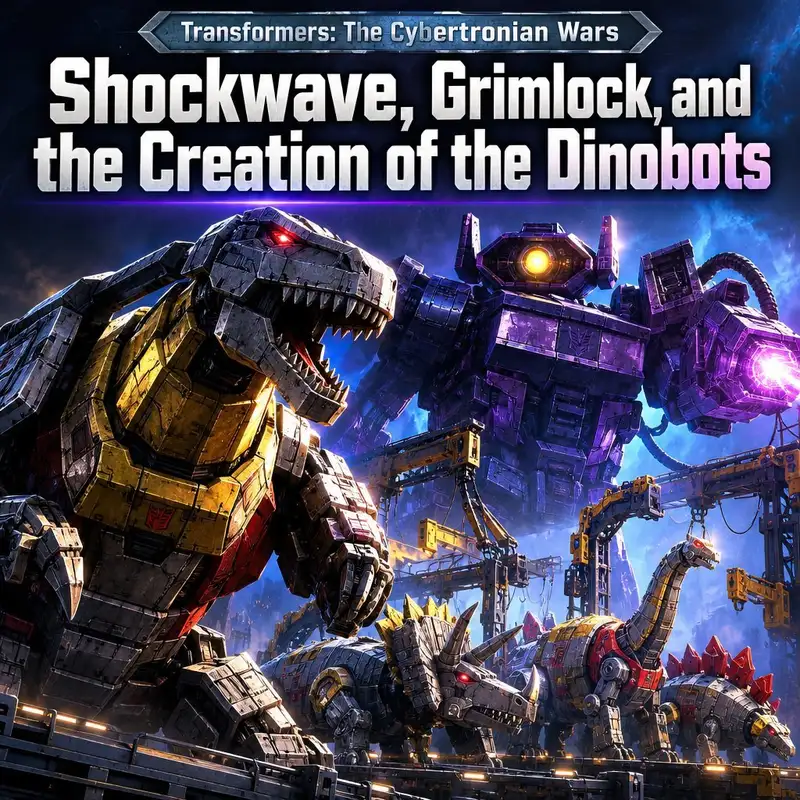
Shockwave, Grimlock, and the Creation of the Dinobots
Grimlock begins this account in restraints. He is held in Shockwave’s laboratory, surrounded by machinery built to examine, alter, and contain living Cybertronians. Starscream approaches the captive Autobot commander with a proposal that sounds practical by Decepticon standards. Freedom, in exchange for allegiance. Grimlock refuses. That refusal matters before any dinosaur form appears on screen. It tells us that Shockwave has not built a new soldier from raw material. He has captured an existing one, and the person inside the altered body still possesses memory, loyalty, and judgment.
This is the High Moon Studios account from Transformers: Fall of Cybertron, set during the final crisis of Cybertron’s civil war. It is not the older Generation One animated story in which the Dinobots are created by Autobot inventors on Earth. Here, Grimlock, Swoop, Slug, Sludge, and Snarl were already Autobots before they became Dinobots. Shockwave gave them new bodies and new battlefield capabilities through forced experimentation. He did not create their minds, their comradeship, or their political identity.
That distinction sounds philosophical until a war makes it operational. Creating a body is one thing. Altering a soldier’s weapons, mobility, or resilience is another. Creating a person is something else entirely. Shockwave succeeds at the first two. He captures an Autobot combat unit, subjects its members to invasive modification, and turns their transformed forms into weapons. But a weapons program is useful only if its products remain under command. That is where the project fails.
The failure begins in the prison cell. Starscream sees Grimlock as a potential asset, perhaps even a useful counterweight in Decepticon factional politics. Shockwave sees him as experimental material. Neither understands the central fact of Grimlock’s position. His primary loyalty is not available for purchase. It belongs to his missing team. To understand why that team mattered, and why Shockwave was willing to reshape it, we need to move outward from the laboratory and into the strategic collapse surrounding it.
Cybertron in Fall of Cybertron is not just a battlefield. It is a failing strategic system. The planet’s energon reserves are depleted, its core has shut down, and the institutions that once sustained Cybertronian life are breaking under the accumulated weight of civil war. The Autobots are no longer planning only for the defense of cities or the recovery of territory. They are preparing the Ark, a ship intended to carry survivors away from a planet that can no longer reliably support them.
That evacuation does not mean the Autobots have accepted defeat in every military sense. Optimus Prime still commands forces defending what can be defended, preserving personnel, gathering resources, and delaying Decepticon attacks long enough to make departure possible. But the Autobot objective has changed. In a conventional campaign, commanders often seek to hold ground, seize an enemy capital, or destroy the opposing army. Here, the more urgent objective is survival. A force that cannot sustain its population cannot remain a government simply by retaining the right emblem over a ruined city.
The Decepticons face a related but different problem. Megatron’s forces retain military power, industrial sites, research facilities, and aggressive operational initiative. Yet conquest of a dying Cybertron offers diminishing returns. Armies require energon for movement, weapons, repair, transport, and basic survival. A Decepticon victory over the Autobots would mean little if the planet itself could no longer support the victors. The war therefore produces a race for alternatives. The side that finds a new source of energy, a route off-world, or a way to control access to both gains more than a tactical advantage.
Shockwave’s space-bridge project belongs to that larger resource crisis. A space bridge is not simply a convenient door between worlds. It is reconnaissance infrastructure, transportation infrastructure, and potential invasion infrastructure. It can locate a distant target, create access to it, move scouts or raiders across interstellar distance, and eventually support extraction or conquest. The bridge’s value lies not only in where it opens, but in who controls its endpoint, how reliably it functions, and whether a force can sustain operations after crossing it.
The Autobots are trying to preserve a population through evacuation. Shockwave is trying to provide the Decepticons with a path toward renewed strategic power. Neither objective can be understood apart from energon. The collapse of Cybertron did not begin with the Dinobots, and Shockwave’s experiment did not cause the whole planetary crisis. But the experiment took place because the crisis made otherwise extraordinary measures appear useful to Decepticon command.
Shockwave’s laboratory was therefore not an isolated exercise in scientific curiosity. It was one node in a larger military system. Its work joined intelligence collection, energy strategy, experimental research, security operations, and weapons development. The laboratories beneath the Sea of Rust were not just places where unusual machinery was stored. They were part of a Decepticon attempt to turn a collapsing homeland into a platform for future conquest.
Shockwave serves under Megatron’s broader authority, but the game presents him with considerable technical freedom. He is a strategic researcher as much as a battlefield scientist. His work on the Insecticons reveals the character of that research. The Insecticons are portrayed as subterranean Cybertronians driven upward by the search for energy after Cybertron’s core shuts down. Shockwave studies them, uses them as security forces, and applies the results of his investigations toward more dangerous military purposes.
This arrangement gives Shockwave a useful force for the Sea of Rust. Insecticons can operate in the tunnels and industrial caverns beneath the planet’s damaged surface. They overwhelm isolated opponents through numbers and mobility. They also provide the scientist with living subjects and an armed perimeter. A laboratory protected by swarming, hostile combatants is more than a research site. It is a prison, a fortified facility, and a denial zone that makes rescue difficult.
Shockwave’s project depends on several linked capabilities. He needs to detect or interpret energy readings beyond Cybertron. He needs a functioning space-bridge tower capable of reaching another world. He needs some means of observing that world and extracting useful data from its life forms. He then needs prisoners whose bodies can endure forced reformatting. Finally, he needs containment strong enough to keep those prisoners from escaping after their alteration. Each link is necessary. A bridge without a destination is a machine without purpose. A new body without control over its occupant is an unstable weapon.
The creatures observed through the bridge provide the models for the Dinobots’ altered forms. The game does not establish that dinosaurs were native to Cybertron, nor does it offer a detailed biological account of the alien life Shockwave studies. What matters is the military lesson he draws from them. Their size, armor, natural weapons, and apparent durability suggest alternate forms that could be adapted for close combat. Shockwave is not trying to recreate a distant ecosystem out of scholarly interest. He is searching for combat designs.
That project has an ethical dimension which cannot be softened by technical language. Shockwave treats sentient prisoners as inputs to a weapons program. Capture becomes acquisition. Reformatting becomes conversion. The individual becomes a test case. This is not simply battlefield salvage or emergency repair. The available evidence indicates coercion. Grimlock and his team are not volunteers seeking new forms. Their bodies are changed under confinement, without consent, for the benefit of the force that captured them.
Shockwave still requires suitable subjects, and he finds them in a unit that already possesses the aggression, cohesion, and combat reputation he seeks. Before they are Dinobots, Grimlock and his comrades are known as the Lightning Strike Coalition Force. Their name suggests a unit designed for rapid, forceful action, but the game does not provide a full administrative history, precise order of battle, or formal table of organization. We should not invent one. What is clear is that they are already a recognized Autobot special combat formation.
The team consists of Grimlock, Swoop, Slug, Sludge, and Snarl. They are not newly manufactured creatures waiting for a name. They are soldiers with existing identities and relationships. Grimlock leads them through personal credibility, battlefield competence, and the trust of his companions. His authority does not appear to rest on bureaucratic procedure. It is practical authority, built where many military leaders build it, in the shared experience of dangerous assignments and the confidence that a commander will act when action is needed.
That strength also carries a cost. Grimlock does not fit easily into a centralized command system. He is an Autobot, but he is not a comfortable subordinate. Optimus Prime’s larger war effort requires coordination, conservation of scarce resources, and attention to the survival of an entire population. Grimlock’s instinct is narrower and more immediate. He focuses on his unit, the enemy in front of him, and the opportunity to break a threat before it grows. Neither approach is irrational. But they can collide.
That is what happens in the Sea of Rust. The Lightning Strike Coalition Force investigates unusual energy readings connected to Shockwave’s activity. The mission is reasonable. In a war defined by energon scarcity, unusual readings deserve attention. They may indicate a stockpile, a laboratory, a concealed installation, or an enemy attempt to exploit the last remaining resources of the planet. But the mission carries risk from the start. Shockwave is operating in territory suited to ambush, concealment, and swarm tactics.
The Sea of Rust is not just a dramatic backdrop for a fight. Its tunnels, wreckage, and confined routes limit observation and make conventional force protection difficult. A small unit can move through such terrain with speed, but it can also be separated from support. A hostile force familiar with the underground network can choose when and where to concentrate. The Insecticons exploit that advantage. They overwhelm the Autobots through massed attack and local control of the environment.
The Lightning Strike Coalition Force is broken apart and captured. For the Autobots, this means the loss of a specialized combat unit at a moment when every capable soldier matters. For Shockwave, it means access to precisely the kind of subjects his project requires: experienced Cybertronians with durable bodies, aggressive combat instincts, and established unit cohesion. He gains bodies. What he does not gain is their loyalty, and that distinction will undo the experiment.
Capture allows Shockwave to impose his technological solution. He reforms the Autobots into dinosaur-like alternate modes modeled on the creatures observed beyond the space bridge. The alteration changes the way each survivor can fight and move. It gives the team forms built around mass, close-combat force, physical intimidation, and the ability to endure hostile terrain. But the game does not provide technical specifications for the procedure. We do not know the exact mechanisms by which every chassis is altered, nor should we pretend to know the biological details behind the change.
What the evidence does establish is disruption. The new forms are not treated as a routine upgrade package. They are the product of imprisonment and experimentation. Grimlock’s speech and behavior are altered enough to suggest that the reformatting has consequences beyond external appearance. He becomes more bestial in manner, more driven by rage, and less easily contained within normal command expectations. Yet the game does not establish a measured loss of intelligence, a precise neurological injury, or a universal rule that dinosaur bodies make Cybertronians less rational.
The experiment therefore contains a contradiction from the start. Shockwave wants more dangerous combat assets, but danger is difficult to standardize. A soldier altered under coercion may possess greater close-range power while carrying every reason to turn that power against the captor. The more force Shockwave builds into the prisoners’ new bodies, the more catastrophic their resistance can become if containment fails. He improves capability without solving command and control.
That problem becomes visible when Starscream offers Grimlock a bargain. Starscream’s proposal is not merely an act of personal opportunism, though it is certainly that. It reveals that Decepticon leaders recognize Grimlock as politically valuable. A commander with combat prestige and a small but fiercely loyal team could be used, recruited, manipulated, or displayed as a trophy. But Starscream mistakes imprisonment for leverage. Grimlock does not see freedom as a private prize. He sees it as the means to find his comrades.
Grimlock turns Starscream’s presence into an escape opportunity. The precise mechanics matter less than the result. A captive whom Shockwave intended to contain, study, and perhaps repurpose breaks free without accepting Decepticon authority. This is the first major failure of the weapons program. The restraints do not produce loyalty. The laboratory does not produce obedience. The Decepticon leadership’s internal rivalries create openings that a determined prisoner can exploit.
Once free, Grimlock does not seek a safe route back to Autobot lines. He searches the laboratory complex and its surrounding tunnels for the other members of his unit. That choice is strategically risky. Escape alone would preserve one capable commander. Recovery of the team risks recapture. But it also reflects the actual source of Grimlock’s authority. He does not command a group of interchangeable chassis. He commands particular people. Leaving them behind would preserve his body while destroying the relationship that made him a leader.
The search is grim. The laboratory and the caves are designed to separate prisoners, complicate movement, and expose intruders to Insecticon attacks. Grimlock learns that Sludge does not escape from the caves with the group during this sequence. The game leaves Sludge’s status less fully resolved than that of the teammates who later reunite. It does not provide a conventional, conclusive death scene that permits a simple declaration of finality. What can be said is that his absence becomes one of the costs of the escape.
Grimlock does recover Slug and Swoop. Their reunion is more than a character beat. It restores the beginning of a unit. The survivors now possess shared knowledge of Shockwave’s methods, shared anger over their treatment, and a practical need to cooperate in an environment controlled by their enemy. Their new forms make them unusual, but their cohesion gives those forms military meaning. Without trust, they would merely be three altered prisoners moving through hostile tunnels.
Snarl remains in danger. He has been taken for further testing, held within the system Shockwave built to turn living subjects into controlled weapons. The rescue of Snarl from Sharpshot expands the escape from individual survival into an act of resistance. Each recovered teammate weakens Shockwave’s control over the experiment. Each recovery also adds another witness to what the laboratory has done. The Dinobots’ eventual identity emerges not from a technician’s designation, but from survivors reclaiming one another.
Small-unit cohesion is the force Shockwave fails to understand. His laboratory possesses restraints, armed guards, experimental knowledge, and access to a strategic bridge project. Yet none of those advantages can substitute for the confidence built among comrades under fire. The Dinobots do not remain together because a command network orders them to do so. They remain together because their shared past gives them a reason to accept risk for one another.
Recovered comrades do not immediately mean recovered mastery over their altered bodies. Grimlock’s most dramatic transformation occurs during a confrontation with Kickback and an unusually large Insecticon. Under intense pressure, and driven by anger, he transforms for the first time into his Tyrannosaurus form. The moment is a tactical breakthrough. A battlefield problem that had threatened to overwhelm him is answered by a new form built for brutal, close-range combat.
The Tyrannosaurus body gives Grimlock obvious advantages in direct confrontation. It allows him to bring greater physical force to bear, to withstand punishment that might have stopped him in his previous form, and to use the terrain of Shockwave’s tunnels in ways the captors did not anticipate. But the importance of the transformation is not that it proves Grimlock is simply stronger than everyone around him. The game does not support precise comparisons of armor, force output, or weapon yield. Its importance is that it changes the available options in a desperate fight.
This is why Shockwave’s apparent success remains incomplete. He has produced a body capable of extraordinary violence. But he has not created a stable combat system. The altered form does not come with demonstrated loyalty to Decepticon command. It does not arrive with a reliable method of control. It does not turn Grimlock into an obedient laboratory product. The first full expression of the new capability is directed against Shockwave’s own forces.
The surviving team now shares a condition imposed upon it by an enemy. They have been captured, altered, scattered, and forced to learn what their new forms can do under combat pressure. The name Dinobots becomes associated with those forms and with the language used around them by their Insecticon adversaries. The exact origin of the name is less important than what the survivors do with it. They adopt it. They make it their own.
That act of naming is politically significant. Shockwave can impose a design, but he cannot automatically impose meaning. The dinosaur forms begin as instruments of coercion. The Dinobot identity becomes an act of reclamation. Grimlock and his comrades take the visible mark of their captivity and turn it into the emblem of a renewed unit. That does not make the violation beneficial. Trauma is not justified because survivors find a way to endure it. But it does deny the captor ownership over the final meaning of the experiment.
The Dinobots are not just the Lightning Strike Coalition Force with new paint and louder weapons. Their experience has changed them. They now possess bodies designed through enemy research, a shared memory of captivity, and a name born from resistance. But neither are they blankly new people. Their ability to become Dinobots depends on their continuity as comrades. The old unit gives the new identity its moral and military foundation.
Their reclamation of identity immediately leads back to an older conflict. Grimlock must decide how the Dinobots will relate to Optimus Prime’s wider Autobot command. The answer comes when the team discovers the full significance of Shockwave’s project. From an observation facility, they learn that the space-bridge tower is not only a laboratory tool. It is part of a Decepticon plan to reach another energy-rich world. If activated and secured, it could offer Megatron’s forces a route to new resources and a possible base for future expansion.
The Dinobots transmit this intelligence to Optimus. This is an important success. The team has escaped the laboratory, recovered enough cohesion to operate, and exposed a Decepticon strategic project that might otherwise have remained hidden. Intelligence success, however, does not guarantee immediate operational action. Optimus is managing a planetary defense and an evacuation under severe energon constraints. His forces are dispersed. The Ark requires protection and power. Every unnecessary engagement risks losing personnel needed for the larger survival mission.
Optimus orders Grimlock to return to base. From the perspective of centralized command, the order is understandable. Grimlock’s unit has already been captured once. It is operating near a heavily defended Decepticon facility. The Autobots need the information it has gathered, but they also need to avoid feeding more troops into a target whose defenses and activation timetable may not be fully understood. A commander responsible for an evacuation cannot treat every enemy installation as a target of equal priority.
Grimlock rejects the order. His decision is driven by several motives at once. Shockwave’s tower is a strategic threat. It is also the center of the system that captured and violated his team. Grimlock has seen the laboratory from inside. He knows that delay may allow Shockwave to complete the project, exploit another world, or repeat the experiment on more prisoners. His refusal is not merely personal rage, though rage is clearly present. It is an operational judgment made by a commander who believes the opportunity to destroy the threat will not return.
The disagreement exposes a familiar tension in war. Central command sees the whole theater but may lack local urgency. The commander on the ground sees the immediate target but may not understand the larger allocation of risk. Optimus has to preserve a population and an evacuation fleet. Grimlock has to decide whether an enemy capability can be allowed to survive. Neither man possesses perfect information. The conflict is not between caution and courage. It is between competing responsibilities.
His decision wins access to the target, but it also brings the Dinobots back into Shockwave’s prepared environment. The tower is not an isolated machine waiting to be smashed. It is protected by Decepticon security, connected to the scientist’s research network, and close enough to the laboratory complex that containment systems can be brought to bear. The assault demonstrates Grimlock’s resolve. It also demonstrates the risk of attacking a strategic installation without the support, reconnaissance, and extraction plan that a larger operation might provide.
Shockwave captures Grimlock again. The recapture is important because it prevents us from treating the Dinobots as unstoppable simply because they have acquired formidable new forms. Their altered bodies are powerful, but they remain vulnerable to restraint, isolation, and prepared defenses. Shockwave still believes he can contain the experiment. He reports to Megatron that the project is ready, suggesting confidence that the bridge and its associated work can now serve Decepticon strategy.
That confidence is misplaced. Grimlock escapes the restraints by transforming, using the very capability Shockwave forced upon him. The moment is the clearest demonstration of the project’s reversal. The new form was intended to create a Decepticon-controlled weapon. Instead, it enables the prisoner to break Decepticon control. Grimlock tears away Shockwave’s arm during the escape, a serious battlefield injury and a symbolic defeat for the scientist’s authority within his own facility.
Grimlock then destroys the tower’s control system. Tactically, this disrupts the Decepticon project. It denies Shockwave a clean activation of the bridge and prevents the scientist from simply proceeding with an orderly expedition to the newly discovered world. Operationally, it damages a system designed to connect research, resource extraction, and military expansion. The Dinobots have turned intelligence into action. They have struck the infrastructure that gave the experiment its strategic purpose.
But the destruction does not create a clean denial victory. The damaged tower destabilizes the portal. Instead of simply closing the route and ending the threat, Grimlock’s attack produces an unstable opening at the center of an already desperate evacuation crisis. This is the cost of improvised action against complex infrastructure. A bridge system can be a weapon, a supply route, an escape route, or all three in rapid succession. Breaking its controls may stop the enemy’s plan while creating new dangers for everyone nearby.
Grimlock’s assault is therefore both successful and incomplete. It defeats Shockwave’s immediate control over the project. It frees the Dinobots from the laboratory system. It interrupts a Decepticon effort to secure off-world resources. Yet it is not a substitute for a broader Autobot strategy. It does not restore Cybertron’s energon. It does not defeat Megatron’s army. It does not repair the political and industrial collapse that has made evacuation necessary. The Dinobots win a crucial local fight inside a larger war that remains beyond their control.
The damaged space bridge now intersects with the Ark’s final departure. Metroplex, the immense Autobot ally whose remaining energon can sustain the launch, transfers that energy to the Ark. The act makes the evacuation possible at the moment it is most needed. The Ark rises from Cybertron under pressure, carrying Autobots away from the planet they can no longer hold. The Nemesis pursues, because Megatron understands that the departing ship represents more than a retreating enemy force. It represents the survival of a political and military community beyond Cybertron.
The unstable portal becomes part of that final movement. The Ark and the Nemesis are drawn into the chaos surrounding the bridge before it collapses. This is not the result of one isolated decision alone. The evacuation has been prepared because Cybertron is dying. Metroplex’s energon transfer is necessary because the Ark lacks the power to depart otherwise. Megatron’s pursuit reflects the continuing war between the factions. Grimlock’s destruction of the tower shapes the conditions around the escape, but it does not single-handedly save every Autobot or determine the entire fate of Cybertron.
The Dinobots remain associated with Cybertron at this moment rather than boarding the Ark’s evacuation. Their story runs alongside the exodus without becoming identical to it. They have reclaimed their unit and destroyed the system that tried to turn them into Decepticon assets. Yet the larger civilian crisis remains unresolved. Cybertronians across the planet face depleted energy, damaged infrastructure, military destruction, and forced dispersal. An evacuation ship can preserve some lives. It cannot instantly restore the world left behind.
Shockwave’s project reveals how war can distort scientific and military judgment. He correctly identifies a strategic problem. The Decepticons need energy, mobility, and a route beyond a dying planet. He successfully constructs a bridge system capable of reaching another world. He successfully captures and modifies an elite Autobot team. In narrow technical terms, much of the program works. The failure is not that Shockwave lacks intelligence, resources, or engineering skill.
His real failure is that he mistakes physical control for command. He assumes that a body can be redesigned without preserving the loyalties carried by the person inside it. He treats Grimlock’s team as raw material when their real military value lies in the relationships he cannot manufacture. He creates fearsome forms, but he does not create obedience. He builds a weapons program around coercion, then discovers that coercion produces subjects who have every reason to destroy the system that made them.
Grimlock’s response is not a simple celebration of individual defiance. His refusal to return to Optimus creates real command friction and contributes to a dangerous, unstable situation around the bridge. He is not always easy to integrate into a broader war effort. Yet his resistance also exposes a threat that centralized command cannot immediately neutralize. His independence is both a liability and an asset. The same qualities that make him difficult to direct make him unwilling to accept Shockwave’s definition of what he has become.
The Dinobots emerge from the ordeal as a reclaimed identity. Shockwave creates their altered bodies. He gives them the material conditions that make dinosaur forms possible. But Grimlock, Swoop, Slug, Snarl, and the absent Sludge remain more than the products of a laboratory. They carry forward memory, comradeship, and agency. By taking the forms forced upon them and making them the basis of their own unit, they turn Shockwave’s experiment into a Decepticon strategic loss.
Shockwave created a form, not a people. His program briefly converted Autobot bodies into Decepticon instruments, but it could not erase prior loyalties or replace solidarity with control. The Dinobots’ true creation was not the moment their chassis changed. It was the moment the survivors chose to stand together, name themselves, and direct the power imposed upon them against the war machine that believed it owned them.