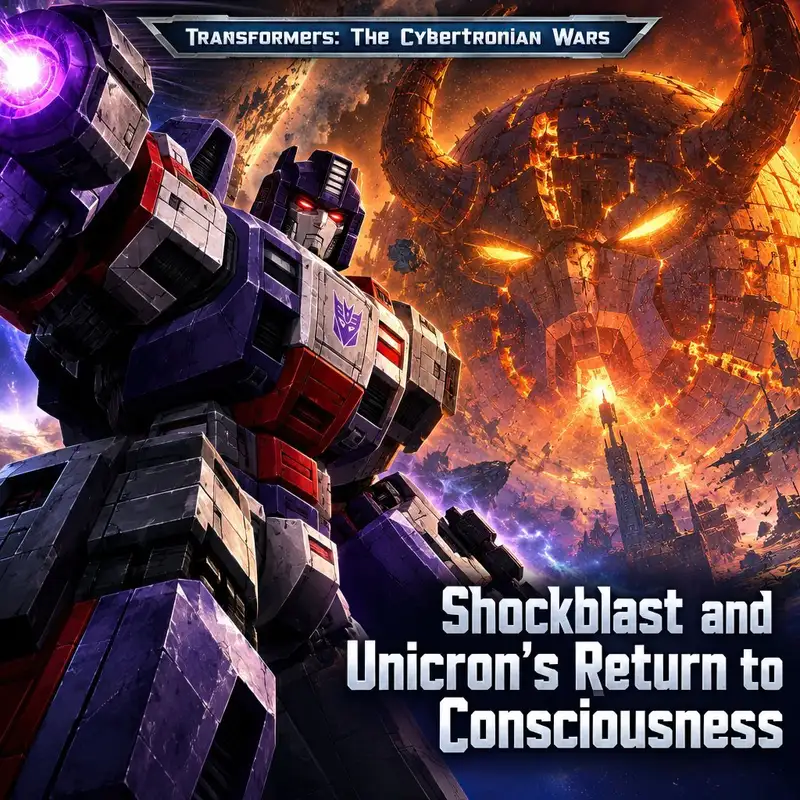
Shockblast and Unicron’s Return to Consciousness
When Shockblast struck Cybertron’s energon towers, he was more than destroying targets of opportunity. He was attacking the power network that sustained a recovering civilization. In Transformers: Energon, set roughly a decade after the Mini-Con war of Armada, Cybertron had entered an uneasy period of cooperation. Autobots and at least some Decepticons were attempting to live after a conflict that had nearly consumed them all. That settlement was fragile. It depended on energy, infrastructure, and the difficult assumption that former enemies could accept limits on their power.
The towers mattered because energon was more than fuel for individual Cybertronians. It supported industry, repair, transport, defense, and the ordinary systems that kept a planet functioning. A tower going down could weaken a military response, but it could also disrupt civilian life and industrial recovery. Shockblast understood destruction. What he did not appear to understand, or care about, was that the infrastructure he wrecked would be needed by anyone who hoped to rule Cybertron after the shooting stopped.
That distinction defined the crisis. The Decepticons did more than seek to seize energon. They were increasingly trying to divert Cybertron’s energy into the damaged remains of Unicron, the planet-sized destroyer defeated at the end of Armada. Their campaign treated the energon grid as a reservoir to be tapped, stripped, or sabotaged. Yet the grid was also the foundation of the society they claimed to want back under Decepticon control. A conqueror who destroys the power system before taking the capital may win a battle and inherit a ruin.
Shockblast’s attack on two towers in “Shockblast: Rampage” therefore carried consequences beyond its immediate damage. It created confusion, weakened defenses, and gave Decepticon forces room to regroup. It also announced that demobilization had failed. The postwar truce had not ended the political struggle. It had only contained it, temporarily, while the survivors of the Mini-Con war attempted to decide what peace would mean.
Shockblast was particularly dangerous because he had not returned as an ordinary Decepticon soldier rejoining a familiar chain of command. Before the events of Energon, he and his brother Six Shot rejected the truce outright. They attacked Autobots and Decepticons alike. That choice placed them outside the settlement and eventually led to imprisonment. Shockblast entered the new conflict not as a disciplined officer returning to service, but as a violent political reject whose hostility extended even to members of his own nominal faction.
That history mattered to Megatron. A commander may use a prisoner, a mercenary, or a former insurgent when circumstances become desperate. War produces such arrangements regularly. A leader sees a useful capability and tells himself that necessity has changed the person carrying it. But Shockblast’s incarceration had not removed the qualities that made him dangerous. It had only postponed the moment when those qualities would again become operationally important.
Megatron’s decision was understandable in the narrowest military sense. Shockblast possessed firepower, aggression, and a willingness to strike protected targets without hesitation. In a campaign centered on disrupting Cybertron’s defenses and feeding Unicron, those traits could seem valuable. Megatron did not need a patient administrator to destroy an energon tower. He needed someone willing to break through resistance, inflict damage, and keep moving.
This was not a minor personality problem. It was a command-and-control problem at the center of the Decepticon campaign. Megatron relied heavily on personal dominance. His authority rested on fear, power, reputation, and the ability to punish disobedience. Those tools can compel immediate action. They do not necessarily create a durable hierarchy, especially among followers who expect force to decide rank.
The return of Unicron intensified that weakness. At the end of Armada, Unicron had been defeated, but not destroyed in any simple conventional sense. Energon begins with the remains of the enormous entity still present and still dangerous. His body and head are separated. His condition is best understood as damaged and incomplete rather than truly dead. The body can be entered, exploited, and supplied. It can also react to danger and consume energy. It is not yet a fully restored and unified Unicron, but it is already far more than inert wreckage.
That gradual progression is important. Unicron does not wake in a single clean instant, as though someone simply flipped a switch. First there is a damaged remnant with an appetite for energon. Then there are defensive reactions and growing signs of activity. Later, the body regains more capability. Eventually, head and body are reunited, and the threat becomes an active intelligence with its own will. Each stage changes the military problem.
A dormant hulk can be looted, occupied, studied, or converted into a base. A partially active body becomes a hazardous installation. A feeding body becomes a logistical sink, demanding constant energy and consuming whatever is brought too close. A reunited Unicron becomes something else entirely. He is no longer a platform for a commander’s ambitions. He is an actor with ambitions of his own.
Alpha Q understood the remains of Unicron differently from Megatron. Alpha Q was a survivor of worlds devastated by Unicron’s earlier campaign of consumption. His own history gave him a motive that was both deeply personal and strategically consequential. He used Unicron’s remains, the separated head, and the Terrorcons not simply to rebuild the planet-eater, but to gather energon for restoration. His purpose was to return life and energy to worlds that Unicron had destroyed.
That did not make Alpha Q’s methods harmless. He was working inside the remains of a planetary destroyer, using dangerous forces and manipulating systems whose full limits were uncertain. His project depended on a machine-organism that had already consumed entire worlds. A restorative objective does not automatically make every method safe. Still, Alpha Q’s goal differed sharply from Megatron’s. Alpha Q wanted energon to repair what had been lost. Megatron wanted energon to restore the destroyer itself and direct that power against his enemies.
The conflict over Unicron was therefore also a conflict over the meaning of energy. The same energon could sustain Cybertron’s grid, supply a defense force, support reconstruction, feed an army, restore a damaged world, or revive the entity responsible for planetary annihilation. Control of the resource did not determine the purpose. Politics did.
Shockblast’s raids placed him directly inside that contest. His destruction of the towers helped destabilize Cybertron, but it also served the larger effort to create openings for Decepticon operations. The towers were strategic nodes. They concentrated energy, supported the grid, and gave defenders a system worth protecting. Attacking them forced the Autobots to disperse attention between immediate security, repairs, civilian stability, and the growing Unicron crisis.
The Decepticon problem was that their attacks did not create a self-sustaining position. They created shortages. A raid can seize stored fuel, capture equipment, or deny power to an enemy. It cannot, by itself, replace the industrial system it damages. If the attacking force depends on the same planet’s energon production, sabotage becomes a dangerous bargain. It may weaken the enemy today while making the conqueror more dependent on extraction, seizure, and emergency measures tomorrow.
That problem became clearer as Decepticon forces fled Cybertron and Unicron’s body began using available energon as an immediate source of sustenance. In “Survival Instincts,” the body’s appetite becomes impossible to treat as a secondary concern. The Decepticons are more than bringing resources to a weapon. They are dealing with something that consumes energy and personnel as part of its return to activity.
There is a familiar military lesson here. Possession is not sustainment. An army can capture a fortress and still be unable to feed it. A navy can acquire a powerful vessel and still lack the fuel, parts, trained crew, and secure harbor needed to operate it. Megatron’s forces possessed access to Unicron’s body, but access did not equal control, and control did not equal a viable strategic capability.
The situation was worse because Unicron did not behave like a passive machine. His head reacted violently against those attempting to hold or direct it. His body drew power into itself. These were warnings. They showed that the Decepticons were not managing an artifact whose purpose they understood. They were participating in the recovery of an entity whose own purposes had never disappeared.
Cybertronian civilians still had much at stake even without a detailed census of every affected district. Damage to energon infrastructure threatens more than a military command center. It affects repair facilities, transportation, industrial work, and the ability of ordinary Cybertronians to remain active and secure. Dependent worlds faced an even harsher calculation. A planet targeted by Unicron could become a source of energy, a site of destruction, or a place whose survival depended on decisions made far away.
For the Autobots, defending the towers was therefore not merely a matter of protecting military property. It was a defense of the material basis for recovery. For the Decepticons, attacking the towers offered immediate leverage. Yet it also revealed the hollowness of their strategy. They were consuming the foundation of the order they hoped to impose.
Megatron’s ambition was larger than sabotage. He sought to restore Unicron and turn him against Cybertron and the Autobots. In that vision, Unicron would solve problems that ordinary armies could not. He could break defenses, consume worlds, terrorize opponents, and make resistance seem futile. A leader who possesses such a force may believe that political settlement is no longer necessary. Why negotiate when a planet-sized destroyer can decide the issue?
The flaw was more than moral, though the intended destruction was plainly catastrophic. The flaw was strategic. A force capable of destroying everything is not automatically capable of building anything. Megatron could imagine Unicron as the final instrument of conquest. He did not demonstrate a credible method for limiting Unicron’s appetite, directing his will, protecting his supply, or ensuring that the restored entity would distinguish Decepticon interests from all other available sources of energon.
Megatron also had to manage a coalition that was not truly cohesive. Some Decepticons had accepted the truce, at least temporarily. Others returned to open conflict. Some commanders followed Megatron because he remained powerful. Others had personal agendas, rivalries, or survival instincts that did not align neatly with a shared political program. Terrorcons and Battle Ravage units could be used as collection and assault forces, but expendable troops are not the same as a stable army.
A command structure built around fear can move quickly. It can also become brittle. Subordinates may conceal doubts, compete for favor, or wait for weakness. Information moves upward poorly because no one wants to report failure. Initiative becomes destructive because field commanders learn that violence is rewarded more reliably than judgment. In that environment, Shockblast was not an anomaly. He was the most obvious expression of a larger institutional weakness.
Megatron knew Shockblast was ambitious. He knew that Shockblast had rejected peace and attacked his own side. Yet he elevated him because the immediate campaign rewarded precisely the behavior that made him untrustworthy. This is one of the old traps of authoritarian command. A leader selects ruthless subordinates to intimidate enemies, then discovers that ruthlessness has no natural stopping point.
Shockblast’s renewed assault on Cybertron in “Each One Fights…” showed the cost. He led Decepticon forces in another effort to destroy energon towers. The Autobots resisted, and Wing Dagger attempted to capture Shockblast rather than simply drive him away. That effort reflected an important reality. Shockblast was not just a hostile combatant. He was a destabilizing commander whose continued freedom threatened any chance of containing the escalation.
The battle produced immediate tactical disruption. Towers were attacked. Defenders were forced to respond. The struggle placed key infrastructure under direct pressure. But the fight also showed how poorly Shockblast’s methods fit the Decepticons’ claimed strategic purpose. A collapsing energon tower damaged Tidal Wave, a Decepticon asset. Shockblast’s assault endangered friendly forces as readily as enemy positions.
That was more than an accident of battle. It was the predictable result of a commander who treated destruction as an end in itself. Shockblast could break things. He could not preserve a line of communication, hold a repaired facility, coordinate a complex withdrawal, or protect the forces needed for the next phase. He was useful for opening a breach. He was poorly suited to exploiting it.
The Autobots, meanwhile, faced a difficult defensive problem. They could not protect every node in a planetary energy system with equal strength. They had to decide where to deploy, which facilities were most vulnerable, and how to respond when an attack might be a diversion for something worse. A defense force can lose effectiveness when it is forced to react everywhere at once. The Decepticon raids exploited that pressure, even if their wider strategy remained self-destructive.
That pattern reached a critical stage in “Unicron Unleashed.” Shockblast’s forces raided Cybertron’s energon core. This was no longer a simple attack on exposed towers. It was an attempt to reach a deeper source of planetary power. Battle Ravage units were able to draw directly on energy associated with Primus. The narrative establishes the effect clearly enough: the operation provided the energy needed for Unicron’s body to reactivate further.
The exact technical pathway is not fully explained, and it does not need to be. What matters is the operational decision. Megatron’s forces were no longer merely scavenging energon from scattered sites. They were reaching into the core systems of Cybertron itself, converting a source of planetary vitality into fuel for Unicron’s return. The campaign had moved from sabotage to extraction on a civilizational scale.
Shockblast’s role in this operation made him more dangerous, but not more legitimate. He had become an operational commander because he could lead destructive missions under pressure. Yet his authority remained borrowed from Megatron, and his ambitions remained his own. The more central he became to Unicron’s revival, the more he could imagine himself as something other than Megatron’s instrument.
At the same time, Alpha Q pursued his own dangerous countercourse. With Unicron’s body reactivated, he drove the separated head into the body, forcing reunification. The act transformed the crisis. Until then, the body and head had been contested components. Each could be occupied, manipulated, or used in a struggle over energon. Once joined, they restored more of the entity’s integrity.
That reunification did not create a simple chain of command. It destroyed the fantasy of one. Megatron had wanted a weapon. Alpha Q had sought a means to restore lost worlds. The Autobots wanted to prevent a new planetary catastrophe. But Unicron was not a neutral structure through which these objectives could be pursued. The more complete he became, the more clearly his own agency shaped the conflict.
The Autobots entered Unicron and attacked from within. This was not an ordinary ground battle, and it should not be reduced to a simple exchange of fire in exotic scenery. They were conducting an interior assault against an enemy that functioned as terrain, fortress, weapons system, and living organism all at once. Passageways, internal systems, energy flows, and defensive reactions were part of the opponent.
Fighting inside such a target imposes unusual burdens. A boarding force must navigate hostile space while preserving routes for reinforcement and withdrawal. It must determine which systems are vulnerable, which are merely dangerous, and which attacks may trigger wider reactions. It must maintain communications in an environment that may interfere with sensors and movement. It must also understand that damaging the enemy can endanger everyone inside.
The Decepticons faced many of the same problems, though they entered Unicron with a different purpose. Megatron hoped to direct the revived entity. His forces attempted to exploit internal access and growing power. But access to a living fortress does not make its occupants masters of the fortress. The closer they came to the source of Unicron’s strength, the more they became exposed to his returning will.
The conflict expanded beyond Cybertron. Earth’s energon was redirected toward Alpha Q’s head, while Autobots and Decepticons struggled within Unicron. The interaction of those energies produced a black-hole-like spatial rift, drawing Unicron and those involved into another region of space. The precise physics are less important than the strategic effect. A crisis once centered on Cybertron’s infrastructure now displaced forces across vast distances and made local control even harder.
Space bridges and spatial disturbances can transform the map, but they do not eliminate the need for coordination. Forces still require a destination, a way to identify allies, a means to recover damaged personnel, and a plan for what happens after arrival. The rift did not solve the Unicron problem. It merely expanded the theater in which the problem had to be managed.
Neither Megatron nor the Autobots possessed a reliable containment model for an awakening Unicron. Megatron had overestimated his ability to dominate the entity. The Autobots had to respond to a threat whose systems, intentions, and limits were only gradually becoming clear. Alpha Q knew more than most about the devastation Unicron could cause, but his restoration project remained entangled with the same body that was now returning to full danger.
This uncertainty matters because military decisions were being made under pressure and with incomplete information. The Autobots could see the danger of reactivation, but stopping it required entering Unicron and confronting Decepticon forces. Megatron could see the value of Unicron’s power, but every step toward restoring that power reduced the plausibility of controlling it. Shockblast saw opportunity, but he mistook proximity to power for ownership of it.
In “A Heroic Battle,” Unicron’s body retrieved its head despite Autobot efforts to stop the reunification. The result was more than a larger or stronger enemy. It was a more coherent one. The head and body had represented separate problems. Their reunion brought identity, appetite, mobility, and destructive capacity into closer alignment. The object of the campaign became increasingly capable of acting for itself.
The Autobots needed a response that operated at the same scale as the threat without pretending that scale alone would decide the war. Optimus Prime discovered that he could powerlinx with Omega Supreme. The resulting Optimus Supreme gave the Autobots a viable counterweight against Unicron’s immense power. Yet the significance was more than visual or physical. It represented adaptation.
Ordinary unit tactics were inadequate against a planet-sized entity capable of consuming worlds and destabilizing the theater around him. The Autobots needed a means to confront Unicron directly, survive long enough to affect the battle, and protect worlds threatened by his renewed appetite. Powerlinking with Omega Supreme created that possibility. It was a response to the changing character of the war, not a substitute for strategy.
There was a sharp contrast between the two approaches. Megatron’s plan depended on domination. He wanted Unicron to become an extension of Decepticon command. Optimus and the Autobots sought a capability that could resist Unicron without assuming they could own him. One side treated the destroyer as a prize. The other increasingly treated him as an existential threat requiring containment and destruction.
Shockblast did not accept Megatron’s primacy in this contest. In “The Power of Unicron,” he attempted to seize control of Unicron for himself. This was the logical culmination of his rise. He had moved from prisoner to useful raider, from useful raider to operational commander, and from commander to rival claimant. Megatron had given him access to power without creating loyalty. Shockblast concluded that the largest source of power in the conflict should belong to the one bold enough to seize it.
His attempt was not an act of successful command. Shockblast never establishes control over Unicron. He reaches for the role, and Unicron overwhelms him. That distinction is essential. Shockblast did not become the master of a superweapon. He became evidence that there was no superweapon to master.
Megatron’s own response could not solve the deeper problem. He might defeat a rival, threaten a subordinate, or reclaim temporary authority over a Decepticon formation. Those methods were familiar. But Unicron was no longer a subordinate in a chain of command. He was an independent force whose restored consciousness made both Megatron and Shockblast look small by comparison.
Shockblast was both. Megatron needed him because the campaign rewarded destructive capability. Megatron feared him because he was plainly willing to challenge anyone above him. That contradiction could be managed only as long as Megatron remained stronger than the threat he was trying to exploit. Once Unicron’s independent agency returned, personal dominance ceased to be enough.
Unicron’s influence overwhelmed Shockblast and turned him into an instrument of the very entity he had hoped to command. The series dramatizes this as possession or domination, but does not provide a technical manual for how the process works. It is enough to say that Shockblast’s agency was deeply compromised. His strength and aggression were redirected through Unicron’s will.
On Blizzard Planet, Shockblast rampaged under that influence. The location became another world endangered by a struggle whose original political center had been Cybertron. The progression was stark. First, energon infrastructure was attacked. Then Cybertron’s core was raided. Then Unicron was reactivated. Now distant worlds faced direct destruction because commanders had tried to turn a consuming intelligence into an instrument of factional war.
Optimus confronted Shockblast and attempted to reach whatever remained of him beneath Unicron’s control. That effort did not excuse Shockblast’s earlier choices. He had rejected peace, attacked critical infrastructure, endangered allies and enemies alike, and tried to usurp Megatron through control of Unicron. He bore responsibility for those actions. But possession complicates the final stage of his story. A person can make grave choices and still become the victim of a power greater than he understood.
Shockblast briefly broke free. In that moment, he attacked Unicron rather than serving him. It was a limited recovery of agency, but a meaningful one. He finally recognized, too late, that Unicron could not be treated as a throne to seize or a weapon to direct. The same force that had magnified Shockblast’s importance had erased his independence.
Unicron killed him by crushing him beneath one of his hands. The scene is decisive. Shockblast does not emerge physically restored from that destruction in the Energon narrative. His death is more than the punishment of an ambitious subordinate. It is the collapse of an entire illusion: that violence without discipline could become leadership, and that proximity to overwhelming power could become control over it.
Shockblast did not lack courage. He did not lack destructive capability. In a narrower conflict, those qualities might have made him formidable for years. But courage without judgment can become recklessness, and firepower without purpose can become self-destruction. Shockblast’s final resistance to Unicron showed that he could recognize the danger. It did not undo the decisions that helped bring the danger into being.
Unicron’s threat continued beyond Shockblast’s death. Blizzard Planet was destroyed, and other worlds remained vulnerable as Unicron drew more energon and extended his campaign of consumption. By this point, the Decepticon objective had fully inverted. Megatron had wanted Unicron restored in order to destroy the Autobots and conquer Cybertron. Instead, Unicron had become a danger to every political objective in the theater, Decepticon included.
The Autobots’ final response depended on more than a single battle. Primus re-energized them, giving them the strength needed to confront the escalating threat. Optimus Supreme could then engage Unicron at a scale ordinary forces could not match. This intervention was extraordinary, but it did not erase the material realities that had brought the crisis about. The struggle still revolved around energon, access, movement, damaged worlds, and the consequences of treating essential infrastructure as expendable.
The tactical record is clear enough. Shockblast’s raids inflicted damage, disrupted defenses, and created openings for Decepticon operations. At the level of individual engagements, he was effective. He could break through, strike hard, and force defenders into costly responses. Tactical success, however, was the smallest measure of the campaign.
Operationally, Shockblast’s attacks helped enable the energon flow that restored Unicron’s body. They weakened Cybertron’s defenses at moments when the Autobots needed to respond to multiple threats. They supported the raid on the energon core and contributed to the conditions under which Unicron could become active again. But operational success brought an operational disaster. The revived entity could not be reliably integrated into Decepticon plans.
Politically, Shockblast’s story revealed the limits of Megatron’s authority. Megatron could intimidate followers and exploit ambitious subordinates. He could not make them loyal through fear alone. Shockblast’s attempted coup was not a surprising betrayal by an otherwise dependable officer. It was the expected result of elevating a prisoner who had already demonstrated contempt for truce, hierarchy, and shared factional purpose.
The logistical and industrial lesson was equally severe. Energon infrastructure could support reconstruction or annihilation. It could help restore worlds devastated by Unicron, as Alpha Q hoped, or revive the destroyer that had ruined them, as Megatron intended. But it could not sustain both purposes without immense cost. Every tower attacked, every core system raided, and every reserve diverted made Cybertron’s recovery more precarious.
For civilians, these were not abstract strategic calculations. A damaged energon grid meant uncertainty in the systems that supported life, work, repair, and security. Worlds threatened by Unicron faced the possibility that their resources would become fuel for their own destruction. Exact population figures and evacuation capacity are not given, but the stakes are unmistakable. The war had moved beyond factional rivalry. Entire societies had become vulnerable to the appetite of a revived planetary destroyer.
Alpha Q’s role adds another layer to that tragedy. He sought to reverse devastation, but his restoration project operated through Unicron’s remains. His goals were not Megatron’s goals, yet both depended on the same hazardous system. That is one of the bleakest features of the crisis. After a catastrophe, survivors may have to work with damaged institutions, dangerous technologies, and compromised resources because nothing else remains available. Good intentions do not remove the risks embedded in those tools.
Optimus and the Autobots succeeded because they eventually recognized the scale and nature of the threat. They did not attempt to make Unicron politically obedient. They sought to prevent further destruction and develop the means to confront him directly. Their response was costly, improvised, and dependent on exceptional power, but it was grounded in a clearer strategic understanding. Unicron had to be resisted as an independent enemy, not acquired as a prize.
Shockblast did not fail because he lacked courage or firepower. He failed because he treated domination as command. Megatron made the same mistake on a larger scale. By feeding Unicron with Cybertron’s own industrial lifeblood, the Decepticons revived an intelligence whose purpose was consumption, not conquest. The crisis proved that a sentient superweapon cannot be made politically obedient merely because a commander can point it at an enemy.