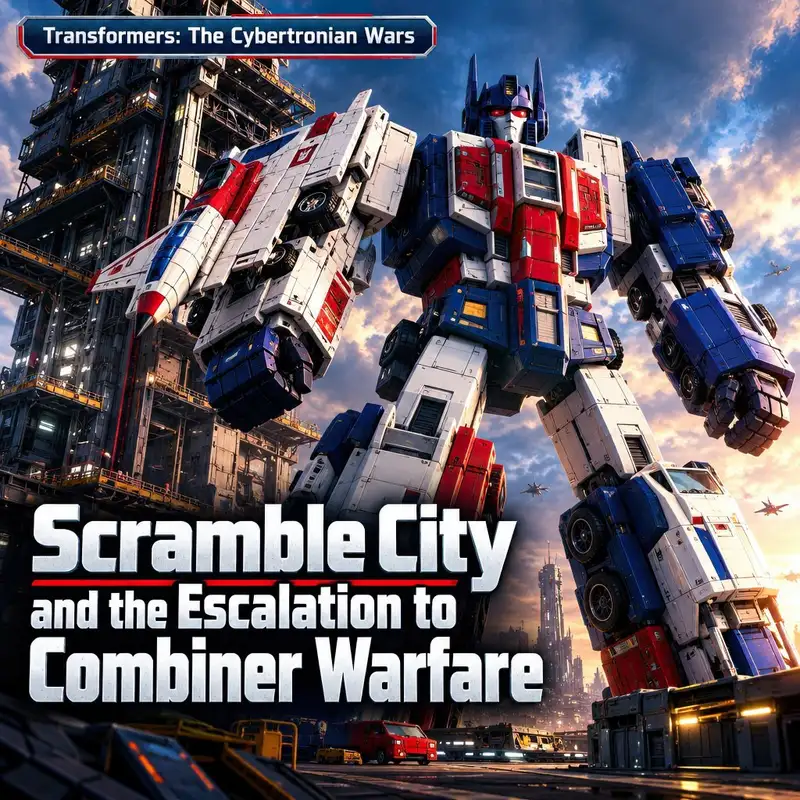
Scramble City and the Escalation to Combiner Warfare
The Autobots have concealed a construction project large enough to change the balance of their war. That alone makes it a target. In the Japanese Generation One history presented by Scramble City, the urgent question is not whether the new installation can fight once completed. It is whether it can survive the vulnerable interval between discovery and activation. A fortress under construction has walls, machinery, and promise. It does not yet have the freedom to move away from danger.
Ultra Magnus oversees the work. The facility is called Scramble City, and its very existence suggests an unusual Autobot decision. Rather than relying only on dispersed teams, hidden bases, and mobile commanders, the Autobots are investing in a large fixed asset. It is being built in secret, which means concealment is part of its defense. Yet concealment is never the same thing as security. A project of this scale creates activity, movement, energy demand, and opportunities for observation, even when the story does not tell us precisely how those signs were detected.
The Decepticons discover the project through reconnaissance. Ratbat penetrates the concealed area and brings the information back to Megatron. That brief intelligence success drives the entire crisis. Megatron does not need a detailed understanding of every system inside Scramble City. He only needs to recognize the strategic problem. If the Autobots complete a new fortified installation, they may gain a protected base, a transport node, a command center, or something more dangerous. The correct Decepticon response, from his perspective, is denial. Strike before the project becomes usable.
That decision gives the OVA its military shape. The coming battle is more than a raid against another Autobot position: it is a race between destruction and activation. The Autobots must protect unfinished infrastructure long enough for it to become an operational asset. The Decepticons must disrupt construction, damage key systems, or force the defenders away before that transition occurs. In wars between advanced machine civilizations, an unfinished installation can be as decisive as an army in the field. Whoever controls the moment of activation can change what the next battle looks like.
Scramble City is often remembered for its transformations and combiners, but before it transforms, it is an industrial undertaking. The OVA shows the result of construction, not the full supply chain behind it. It never establishes how long the work took, how many Cybertronians labored there, where the raw materials came from, or how the Autobots protected every component. Those details remain outside the record. Still, the visible fact of a concealed fortified complex supports a reasonable conclusion. Metroplex, the completed form of Scramble City, is not an ordinary reinforcement that simply drove in from another battlefield.
His construction implies sustained engineering, energy, coordination, and an ability to assemble a large strategic system under wartime conditions. That matters because such a project creates opportunity costs. Resources devoted to a fortress cannot be used elsewhere with the same ease. Skilled labor assigned to construction is not available for repair, reconnaissance, or front-line service. The Autobots may have judged those costs acceptable because a mobile fortress could protect more than itself. It could provide a durable point around which other forces could operate.
Ultra Magnus’s role is important here. In this Japanese branch, he is already a senior Autobot officer during the period represented by Scramble City. He is not just present for dramatic scale. He supervises the strategic asset at the center of the operation. Optimus Prime, meanwhile, leads the immediate battlefield defense when the Decepticon attack comes. The distinction is useful. One commander is associated with creating and activating the new capability. The other must hold the line long enough for that capability to matter.
Megatron’s attack begins with assets the Decepticons already understand. Starscream, Thundercracker, Skywarp, and the Constructicons join the assault. The Constructicons combine into Devastator, whose appearance is framed by the OVA’s opening recap as an established example of concentrated Decepticon combat power. Devastator is not presented as a complete theory of warfare. He is a demonstrated problem. Ordinary Autobot defenders must face a single large combatant formed from several individual Decepticons who can otherwise act independently.
That concentration changes the local battlefield. When separate warriors combine, they no longer present the enemy with several dispersed targets. They create one heavier target with a larger physical presence and a concentrated ability to break defenses. The immediate advantages are easy to understand. A combiner can apply force at one point, absorb attention that might otherwise be divided among several opponents, and intimidate defenders whose weapons were intended for individual Cybertronians rather than a combined formation.
There are risks as well. A combiner brings valuable personnel into one exposed formation. If the combined body is disrupted, multiple fighters may be affected at once. A force that concentrates its strength also concentrates its vulnerability. It may become easier to identify, easier to prioritize, and harder to conceal. The OVA does not supply technical data about command links, internal control, or the exact mechanics of combination. It does show the operational consequence. Devastator is dangerous because he can impose a new scale of violence on a defensive position that has not yet completed its own transformation.
The Decepticon attack therefore places the Autobots in a difficult position. They cannot simply meet Devastator with scattered resistance and hope that courage compensates for mass. Nor can they abandon Scramble City without conceding the very objective they have invested in. The site is too valuable to surrender, and too unfinished to defend itself fully. The answer must be a counterweight, a force capable of confronting Decepticon concentrated power while the larger project reaches activation.
Optimus Prime commits the defense, and Ultra Magnus deploys the Aerialbots. Their importance is not just that they can become Superion. Before combining, the Aerialbots possess mobility that ground-bound defenders may lack. Their flight-capable forms allow them to arrive rapidly, reposition, and concentrate where the fight is most dangerous. That does not establish permanent Autobot control of the air. The Decepticons also possess aircraft-capable forces, and the OVA does not present a detailed air campaign. It does establish that rapid movement lets the Autobots create a local answer to Devastator’s assault.
When the Aerialbots form Superion, the contest changes. The Autobot defense now has a heavy asset of its own. Superion defeats or drives back Devastator, demonstrating that the Decepticons’ existing combiner advantage is no longer unique. This is an important tactical result, but it is not yet a strategic victory. The objective remains Scramble City. A combiner duel may decide which force controls a few critical minutes, but those minutes only matter because the city is still being completed behind the fighting.
The Superion-Devastator engagement also marks a shift in the local logic of the war. Individual warriors still matter. Optimus and Megatron still command. Aerial and ground forces still maneuver around the larger conflict. But the most consequential action now turns on elite formations able to alter the balance of force in a single location. The question becomes not only which faction has more fighters nearby, but which faction can field the right concentrated asset at the right moment.
Megatron’s response is escalation. He does not treat Devastator’s setback as proof that the attack should end. Instead, he deploys the Stunticons, who combine into Menasor. That decision makes the OVA more than a simple story of Autobot defense. It becomes an arms-race sequence. One side demonstrates a new countermeasure. The other side answers with another concentrated weapon. The battlefield begins to revolve around whether either faction can keep adding enough force to make the previous answer obsolete.
Menasor’s arrival changes the immediate problem for Superion. The Autobot combiner is no longer confronting an older Decepticon heavy asset that has already been checked. He is now facing a formation introduced specifically into a fight where combiners have become decisive. The OVA does not provide a formal Decepticon doctrine explaining where Menasor belongs in a chain of command. It never establishes a standardized combiner corps, a training pipeline, or a production system capable of turning out endless teams. What it does show is a commander using another elite asset to restore pressure at a critical point.
That distinction matters. A formal military doctrine is more than the possession of a weapon. It requires organization, training, maintenance, communications, assumptions about how the weapon will be used, and a method for replacing losses. Scramble City offers none of that in detail. Its military history is narrower and more immediate. Megatron sees that Superion has neutralized Devastator’s advantage. He introduces Menasor because the Decepticons still need to break the Autobot defense before Scramble City activates.
Combiner-versus-combiner warfare concentrates the battle around a few decisive bodies. That can produce dramatic results, but it also narrows the margin for error. A commander who relies on a small number of exceptional formations may achieve sudden local superiority. He may also find that the loss, diversion, or disruption of one formation damages the entire plan. In a conventional force, casualties and equipment failures can sometimes be distributed. In a fight centered on an elite combined asset, failure is visible and immediate.
The struggle between Superion and Menasor takes place within a larger operational contest. The Decepticons are not there merely to prove which combiner is superior. Their mission is to deny the Autobots a strategic installation. The Autobots are not defending Superion as an end in himself. They are buying time and preserving the construction effort. For that reason, a tactical victory cannot be confused with mission success. Even if one combiner drives off another, the crucial question remains whether Scramble City can complete its transformation.
The OVA then demonstrates its most unusual idea. A component from the Decepticon side is temporarily attached to Superion. The precise identification of that component varies across English-language summaries and translations, and the larger point does not depend on forcing a disputed name into the record. What matters is the action itself. A combiner’s components are shown to possess a degree of interchangeability. An enemy element can be used to interfere with the opposing formation.
This is what the title’s word scramble means in practical terms. The combined body is not portrayed as a permanently fixed arrangement in which every limb has only one possible place. The OVA presents a modular architecture, one that can be altered during combat. That creates tactical flexibility. A formation may be able to adapt its configuration, exploit an available component, or disrupt an opponent by turning a piece of that opponent’s own force into a temporary liability.
The effect is more interesting than a simple increase in strength. Modularity complicates recognition and control. A commander facing a combiner can no longer assume that the body seen at the beginning of the engagement will have the same configuration later. A disruption operation may target the relationships among components rather than merely attacking the combined body from outside. If a team depends on predictable connections, then an unexpected substitution can become a form of battlefield interference.
Still, the evidence must be handled carefully. The OVA demonstrates that such a change can occur. It never establishes a universal rule for all combiners, every Cybertronian body, or every later continuity. It never tells us whether mixed arrangements are reliable, safe, common, or sustainable over long engagements. It never provides a manual for command authority within a scrambled team. We never see a standardized system of authentication, training, or control that would make battlefield interchangeability routine.
The fact that a capability appears once does not prove that it can be used everywhere. A field improvisation may depend on unusual circumstances. It may demand compatible systems, cooperation from the attached component, or a vulnerability unique to that encounter. The OVA gives us a possibility, not a complete doctrine. That restraint is important because the concept is visually memorable. The temptation is to treat it as proof that combiner warfare has solved the problem of force concentration through perfect modularity. The story does not support that conclusion.
There is also a production history behind the idea. Scramble City was created in the mid-nineteen eighties as a showcase for a new toy concept. The compatible combiner teams marketed under that concept were designed with interchangeable limb components. The fiction emphasizes scrambled configurations because the product engineering made them possible. That is useful context, but it is not the same thing as military evidence. Toy compatibility explains why the OVA highlights modular combination. It does not fill in every unanswered question about Cybertronian biology, industrial practice, or battlefield doctrine.
The production concept and the fictional event reinforce one another without becoming identical. The OVA translates an engineering feature into a dramatic tactical device. It gives the audience a reason to see compatible components exchanged during battle. But the story remains brief. It never shows an army reorganizing itself around modular formations. It never shows a logistics service stocking interchangeable components, commanders writing formal scramble procedures, or medics rebuilding damaged combiners from common parts. Those would be later questions. Scramble City does not answer them.
Even this flexibility proves insufficient once the Decepticons escalate again. The Combaticons arrive and form Bruticus. This is a genuine turning point because it alters the number of heavy assets in the fight. Superion and the Autobots are no longer dealing with a single opposing combiner. The Decepticons now bring another combined formation into the same battle, creating a local advantage through additional concentrated force.
Bruticus should not be described simply as stronger than every other participant. The OVA’s significance lies in the pressure created by another heavy formation, not in unsupported measurements of power. Menasor and Bruticus together force the Autobots to confront multiple high-value threats while still trying to complete Scramble City. The Decepticons do not need to defeat every Autobot on Earth. They need enough superiority at this location to prevent activation.
This is one of the hazards of escalation. Once both factions field elite systems, neither can rely on parity for long. Each successful counter encourages another answer. A single combiner can be checked by another combiner. That pair can be overwhelmed by a second enemy formation. The force balance becomes volatile. Commanders must decide whether to commit their rare assets together, hold them in reserve, or gamble that a new capability will arrive before the enemy’s next escalation takes effect.
The OVA remains centered on individual leaders rather than institutions. Megatron directs the Decepticon offensive. Optimus Prime leads the Autobot defense. Ultra Magnus oversees the activation of the city. We never see staff officers coordinating a fully developed combined-arms system, nor do we see a formal headquarters managing multiple combiner brigades. The command structure is personality-centered, as much of this era of Transformers storytelling is. That does not make the escalation meaningless. It tells us that the technology is advancing faster than the institutions shown using it.
Concentrated power also produces concentrated risk. Menasor and Bruticus are formidable because they dominate a tactical point. They are also visible, difficult to ignore, and dependent on remaining intact long enough to affect the objective. A large combined formation cannot easily disappear into ordinary terrain. It attracts the enemy’s strongest response. The larger the asset, the more likely that protecting it becomes a mission in its own right.
At this point, the Autobots do not answer with another ordinary team. They answer by completing Scramble City itself. The installation transforms, first into a mobile fortress and then into Metroplex. This is a categorical change. Metroplex is not just another combiner added to the lineup. He is a city-former, a strategic installation capable of becoming a combatant. His activation compresses functions that are normally separate. Base infrastructure, defensive shelter, mobility, command potential, and heavy firepower now exist within one immense asset.
That fusion of roles is militarily significant. A conventional base is usually valuable because it stores supplies, supports repairs, shelters personnel, and anchors communications. A combatant is valuable because it can move toward danger and apply force. Metroplex blurs those categories. In fortress form, Scramble City can serve as a protected position. Once mobile, it can relocate that protection. In robot form, it can intervene directly against the enemy formations threatening it.
The advantage is obvious. The Autobots no longer need to defend a fixed construction site in quite the same way because the completed site can act. The defensive objective has become an active participant in its own survival. Metroplex defeats Menasor and Bruticus with powerful cannon fire, and the Decepticon denial operation fails at its essential task. The project has activated. What Megatron hoped to destroy before it became dangerous has become dangerous precisely because he failed to stop it in time.
The Protectobots, combining as Defensor, also support the Autobot side during this transition. Their presence reinforces the sense that the Autobots are now using several forms of concentrated defense. Yet Defensor’s role should not be inflated beyond what the OVA demonstrates. The team’s name and later associations may invite assumptions about a formal emergency-service doctrine, but this story primarily establishes battlefield support during a crisis around Scramble City. The broader institutional structure remains unstated.
Metroplex’s intervention resolves the immediate fight, but it creates a larger strategic problem. A city-former is a remarkable asset precisely because it is not easily treated as expendable. Its construction implies extraordinary commitment. Even without exact figures, it is reasonable to see it as a major investment in engineering and sustainment. Such a system would require maintenance, protection, energy, specialized knowledge, and a secure operational purpose. A force cannot casually substitute another city-former if one is lost or disabled, unless the story establishes that capacity. Scramble City does not.
That makes Metroplex both powerful and vulnerable. His firepower can reverse a battlefield. His size and importance make him an obvious priority for Decepticon planning. A mobile fortress can reduce the danger of being fixed in one place, but it cannot become inconspicuous. Once the city moves, it announces itself as a central object of conflict. The Autobots have gained a decisive defender, but they have also gained a strategic asset that may demand a large share of their future attention.
The OVA’s closing moments make that point with ruthless economy. The Autobots celebrate the activation of Metroplex and the defeat of the Decepticon combiners. Then the ocean opens, and a rival city-former rises from the sea. English-language discussion usually calls him Trypticon. Japanese material uses the name Dinosaurer. The naming difference does not change the military meaning of the image. The Decepticons have brought forward an answer at the same scale.
The emergence from the water is a surprise from an unexpected axis. The Autobots have been focused on the construction site, the ground assault, and the immediate contest among combiners. The sea becomes a concealed approach route. That does not prove that Trypticon is a conventional submarine, that he operates according to a naval doctrine, or that the Decepticons possess a complete maritime campaign plan. The OVA establishes only what it shows. A Decepticon city-former can arrive from the ocean and overturn the assumption that Metroplex has settled the balance.
This is a littoral surprise, not a complete naval history. The dramatic image is strategically useful because it reveals how limited the Autobot victory really was. They successfully defended Scramble City. They activated Metroplex. They drove back the immediate Decepticon heavy formations. But they did not end Decepticon capacity for escalation. The enemy has revealed an equivalent kind of strategic asset, one capable of threatening the new Autobot fortress on terms no ordinary unit can easily answer.
The OVA ends there. It never shows a completed battle between Metroplex and Trypticon. It never provides a winner, a casualty list, a damage assessment, or a final campaign outcome. Any claim that one city-former decisively defeated the other in this story would go beyond the source. The cliffhanger is the point. It denies the audience a settled hierarchy and instead presents escalation as an open process.
That refusal to finish the fight is one of Scramble City’s most important military ideas. The Autobots have solved the immediate problem of an unfinished fortress under attack. Their solution has not ended the arms race. It has raised the stakes of the next encounter. The Decepticons respond not by conceding defeat, but by demonstrating that they too possess a city-scale answer. Victory at one level of war has produced a more dangerous contest at the next.
In direct combat terms, the OVA shows that combiners and city-formers can reverse local force balances. Devastator threatens the Autobot project until Superion counters him. Menasor restores Decepticon pressure. Bruticus creates a multi-combiner advantage. Metroplex then overwhelms the immediate threat. Each arrival changes the battlefield because each introduces concentrated capability where individual fighters alone have become insufficient.
Across the campaign, the struggle is about activation. The Decepticons identify an unfinished strategic installation and attempt to destroy it before it can move or fight. The Autobots delay that effort with mobile defenders and elite combined formations. Metroplex’s transformation converts an exposed construction site into an operational fortress. That is the decisive result of the battle. The Decepticons fail to prevent the new Autobot asset from entering the war.
At the intelligence level, Ratbat’s reconnaissance is indispensable. The Decepticons do not stumble upon Scramble City by accident. They learn enough to recognize a developing threat and act on that knowledge. The lesson is simple. Concealment can delay an enemy response, but a secret project remains vulnerable once its existence is exposed. A fortress is never only walls and weapons. It is also information: who knows it exists, who understands its purpose, and who can strike before it is ready.
At the logistical and industrial level, Metroplex represents concentrated investment. The OVA does not tell us whether the Autobots can build another one, how long construction required, or what supply network sustained it. Those omissions matter. They prevent us from describing city-formers as routine equipment. The available evidence supports a more cautious interpretation. Metroplex is a high-value asset whose creation reflects substantial Autobot commitment. Trypticon’s appearance suggests that the Decepticons have made a comparable commitment, but the scale and organization behind that effort remain unknown.
In political terms, the city-formers symbolize more than raw force. They embody each faction’s willingness to centralize military power around singular, prestigious strategic systems. A city that becomes a warrior is also a declaration. It says that infrastructure itself has become militarized. The boundary between civilian support, military basing, command authority, and direct combat is no longer secure. Whoever attacks the city attacks a weapon. Whoever protects the weapon also protects a concentration of resources that may be difficult to replace.
The civilian dimension remains largely absent from the OVA. Scramble City is not established here as a populated civilian capital, and the story does not document evacuations, urban casualties, or the fate of noncombatants. That absence should not be filled with invented tragedy. Yet the scale of Metroplex and Trypticon points toward an obvious future danger. When bases and cities become combatants, military targets and urban spaces become harder to separate. The episode never shows the civilian cost. It shows why such a cost could become difficult to avoid.
Scramble City also reveals the limits of an arms race built around exceptional assets. Bigger systems can break a tactical deadlock, but they never resolve the political conflict that produced the war. A new fortress may save a project. A new combiner may win a local fight. None of that tells us how either faction will govern, how it will secure energy, how it will maintain alliances, or how it will prevent the next escalation. The OVA’s final image is not peace through superior firepower. It is parity at a more destructive scale.
Its production history sharpens that interpretation without replacing it. Released in Japan in nineteen eighty-six, Scramble City was closely connected to a new wave of transforming toys. The modular combiner feature was not an accidental detail. It was central to the design appeal of the Scramble City concept. The OVA turns that design logic into narrative logic. Components switch positions. Teams combine. New forms arrive in sequence. The audience is invited to see how compatibility changes the possibilities of battle.
But production context cannot be used to invent missing fictional facts. The toys’ compatible connectors do not prove that every combiner in this Japanese continuity follows the same mechanical rules. A marketed assortment does not prove an in-universe order of battle. The existence of several named teams does not establish that either faction possesses a standardized mass-production program. And the arrival of Metroplex and Trypticon does not tell us their exact dimensions, fuel requirements, crew arrangements, or command systems.
Later Transformers stories would revisit combiners, city-formers, and the idea of wars organized around combined bodies. Other continuities would give these concepts different histories, technologies, and political meanings. None of those later versions control this one. Scramble City belongs to the Japanese Generation One animated branch and to a specific moment in its mid-nineteen eighties development. Its value lies partly in how compactly it stages a transition from familiar team combat to a struggle dominated by modular and city-scale weapons.
The transformation of Scramble City into Metroplex is therefore not just a spectacle of size. It is the moment when the Autobot defense stops protecting an object and begins using that object as its decisive weapon. The emergence of Trypticon answers that transformation with a warning. Once one faction fuses base infrastructure with battlefield power, the other faction will seek a comparable capability. The military problem grows because the solution grows.
Scramble City makes concentrated, high-value assets central to the local war. Combiners gather several warriors into a force capable of breaking or checking another heavy formation. Modularity creates opportunities for temporary adaptation and disruption. City-formers push the idea further by merging fortress, infrastructure, and combatant into a single strategic system. The OVA does not establish a complete doctrine for any of these forces, and it never settles every hierarchy or confrontation. What it does show clearly is the beginning of a new cycle of escalation.
The sequence is the real point. Secrecy protects a strategic project until intelligence exposes it. The Decepticons answer with a denial attack and heavy force. The Autobots counter with new formations of their own. Once Scramble City comes online, the enemy responds with an opposing city-former. Concentrated power saves the project, but it also raises the price of the next battle. The victory does not end escalation. It proves that each side now has reason to bring something larger to the field.