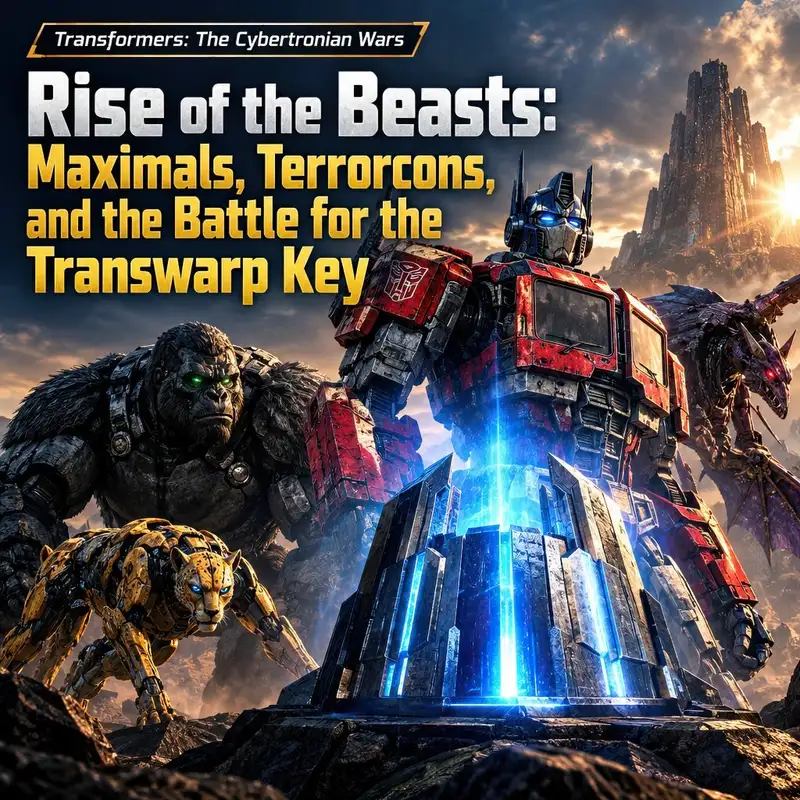
Rise of the Beasts: Maximals, Terrorcons, and the Battle for the Transwarp Key
Apelinq’s last stand was not an attempt to save his world. That battle had already passed the point where a local victory could matter. Scourge, serving the planet-devouring Unicron, had come for the Transwarp Key. The Maximals understood what that meant. If their enemy acquired the Key, distance would stop protecting other worlds. Apelinq’s task was narrower and more severe. He had to delay Scourge long enough for the surviving Maximals to escape with the route their enemy wanted.
That is the military meaning of the opening disaster in Rise of the Beasts. Apelinq was fighting a rear-guard action, the kind of operation in which survival depends not on defeating the attacker, but on buying a few more minutes for someone else. He could not destroy Unicron. He could not defeat Scourge in single combat. He could only make the pursuit costly enough, and slow enough, that Optimus Primal and the other Maximals could carry the Key beyond immediate reach.
The Transwarp Key is often treated as a superweapon because its consequences are so large. That description is understandable, but incomplete. Its central value is mobility. The Key opens portals through space and time. It can turn separation into access. For a refugee force, that means escape. For stranded Autobots, it offers a way home. For Unicron, it means that worlds which might otherwise remain beyond his reach become targets on a corridor of conquest.
Unicron’s ambition is not described in the language of ordinary statecraft. He is not seeking a border adjustment, a trade route, or a position in Cybertronian politics. He consumes worlds. Yet the Transwarp Key still creates a recognizable strategic problem. Even an overwhelmingly powerful enemy must reach the place he intends to destroy. The Key reduces that problem. It gives Unicron a means to bypass the normal barriers of distance, travel time, and planetary isolation.
The Maximals escaped, but escape came with a condition. They had to remain hidden. The surviving group reached Earth and adopted animal alternate modes, blending into environments where Cybertronian vehicles and spacecraft might have drawn attention. Their forms gave them mobility across forests, cliffs, rivers, and open ground. More importantly, those forms supported concealment. A gorilla, a cheetah, a rhinoceros, and a falcon could remain near an unfamiliar human civilization without announcing that an interstellar war had arrived.
These Maximals are not the Maximals of the Beast Wars television series, despite the shared names and animal modes. Rise of the Beasts establishes its own history. Optimus Primal, Airazor, Cheetor, and Rhinox are survivors of a destroyed homeworld, not visitors from another version of Cybertronian history. Their story is shaped by flight from Unicron, by the burden of safeguarding the Key, and by years spent avoiding the attention of both enemies and potential allies.
Their animal forms do not make them a separate biological species from Autobots. In this film, Maximal and Autobot describe distinct groups with different experiences, loyalties, and wartime histories. The distinction matters because the Maximals do not arrive on Earth as reinforcements in an Autobot campaign. They are refugees preserving a secret. Their first obligation is survival. Their second is denying Unicron the tool that destroyed their world.
That experience explains Optimus Primal’s caution. He has seen what happens when the Key becomes an object of pursuit. To an observer who has lost a planet, there is little comfort in hearing that someone else intends to use the same artifact for a worthy purpose. A corridor can carry refugees away from danger. It can also carry danger directly to them. The physical object remains the same. The political and military meaning depends on who controls it, who can activate it, and who is waiting on the other side.
The Maximals’ concealment on Earth was therefore more than hiding in the woods. It was an intelligence policy. They had to protect their own existence, suppress information about the Key, and avoid creating a signal that would guide Scourge to their refuge. They could not build a conventional defense network without attracting attention. They could not openly recruit human governments without revealing themselves. Their security depended on remaining difficult to find and even harder to understand.
That strategy had limits. Concealment is strongest when the hidden object remains dormant. Once someone recognizes its significance, activates it, or broadcasts its location, the advantage begins to collapse. The Maximals had survived by keeping the Key beyond Unicron’s reach. They could not guarantee that it would remain beyond the reach of everyone else.
By nineteen ninety-four, the Autobots on Earth faced a different emergency. They were also displaced from Cybertron, but their strategic problem was not inherited from the Maximals’ evacuation. Optimus Prime led a small force that had survived the fall of Cybertron seen in Bumblebee. Their situation on Earth was not one of comfortable exile. They had found refuge, but not a solution. They had no reliable route home and no assurance that Cybertron could be reached by ordinary means.
For Optimus Prime, the Transwarp Key represented possibility. A system capable of opening a portal across immense distance could reconnect the Autobots with their lost world. That objective was not selfish. A commander responsible for scattered survivors has an obligation to consider how they might return home, reunite with allies, and recover a future larger than life in hiding. The trouble was that the Key could not distinguish between an Autobot evacuation route and a Terrorcon invasion route.
The Autobots were searching for a way to return to Cybertron. The Terrorcons were hunting for a way into Earth’s future. The Maximals were trying to ensure that neither pursuit exposed their hidden sanctuary. Then Noah Diaz entered the situation through what appeared to be an ordinary act of desperation.
Noah was not a general, intelligence chief, or official representative of any government. He was a former military electronics specialist struggling to find work and support his family. His concerns were immediate. His younger brother Kris needed care. His mother needed income. The great politics of Cybertron meant little beside rent, medical bills, and the daily pressure of trying not to disappoint the people depending on him.
His attempt to steal a Porsche brought him into contact with Mirage, an Autobot using that vehicle form as cover. The encounter demonstrates both the usefulness and the weakness of transformation as disguise. Mirage could move through Brooklyn as an expensive civilian automobile. He could access roads, traffic, garages, and neighborhoods without arriving as a visibly alien war machine. But a disguise is not a guarantee of security. It relies on behavior, circumstance, and the ability to avoid the wrong person at the wrong moment.
Noah was precisely that wrong person. He did not uncover Mirage through a sophisticated military sensor network. He found him because he tried to take the car. War often enters civilian life this way. Not through a declaration broadcast from a capital, but through an accident, a job, a piece of equipment, or a decision made under financial pressure. Noah did not choose a role in an interstellar conflict. He encountered it in the infrastructure of his own city.
His value to the Autobots was not that he represented humanity as a whole. He did not. He brought technical confidence, improvisational skill, and an understandable reluctance to abandon people in danger. He could work with unfamiliar systems without pretending to master them. That difference changes the stakes. Noah becomes useful because he can adapt under pressure, not because he suddenly commands an army or understands all Cybertronian technology.
Mirage also becomes important because he provides Noah with access. The Autobot can move him through the city, shield him in a fight, and eventually incorporate him into an improvised combat role. But the partnership is not a clean division between human pilot and mechanical vehicle. Noah remains physically vulnerable. Mirage remains subject to damage and tactical pressure. Their cooperation works because each covers a limitation the other cannot solve alone.
At roughly the same time, another civilian specialist triggered the event that turned a concealed artifact into an active crisis. Elena Wallace worked at a museum, where she had the training and curiosity to recognize that an ancient object contained something more than its official description suggested. Her role was not to command a battlefield. It was to interpret evidence. She noticed a pattern that others had overlooked and pursued the question far enough to activate part of the Transwarp Key.
That activation changed the strategic situation. A hidden artifact can remain outside a war if no one knows what it is, where it is, or how to use it. Once Elena awakened the Key, it emitted a signal. The Autobots detected it. The Terrorcons detected it. The Maximals’ long effort to keep the Key’s significance obscured was suddenly compromised by a combination of human research and alien technology.
This was not a failure of Elena’s intelligence or professionalism. She had no reason to know that the object was connected to a planetary predator. Her work solved an interpretation problem. She recognized that the artifact contained a system requiring explanation. But from the Maximals’ perspective, the incident exposed the fundamental weakness of passive security. A secret can survive for years, perhaps centuries, yet still be broken in a moment when the right person asks the right question.
Elena’s contribution remains distinct from Noah’s. Noah helps solve movement, access, and direct-action problems. Elena helps solve questions of meaning, location, and historical connection. Without her, the coalition lacks crucial knowledge about the Key and the route to its remaining component. Without Noah, that knowledge might never be carried through the physical danger surrounding it. Neither human replaces the Cybertronian forces. Both become essential because the conflict cannot be won by firepower alone.
The Terrorcons understood that well. They were not another Decepticon army, and the film does not present them as such. They are an expeditionary force serving Unicron. Their mission is focused. Scourge leads them in the field, while Battletrap and Nightbird provide additional combat capability. They do not need to occupy every city, recruit a mass army, or establish a durable government before they become dangerous. They need only acquire the Key and activate it.
Scourge’s authority is practical rather than constitutional. He does not appear as the leader of a broad Cybertronian political movement. His power comes from his relationship to Unicron, his effectiveness as a hunter, and his ability to intimidate those around him. He is a field commander whose mission has consequences far beyond the size of his unit.
His trophy-taking reinforces that point. The emblems and fragments he collects are not just decoration. They are evidence of a predatory command culture. Scourge defines success through pursuit, defeat, and the visible possession of what he has taken from others. Such trophies advertise his relationship to power. They tell subordinates and enemies alike that resistance becomes material for the victor’s display.
The Terrorcons’ danger lies in their combination of mobility, focus, and external backing. Scourge does not need to build an industrial base on Earth. He does not need to persuade humans to accept Unicron’s rule. He is an advance element. His task is to create access for something much larger than himself. In that respect, the Terrorcons are less like a conventional occupying force than an armed reconnaissance and recovery team operating on behalf of a strategic predator.
The confrontation around the museum makes that reality visible. The Autobots are not recovering a relic from a rival Cybertronian faction. They are trying to stop a Terrorcon expedition from opening a corridor for Unicron. The stakes rise because the Key is no longer hidden, and because Scourge has demonstrated that he can reach it faster than any local authority can understand what is happening.
At this point, the Maximals and Autobots finally meet as organized groups rather than scattered witnesses to the same crisis. Their alliance is not immediate friendship. It is a negotiation under pressure between leaders who understand the threat differently. Optimus Prime sees a route that could end his force’s isolation. Optimus Primal sees the same route as the instrument of his people’s disaster.
Airazor helps explain why the Maximals are so determined to prevent the Key’s use. She is more than an exposition officer assigned to deliver background information. She is a survivor with a memory of pursuit. The Maximals have spent their time on Earth protecting themselves from a danger that never truly disappeared. Their caution is grounded in experience. They know that Unicron does not require a permanent foothold to be catastrophic. He requires access.
Prime’s position is understandable, but narrow. His Autobots are far from Cybertron, uncertain of what became of their world, and without a secure means of return. A commander in that position will naturally look at the Key as an opportunity. The danger is that he initially treats the artifact as a solution to Autobot isolation before fully accepting that it is also the cause of Maximal exile.
Primal’s position is also limited. Denial can preserve a refuge, but it does not create a future by itself. Hiding had kept the Maximals alive, yet it had not removed Unicron from the wider universe. The arrival of the Autobots and the activation of the Key make long-term concealment impossible. Primal cannot simply send the newcomers away and resume the old security policy. The threat has already found Earth.
Neither leader commands the other’s force. Prime has authority over Autobots. Primal has authority over Maximals. Their cooperation depends on common danger, not a shared chain of command. That matters in practical terms. Each leader must persuade rather than order. Each has to weigh the risks his own people are being asked to take. Each has to accept that the other possesses knowledge and capabilities he does not control.
The coalition begins because their interests overlap. The Autobots cannot use the Key if Scourge captures it. The Maximals cannot keep Earth hidden once the Key’s signal is active. The humans cannot remain outside the conflict when the artifact’s activation has made their planet a target. Cooperation is not born from sentiment. It is born from the recognition that separate objectives have been overtaken by a larger threat.
That recognition leads the group to Peru, where the second component of the Key is connected to a Maximal sanctuary and to the history Elena has begun to uncover. The journey from Brooklyn to Peru is a useful reminder that even a device capable of bending space does not eliminate ordinary geography. Before the Key can open a portal, its components must be found, reached, protected, assembled, and activated.
The coalition needs transport. It needs knowledge of the site. It needs people who can interpret symbols, navigate access routes, and understand which pieces of the past matter in the present. The Maximals’ prior connection to the region gives them local historical knowledge. Elena can recognize patterns in the artifacts and structures around the Key. The Autobots provide combat power and a willingness to move quickly. Noah provides the adaptability required when plans collide with physical obstacles.
Peru is therefore not just an exotic battlefield chosen for scenery. It is strategic geography. It is where the remaining Key component lies, where the Maximals’ concealed history becomes operationally relevant, and where every participant’s objective converges. A distant artifact can be decisive only if someone can control the ground around it.
The expedition is also improvised. This is not a campaign supported by a planetary government, a vast logistical network, or a prepared military alliance. The Autobots and Maximals have limited time. They cannot rely on a human state to secure roads, airspace, archaeological sites, or evacuation corridors. They do not have the luxury of rotating damaged units, establishing large repair facilities, or building a layered defense around the Key.
That absence of institutional support increases the burden on individual participants. Noah and Elena bear risks that, in a more organized political order, would belong to intelligence services, engineers, security forces, and emergency authorities. The film does not show a fully mobilized human response because the threat remains largely outside public knowledge. The world is in danger before its governments have had time to understand that danger exists.
The coalition reaches Peru with unresolved disagreement still intact. Prime has not abandoned the hope that the Key could return the Autobots to Cybertron. Primal has not stopped seeing it as the instrument of Unicron’s advance. Their shared operation works only because the Terrorcons remain the immediate danger. Then Airazor’s compromise reveals how fragile their security has become.
Airazor is altered by contact with Scourge and Unicron’s influence. The film does not offer a complete technical explanation of the process, and it would be a mistake to turn the event into a universal rule about Cybertronian minds, sparks, or possession. What matters here is the operational effect. A trusted Maximal, someone with knowledge of the sanctuary and the Key, becomes an avenue through which the enemy can gain access.
This is not evidence that Airazor’s loyalty was weak. It is evidence that a force can be compromised without choosing betrayal. In military and intelligence history, security boundaries often fail not because a trusted person suddenly decides to serve the enemy, but because injury, coercion, manipulation, or altered judgment turns personal knowledge into hostile access. The closer someone is to a protected system, the more damage can follow when that person is compromised.
For Primal, Airazor’s condition is both a personal tragedy and a command crisis. He must care for a longtime comrade while recognizing that her altered state threatens the very objective she helped protect. A leader’s responsibility to an individual does not disappear during war. Neither does the responsibility to prevent a larger catastrophe. The film gives Primal no painless solution. He has to make a decision in which compassion and duty point in different directions.
Prime faces a related realization. His plan to use the Key is becoming harder to defend. The artifact has already drawn Scourge to Earth. It has already endangered humans, exposed the Maximals, and created a route that Unicron can exploit. Even if Prime could imagine using it after the battle, the immediate priority can no longer be extraction. The coalition must first deny the enemy the ability to turn the Key into a permanent invasion corridor.
This is the moment when strategic mobility changes from an opportunity into an emergency. The question is no longer whether the Autobots should use the Key to go home. The question is whether anyone can prevent Unicron from using it to arrive.
Scourge succeeds in reuniting and activating the Key. At the mission level, this is a Terrorcon success. The artifact functions. A portal opens. Unicron is able to approach Earth through a route that did not exist before. For the Terrorcons, the recovery operation has achieved its immediate purpose.
But a mission success is not always a strategic victory. The portal is active, yet still vulnerable. The Terrorcons have created access, but they have not secured lasting control. The coalition remains in the field. The Key has become the center of a battle in which timing matters as much as force. If the Autobots, Maximals, Noah, and Elena can disable the system before Unicron fully enters the theater, the Terrorcons’ achievement can still be reversed.
In the immediate fight, the battle is fought by individuals and small teams. Optimus Prime confronts Scourge. Bumblebee returns to the fight. Maximals and Autobots engage Terrorcon forces around the Key. These actions matter because the site must be physically contested. The coalition cannot solve the problem from a safe distance. It has to hold ground near an active portal while an enemy force tries to preserve access.
Operationally, the objective is more specific. The coalition must keep the Key site contested long enough for technical intervention. It is not enough to win a series of duels. A fighter can defeat an opponent and still fail if the portal remains open. The combat elements must create time and space for the people who can reach the Key and interrupt its function.
Strategically, Unicron seeks a durable approach route to Earth and beyond it. A world-consuming power does not need to conquer every block, building, or village before a portal becomes decisive. If Unicron can establish reliable access, Earth becomes exposed to a threat that ordinary national defenses were never designed to meet. The Key is strategically dangerous because it converts a remote cosmic entity into an immediate local problem.
Politically, Prime’s priorities have changed. The route to Cybertron cannot be separated from Earth’s defense. Any attempt to preserve the Key for Autobot use would leave open the possibility that Unicron could recover it later. The desired escape route has become too dangerous to possess casually. Prime has to accept that returning home cannot take precedence over preventing another world from suffering the fate of the Maximals’ home.
For intelligence, Noah and Elena become indispensable. Elena’s understanding of the artifact and its context allows the coalition to recognize what must be done. Noah can reach and work within the dangerous space around the system, aided by Mirage and by his own refusal to abandon the people beside him. Their role is not glamorous in the conventional sense. It is access, interpretation, and technical action under fire. Yet without it, the larger combat effort has no way to achieve its purpose.
This is combined arms in miniature. The Maximals bring mobility, local familiarity, and the combat instincts of survivors who have already faced Unicron’s servants. The Autobots provide direct engagement, leadership, and the willingness to meet Scourge where he is strongest. The humans provide the narrow but essential skills required to understand and reach the Key. None of these capabilities is sufficient alone.
The battle also reveals the limits of brute force. Destroying an active portal system is dangerous because the portal itself has become part of the battlefield. The coalition cannot simply fire at the Key without considering the consequences of an unstable collapse. They have to manage combat, timing, and technical disruption at once. The artifact’s power creates the crisis, but it also constrains the solution.
Scourge remains the key obstacle because he embodies the Terrorcons’ mission. He is not trying to govern Earth. He is trying to keep the corridor open long enough for Unicron to enter. That makes him a dangerous opponent even without an army behind him. His success would not be measured by territory seized. It would be measured by the arrival of something far more destructive than his own force.
Optimus Prime’s confrontation with Scourge is therefore not just personal revenge or a contest of individual strength. Prime has to remove the commander who is holding the Terrorcon operation together. Noah’s involvement matters for the same reason. He is not replacing Prime. He is helping break the chain between Scourge’s battlefield control and the Key’s continued activation.
The defeat of Scourge breaks that chain. The Terrorcons lose their practical field commander, and the coalition gains the time it needs to complete the denial operation. But Scourge’s defeat alone would not have been enough. The Key itself has to be rendered unusable. Otherwise another force, another survivor, or Unicron himself might eventually exploit the same corridor.
Bumblebee’s return to action contributes to that final effort. His recovery is significant within the immediate battle because a damaged Autobot returns when the coalition needs every available defender. It should not be treated as proof that death and resurrection follow a simple, repeatable rule in this film branch. The event shows that extraordinary recovery can occur under specific circumstances. It does not establish that every loss is reversible or that battlefield casualties are without consequence.
The Key is destroyed or disabled, and the portal closes before Unicron can fully enter the Earth theater. This is a denial victory. The coalition does not destroy Unicron. It does not remove the wider threat he represents. It does not restore the Maximals’ lost world. It does not provide the Autobots with a route back to Cybertron. What it does is prevent the Terrorcons from converting a temporary opening into permanent access.
That difference is important. Tactical success belongs to the fighters who survive the battle and defeat Scourge. Operational success belongs to the coalition that holds the site long enough to stop the Key. Strategic success is more limited. Earth is defended against immediate consumption, and Unicron is delayed. But delay is not the same as final victory. A threat can be pushed back without being removed.
The aftermath also produces an alliance, but not a completed peace. The Autobots and Maximals have fought beside one another. Prime has learned why Primal treated the Key with such suspicion. Primal has seen that the Autobots can shift from private objectives to collective defense when the stakes require it. Mutual respect has been earned, but the groups remain distinct, shaped by different losses and different hopes.
Noah and Elena are also indispensable to the outcome, though they do not become evidence that humanity has established a formal military partnership with Cybertronians. Their experience is personal, local, and extraordinary. Noah’s family remains part of the human world that the conflict threatened. Elena returns from a struggle in which historical research became a matter of planetary survival. Their participation shows that ordinary people can become decisive when institutions have not yet caught up with reality.
The later contact from G I Joe is a signal of possible future involvement, not proof that a finished human-Cybertronian alliance already exists. No treaty, joint command, doctrine, or shared campaign has yet been established by the story. It is an invitation, not a record of completed cooperation.
What the coalition won was time, survival, and a new understanding of the Key. The Autobots initially saw it as escape. The Maximals saw it as a dangerous secret. The Terrorcons saw it as a path for conquest. By the end, the only responsible course was to treat it as a corridor that had to be denied.
That decision did not solve every problem. It left Cybertron distant. It left Unicron alive. It left Earth vulnerable to a universe larger and more dangerous than its civilian institutions yet understood. But it prevented isolated survivors from pursuing separate goals while a greater threat used their division against them.
The battle for the Transwarp Key matters because it shows that mobility is never neutral. A route home can become an invasion route. A refuge can become a target. A hidden artifact can become a signal that draws war across the stars. The Autobots, Maximals, Noah, and Elena prevail because they stop treating the Key as a prize to possess and recognize it as a passage no one can safely control while Unicron waits beyond it.