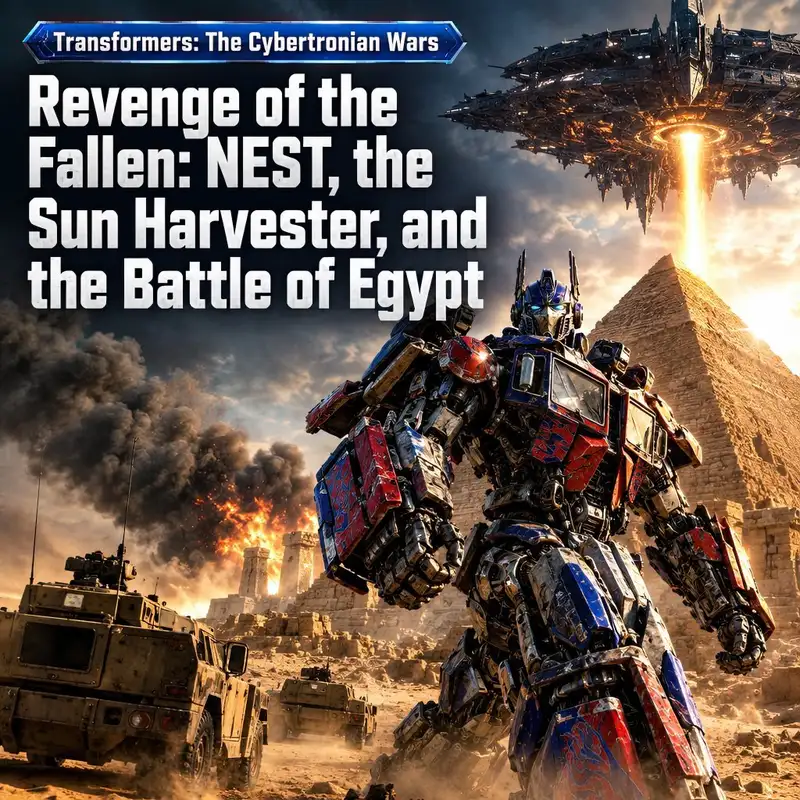
Revenge of the Fallen: NEST, the Sun Harvester, and the Battle of Egypt
In Shanghai, civilians are pushed away from a city district under the explanation that a toxic spill has made the area unsafe. The cover story is practical. It clears streets, limits witnesses, and gives emergency services a reason to control movement. Behind that public fiction, a different operation is under way. Helicopters arrive, soldiers establish a perimeter, aircraft control the airspace, and Autobots move toward a Decepticon threat hidden inside the city. The alliance formed after Mission City has become something more organized than a desperate one-time defense.
This is the world of the 2009 film Revenge of the Fallen, set roughly two years after the first live-action battle for Earth. The human-Autobot partnership is now called NEST, a classified force hunting surviving Decepticons across national borders. In Shanghai, NEST demonstrates that it can find an enemy, isolate an urban area, bring human and Cybertronian forces together, and destroy a target before the public learns what actually happened. It also demonstrates the political cost of that method. A city can be saved from a Decepticon and still be left damaged enough to make the rescuers look dangerous.
Major William Lennox directs the human side of the operation. Optimus Prime leads the Autobots, who fight beside NEST but are not its subordinate equipment. That difference changes the stakes. NEST is a partnership, not a human army with alien attachments. Lennox can coordinate soldiers, aircraft, communications, and evacuation. Optimus can direct Autobots whose loyalties, strategic obligations, and understanding of the Decepticons extend far beyond any human chain of command. Their cooperation is effective because each side provides what the other lacks. It is also unstable because neither side fully controls the other.
The immediate targets in Shanghai are Decepticons including Sideways and Demolisher. Sideways attempts to evade the pursuit through the urban environment. Demolisher is a more visible threat, large enough to turn the streets into a battlefield and dangerous enough that ordinary police or military response would be inadequate. The Autobots provide the direct combat power needed to engage such an opponent at close range. Human personnel provide coordination, perimeter security, and support. The operation succeeds in its narrow mission. The hostile machines are stopped. But success brings debris, panic, and a highly visible trail of destruction.
Before Demolisher is destroyed, he warns that the Fallen will rise again. NEST receives the warning, but it does not yet understand it. This is the central intelligence problem of the film. The alliance has become good at reacting to Decepticon appearances. It has not identified the enemy’s campaign objective. A military organization can possess capable troops, aircraft, secure facilities, and experienced commanders, yet still be strategically blind if it does not know what the enemy is trying to achieve. Shanghai is proof that NEST can win a firefight. It is also proof that winning firefights is not the same as understanding the war.
NEST is best understood as a covert human-Cybertronian strike partnership. It operates from Diego Garcia in the Indian Ocean and pursues Decepticon threats wherever the political circumstances permit. The film presents it as an international security arrangement, but not as a fully documented multinational army with a known treaty, budget, force structure, or public mandate. We see its function more clearly than its legal architecture. NEST exists to locate hostile Cybertronians, bring sufficient force to bear quickly, and keep the wider conflict concealed from most of the world.
That secrecy is both an advantage and a weakness. It allows NEST to move without turning every Decepticon incident into an international crisis. It protects civilians from panic and prevents hostile forces from gaining easy access to public information. But secrecy also limits accountability. Citizens do not know why a neighborhood was evacuated, why military aircraft appeared overhead, or why a city block now resembles a disaster zone. Governments may cooperate with NEST, but the film does not show a durable political system through which the public can evaluate, authorize, or challenge that cooperation.
The human side of NEST brings capabilities that the Autobots cannot simply replace. Human forces possess access to bases, transport networks, conventional aircraft, armored vehicles, communications systems, and the authority to operate within Earth’s political geography. They can clear airspace, mobilize emergency services, use established military infrastructure, and direct fire support against identified targets. They also understand the terrain of human institutions. A Decepticon can hide in a city, but it still has to move through roads, power systems, military zones, ports, and communication networks that humans know how to manage.
The Autobots contribute a different kind of capability. They can identify and fight Decepticons as fellow Cybertronians. They understand technologies, languages, and threats that humanity cannot yet reproduce or fully interpret. Their alternate modes give them unusual mobility and concealment. Their bodies can engage adversaries against which conventional weapons may be insufficient, imprecise, or too slow to employ. Most importantly, they know that the Decepticon problem is more than a series of isolated attacks. It is part of a larger conflict with origins, leaders, and technologies that predate humanity’s involvement.
Neither partner can solve the crisis alone. Human forces can organize a battlefield, but they cannot reliably interpret ancient Cybertronian systems or confront every Decepticon at close range. The Autobots can defeat powerful individual enemies, but they cannot control human airspace, supply chains, political authorities, or civilian evacuation without cooperation. NEST works because it combines those strengths. Its difficulty is that this combination depends on trust, improvisation, and a legal structure too vague to settle the hardest questions before they become emergencies.
Shanghai gives Theodore Galloway an opening to challenge the entire arrangement. Galloway arrives as the president’s national security adviser and liaison to NEST. He does not see the operation as a clean success. He sees a foreign city damaged by a battle between alien factions, a human military force operating under secrecy, and Autobots who retain their own weapons, intelligence, and political authority. From his position, the obvious question is not whether NEST destroyed Demolisher. It is why Earth is still paying the price for a war that began somewhere else.
Galloway’s concern is not irrational. The Autobots came to Earth, and the Decepticons followed. The first film ended with the destruction of Mission City. Now Shanghai has been devastated in another engagement. To a political official responsible for national security, the pattern appears straightforward. The Autobots may be allies, but their continued presence may also attract further attacks. If the goal is to protect humanity, perhaps the most sensible answer is to remove the alien combatants from Earth rather than let their civil war become a permanent feature of human life.
Lennox, General Morshower, and Optimus see the danger differently. They have spent two years confronting Decepticons in the field. They know that the enemy has not disappeared after Mission City. They also know that forcing the Autobots off Earth would not necessarily remove the threat. It might simply leave humanity with less intelligence, fewer capable allies, and no warning when the Decepticons returned. Their argument rests on operational experience. Galloway’s rests on political responsibility. Both sides are looking at the same destruction, but they are drawing different conclusions from it.
While NEST debates whether the alliance itself has become a liability, the Decepticons exploit a security gap. Soundwave gains access to a military satellite and uses it to locate a surviving fragment of the AllSpark. In this film’s continuity, the AllSpark was destroyed at the end of the first battle for Earth. The object has not been restored intact. What remains is a shard, a residual piece with enough power to matter enormously in the wrong hands. The Decepticons do not need to recover the whole artifact. They need only enough of it to restore a commander.
The fragment is held at a secure naval facility. Megatron’s remains, meanwhile, have been preserved under military guard in the Laurentian Abyss. The film makes clear that the United States has tried to contain both dangerous material and a dangerous body. It does not give a detailed account of the naval command structure, the security procedures, or the technological safeguards involved. We should resist the temptation to invent them. The important point is simpler. A force that can penetrate military networks, coordinate a recovery operation, and exploit one surviving artifact can undo years of containment in a matter of hours.
The Decepticons obtain the shard and use it to revive Megatron. This is a major command event, but not quite in the way it first appears. Megatron returns as the recognizable leader of the Decepticons, and Starscream’s position becomes more precarious after having exercised authority in Megatron’s absence. Yet Megatron is not the supreme strategic actor in this campaign. He answers to the Fallen, an ancient Prime whose goal shapes the entire operation. Megatron commands violence, intimidation, and Decepticon forces. The Fallen provides the plan.
The recovery of Megatron shows how an enemy can regain initiative without defeating every opposing unit. The Decepticons do not need to destroy NEST worldwide. They do not need to seize every human base or defeat every Autobot in open battle. They need to capture one fragment, restore one leader, and use that leader to coordinate the next stage of the campaign. This is the logic of concentrated strategic effort. A small number of decisive resources can matter more than a broad but unfocused exchange of fire.
Once Megatron returns, the conflict rapidly shifts from a covert counter-Decepticon campaign to a global coercive crisis. The Fallen broadcasts a demand for Sam Witwicky. He tells humanity that Sam must be surrendered. The message is more than a threat against one young man. It is an attempt to turn global fear into political pressure. If governments believe that handing over Sam might end the attacks, then every government has an incentive to isolate him, capture him, or distance itself from the Autobots who protect him.
The film depicts attacks around the world, heightened military alert, the loss of the aircraft carrier USS Roosevelt, and thousands of reported casualties. The exact scale of these events is not established with the precision a real military historian would want. The film gives reports, images, and alarm rather than a reliable global order of battle. Still, the strategic effect is unmistakable. The Decepticons have demonstrated reach. They can strike military assets, threaten populations, and make the cost of resistance visible enough that leaders may begin to treat surrender as a form of risk management.
Sam is not a military commander. He does not possess a formal rank, a chain of command, or authority over NEST. What he has is knowledge embedded in his mind after contact with the AllSpark. He begins seeing Cybertronian symbols that seem meaningless even to those around him. That makes him an intelligence node of an unusual kind. The information is personal, unstable, and difficult to interpret. It cannot simply be downloaded into a secure network or handed to an analyst. Yet it may be the only path toward understanding what the Decepticons need.
Sam turns to Seymour Simmons, a former Sector Seven agent. Simmons is not valuable because he commands troops or controls a base. His value is interpretive. Sector Seven had spent years collecting fragments of Cybertronian history, technology, and evidence of earlier contact with Earth. Its records are incomplete, its assumptions are imperfect, and its institutional habits are hardly a model of democratic transparency. Still, Simmons can recognize that the symbols may connect Sam to a much older story than the current Decepticon hunt.
The search leads to Jetfire, an aged Cybertronian hidden at the Smithsonian National Air and Space Museum. Jetfire is a former Decepticon, but he is not presented as a standard field combatant in the condition to lead an assault. Age and damage have limited him. His importance lies in two capabilities. First, he can explain what the symbols mean. Second, he possesses a space bridge, a means of moving across vast distances without conventional travel. In the immediate crisis, those two abilities matter more than raw firepower.
Jetfire’s historical account gives the campaign its missing strategic context. According to his testimony, seven original Primes traveled between stars to harvest Energon, the energy source on which Cybertronian life depends. They followed a rule: no Sun could be harvested if doing so would destroy a world that contained life. One of the Primes broke that rule. He attempted to use the machine on Earth. For that betrayal, he became known as the Fallen.
This account should be treated carefully. It is the film’s own ancient history as related by Jetfire. It is not a universal account of Cybertronian origins, the Primes, or the Fallen in every Transformers story. Within this film, however, it explains the enemy’s objective. The Fallen is not just seeking a weapon to defeat Optimus. He is pursuing an ancient energy-extraction system that would destroy Earth’s Sun. His revenge and his resource strategy are joined together. Earth’s extinction would also provide the Energon he seeks.
The other Primes prevented the machine’s activation by hiding the Matrix of Leadership, the key required to control the Sun Harvester. They conceal it inside a tomb made from their own bodies. The story is mythic in scale, but its military importance is concrete. The Matrix is not just a symbol of legitimate leadership. It is an access key to a weapon system. Whoever possesses it may determine whether the Sun Harvester remains dormant or becomes active. Ancient mythology has become a present-day command-and-control problem.
Jetfire’s space bridge changes the operational geography of the search. It moves Sam and his companions to Egypt far more quickly than ordinary travel would allow. But it should not be mistaken for unlimited portal logistics. The film shows a particular capability used by a particular, damaged Cybertronian at a critical moment. It does not establish that NEST can open a bridge anywhere, move an army through it at will, or sustain a global campaign through identical portals. Exceptional mobility can alter a crisis without becoming a general transportation system.
Egypt matters because two separate trails converge there. The Matrix is hidden in an ancient tomb, while the Sun Harvester lies concealed beneath a pyramid complex. The film compresses real geography into a rapid sequence of locations and movements. It is not a precise operational map of Egypt. What matters is the strategic relationship between the sites. Sam’s group needs to recover the Matrix before the Decepticons can activate the Harvester. The Decepticons need to find Sam because his knowledge may lead them to the same key.
The Sun Harvester is not ordinary Decepticon industrial infrastructure. It is not a refinery, a portable generator, or a technology that can be copied after one successful demonstration. It is a unique ancient machine designed to extract Energon through the destruction of a star. The film does not explain its workings according to real astrophysics, and it does not need to. Its strategic function is clear enough. If activated near Earth, it will destroy the Sun. The result would not be a local defeat or even a conventional planetary invasion. It would be the loss of the system on which life on Earth depends.
Sam, Mikaela, and Simmons reach the tomb and recover the Matrix. Then the Matrix disintegrates into dust. This is an intelligence crisis within a military crisis. They have found the object that explains the enemy’s plan, but not a usable solution. The physical key appears lost. The group cannot simply call NEST and report that the mission is complete. The discovery has changed what they know, but it has not yet changed what they can do. In warfare, information without a practical means of acting on it can be as frustrating as ignorance.
At the same time, the alliance suffers its sharpest command shock. Optimus Prime is killed in the forest battle against Megatron, Starscream, and Grindor. His death is more than a personal loss for the Autobots. It removes the partner most capable of connecting Autobot authority with human military cooperation. Optimus is the political leader of the Autobots and a trusted battlefield ally of Lennox and Morshower. Without him, the alliance loses a commander, a symbol of continuity, and an individual whose personal judgment had held much of the relationship together.
The forest engagement also reveals the Decepticons’ operational method. They do not need every fight to be decisive on its own terms. By concentrating several major combatants against Optimus, they remove the most important Autobot leader at the moment the wider campaign is moving toward Egypt. The result is a temporary collapse of initiative on the Autobot side. NEST still has soldiers and equipment. The Autobots still have capable fighters. But the coalition has lost the figure who best understood both the immediate threat and the political meaning of their partnership.
Galloway responds to the growing crisis by attempting to shut NEST down and by arguing that Sam should be surrendered. His authority is real. He is more than an obstructionist civilian wandering into a battlefield. The problem is that his decisions are based on incomplete intelligence and a framework that has not anticipated this kind of emergency. He knows that Decepticons are attacking. He knows that Sam is the target. He knows that Optimus is dead. But he does not yet understand the Matrix, the Harvester, or the Fallen’s intention to destroy the Sun.
Lennox receives Sam’s coordinates and decides that NEST must support him. This is a clash between legal authority and practical battlefield necessity. The film does not provide enough information to describe Lennox’s action as a fully documented mutiny or to map every order and counterorder. What it shows is a commander making an emergency judgment. If Sam’s information is connected to the Decepticons’ objective, then abandoning him may mean abandoning the only path to stopping a planetary threat. Lennox chooses to act before the political system has caught up with the intelligence.
That decision depends on relationships built during the earlier campaign. NEST can move because Lennox has personnel who trust his judgment. The Autobots can cooperate because they have fought alongside human forces before. Morshower can provide senior military support because he recognizes the scale of the danger. None of this is automatic. It is the accumulated result of shared operations, casualties, and professional confidence. In a better organized alliance, those relationships would be reinforced by clear rules. In NEST, they must substitute for them.
The deployment to Egypt still requires conventional military effort. Jetfire’s bridge has moved the civilian intelligence party, but it does not transport the entire NEST force wholesale. Soldiers, aircraft, vehicles, equipment, communications, and Optimus Prime’s body must be moved and coordinated through more familiar means. This is an important distinction. The film’s most dramatic technologies can create openings, but they do not eliminate logistics. A force arriving at the wrong time, without communication, targeting, fuel, or recovery capacity, is not made effective merely because the distance was crossed quickly.
NEST’s greatest vulnerability is therefore not its lack of firepower. It is its lack of a settled political mechanism for deciding how humans and Autobots will act when survival, sovereignty, and alien autonomy collide. The alliance can function brilliantly when Lennox and Optimus agree. It can function under pressure when Morshower supports the field commanders. But it remains vulnerable to any official who asks a question it has never properly answered: who has the authority to commit Earth’s forces when the threat comes from another civilization’s war?
The Battle of Egypt brings every unresolved problem into one place. The battlefield is built around a major archaeological landscape and a pyramid complex concealing the Sun Harvester. The film offers a compressed geography rather than a realistic campaign map, but the operational problem is plain. The Decepticons are defending access to the machine. NEST and the Autobots must prevent activation, recover or protect the Matrix, and survive long enough to restore a coherent command structure. The fight is not just over ground. It is over time.
The Decepticon defense includes Constructicons, Cybertronians whose combined form becomes Devastator. In this battle, Devastator’s key role is excavation. The combined machine tears into the pyramid to uncover the Harvester beneath it. That makes him an engineering asset as well as a battlefield threat. The Decepticons are not using raw strength for spectacle alone. They need to expose and prepare the ancient machine before the Matrix can be used. Their tactical actions serve a strategic objective.
NEST responds with a recognizable combined-arms approach. Human ground forces maneuver with armored vehicles. Aircraft provide mobility, surveillance, and attack options. Communications connect units that cannot all see the same part of the battlefield. Autobots engage Decepticons directly, drawing attention and applying force where human troops cannot safely or effectively close the distance. Human commanders coordinate targeting and call in support. No single element dominates the operation. The battle works when the elements cover one another’s limitations.
This complementarity is the real achievement of NEST. Human forces are not shown defeating every Cybertronian threat on equal terms through conventional firepower alone. Nor are the Autobots shown fighting the whole battle without human assistance. The humans can identify targets, maintain communications, coordinate aircraft, and deliver specialized strikes. The Autobots can penetrate hostile formations, fight at close range, move through terrain in ways human vehicles cannot, and understand the enemy’s technology. The partnership turns separate capabilities into an operational system.
Lennox’s role is especially important because he provides coordination rather than merely personal combat prowess. He directs forces, identifies priorities, and helps connect local engagements to the larger objective. In a battle involving towering Cybertronians, ancient machinery, aircraft, and dispersed ground troops, someone must decide which threat deserves attention first. That is command. It is not glamorous, and the film does not provide a full staff map or communications plan. But the battle repeatedly shows that accurate direction, target marking, and timely support can matter as much as any individual weapon.
Sam’s role remains central because the Matrix has become the decisive access key. He is still not a commander. He does not direct airstrikes or maneuver armored vehicles. Yet the campaign turns on whether he can reach the object, understand its meaning, and bring it to Optimus. This is one of the uncomfortable realities of intelligence-driven conflict. The person with the vital information may be poorly protected, politically vulnerable, and entirely unsuited to command. A coalition may have to build an operation around preserving that person long enough to act.
Sam is apparently killed by Megatron during the Egyptian battle. The film then presents a metaphysical event. The original Primes appear to him and explain that the Matrix must be earned, not just found. This should not be treated as a standard Cybertronian medical procedure or a universal rule about sparks and resurrection. It is an extraordinary event in this film’s particular mythology. Its military consequence, however, is immediate. Sam returns with the Matrix restored and with the means to revive Optimus Prime.
The Matrix is merged with Optimus’s spark, restoring him to life. Jetfire had earlier suggested that resurrection was not the Matrix’s intended purpose. The film nevertheless presents the revival as real. Again, the point is not to invent a general doctrine of Cybertronian repair. The point is that the coalition’s strategic problem changes at the moment its leader returns. The Autobots regain their commander. NEST regains its most trusted alien partner. And the force opposing the Fallen regains someone capable of acting directly against the Harvester.
Jetfire then makes the final sacrifice. He gives his components so that Optimus can use them as additional armor, weapons, and propulsion. Jolt helps integrate the systems. This is not ordinary resupply. It is a one-time transfer from an aged Cybertronian whose decision carries both tactical and moral weight. Jetfire cannot simply be replaced by a warehouse of spare parts. His sacrifice gives Optimus the mobility and striking power needed for the final attack, but it also reminds us that the alliance’s decisive advantages often depend on unique individuals rather than durable institutions.
At last, the coalition’s separate strands align. Sam has supplied the necessary artifact. NEST has kept the battlefield contested and delivered human support where it can matter. The Autobots have engaged the Decepticons directly. Optimus has returned to command. Jetfire’s sacrifice has created the capability for a final strike. The battle changes from a desperate effort to slow the Decepticons into a coordinated attempt to destroy the Harvester before activation becomes irreversible.
Optimus reaches the machine, destroys the Sun Harvester, and kills the Fallen. The immediate result is decisive. The ancient system is denied to the Decepticons. Earth’s Sun is saved. Megatron is heavily damaged, and Starscream withdraws with him. The Decepticon force has suffered a serious defeat. But Egypt is not the end of the war. Megatron survives. Starscream survives. The Decepticons remain active. A campaign objective has been defeated, not the entire enemy movement.
The civilian cost also remains visible, even if the film does not dwell on it as long as it might. Shanghai is evacuated under a false cover story. The global Decepticon assault brings reported casualties and military losses. Egypt becomes a battlefield around places of immense historical and human significance, while the experiences of Egyptian civilians and institutions remain largely outside the story’s frame. This absence is itself revealing. Great-power and alien conflicts often treat local populations as terrain, witnesses, or evacuation problems when they should be recognized as political actors with their own rights, losses, and claims.
The Battle of Egypt proves that the human-Autobot alliance is militarily effective precisely because neither side can solve the crisis alone. NEST provides command networks, mobility, targeting, conventional support, and access to Earth’s military infrastructure. The Autobots provide intelligence, transformation-based mobility, direct combat capability, and knowledge of dangers that humanity cannot yet fully comprehend. Together, they can defeat an enemy plan that would overwhelm either partner acting separately.
But the battle also reveals the weakness beneath that success. NEST is held together by emergency trust rather than durable political legitimacy. It can destroy the Sun Harvester, but it cannot by itself settle who has the authority to defend Earth, how much secrecy citizens should accept, or how a human world can survive being drawn into another civilization’s war. The machine is destroyed. The Sun endures. The harder task is building an alliance capable of surviving the next crisis without first having to nearly break apart.