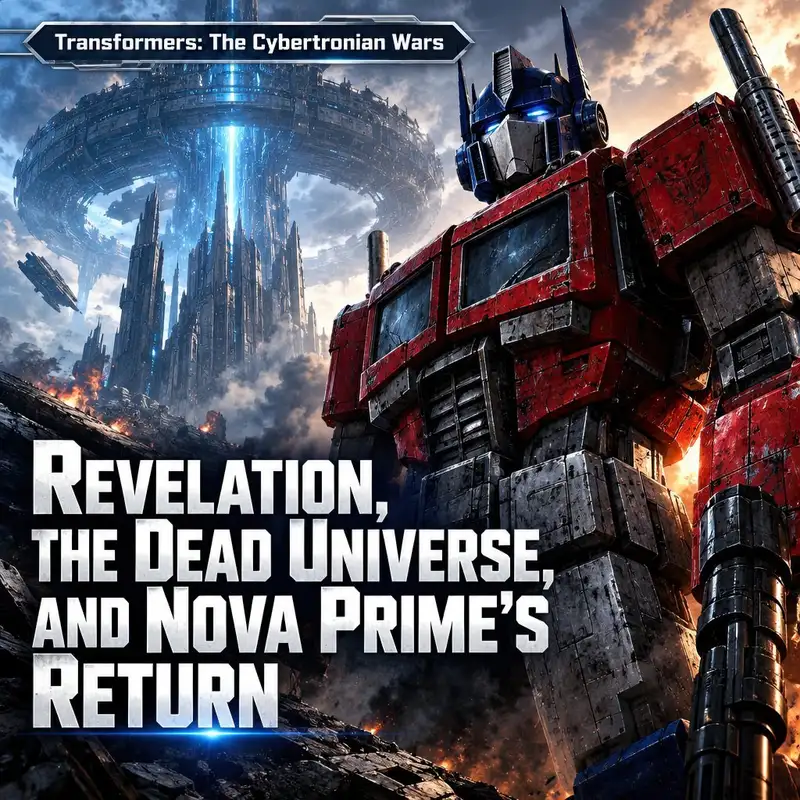
Revelation, the Dead Universe, and Nova Prime’s Return
On Garrus-9, Optimus Prime faced a predecessor who should have been dead. Nova Prime had vanished long before Optimus inherited the burden of command, lost with the first Ark beyond the Benzuli Expanse. Yet the figure confronting him had returned with an army, a plan to breach the boundary between realities, and a new name that marked both survival and corruption: Nemesis Prime. The immediate contest was military. The larger contest was over what Prime authority meant when stripped of restraint.
This is the 2005 I D W Transformers continuity, where Nova Prime was not a distant legend with a fixed, uncomplicated reputation. He was an earlier holder of Cybertronian authority whose disappearance had allowed later generations to turn him into a symbol. His return made that symbolism dangerous. Nova did not come back asking to resume office, negotiate a settlement, or reclaim a lost homeland. He came back at the head of an Expansion intended to make the living universe answer to powers shaped in the Dead Universe.
Nemesis Prime’s argument to Optimus was revealing. He treated the Matrix not as a source of responsibility, but as a restraint imposed on a leader who deserved freedom of action. The Darkness associated with the Dead Universe offered the opposite promise. It offered power without the obligations that had limited him before. That made the confrontation at Garrus-9 more than a struggle over an artifact or a battlefield. It was a dispute over whether authority exists to protect a society, or whether society exists to serve the ambitions of the powerful.
Nova Prime’s fall into the Dead Universe did not create every element of that worldview. Before the first Ark disappeared, his government had already embraced an aggressive vision of Cybertronian expansion. He believed Cybertron should reach beyond its own borders and establish a larger sphere of power. Exploration was part of the public language of the project. The deeper purpose was more coercive. New worlds were more than places to know. They were potential territory, resources, and populations to be brought under Cybertronian control.
That distinction matters because it prevents Nova from becoming a simple victim of cosmic corruption. The Dead Universe changed him. It damaged his body, altered his conditions of survival, and bound his later power to forces that did not belong to ordinary living reality. But the political impulse behind his Expansion already existed. Nova had imagined Cybertronian power as something entitled to spread. The Dead Universe did not invent his imperial logic from nothing. It gave that logic a harsher environment, stranger tools, and fewer moral limits.
The first Ark embodied the contradiction. It was presented as a vessel of exploration, but it carried an expedition prepared to enforce Nova’s ambitions. Jhiaxus, already a figure of scientific and strategic importance, was closely connected to the enterprise. His later work would show how readily technical expertise could be turned toward manipulation, experimentation, and control. Omega Supreme opposed Nova’s plans, an important reminder that the expedition was not the uncontested expression of Cybertronian civilization. Even before disaster, there were Cybertronians who recognized expansion as a political choice, not a natural law.
The Ark did not reach a new colony or a conventional frontier. It entered the Benzuli Expanse and disappeared. Nova Prime, Galvatron, Jhiaxus, and others aboard were presumed lost. For the living Cybertronians left behind, that loss became part of history. The expedition had vanished beyond recovery. The apparent finality of that disappearance was precisely what made Nova’s later return so destabilizing. A dead predecessor can be memorialized. A predecessor who returns with claims, soldiers, and an invasion route is another matter entirely.
The Dead Universe should not be reduced to an ordinary neighboring dimension with a tidy map and familiar laws of survival. The comics establish a realm or condition separated from the living universe by a boundary that can be crossed only through dangerous and specialized means. Its relationship to ordinary space is unstable. Its inhabitants do not just operate there as healthy Cybertronians on a distant world. Their existence is marked by damage, dependency, and the corrosive influence of powers that are only partly explained.
Nova survived that passage, but survival came at a cost. The former Prime emerged in a state that was neither a conventional recovery nor a straightforward resurrection. He became associated with the Darkness, a force that functions in opposition to the moral and symbolic role Nova assigns to the Matrix. It is tempting to call the Darkness an anti-Matrix, but that phrase suggests a precise metaphysical symmetry the story does not fully establish. What the record clearly shows is a power that amplifies domination, possession, and the separation of authority from responsibility.
Nova’s new identity as Nemesis Prime therefore carried more than visual menace. It represented a political transformation. A Prime, in this continuity, is not automatically legitimate because of a title, a body, or a relic. Nova had once held recognized authority. In the Dead Universe, he retained the memory and prestige of that office while discarding the duties that ought to accompany it. He returned not as a guardian of Cybertronian life, but as a claimant who believed the living universe could be reorganized for Cybertronian supremacy.
The Dead Universe also placed limits on Nova’s project. Its forces could not just march into living reality and remain indefinitely without consequence. Crossing the boundary required infrastructure, energy, preparation, and ways to manage the instability of bodies shaped by the Dead Universe. That limitation is central to understanding the crisis. The Expansion was not an unstoppable supernatural tide. It was a military and technological system. It needed access points, protected installations, energy sources, agents in the living universe, and commanders who could coordinate activity across the divide.
The core of that system was the Nega-Core network. These devices were placed at strategically significant locations, including Cybertron, Gorlam Prime, and Corata-Vaz. Each node had to be activated and protected. The network was supported by guardians, by portal systems, and by preparations intended to make the boundary between the Dead Universe and living reality increasingly permeable. The exact technical mechanisms remain obscure, but the operational pattern is clear. Nova was building a connected invasion architecture rather than relying on one decisive breach.
That architecture created strength through dispersion. A threat spread across multiple worlds is difficult to defeat with a single strike. The Autobots could not just locate Nova, win a duel, and assume the danger had passed. They had to understand how the Nega-Cores related to one another, identify the guardians assigned to them, and learn where the enemy obtained the energy needed to sustain the project. The Expansion’s complexity gave it resilience. It also created vulnerabilities, because every site needed activation, security, power, and communication.
The Benzuli Expanse was the route around which this system revolved. It was more than a place where a battle might occur. It was the boundary through which the Expansion hoped to establish a lasting connection between worlds that should not have been joined. Nova’s objective was not a raid, a rescue, or a limited incursion. He intended to create conditions in which the Dead Universe could extend itself into living space. That ambition required more than troops. It required a supply and access system capable of surviving disruption.
Cybertron mattered because of its political and symbolic value. Gorlam Prime mattered because it became entangled in Jhiaxus’s experimentation and in the portal network. Corata-Vaz mattered because it housed another operational node. Earth mattered because it possessed accessible energon. These worlds were not interchangeable scenery. Each filled a different role in the Expansion’s larger design. Nova’s force did not need to conquer every world immediately. It needed to turn selected worlds into functioning components of a system that could support the breach.
Optimus Prime had reason to take the threat personally, although the crisis could not be reduced to a private rivalry. Earlier, while temporarily existing in infraspace, Optimus had encountered Nova’s presence or image. The experience was disturbing precisely because Nova belonged to a past that should have been closed. Optimus then investigated Nova’s history and his conflict with Omega Supreme. That inquiry uncovered the political meaning behind the lost Ark expedition. The predecessor Optimus had inherited in name was more than a fallen explorer.
For Optimus, the discovery was an institutional warning. He carried Prime authority in a war already shaped by factional violence, secrecy, and competing claims to legitimacy. Nova’s return showed how easily an inherited office could be used against the values it was supposed to represent. A title could survive its holder’s moral collapse. An artifact could be claimed by someone who no longer understood duty. A leader could invoke Cybertron’s interests while treating Cybertronians, colonists, and other worlds as instruments.
This was not abstract philosophy. Nova’s model of authority had direct military consequences. If a Prime sees restraint as weakness, then diplomacy becomes delay, civilian protection becomes inconvenience, and a foreign world becomes a fuel depot. The Matrix becomes valuable only when it confirms command. The Darkness becomes attractive because it removes limits. Optimus’s opposition to Nova was therefore not a matter of preserving a ceremonial succession. It was a refusal to accept that power without responsibility was still worthy of the name Prime.
Cyclonus demonstrated the operational reach of the Dead Universe force. Acting under Nova’s orders, he returned to Cybertronian space and attacked Hound’s unit. The attack showed that the Expansion could place capable operatives in the living universe, at least for limited periods. Cyclonus was more than a messenger. He was a forward-deployed asset, able to strike Autobot forces and advance the activation of the network. His actions gave Nova’s plan a physical presence on worlds that had believed the Dead Universe safely distant.
Cyclonus then reached Corata-Vaz and activated a Nega-Core. That activation awakened Thunderwing, a guardian whose presence transformed the site from a hidden piece of machinery into an immediate military crisis. The enemy had succeeded in bringing a major defensive asset online. Yet Cyclonus also revealed the limits of that success. His presence in the living universe was unstable. The Dead Universe had produced soldiers, but not soldiers who could operate indefinitely and without cost in the environment Nova sought to conquer.
That weakness did not make Cyclonus harmless. Unstable personnel can still complete missions, inflict losses, and force an enemy to divert resources. But it meant Nova’s invasion could not rely on ordinary occupation doctrine. His forces needed preparation and protection. They needed guardians that could hold ground when Dead Universe operatives could not. They needed portals that reduced exposure and energy systems that sustained the transition. Every advance into living reality carried a biological and logistical burden that Nova could not just command away.
For the Autobots, the activation at Corata-Vaz clarified the scale of the problem. Eliminating one infiltrator would not shut down the Expansion. They needed to find the network, understand its dependencies, and develop ways to fight guardians built for conditions ordinary Autobot units were not prepared to face. The crisis was becoming a distributed counteroperation. Intelligence teams, technical specialists, field commanders, and assault units would all have roles. There would be no single front line, because the enemy’s front line ran through portals, laboratories, energy sites, and compromised minds.
The Gorlam Prime operation exposed the most unsettling form of that compromise. Nightbeat had been investigating missing memories and the wider Dead Universe conspiracy. His work placed him alongside Hardhead, a soldier whose directness and endurance made him useful in a dangerous environment. Yet the investigation was undermined from within. Jhiaxus remotely controlled Nightbeat, turning an investigator into an unwilling weapon against his own ally. The threat was not disguised merely by an alternate mode or a false identity. It was hidden inside a trusted individual’s damaged autonomy.
Hardhead’s confrontation with Nightbeat was tragic because it was not a clean fight between clear enemies. Nightbeat’s altered condition stripped him of meaningful control at the moment when Hardhead had to respond. Hardhead survived, but Nightbeat did not. The event should not be treated as a spectacular casualty for its own sake. It demonstrated a profound command-and-control danger. An army can defend its bases, encrypt its messages, and screen its recruits, yet still be vulnerable if an enemy can alter memory, seize bodily control, or weaponize trusted personnel.
Jhiaxus’s role was particularly important. He was more than a scientist attached to Nova’s force. His work linked research to strategy. Remote control of Nightbeat created confusion, delayed trust, and converted knowledge of Autobot methods into a direct attack. The same broader network involved portals, guardian technology, and experiments affecting worlds beyond Cybertron. Technical expertise gave the Expansion options that conventional forces did not possess. It also revealed the ethical poverty of a project willing to treat sentient minds as equipment.
Hardhead escaped the immediate danger and entered the portal environment while evading pursuing Micromasters. That passage gave the story a brief and disorienting glimpse of the conditions surrounding the Dead Universe network. It reinforced an essential fact about the war. The boundary was not a simple door that either side could walk through at will. It was an operational environment with its own dangers, uncertainties, and constraints. The Autobots were fighting an enemy whose routes and conditions of existence were only partly understood.
That possibility widened the moral stakes. Nova’s plan was not only about reopening a route for lost Cybertronians. It was about imposing conditions shaped by the Dead Universe on places that had not chosen them. A colony could become a laboratory. A population could become part of an adaptation experiment. A world could become infrastructure. This was the same political habit visible in Nova’s earlier expansionism, now intensified by an environment where ordinary limits had become obstacles to be overcome rather than responsibilities to respect.
The Autobots still lacked a complete picture of the system. They had fragments of evidence, damaged witnesses, and sites whose purpose was not immediately clear. Their breakthrough came through the Magnificence, an information-seeking device hidden on Ki-Aleta. Hot Rod brought Dealer to it, hoping to gain answers that could be acted upon. The Magnificence was not a conventional intelligence archive. Its value lay in its ability to reveal knowledge beyond the reach of ordinary surveillance. In a crisis built around hidden nodes, that made it strategically significant.
Dealer complicated the mission because he was not a reliable ally. His interests lay in exploiting information for personal gain, and he had already betrayed Hot Rod’s former team. His treachery mattered, but it should not overshadow the larger lesson. The Magnificence was valuable precisely because the war had created an information market. Secrets about portal sites, energy sources, and ancient technologies could become weapons, bargaining chips, or commodities. In such an environment, possessing knowledge did not guarantee that knowledge would serve the public interest.
The Magnificence supplied the Autobots with a targetable picture of the Expansion. It identified the Nega-Cores and their guardians. It revealed the importance of Earth’s energon supply. It clarified Gorlam Prime’s role in the portal system. This was a turning point because the Autobots could finally connect events that had appeared separate. Cyclonus at Corata-Vaz, Nightbeat’s compromised investigation, strange developments on Gorlam Prime, and energy theft on Earth were not isolated incidents. They were pieces of one operational design.
Information alone did not end the crisis. Knowing the location of a guardian is different from being able to defeat it. Knowing that Earth’s energon is important is different from stopping its extraction. Knowing that a portal exists is different from surviving passage through it or closing it without catastrophic consequences. But intelligence transformed Autobot planning. Instead of reacting to each attack as an emergency, they could identify critical nodes and allocate specialized teams. The conflict shifted from confusion toward coordinated disruption.
Earth’s role illustrates why logistics deserves as much attention as combat. Straxus and Grindcore were harvesting energon in Jiangxi Province. The operation made Earth more than another battlefield where Cybertronians could hide among human vehicles and settle old scores. It turned the planet into a prospective fuel source for the Expansion. Energon extraction, storage, transport, conversion, and protection all formed part of the enemy’s sustainment problem. A dimensional invasion still requires power. Cosmic ambition does not exempt an army from supply.
Sideswipe’s fight with Straxus and Grindcore unfolded within that wider emergency. His personal struggle to step out from Sunstreaker’s shadow gave the local conflict emotional weight, but it also showed how large campaigns are experienced by the individuals caught inside them. A soldier may be confronting an old insecurity, a rival, or a question of reputation while unknowingly defending a node in a much larger strategic contest. Personal motives and strategic necessity often occupy the same battlefield without being identical.
The fight on Earth could disrupt an energon operation, but it could not solve Nova’s broader sustainment problem by itself. Capturing a source of fuel is not the same as building a secure supply chain. The energon had to be extracted, moved, protected from Autobot interference, and integrated into systems compatible with the Expansion. Every stage created a point of failure. Earth was valuable, but its very value exposed it. Once the Autobots understood the network, the fuel depot became a target rather than an invisible asset.
Thunderwing presented a different sort of problem. As a guardian awakened by the Nega-Core at Corata-Vaz, he embodied the danger of treating every crisis as a contest of courage. The Wreckers were an elite Autobot force with experience in difficult missions, yet their reputation did not make them automatically capable of defeating a guardian shaped by Dead Universe technology. Their failure demonstrated a hard military truth. Skill and aggression matter, but they do not erase a mismatch in equipment, environment, or enemy design.
The guardian was more than another enemy to outfight. Thunderwing’s capabilities required the Autobots to rethink the conditions under which they could approach and survive the objective. A frontal assault by celebrated soldiers had reached its limit. The problem moved from battlefield valor to technical adaptation. That is often the point at which a campaign either becomes more effective or begins wasting its best personnel in repeated attacks against a threat they are not equipped to understand.
Jetfire and the Technobots helped produce the necessary adaptation. Working from technology associated with Thunderwing, they developed protective carapaces for Cloudburst’s crew. This was not evidence that the Autobots had copied the Dead Universe system, mastered all of its science, or created standard armor for the entire faction. The equipment was specialized. It answered a narrow operational need: allowing a team to endure proximity to the guardians and act where ordinary Autobot bodies could not safely function.
That distinction is important because unique technologies often create misleading impressions of military power. A single artifact, prototype, or specialized suit can decide a mission without becoming an industrial capability. The Autobots had not solved the Dead Universe problem in general. They had found a way to give selected personnel a chance against one part of it. The success depended on intelligence from the Magnificence, technical work by specialists, and coordination between teams operating at different sites. It was a system-level response to a system-level threat.
The broader counteroperation was therefore distributed by necessity. Some Autobots investigated compromised agents and portals. Some fought to protect or reclaim energy sources. Some developed equipment for guardian assaults. Others confronted Nova directly. This was not a neat conventional campaign with a single army advancing across a map. It was closer to an emergency effort to dismantle an interconnected hostile network before its separate components could become a permanent bridgehead. The Autobots did not need to destroy every mystery of the Dead Universe. They needed to break the Expansion’s ability to function.
That brings the crisis back to Garrus-9. Optimus’s confrontation with Nemesis Prime occurred at the center of the political argument, but it was not a substitute for the other operations. Nova still possessed the authority of a former Prime, the strength derived from the Darkness, and the command presence of someone accustomed to seeing entire worlds as pieces on a strategic board. He could present his cause as liberation from weakness. In reality, the freedom he celebrated was freedom from obligation to anyone who could not serve his project.
Nova’s claim that the Matrix had limited him exposed the deepest flaw in his conception of leadership. The Matrix, in this context, represented more than a tool of power. It was associated with continuity, responsibility, and the notion that a leader’s authority must be exercised on behalf of others. Nova saw those expectations as chains. The Darkness seemed to offer a purer form of command, one in which the will of the strongest could expand without the inconvenience of conscience, consent, or restraint.
That was the endpoint of Nova’s pre-Dead Universe politics. Before his disappearance, he had already viewed expansion as a right of Cybertronian power. After the Dead Universe transformed him, that right became absolute. The living universe was no longer a field of possible relations among peoples and worlds. It was territory to be opened, harvested, altered, and controlled. His claim to Prime authority was therefore hollow. He retained the title’s prestige while rejecting the principle that gave the title moral meaning.
Galvatron’s role in Nova’s defeat must be understood carefully. He had served within Nova’s orbit, but he was not a faithful guardian of Nova’s political vision. Galvatron was ambitious, powerful, and willing to cooperate when cooperation advanced his own position. At Garrus-9, he betrayed Nemesis Prime and shot him. This was not an act of democratic principle. It was not a conversion to the Autobot cause. It was a bid to seize the power Nova commanded, especially the power associated with the Darkness.
The betrayal weakened Nova at a decisive moment, but it did not create the Autobot victory by itself. Galvatron’s ambition removed one pillar of the Expansion’s command structure while revealing another weakness in Nova’s system. A project built around personal domination can appear unified until subordinates conclude that the ruler’s power is available for the taking. Nova demanded obedience, but he had not created a durable political order. He had created a hierarchy of force, fear, opportunity, and rival claims.
The Darkness then attempted to transfer itself to Optimus. The moment was more than a test of physical endurance. It offered Optimus the temptation Nova had embraced: power detached from moral restraint. Optimus rejected possession. He did not attempt to turn the Darkness into an Autobot advantage or claim that a better leader could safely use the same corrupting authority. Instead, he redirected the immediate danger toward Galvatron, whose own effort to acquire the power left him exposed to it.
Optimus then threw Galvatron into the solar pool on Garrus-9. The immediate tactical outcome was clear enough. Nemesis Prime was neutralized in the confrontation, and Galvatron was removed from the field. But Revelation does not provide a simple final accounting of Galvatron’s survival or of every consequence attached to the Darkness. The story’s restraint on that point matters. In a conflict involving altered bodies, unstable realms, and extraordinary forces, apparent destruction is not always identical to settled historical closure.
Nova’s political defeat was more complete than his physical one. He had returned claiming to represent a liberated and stronger form of Prime authority. At Garrus-9, that claim collapsed. His closest powerful subordinate betrayed him. The power he invoked sought a new host rather than demonstrating loyalty to its chosen commander. And Optimus refused the premise that leadership required abandoning restraint. Nova had not restored the old Cybertronian order. He had revealed how far an old Prime could fall when authority became an end in itself.
The final task was not to celebrate the duel. It was to close the network. The Autobots returned the Nega-Cores to the Dead Universe and detonated them there, closing the Benzuli Expanse. This succeeded because it attacked the Expansion at the level that mattered most. The network’s ability to coordinate access between realities depended on its linked infrastructure. Without functioning cores and a viable route, guardians, infiltrators, energy operations, and commanders could no longer combine into a coherent invasion system.
The intelligence lessons were severe. Nightbeat’s fate demonstrated how memory alteration and remote control could undermine trust inside a fighting force. The Magnificence showed how a single source of actionable knowledge could change an entire campaign, while Dealer’s betrayal warned that information could be exploited as readily as it could be used for defense. The Dead Universe crisis also exposed the limits of inherited archives. Cybertronians believed Nova’s expedition was lost. Their historical understanding had not been false, exactly, but it had been dangerously incomplete.
The civilian consequences did not vanish when the Expanse closed. Earth had been used as an energon source in a war its population did not control. Gorlam Prime had undergone an extraordinary and unsettling transformation toward a Cybertron-like state. The comics leave important aspects of that change unresolved, including the degree to which its inhabitants understood or consented to what was happening. That uncertainty is itself part of the damage. War does not only destroy cities and bodies. It can alter a society’s environment, memory, and sense of what it is.
Revelation therefore ended with containment, not peace. The immediate invasion route was shut down, but the Dead Universe had not become irrelevant. Jhiaxus remained connected to later developments. The forces and ideas associated with the Dead Universe did not disappear simply because one network had been destroyed. The crisis had shown that the boundary could be found, crossed, exploited, and contested. Once that knowledge existed, later actors could try to use it again, even if the original Expansion had failed.
Nova Prime returned because the Dead Universe preserved and transformed a former Prime who had already imagined Cybertronian power as a right to expand. He failed because his invasion was never the invincible return of the dead. It was a fragile network dependent on portals, guardians, stolen energy, specialized technology, compromised agents, and subordinates who saw power as something to seize rather than a purpose to serve. The Autobots prevailed not through one duel alone, but by exposing and breaking the system that made invasion possible.
The lasting warning is sharper than the closing of a portal. Nova treated authority, territory, bodies, worlds, and even reality itself as material for Cybertronian dominion. That belief survived his first defeat because it had existed before the Dead Universe gave it monstrous form. Sealing the Benzuli Expanse stopped an invasion route. It did not erase the ambition that made Nova Prime willing to build one.