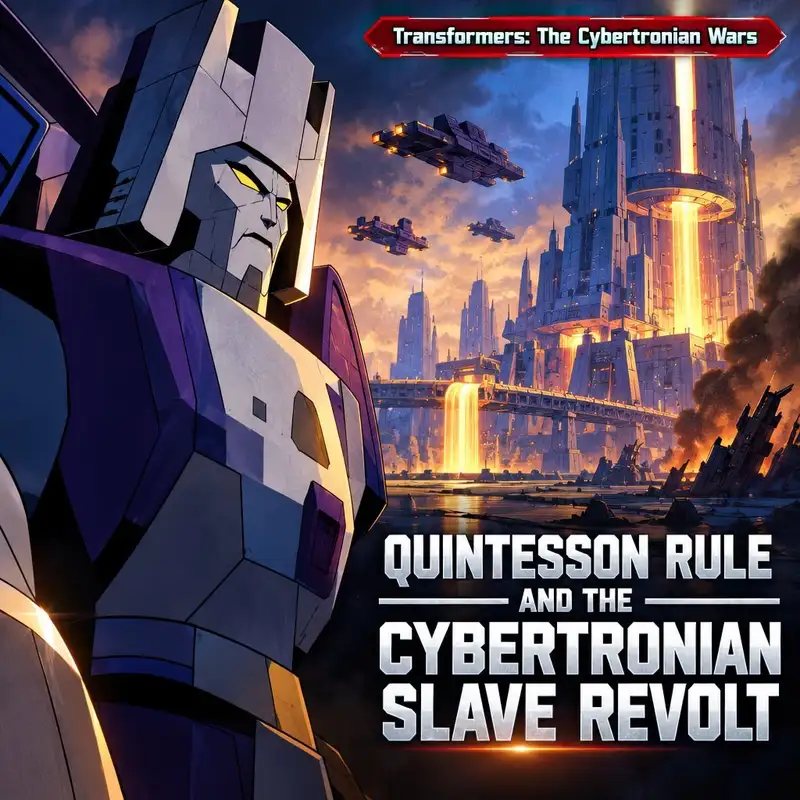
Quintesson Rule and the Cybertronian Slave Revolt [Cartoon]
Dawn comes to Hive City as an assault timetable, not a change in light. Outside the city, a rebel force prepares to attack the center of the regime that owns them. They are not a polished army. They are laborers, technicians, and scientists, people whose ordinary work has kept Cybertron’s factories operating. Before them stand the Dark Guardians, immense Quintesson security machines built for precisely this moment: the day the workers decide that production will no longer mean obedience.
The immediate military problem is severe. A labor revolt can disrupt a factory, seize tools, and overwhelm isolated overseers. It cannot easily storm a fortified industrial capital defended by specialized heavy assets. The rebels have purpose, local knowledge, and numbers that the episode never precisely defines. The Quintessons have organized violence. Their Guardians can break an attack before it reaches the city, and their rulers still expect fear to do much of the work for them.
Hive City matters for more than its defenses. It is the political center of Quintesson authority on Cybertron, and it is also a monument to compelled labor. The rebels were forced to build it. Its towers, infrastructure, and industrial systems represent the practical results of a society in which one population gives orders and another performs the work. Capturing that city does more than gain ground. It shows that the masters can no longer protect the world they claimed to own.
This account belongs to the American Generation One animated history, particularly the episodes “Five Faces of Darkness, Part Four” and “Forever Is a Long Time Coming.” Other Transformers continuities tell very different stories about Cybertron’s origins and its early wars. They do not control here. In this cartoon history, the Quintessons are the former rulers of Cybertron and the creators of the robot populations they exploit there.
The cartoon does not give a complete planetary origin story. It establishes Cybertron as a Quintesson industrial domain, a manufacturing center ruled by alien owners, but it does not fully explain how the planet itself came into being or every stage by which their system was established. That limit matters. The evidence is strongest when it concerns the condition of the robot population under Quintesson rule, the revolt against that rule, and the later division that produced Autobots and Decepticons.
The Quintessons do not govern Cybertron as representatives of the population living there. Their authority rests on ownership. They manufacture robots for different purposes, direct their labor, and treat them as products and slaves. The planet’s economy exists to serve Quintesson needs. Its factories produce goods, maintain infrastructure, and support a ruling class increasingly detached from the labor that sustains it.
That arrangement creates an essential weakness. A factory empire depends on the people, or in this case the constructed beings, who understand how to make and repair everything inside it. The Quintessons may hold legal title, weapons, and command positions, but the workforce possesses the practical knowledge. It knows the machinery, the routes through the facilities, the systems that fail first, and the labor required to keep a complex industrial world alive.
The Quintessons divide their robot products into broad functional categories. Some are made as consumer goods. Others are made as military hardware. In later Cybertronian history, those populations become the ancestors of Autobots and Decepticons. At this stage, however, they are not separate species, and they are not born into permanent moral identities. They are categories imposed by their makers for production and control.
That distinction is central to the tragedy that follows. The future Autobots do not begin as a naturally peaceful people, and the future Decepticons do not begin as beings fated to seek tyranny. The Quintessons create functional populations for different jobs. Over time, those inherited purposes become social identities. A production decision hardens into a political division, and a political division later becomes a military one.
The Quintessons improve their system by giving their robots simulated intelligence. The immediate purpose is efficiency. A more capable worker requires less supervision, solves more technical problems, and can take on tasks that would otherwise demand Quintesson attention. The rulers gain convenience. Their factories become more productive. Their own society becomes more idle, more dependent, and less capable of directly managing the civilization it dominates.
But intelligence is not just a better tool for following orders. A worker who can solve problems can also recognize exploitation. A technician who understands a security system may understand its weaknesses. A population capable of manufacturing more robots has crossed an important threshold. It is no longer merely a collection of isolated machines waiting for instructions. It is becoming a society with technical memory, shared interests, and the ability to imagine life without its owners.
The episodes describe that development in broad terms. The robot population becomes increasingly aware, increasingly emotional, and increasingly unwilling to accept the role assigned to it. The cartoon never provides a full sociology of this change. It does not map every workplace, name every underground organizer, or show how each product category responded. Still, the historical pattern is clear enough. Greater autonomy creates the conditions for greater resistance.
Intelligence alone does not produce rebellion. A population may understand that it is oppressed and still lack the ability, confidence, or opportunity to act. The Quintesson system supplies those pressures as well. Its rule is enforced through intimidation, punishment, and public violence. The regime does not just organize labor. It reminds the labor force that it exists under threat.
The Quintessons use Sharkticons and other instruments of coercion, but the most important counter-revolt assets in this story are the Dark Guardians. These machines are built to confront mass resistance. Their presence reveals that Quintesson rule is not secure simply because the rulers claim ownership. They expect rebellion. They have prepared an answer to it. The Guardians are the physical expression of a regime that knows its legitimacy is thin and intends to compensate with overwhelming force.
The slave brand carried by the robot workers gives that domination a visible form. It marks an individual body as Quintesson property. The brand is more than an administrative device: it is a daily political message. It tells every worker that the regime considers their labor, movement, and identity subject to ownership. In a system already defined by force, the mark turns subordination into something the oppressed cannot ignore.
Such symbols can have consequences beyond their original purpose. The regime believes the brand will normalize obedience. Instead, it creates a common grievance. A mark intended to isolate and degrade its bearer becomes evidence that many different workers share the same condition. The Quintessons have manufactured not only labor categories but also a powerful language of collective humiliation.
Fear can suppress open resistance for a long time, but it is expensive to maintain. It requires guards, punishments, informers, weapons, and examples made of those who disobey. It also requires confidence that the people carrying out the regime’s work will continue to cooperate. Once that confidence begins to erode, the same institutions meant to control the population can become reminders of why change is necessary.
The Quintessons’ deeper strategic mistake is not that they fail to use enough force. It is that they build a civilization in which a large, technically capable, self-aware population has every reason to resent its rulers. They concentrate coercive power in systems that must be operated, maintained, and understood inside the industrial world. They depend on workers while denying those workers any share in political authority.
An empire can survive a shortage, a strike, or an isolated revolt. It struggles to survive when its labor force becomes the opposition, its technicians become organizers, and its own security architecture becomes vulnerable to insider knowledge. The exact networks through which the rebels communicate are not fully documented by the cartoon. We should not invent a detailed underground command structure. Yet the existence of a coordinated attack on Hive City shows that the opposition has moved beyond private resentment.
The rebellion therefore is not a spontaneous malfunction in a factory system. It is organized political action. Its participants have a common objective: freedom from Quintesson ownership. They understand that the decisive obstacle is not a single overseer or a single workshop. It is the security system protecting the ruling center. They must neutralize the Dark Guardians, or the assault on Hive City will fail before it has meaning.
That is the point where A-3 becomes important. Later in the episode, he is identified as the younger form of Alpha Trion. But in the revolt itself, his historical significance lies less in later reputation than in his role as organizer and technical problem solver. He recognizes the decisive military fact. The rebel force cannot defeat the Guardians in a conventional battle.
A-3 does not answer that problem by somehow turning every worker into a heavy combatant. He develops a specific means of disabling the Guardians. The device is called the Coder Remote, and he conceals it within his Quintesson slave brand. This is a remarkably precise form of resistance. The rebels take an instrument meant to signify ownership and use it to carry the mechanism that will break the masters’ hold.
The Coder Remote should not be exaggerated into a universal Cybertronian superweapon. The story establishes that it can disable the Dark Guardians. It never shows that it can defeat every Quintesson machine, destroy the rulers’ civilization by itself, or provide a blueprint for postwar government. Its importance is operational. It removes the security barrier that makes a direct assault impossible for a force without comparable heavy weapons.
That is often how insurgent breakthroughs occur. The weaker side does not need to surpass the stronger side across every category of force. It needs to identify the system that makes the stronger side dominant and render that system ineffective at the critical moment. The Guardians give the Quintessons confidence that Hive City cannot be taken. A-3’s device turns that confidence into a liability.
The choice to hide the remote in the slave brand adds another layer of meaning. The brand was imposed to make subordination permanent and visible. A-3 transforms it into a tool of liberation. The act does not erase the suffering represented by the mark, but it changes its political meaning. The oppressed are no longer defined only by what was done to them. They use the regime’s symbol against the regime itself.
The Quintessons understand enough to recognize A-3 as dangerous. Their response is not just a local arrest or a battlefield counterattack. They attempt something far more ambitious. Through time manipulation, they abduct A-3 before the assault on Hive City, hoping to remove the organizer whose technical work makes the rebellion possible. Their objective is decapitation, taken to an extreme.
The plan rests on a familiar assumption. If a movement depends on one leader, remove that leader and the movement collapses. There is some logic to it. A-3 holds the Coder Remote. He appears to coordinate the attack. The rebels need his expertise at precisely the moment when they face the Dark Guardians. From the Quintesson perspective, taking him out of the historical sequence should prevent the revolt and preserve their rule.
But the operation also exposes the limits of their understanding. A-3 may be essential to the immediate assault, yet he is not the cause of all resistance. The rebellion exists because the Quintessons have created the conditions for it. Workers, scientists, and technicians are already prepared to act. Beta and the other rebels do not become dissatisfied only after A-3 appears. His leadership gives their anger an operational form.
More importantly, the Quintessons’ temporal intervention introduces variables they cannot control. Their effort to rewrite the past brings Autobots from approximately the year two thousand six into the historical crisis. These future Cybertronians are not dispatched as planned liberators. They become involved because the Quintessons’ own operation has displaced them through time.
This creates a second problem in the future. Rodimus Prime and the Autobots of that era must recover their comrades while confronting the danger created by an open time window. They understand that careless interference could damage the history from which they came. Their goal is not to manufacture a rebellion that never existed. It is to prevent the Quintessons from destroying an event that their own history already records as a successful liberation.
That distinction matters. The future Autobots assist the uprising, but they do not create its political cause. They do not supply the desire for freedom, the social base of the revolt, or A-3’s technical solution. The rebellion belongs to the enslaved population of Cybertron. The time travelers become accidental participants in a struggle already underway.
The Quintessons make another strategic error by treating time as though it offers perfect control. Their plan assumes that removing A-3 will produce one predictable result. Instead, it pulls armed and capable outsiders into the very battle they hope to prevent. Neither side fully commands the consequences. Time travel in this story is not a clean instrument of policy. It is an unstable attempt to escape the political failures of the present.
When dawn comes at Hive City, the practical problem remains the Dark Guardians. The rebels cannot simply advance into the city while those machines remain active. The future Autobots therefore play a limited but decisive role. They draw the Guardians away from the city’s defenses, creating the opening A-3 requires.
This is not a contest of raw firepower alone. The diversion matters because it separates the Guardians from the site they are meant to protect. It forces the Quintesson security system to react. A force designed to crush rebels at the gates becomes exposed to manipulation when the attackers can divide its attention and pull it beyond the defensive perimeter.
A-3 then activates the Coder Remote. The Dark Guardians are disabled. At close range, that is the decisive moment. The rebels have not suddenly become a conventional army with superior armor, weapons, and training. They have removed the one capability that made the regime’s defenses overwhelmingly stronger than their own.
Once the Guardians are down, Hive City is exposed. The rebel assault can move toward the political and industrial center without being annihilated by the Quintessons’ specialized counter-revolt machines. The significance of that change is greater than the destruction or defeat of any one enemy formation. It demonstrates that the masters cannot guarantee security even at the heart of their own domain.
A-3’s response to the future Autobots is revealing. He orders them to return to their own era. From his perspective, the historical result is already secured. The rebels no longer need outsiders to take freedom on their behalf. Their task is to complete the liberation of their own world.
The episode never shows every stage that follows. It never provides a complete planetary campaign. We never see a formal Quintesson surrender, a detailed evacuation, a full order of battle, casualty figures, or a map of every city seized by the rebels. The later outcome is summarized: the Quintessons are driven from Cybertron, and the robot population enters a period of self-rule.
That absence is not the same as a lack of importance. The fall of Hive City is a breakthrough because it attacks the structure of Quintesson power at its center. The rulers depend on their industrial system, their coercive assets, and the obedience of the beings who operate both. Once their Guards fail and their capital becomes vulnerable, their authority loses its practical foundation.
A ruling class can recover from a battlefield loss if it retains loyal forces, secure supply, and political support. The Quintessons appear to have none of those advantages among the population of Cybertron once the rebellion reaches this stage. They possess weapons and claims of ownership, but they do not possess durable legitimacy. Their society functions because enslaved robots make it function. When those robots withdraw obedience, the rulers’ position becomes increasingly untenable.
The strategic outcome is therefore larger than the disabling of the Guardians. The Guardians’ failure opens Hive City. The loss of Hive City demonstrates that Quintesson power can be challenged. The wider revolt then removes the Quintessons from Cybertron. Tactical success becomes operational access, and operational access helps produce strategic collapse.
For the liberated population, however, victory creates a difficult new reality. Freedom ends formal ownership, but it does not by itself provide a common political order. The same society that has overthrown its masters must now manage factories, security, production, repair, education, leadership, and relations among populations designed for very different functions.
The cartoon establishes a period of peace after the Quintessons’ expulsion, but it never explains how that peace was organized. We never see a constitution, an election, a property settlement, a legal code, or a process for demobilizing the systems inherited from Quintesson rule. The record never tells us how former labor categories were represented, how military hardware was integrated into civilian life, or how justice was administered after centuries of exploitation.
That is not a gap we should fill with invented institutions. It is, however, a meaningful historical absence. Revolutions often discover that removing a ruler is only the first task. The harder work is building a society in which the structures created by the old regime no longer define power, status, and fear.
Cybertron’s former product categories do not disappear merely because the Quintessons do. The population remains shaped by a system that divided beings according to designed purpose. Some had been made for consumer functions. Others had been made as military hardware. Those differences involve work, capability, and social expectation. Without trusted institutions to manage them, they can become the basis for new political rivalry.
The later cartoon history presents the broad sequence. The former military-hardware robots eventually seek conquest over the former consumer-goods population. In response, the consumer-goods robots militarize to defend themselves. The first group becomes the Decepticons. The second becomes the Autobots.
The significance of this account is easy to miss if one begins with the later war. The Decepticons and Autobots are not, in this telling, alien peoples who encounter one another after the Quintessons leave. They emerge from the same liberated population. Both inherit the world built by Quintesson industry. Both are shaped, in different ways, by the categories imposed under Quintesson rule.
That does not mean the later sides bear equal responsibility for the conflict that follows. The cartoon explicitly describes the military-hardware population as pursuing conquest, while the consumer-goods population militarizes in resistance. But it does mean that the origins of the later war cannot be understood as only a simple claim that one population was manufactured evil and the other manufactured virtuous.
Military function may provide an initial advantage in coercion, organization, and combat capability. A population built for military hardware begins with resources that can be turned toward domination. A population built for consumer roles may begin without the same martial orientation and may have to organize defensively under pressure. Yet function does not settle political morality by itself. People and institutions make choices with the capacities they inherit.
The Quintessons’ old system remains present in the new conflict because it has already divided Cybertronian society into categories that can be mobilized against one another. The external master is gone, but the machinery of division survives. The former slaves are free from Quintesson ownership, yet they are not automatically free from the social identities that ownership created.
This is the unfinished business of the revolt. The rebels succeed at the tasks before them. They turn technical knowledge into resistance. They neutralize the Dark Guardians. They expose Hive City. They drive out the rulers who treated them as property. The liberation is real. It is not a symbolic gesture, and it is not just an interruption in Quintesson control.
But the victory does not visibly resolve the question of how Cybertron’s liberated population will share power. It never shows a durable settlement between former consumer-goods robots and former military-hardware robots. It never establishes institutions strong enough to prevent one group from treating its inherited combat capacity as a license to rule the other.
That failure is not necessarily the fault of the rebels at Hive City. The cartoon never provides enough evidence to assign blame among the generations that follow. What it does show is a recurring problem in revolutionary history. A movement can be united by opposition to oppression and still divide once the oppressor is gone. Shared suffering creates solidarity, but solidarity must be translated into institutions if it is to survive victory.
The Quintessons lose Cybertron because their factory empire produces the people capable of ending it. They grant enough intelligence for their workers to become efficient, but also enough awareness for them to understand their condition. They concentrate technical knowledge among the enslaved. They rely on a security system that can be defeated by insider innovation. And they mistake ownership backed by force for political authority.
The assault on Hive City succeeds because the rebels do not try to defeat the Quintessons everywhere at once. They identify the decisive obstacle, the Dark Guardians, and develop a way to neutralize it. The future Autobots create the diversion, but the rebellion's strength comes from the people who have lived inside the Quintesson system, understand its machinery, and are prepared to seize the world they were forced to build. Their victory is practical before it is symbolic: the regime loses the security mechanism that made obedience appear permanent.
Liberation, however, does not erase the social categories the Quintessons created. Former functional groups remain divided by inherited capabilities, status, and expectations. Military power becomes a temptation, defensive militarization becomes necessary, and the revolution against slavery becomes the prehistory of civil war. In this cartoon history, Hive City is Cybertron's founding act of freedom, not the founding of a finished political order. The masters are removed. The harder task is deciding whether the roles imposed by that old regime will continue to organize domination, or become part of a society those former slaves govern together.