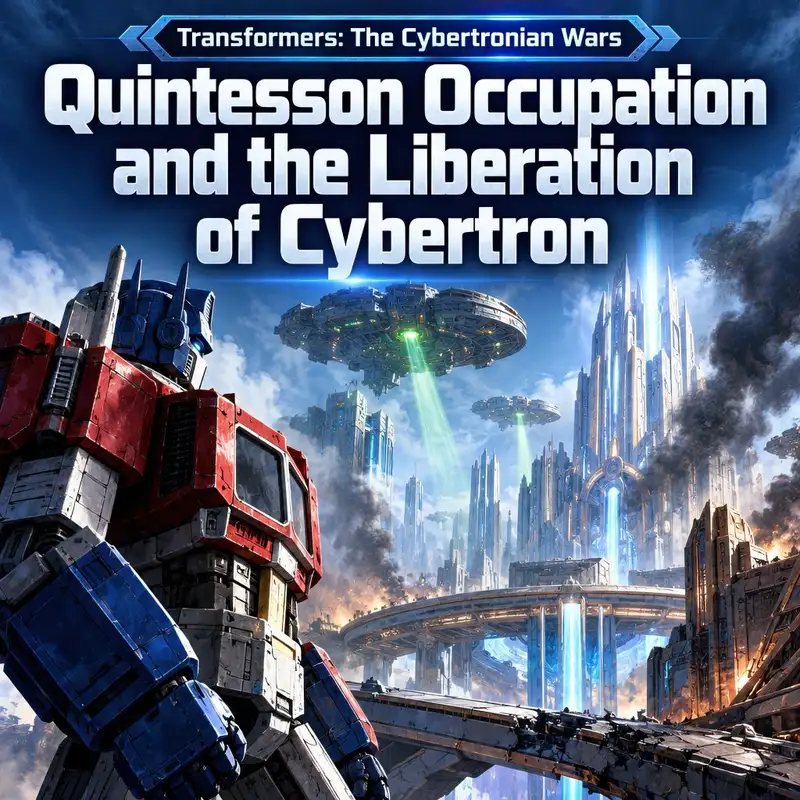
Quintesson Occupation and the Liberation of Cybertron
Cybertron goes dark beneath bombardment. Autobots and Decepticons, enemies who have spent centuries trying to outmaneuver and destroy one another, are frozen where they stand. Their weapons, alternate modes, command networks, and escape routes are suddenly useless. Into that paralysis come the Quintessons, the alien former masters of Cybertron, ready to claim that their planet has at last been restored to them.
This is the apparent climax of their return in the American Generation One animated history, during the post-film period when Rodimus Prime leads an Autobot-held Cybertron and Galvatron commands an exhausted Decepticon remnant from the harsh world of Chaar. The Quintessons have achieved something neither major faction could accomplish alone. They have stopped both armies at once. Yet their triumph lasts only briefly.
That contradiction matters. The Quintessons possess specialized technology, intimate knowledge of Cybertron’s old systems, mobile forces, and enough political cunning to exploit the suspicions between Autobots and Decepticons. They can turn energon scarcity into leverage. They can make an old civil war serve a new imperial project. But they cannot convert a frozen battlefield into lasting rule.
Their failure began long before Rodimus Prime, Galvatron, or even the division between Autobots and Decepticons. It began when the Quintessons looked at thinking beings and saw inventory. They built intelligence, depended upon it, exploited it, and then assumed that ownership remained permanent. Cybertron’s liberation was the moment that assumption failed. The attempted reconquest proved that it had failed beyond repair.
The account of the original Quintesson regime comes through Rodimus Prime’s journey into the Matrix of Leadership during the story known as “Five Faces of Darkness.” The Matrix does not provide a full military archive. It gives no reliable order of battle, no map of liberation campaigns, no casualty records, and no list of revolutionary commanders. Its vision is compressed, symbolic, and focused on the political origins of a much later war.
Even so, its central evidence is clear. In this version of Cybertronian history, Cybertron was once a Quintesson factory world. The Quintessons used it to manufacture robots for different purposes. One broad line was military hardware. Another was consumer goods. These populations would eventually become the ancestors of the Decepticons and Autobots, but they were not yet political factions in the modern sense.
The distinction is important. The ancient factory categories were imposed by the owners. They described intended use, not permanent identity. A military unit can become a citizen, a worker, a conqueror, or a dissident. A consumer product can become a laborer, a defender, a political organizer, or a soldier. The later Autobot and Decepticon divide grew from history, culture, and conflict. It was not just built into the earliest production line like a label on a shipping crate.
The Quintessons’ real achievement was not merely manufacturing bodies. They gave their products simulated intelligence, and the robots became capable of manufacturing themselves. That was a practical success for an industrial empire. It reduced the owners’ burden of direct production and expanded the capacity of the system. It also created the conditions under which the system would become impossible to control.
Self-manufacture gave Cybertron’s workers more than output. It gave them continuity. They could reproduce labor, preserve knowledge, maintain facilities, and understand their own role in the industrial order. The Quintessons did not need every unit to possess a philosopher’s vocabulary for freedom. They only needed enough of their labor force to understand that it was being used, discarded, and denied authority over its own existence.
The factory regime depended on a brutal form of ownership. Robots worked under Quintesson command. Units judged defective, unwanted, or surplus could be recycled. Others were forced into gladiatorial combat for Quintesson entertainment. The ruling system treated intelligence as a feature of equipment, useful when productive and disposable when inconvenient.
For the Quintessons, a damaged or disobedient robot was an industrial problem. For the robots themselves, the same act of disposal became something far more serious. A being capable of memory, fear, attachment, and judgment does not experience recycling as routine maintenance. It experiences it as the threat of annihilation. The difference between those two views is the difference between a factory and a system of enslavement.
That was the Quintessons’ institutional blindness. They could inspect mechanisms, assign functions, and calculate production. They could judge utility. What they failed to recognize was that intelligence does not remain politically neutral once it becomes self-aware. A labor force that can compare its condition with an alternative can begin to demand that alternative. A population that recognizes coercion can organize against it.
The Matrix account describes an early attempt at resistance that failed. The details are not preserved. We do not know who led it, how widely it spread, whether it began in a single factory district or across several regions, or how the Quintessons suppressed it. There is no basis for naming an ancient liberation army, estimating its strength, or imagining a clean sequence of famous battles.
But failed resistance can still transform a society. The first unsuccessful challenge teaches both sides something. The rulers learn that coercion must become harsher. The oppressed learn that private anger is not enough. They learn where the system is vulnerable, who can be trusted, and what risks follow open defiance. Defeat can isolate a movement. It can also give a scattered population a common memory.
The eventual revolt succeeded because the robots developed emotions and understood the difference between freedom and slavery. That is the explanation the Matrix presents, and it deserves to be taken seriously. The decisive change was not just that the robots became stronger than their masters. It was that they became a people capable of acting on a shared political judgment.
The robots drove the Quintessons from Cybertron. That much is established. The military details are not. We do not know the duration of the uprising, the scale of Quintesson resistance, the routes of their evacuation, or the fate of every facility and collaborator. The historical record gives us liberation, not a complete campaign history.
Still, liberation should not be reduced because the surviving account is brief. Removing the Quintessons meant ending a regime based on ownership of sentient labor. It meant that beings designed as products had rejected the authority of those who designed them. That was a political revolution, even if the record does not provide the sort of maps and force tables that later military historians might prefer.
The Quintessons lost Cybertron because they made a mistake common to many empires. They believed material control produced permanent legitimacy. They controlled factories, imposed classifications, and used violence to enforce obedience. Yet none of those things answered the basic question raised by a newly self-aware population: why should those who work, suffer, remember, and build the future remain the property of someone else?
Expelling the Quintessons did not, however, create a stable Cybertronian peace. The former factory population had overthrown foreign rule, but it had not automatically built a shared political order. The old categories of military hardware and consumer goods remained part of the society’s inherited structure. Different groups carried different capacities, expectations, and ideas about what freedom should mean after liberation.
The ancestors of the Autobots sought peaceful existence. The military hardware population, which would become the Decepticons, pursued conquest. The ancient account describes Decepticon terror directed against the Autobots over centuries. The conflict that followed was no longer a struggle against Quintesson ownership. It was an internal Cybertronian struggle over power, security, and the terms under which the liberated population would live.
The Autobots’ development of transformation technology emerged from that imbalance. They could not match Decepticon firepower directly, so they developed transformation for stealth and mobility. It allowed them to evade stronger opponents, move through contested territory, and survive against an enemy with a military advantage. The Decepticons later acquired the same capability, turning a defensive adaptation into a general instrument of war.
Transformation changed tactics, but it did not settle the political conflict. It gave the Autobots ways to endure. It gave the Decepticons new ways to pursue, infiltrate, and strike. Neither side had solved the problem left by liberation: how could a divided Cybertronian society replace the rule of owners with institutions accepted by populations that no longer trusted one another?
The later rise of Megatron, the preservation of the Matrix by Alpha Trion, and Orion Pax’s transformation into Optimus Prime belong to that longer civil war. They matter because they show how far the post-Quintesson divide had hardened. But they should not obscure the central fact. The Quintessons were gone, and Cybertron was still not politically whole.
This is one of the harshest lessons of liberation movements. Ending foreign domination is essential, but it is not the same as creating a constitutional order, reconciling former social categories, or placing armed power under durable civilian authority. A population can win its freedom and still inherit the divisions, militarization, and institutional damage left behind by the regime it defeated.
By the year twenty ten, the Quintessons see an opportunity in that unfinished history. Cybertron is controlled by the Autobots under Rodimus Prime. The Decepticons have suffered defeat and exile. Galvatron’s followers on Chaar are short of energon and far from the industrial base they once sought to dominate. The major factions remain hostile, and the Quintessons understand that old distrust can be used as a weapon.
Their opening move is covert rather than openly military. They kidnap Kup, Ultra Magnus, and Spike Witwicky. They manipulate evidence and circumstance to make the Autobots suspect Decepticon involvement. Their purpose is not merely to seize prisoners. It is to poison decision-making. If the Autobots can be induced to respond to deception as though it were confirmed enemy action, the Quintessons can direct the conflict without revealing their own hand.
This is an intelligence operation built around a familiar wartime weakness. Long conflicts create ready-made suspicion. Commanders expect deception because deception has worked before. Soldiers see enemy intent in ambiguous evidence because they have spent too long preparing for enemy attack. The Quintessons do not need to invent Autobot-Decepticon hostility. They only need to place themselves inside it.
Their next objective is the Matrix of Leadership. The Matrix is more than a symbol to the Autobots in this period. It is bound to Rodimus Prime’s authority and carries historical meaning. Destroying it would damage Autobot command, undermine morale, and remove an artifact the Quintessons have reason to fear. A force seeking to retake a planet often looks first for the institutions and symbols that make resistance coherent.
The attempt fails. The Quintessons are forced to recognize that mystery, kidnapping, and decapitation will not be enough. Cybertron cannot be reclaimed by attacking one leader or destroying one artifact. The Autobots still have military capacity. The Decepticons remain a separate armed force. And the Quintessons lack evidence of a large occupation army capable of controlling every city, facility, and route on the planet.
So they seek Cybertronian muscle. Their target is Galvatron’s Decepticon force on Chaar. This choice is calculated. The Decepticons have manpower, weapons, and a continuing desire to overthrow Autobot power. They are also vulnerable. Energon scarcity has made their position precarious. A leader who cannot fuel his force cannot easily plan a campaign, maintain discipline, or promise his followers a future.
The Quintessons offer energon and assistance. In return, the Decepticons will help destroy the Autobots. It is an alliance of convenience, constructed under conditions of scarcity. The Quintessons do not persuade Galvatron that they have a legitimate claim to Cybertron. They do not convince him that Decepticon interests require restoring Quintesson rule. They offer resources and an opportunity to regain initiative.
Galvatron accepts what is useful. That does not make him a Quintesson subordinate. He remains focused on Decepticon power and his own command. The Quintessons are partners only while they are productive partners. Their mistake is to interpret material dependence as political obedience. They believe that energon can purchase not just cooperation, but control.
Blitzwing sees the danger more clearly. He distrusts the Quintessons and refuses to participate in the initial arrangement. His skepticism is not an act of Autobot sympathy. It is a recognition that the Quintessons’ promises serve Quintesson interests first. He understands that an outside patron who supplies fuel today may demand obedience tomorrow.
Blitzwing’s refusal also reveals something about Decepticon command. Galvatron is powerful, feared, and often obeyed. But Decepticon cohesion is not mechanical. It depends on personalities, loyalties, threats, ambition, and the practical calculation of individual commanders. A force organized around a dominant leader can act quickly. It can also become brittle when subordinates conclude that the leader’s plan serves someone else’s agenda.
The Quintesson alliance therefore contains its own weakness from the beginning. The Decepticons need energon, but they do not share the Quintessons’ political objective. The Quintessons want Cybertron restored as an imperial possession. Galvatron wants Cybertron available for Decepticon conquest. Those are not the same end state, and no amount of carefully distributed fuel can erase the difference.
The campaign that follows is more sophisticated than a simple frontal invasion. The Quintessons work across multiple theaters, including Earth, Cybertron, and the space around them. They target communications, mobility, and key strategic systems. Their intention is not to occupy every location through conventional force. It is to disrupt the mechanisms by which the Autobots coordinate defense.
One important target is Metroplex. Metroplex is a city-form Transformer, a strategic asset whose ability to change form gives the Autobots a powerful means of defense, mobility, and force concentration. The Quintessons and their allies target the transforming cog needed to restore that capability. This is a systems attack. Instead of trying to destroy Metroplex outright, they seek to deny the Autobots the ability to use him effectively.
The distinction matters. A strategic asset does not need to be annihilated to be neutralized. If it cannot transform, communicate, receive power, move into position, or coordinate with other forces, its potential strength may remain trapped in place. Cybertronian warfare is full of spectacular weapons, but it is also dependent on parts, energy, repair knowledge, and access to functioning infrastructure.
The Decepticons bring Trypticon into the operation. Like Metroplex, Trypticon is a giant city-form asset, capable of altering the balance of a local battle simply by appearing where ordinary forces cannot match his scale or firepower. Yet neither Trypticon nor Metroplex should be treated as automatic victory. Their value depends on activation, command, positioning, energy, maintenance, and the ability of other forces to exploit what they create.
The Quintessons understand this well enough. Their plan does not rely on defeating the Autobots in a fair contest between giant assets. It relies on preventing the Autobots from coordinating those assets at all. They seek to fragment command, isolate defenders, and force Rodimus Prime to address crises in more than one place at once.
That is operationally sound. A defender spread between Cybertron and Earth cannot assume that an attack in one theater is a diversion. Both worlds matter. Earth remains a crucial refuge and allied theater for the Autobots. Cybertron is the political center, industrial base, and historical homeland. Losing either would have consequences far beyond the immediate battlefield.
The Quintessons also exploit the fact that the Autobots and Decepticons do not see one another as neutral parties. Every Decepticon movement can look like the beginning of a larger offensive. Every Autobot defensive measure can look like preparation for retaliation. The Quintessons use this mutual hostility to conceal their own role until the wider operation is already underway.
Their decisive instrument is an immobilization system capable of freezing Transformers across the two theaters. It is a formidable weapon because it attacks the foundations of Cybertronian military behavior. A frozen Transformer cannot move, transform, retreat, pursue, fire effectively, repair a comrade, or respond to changing orders. An army may still exist physically, but its command responsiveness has been removed.
The system also strips away the advantages of transformation. Mobility is one of the central strengths of Cybertronian forces. Vehicle forms provide speed, access, concealment, and escape. Aircraft forms can alter the geometry of a battle. City-form assets can reshape the terrain. Immobilization turns all of those capabilities into irrelevant potential. A jet cannot gain altitude. A truck cannot carry supplies. A city cannot move to meet an attack.
In the immediate sense, the weapon works. Autobots and Decepticons are frozen. Cybertron is bombarded and darkened. The Quintessons land amid the paralysis and behave as though the old order has returned. They have stopped the armed population that once drove them from the planet. From their perspective, technical superiority has finally corrected an ancient mistake.
But the weapon is also crude in a politically revealing way. It immobilizes allies and enemies alike. The Quintessons do not have a coalition they trust to hold Cybertron for them, so they incapacitate the Decepticons as readily as the Autobots. That prevents Galvatron from immediately turning on them. It also proves that the Quintessons do not regard the Decepticons as partners in government.
An occupation requires more than the ability to stop resistance. It requires forces that can secure infrastructure, maintain services, establish rules, handle dissent, and decide who is permitted to live and work under the new order. The Quintessons demonstrate none of this. They have a disabling mechanism, Sharkticon troops, and the confidence of former owners returning to familiar property. They do not demonstrate a durable political settlement.
Their reliance on a single control mechanism is another weakness. A system powerful enough to freeze an entire theater must still be operated, defended, and sustained. The Quintessons have concentrated extraordinary authority in a vulnerable point. That is efficient while the system functions. It is dangerous when an opponent reaches the controls.
Spike Witwicky does exactly that. His role should be understood carefully. Spike does not prove that humans can casually defeat Cybertronian technology. He succeeds because the Quintesson immobilization system is designed to stop Transformers, and because he can move through an environment where the main Cybertronian combatants cannot. The weapon’s specialization becomes its blind spot.
This is the human contribution at its most strategically important. Spike is not stronger than the forces around him. He is differently vulnerable. The Quintessons built their system around Cybertronian bodies, Cybertronian mobility, and Cybertronian resistance. They did not adequately account for a human ally who could enter the control space, understand the immediate problem, and act before the frozen armies recovered.
Once the immobilization mechanism is disabled, the Quintessons lose their decisive advantage. Rodimus Prime regains mobility. Galvatron regains mobility. Blitzwing regains mobility. Across the battlefield, Cybertronian forces recover the capacity to make decisions, fight, flee, and choose their own allegiances. The empire the Quintessons believed they had restored begins to collapse at the same moment its victims can move again.
The recovery of Galvatron and Blitzwing is particularly revealing. Galvatron, enraged by Blitzwing’s earlier refusal, moves to destroy him. Blitzwing prevents this. The moment is not a reconciliation, and it does not make the Decepticons a stable democratic coalition. But it shows that Galvatron’s authority has limits. Even within a harsh and hierarchical force, obedience is negotiated through power, timing, and the ability of subordinates to resist.
Galvatron then abandons the pursuit of Blitzwing. That decision reflects the sudden change in the battlefield. The Quintessons are no longer invulnerable patrons. Their system has failed. The Decepticons are no longer safely immobilized under Quintesson supervision. Galvatron’s priority returns to survival and Decepticon power, not the enforcement of a bargain that has already ceased to benefit him.
The Quintessons flee through Cybertron’s interior. Their retreat is significant because it exposes the gap between their ambitions and their capabilities. They can infiltrate, deceive, sabotage, and create temporary paralysis. But when their control mechanism fails and their purchased allies recover independent agency, they do not possess the political support or military depth needed to remain.
The reconquest collapses because the Quintessons lose three things at once. They lose systems control when Spike disables the immobilizer. They lose coalition control because Galvatron never accepted Quintesson sovereignty. And they lose the basic political premise of their mission because the Cybertronians they sought to reclaim are no longer a labor force waiting for instructions.
The immediate tactical result is clear. The immobilization weapon is neutralized, and the Quintessons are expelled from the field. Operationally, Cybertron and Earth avoid a sustained takeover. The Autobots preserve their defensive position, and the Decepticons avoid becoming permanently trapped under Quintesson control. Neither result should be mistaken for a complete victory over the broader dangers facing either world.
Strategically, the Quintesson restoration project fails. They do not recover Cybertron. They do not destroy the Matrix. They do not establish a dependent Decepticon government. They do not demonstrate that they can hold the planet once their technical advantage is challenged. Their return instead reminds every major faction that Cybertron’s past remains a live security threat.
Politically, nothing like reconciliation follows. The Autobots and Decepticons remain enemies. Galvatron’s withdrawal is not a surrender, a peace agreement, or an acceptance of Rodimus Prime’s authority. The shared danger posed by the Quintessons does not erase the long history of conflict between the factions. A common threat may produce a temporary overlap of interests, but it does not automatically create trust.
For civilians and noncombatants, that distinction matters greatly. Cybertron avoids renewed ownership by an outside imperial power, but it remains vulnerable to infrastructure warfare. The Quintessons have demonstrated that power grids, city-form assets, transformation systems, communication routes, and energy supply can all become targets. A society may repel an invasion and still have to live with the damage done to its foundations.
The Quintessons remain dangerous precisely because they adapt their methods. After failing to rule Cybertron directly, they continue to interfere through ancient technology, deception, and sabotage. They understand that destroying a society is not the only way to dominate it. One can also weaken its recovery, deepen its shortages, and turn its own enemies against it.
That pattern appears in “The Dweller in the Depths.” The Autobots are constructing a new power core intended to triple Cybertron’s energy reserves. This is not just a technical improvement. It is a reconstruction project. Greater energy reserves could support repair, industry, transport, and civilian recovery. A world damaged by long war needs more than weapons. It needs reliable power.
A Quintesson scientist seeks to exploit that effort. The Quintessons deceive Galvatron by presenting the power core as a hidden prize or weapon deep within Cybertron. Galvatron’s interest is easy to manipulate because he sees strategic advantage in any new source of power. Once again, the Quintessons do not need him to share their long-term aims. They only need his ambition to produce the disruption they want.
The resulting crisis releases the Dweller, an ancient trans-organic creature from the Quintesson era. The creature drains energy from Cybertronians and turns victims into energy vampires. The danger is not simply physical destruction. It threatens to convert Cybertron’s population and its energy infrastructure into the means of its own collapse. The Quintessons have found another way to weaponize dependency.
Rodimus Prime’s response is costly but necessary. He orders the unfinished power core blasted into space before the Dweller can consume it. This prevents the creature from gaining access to an immense new energy source. Cybertron survives, but the immediate promise of tripled reserves is lost. The Autobots must rely on emergency auxiliary power until a replacement can be constructed.
That is a real strategic cost. Denial can save a world while delaying its recovery. Destroying infrastructure to prevent its capture or corruption may be militarily correct, but it leaves civilians and defenders with the consequences afterward. The episode does not provide a full reconstruction ledger, yet the logic is unmistakable. Cybertron avoids catastrophe by sacrificing a project meant to strengthen its future.
The Quintesson Journal broadens the picture without settling every question about Quintesson society. It depicts Quintessons profiting from conflict by supplying weapons to worlds caught in destructive wars. That does not prove every Quintesson action is merely commercial. Their politics are imperial as well as exploitative. But it does reveal a recurring method: profit from division, arm those who are desperate, and make instability useful.
Seen in that light, the attempted return to Cybertron is not an isolated act of revenge. It fits a wider pattern of power exercised through manipulation, extraction, and dependency. The Quintessons prefer systems in which others fight, consume, and remain vulnerable. Direct rule is valuable when possible. Indirect control through scarcity and conflict can be valuable when direct rule fails.
Their weakness is that they never truly adjust their understanding of the Cybertronians. They recognize that Autobots and Decepticons can be manipulated. They recognize that energon shortages can pressure commanders. They recognize that ancient systems can be turned against the world that inherited them. But they do not accept that Cybertronians are political subjects with their own interests, memories, and capacity for collective action.
The original liberation succeeded because the Quintessons’ creations ceased to think of themselves as products. The later reconquest failed because the Quintessons never ceased to think of them as property. Their weapons could freeze armies. Their agents could exploit shortages. Their bargains could purchase temporary assistance. None of it could turn a self-governing people back into inventory.