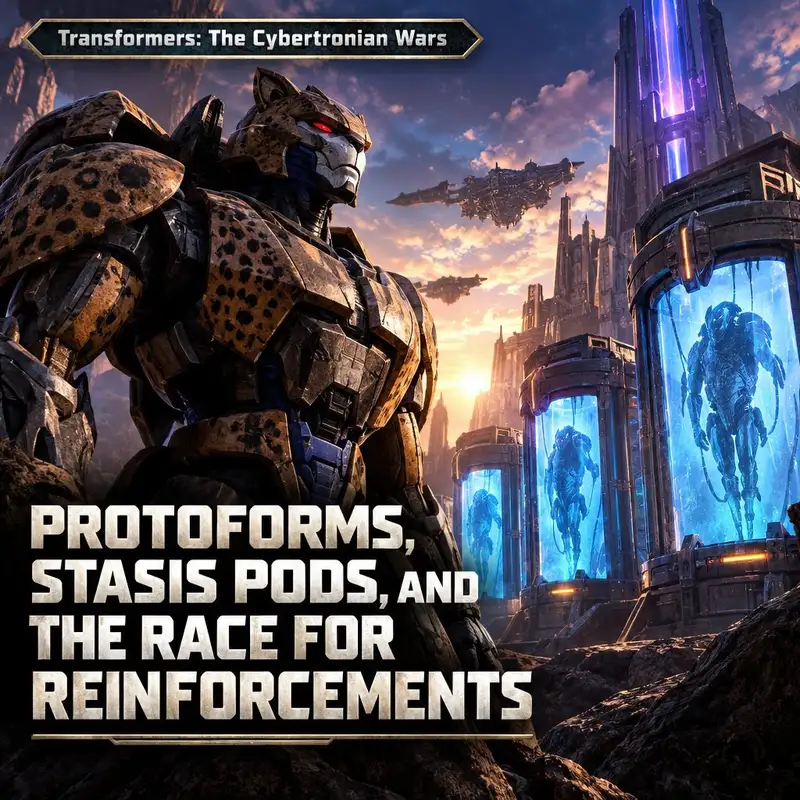
Protoforms, Stasis Pods, and the Race for Reinforcements
A pod was falling out of orbit, and neither side on prehistoric Earth could afford to treat it as debris. Somewhere inside was a Maximal life, held in stasis since the crash of the Axalon. If Optimus Primal’s small force reached it first, they might regain a comrade. If Megatron’s Predacons arrived first, that same life might become an enemy. And if the pod broke apart, or its systems failed before either side reached it, there might be no reinforcement at all.
That was the real character of the stasis-pod war in the North American Beast Wars screen history. The struggle was more than a hunt for additional fighters. It was a contest over scattered, vulnerable Cybertronian lives. Every recovery demanded reconnaissance, speed, technical skill, security, and judgment. Every activation raised a harder question than simple manpower. Who would this newly awakened being become, and who had the authority to decide?
A stasis pod was a protective capsule carrying a protoform or inactive Cybertronian occupant. On a functioning voyage, that arrangement offered safety and controlled deployment. After the Axalon crashed, it became something far less orderly. The pods were dispersed around an unfamiliar world, their locations uncertain, their descent patterns dangerous, and their occupants beyond the immediate protection of their own faction.
The Maximals had not arrived on prehistoric Earth to wage a planned campaign. They had pursued Megatron after he stole the Golden Disk, an artifact with information important enough to justify a transwarp chase. The pursuit ended badly. The Axalon crashed. The Predacon vessel Darksyde crashed as well. Both sides survived, but survival did not produce anything resembling a stable military balance.
Optimus Primal began with a small active force and a damaged base. Megatron had his own limited Predacon group, but the Maximals faced an immediate problem that the Predacons did not share in quite the same way. Their ship had carried comrades in stasis. Those personnel had become scattered across the planet before they could be awakened, organized, or protected.
The result was not a reserve force waiting politely behind the line. It was a dispersed reserve, broken into individual capsules and scattered through hostile terrain. Some pods remained intact. Others descended unpredictably. Some could be found and activated. Others could not be reached before the enemy. Some were damaged. And at least one did not contain an active spark at all.
The local environment made the problem worse. Prehistoric Earth was saturated with energon. That made the planet valuable, but it also made prolonged robot-mode exposure hazardous. The Maximals and Predacons adopted beast forms partly as protection against that energy. A rescue mission, then, was never just a matter of flying to a crash site and opening a hatch. The rescuers themselves had to operate under environmental limits.
That changed the meaning of mobility. A flying combatant could search wide areas and reach a descending pod quickly, but speed alone did not secure the site. A pod might land in rough ground, near unstable energon deposits, or within reach of an enemy ambush. Ground forces still had to hold terrain, move equipment, and protect a damaged occupant while technicians worked.
The crash also imposed a severe industrial constraint. Neither faction demonstrated the ability to manufacture replacement personnel quickly on prehistoric Earth. There was no visible production line that could replace a lost Maximal scout, medic, or flier with a newly built equivalent. The stasis pods were therefore a finite reserve. Each one mattered because it represented a life that could not simply be replaced by ordering another unit from a factory.
On the battlefield, a recovered pod might add one more capable combatant. For a small force, that could matter immediately. Another flier expanded reconnaissance. Another ground fighter improved local security. Another specialist reduced strain on the existing crew. In a war fought by small teams across a vast and unfamiliar landscape, one additional participant could alter the outcome of a patrol, a raid, or a defense of the Axalon.
Operationally, recovered personnel widened the Maximals’ ability to search, patrol, and respond. A force that begins with only a handful of active members cannot be everywhere. It must choose what to guard, what to investigate, and what to abandon. Every successful recovery gave Optimus Primal more flexibility. Every lost pod gave Megatron either an additional asset or the comfort of knowing that the Maximals would remain stretched thin.
Strategically, the stakes were larger still. The Predacons did not need merely to destroy Maximal reinforcements. Megatron wanted to convert them. A captured protoform might become a Predacon soldier, deny the Maximals a comrade, and change the balance of force in all three ways at once. The same pod could therefore represent rescue for one side, recruitment for the other, and catastrophe for its original owners.
There was also a political question embedded inside the machinery. A stasis pod could preserve a body, a spark, activation systems, and the means to establish a local beast configuration. But it did not guarantee a settled allegiance. The series shows damaged identity circuits, imposed activation codes, immediate factional instruction, moral resistance, and dangerous instability. It does not establish one simple rule for what every protoform knows or believes before activation.
The first major pod race made that complexity impossible to ignore. In the episode known as “Fallen Comrades,” a stasis pod’s orbit decayed. Its descent created a deadline. Both factions understood the opportunity. The Maximals saw a stranded comrade. The Predacons saw a chance to seize that comrade before Optimus Primal could recover them.
The mission became a test of command priorities. Primal needed reinforcements, but he also had to protect the Axalon. A small force cannot send everyone after every opportunity. Dinobot, who had once served Megatron and understood Predacon thinking, recognized the danger. A falling pod could be more than a rescue target. It could be a lure, drawing defenders away from the Maximal base and exposing the survivors who remained behind.
That concern was not cowardice. It was an appreciation of the enemy’s options. Megatron did not have to win every fight at the crash site. If the Maximals stripped the Axalon of protection, the Predacons could exploit the resulting weakness. A reinforcement mission could become a diversion. The very urgency of rescue could be turned against the rescuers.
Both sides had to estimate where the pod would come down, choose routes, and send units able to reach it. The series does not provide the kind of orbital data that would satisfy a modern aerospace planner, and it does not need to. More important, the landing zone was uncertain enough to make speed, local knowledge, and interception decisive.
The pod eventually yielded Tigatron. But the recovery did not produce the clean result that either side might have expected. Tigatron’s identity circuits had been damaged. He emerged with a powerful connection to the world around him and did more than report for duty as another Maximal member of the chain of command.
His choice to remain in the wilderness was strategically significant. The Maximals had recovered a life, but they had not received a conventional reinforcement in the full military sense. Tigatron could assist them when circumstances aligned, yet he remained independent. His priorities were shaped by the environment and by the damage associated with his emergence.
The distinction matters because it prevents an easy inventory mindset. A pod was not a crate containing a rifle or a replacement engine. It carried a person. Even when the person survived activation, the result could include injury, altered memory, incomplete identity, or a political choice that commanders had to respect whether they liked it or not.
Tigatron’s case also exposed a weakness in Megatron’s approach. The Predacon leader understood the value of conversion and capture, but capture was not the same as durable control. A newly awakened Cybertronian could not always be treated as an empty chassis waiting for a faction insignia. The first hours after activation mattered, but they did not settle every later decision.
The search for pods was therefore a struggle for information as much as for territory. Both sides needed to know where a pod was, what condition it was in, who could reach it, and whether the enemy had already arrived. In a conventional campaign, commanders may rely on maps, established roads, friendly population centers, and secure communications. On prehistoric Earth, neither faction possessed those advantages in reliable form.
Terrain mattered. Dense wilderness, cliffs, water, caves, and energon-rich regions complicated movement. A flier could cross distance rapidly, but it could not always hold a site alone. A ground unit might arrive later yet prove essential once the fighting began. A pod also had to be examined, protected, and sometimes moved. Recovery did not end when a scout made visual contact.
Cheetor often illustrates this side of the war. His speed and curiosity could make him an early responder, scout, or courier. Those qualities were useful, especially when the Maximals lacked numbers. But a fast scout was not a complete recovery system. He still needed support from commanders, technicians, and other fighters. In a small expeditionary force, the difference between locating an asset and securing it could be the difference between success and disaster.
Communications were vulnerable as well. Energon interference already made the planet difficult to operate on. Later events showed that deliberate electronic disruption could blind scanners and break coordination at the moment it mattered most. A side that lost contact with its scouts might not know whether a pod had landed safely, been captured, or become a trap.
The episode “The Spark” pushed the problem beyond search and combat recovery into field medicine. Another stasis pod entered an erratic descent. The situation was urgent not only because the Predacons might reach it. The pod itself had been damaged. Its activation sequence had failed, and a locking component had burned out.
Inside was Airazor. Her spark was deteriorating. The crucial problem was no longer whether the Maximals could tow the pod back to the Axalon before the Predacons intervened. The question was whether they could stabilize the occupant at the point of failure. Delay risked the loss of a Cybertronian life before any formal recovery could take place.
Rhinox became central to the mission because he possessed the technical and medical competence the situation required. His role is easy to overlook in a series full of combat scenes, but it reveals what stasis-pod recovery actually demanded. Firepower could secure a perimeter. It could not restore a damaged activation sequence. Speed could reach the site. It could not necessarily preserve a failing spark.
The Maximals had to make a practical choice. Transporting the damaged pod might have been safer from an enemy attack, but it could have taken too long. Stabilization had to happen in the field, under pressure, with limited equipment and an uncertain tactical situation. That is the kind of decision that separates recovery operations from simple retrieval.
Airazor survived and joined the Maximals. Tactically, that gave Optimus Primal a valuable flier. Operationally, it expanded the Maximals’ reach. But the deeper lesson was logistical and biological. Stasis was protective, not invulnerable. A pod could preserve a life through space travel and planetary descent, yet damage to the pod could become damage to the person within it.
The recovery also demonstrated the value of specialized personnel. A force with better medics, engineers, diagnostic tools, and repair capacity could turn a damaged reserve into usable strength. A force without those resources might find the same pod and still fail. Possession alone was not enough. Capability had to reach the point of crisis.
That was particularly important on prehistoric Earth, where the Axalon could not operate as an untouched rear-area hospital. It was a damaged base in contested territory. The Maximals had to choose when to bring problems home and when to solve them forward. Every field repair consumed attention, equipment, and security that could not be used elsewhere.
The Predacons understood that vulnerability. Their strategy did not depend solely on winning open fights. They could exploit damaged systems, disrupt communications, seize a pod before activation, or force the Maximals into a rescue operation under unfavorable conditions. In a conflict this small, every mission had a double edge. Saving one comrade could expose several more.
“Spider’s Game” showed how the pod contest evolved when open competition gave way to covert seizure. Tarantulas intercepted a descending pod, but he was more than carrying out Megatron’s orders. He intended to reprogram the protoform for his own purposes. The pod had become an opportunity for private power inside the Predacon camp.
This was a serious institutional problem for Megatron. The Predacons were not a seamless military machine. Megatron held formal authority, commanded fear, and set broad objectives. Yet individuals such as Tarantulas possessed technical knowledge and independent ambitions. A newly activated warrior under Tarantulas’s private influence could have become a personal asset, strengthening the scientist-spider’s position against both the Maximals and his own leader.
Blackarachnia’s discovery of the operation made the situation still more complicated. She was more than a passive subordinate witnessing a technical procedure. Her presence exposed the internal politics surrounding the pod. The question was no longer only whether Maximals or Predacons would obtain the occupant. It was which Predacon, under what conditions, and with what future loyalty.
This is where the race for reinforcements became a contest over command authority. A captured protoform could not be treated as neutral equipment. Whoever controlled the activation, programming, instruction, and first period of socialization might shape a new participant’s place in the war. Megatron wanted new soldiers who answered to Megatron. Tarantulas wanted something more useful to Tarantulas.
The episode also brought electronic warfare into the contest. Megatron used electromagnetic disruption against scanners and communications. That attack did not create a new army, but it changed the conditions under which both factions could operate. A side that cannot see, communicate, or coordinate may arrive too late even when its fighters are physically nearby.
The effect was especially dangerous because the Maximals already depended on rapid response. Their force was small, their base was exposed, and their potential reinforcements were scattered. Denying them information could delay rescue just long enough for a pod to be captured, damaged, or quietly removed from the battlefield.
Electronic disruption also protected deception. A pod seizure conducted under broken communications could be mistaken for an accident, a failed descent, or an enemy ambush. In military terms, the first side to reach the asset did not necessarily need to destroy the other. It only needed to prevent an effective response until control had become a fact on the ground.
The outcome of Tarantulas’s operation produced Inferno, whose activation demonstrates another dimension of stasis technology. The pod scanned a local life form and generated a beast configuration suited to the planet. That process mattered for survival. A newly awakened Cybertronian needed protection from Earth’s dangerous energon environment. But the beast form was only one part of the transformation from inactive occupant to active combatant.
Inferno emerged into a Predacon structure. He received Predacon activation language and immediate direction. The process placed him rapidly within a military hierarchy. He did not arrive as an outsider allowed weeks or months to study competing political traditions. He awakened amid a faction that had already claimed him, named his loyalties, and given him a commander.
That is powerful evidence that activation could shape allegiance. It is not proof that an activation code produced permanent, unquestioning loyalty in every protoform. The series is more complicated than that. Tigatron emerged damaged and independent. Blackarachnia’s history does not support the idea of permanent obedience to Predacon authority. And later events involving Silverbolt show that an assigned factional role could be challenged.
Inferno does show, however, how quickly a faction could turn a recovered pod into military capacity. The first instructions a new arrival received mattered. So did the local command environment. A warrior activated under Megatron’s banner, surrounded by Predacons and given immediate purpose, entered the war very differently from one awakened among Maximals, alone in the wilderness, or under emergency medical care.
The pod system also had uses beyond personnel recovery. In “Other Voices,” the Maximals still possessed intact stasis pods and considered using one as part of an escape craft. That decision reveals that the pods were more than capsules for sleeping passengers. They were pieces of survival infrastructure, adaptable enough to matter in evacuation and long-distance escape planning.
This created another kind of scarcity. An intact pod could preserve a future occupant, but it could also help preserve the active force already fighting on the planet. Commanders might have to choose between maintaining a reserve and using available hardware to escape immediate destruction. The series provides no complete technical manual for the pods, and none is needed. Their strategic value was broad enough to create competing demands.
That use also reminds us that the Beast Wars were not fought on a stable front. The Maximals were stranded far from home, operating from a damaged vessel, and facing threats that could make the entire planet untenable. Reinforcement, evacuation, and survival were connected problems. A pod could support the future, but it could also become necessary to preserve the present.
By the time of “Coming of the Fuzors,” the Maximals understood that some pods had landed in Predacon territory while others remained unlocated. That fact alone imposed a harsh reality. The battlefield was not divided neatly into Maximal and Predacon zones with a clear front line between them. Potential reinforcements could lie behind enemy access routes, in contested wilderness, or in places neither side had yet found.
One recovered pod contained a blank protoform without a spark. This was an important corrective to any simple assumption that every pod held a fully recoverable individual. The pod had value, but it did not yield an immediately activatable person. The difference between body, spark, and activation capacity mattered. Recovering the container did not automatically mean recovering a comrade.
Megatron, meanwhile, activated Quickstrike and Silverbolt using Predacon codes. From a narrow military perspective, this was exactly what the Maximals feared. The Predacons had gained new participants while denying the Maximals access to them. In a small war, even a few additional fighters could affect patrols, raids, and the security of both bases.
Yet Silverbolt complicated the story. His eventual resistance to Predacon conduct showed that political identity was not settled once and for all at the moment of activation. The codes, instructions, and surrounding command structure mattered. They could establish a role and provide an initial framework of allegiance. But moral judgment and personal agency still mattered as well.
Silverbolt should not be used to claim that programming or factional socialization had no effect. The evidence supports a more careful conclusion. Initial control is powerful. It gives a faction the first chance to define duty, comradeship, enemy identity, and acceptable conduct. But it does not erase the possibility that an awakened individual may reject what they have been told.
That made the pod race political in a deeper sense. The sides were not only fighting over the right to place another blaster in the field. They were fighting over the first social world a new Cybertronian would encounter. Would the newcomer awaken among Maximals who regarded them as a lost comrade? Among Predacons who treated them as a weapon of conquest? Alone, injured, or confused in an unfamiliar wilderness? Those conditions could shape the future war.
The most disturbing case was Protoform X, discovered in “Bad Spark.” This was not an ordinary stasis passenger and should not be treated as evidence for ordinary Cybertronian biology. Protoform X had been created through a dangerous Maximal experiment. The aim was to reproduce the unusual resilience associated with the original Megatron’s Starscream, a figure from the older Generation One history whose spark possessed exceptional properties.
The experiment failed in every sense that mattered. Protoform X was unstable, violent, and apparently extraordinarily difficult to destroy. The Maximals had not been transporting the subject as a routine reinforcement. They were carrying him away for disposal far from populated space. His pod was a containment measure, not a reserve intended for future activation.
That difference transformed the discovery into a command crisis. Cheetor found something that looked, at first glance, like another lost pod. But recovery was not automatically the right answer. The Maximals now faced the question that every military organization eventually faces when dealing with dangerous experimental assets: does possession create an obligation to preserve, a need to contain, or a requirement to destroy?
Megatron saw the same asset differently. To him, Protoform X was an opportunity. If he could control the subject, he could add a devastating weapon to his force. The result was Rampage, a combatant whose destructive capacity and instability created problems for everyone around him, including the faction that tried to employ him.
Tactically, Rampage gave the Predacons access to a formidable and frightening fighter. Operationally, however, such an asset imposed costs. Containment, coercion, supervision, and the fear of betrayal consume command attention. A weapon that cannot be trusted is more than an advantage. It is a source of risk that may injure allies, disrupt plans, or force commanders to devote resources to managing their own side.
Strategically, Protoform X demonstrated that not every reserve should be activated. Military organizations often assume that an available asset should be recovered and used before the enemy can seize it. The Beast Wars offers a harder lesson. Some assets are so unstable that their recovery can create a greater danger than their loss. The enemy may still weaponize them, but that does not make the original restraint irrational.
There was also a moral failure embedded in the case. The Maximals had created Protoform X through experimentation. The series provides no full institutional history of the project, nor does it establish every official responsible. But it does make clear that the dangerous subject was not a Predacon invention. The Maximals’ own attempt to reproduce an exceptional spark had produced a being they could neither safely integrate nor easily destroy.
Megatron exploited that failure. He did not create the original problem, but he recognized its military potential. This is one reason the stasis pods cannot be understood as simple containers of future strength. A pod could contain a comrade, a damaged survivor, an empty body, a recruitable soldier, an independent actor, or a threat too dangerous for either side to control.
The falling pod in “Fallen Comrades” therefore captures the larger reality of the Beast Wars. What looked like a race for reinforcements was really a race through several stages of uncertainty. First came detection. Then interception. Then security. Then repair or stabilization. Then activation. Then instruction, allegiance, and the first exercise of personal agency.
The Maximals could not solve that problem with courage alone. They needed scouts who could find the pods, fighters who could secure them, communications that survived interference, medics and engineers who could preserve damaged occupants, and commanders willing to recognize that recovery did not always produce an obedient soldier. They also needed restraint, especially when the asset in question was too dangerous to treat as a routine reinforcement.
The Predacons needed more than capture. Megatron could seize pods and impose Predacon codes, but he still had to manage the people and ambitions within his own faction. Tarantulas’s private scheme showed that a recovered protoform might strengthen a rival rather than the Predacon cause as a whole. Inferno showed the power of immediate socialization. Silverbolt showed its limits. Rampage showed the danger of mistaking destructive capacity for reliable control.
The stasis pods reveal that the Beast Wars was fought not only over territory, energon, or the stolen Golden Disk. It was fought over the fragile process by which a stranded society decided who would survive, who would belong, and who might become dangerous enough to alter the war.