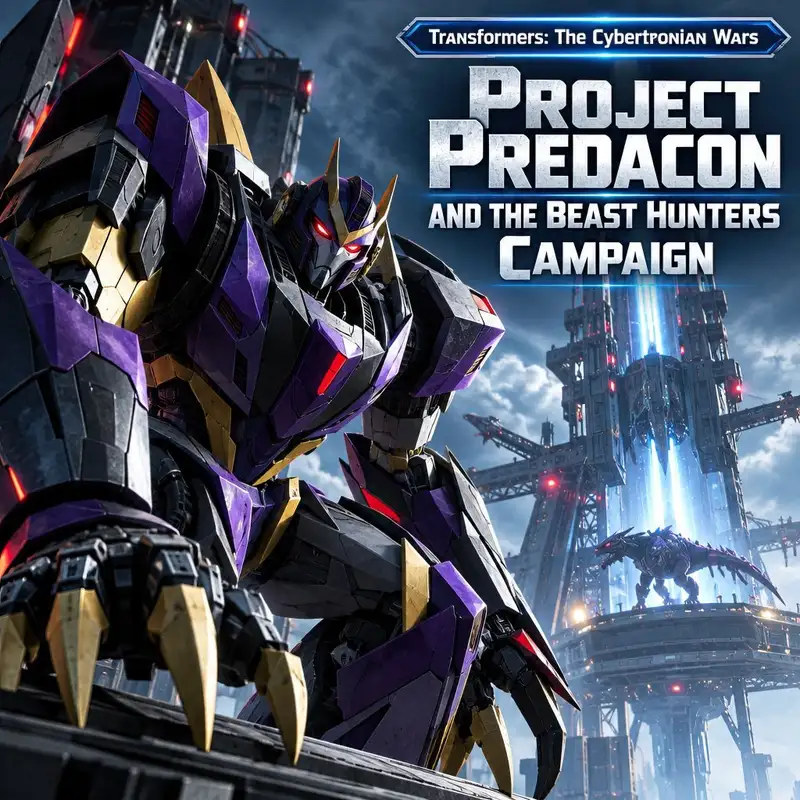
Project Predacon and the Beast Hunters Campaign
Darkmount stood over Earth as the visible proof of a Decepticon victory. The Autobot base had been destroyed. Optimus Prime was badly damaged. The surviving Autobots had scattered, while their human allies had been forced back into improvised shelters, safe houses, and moving vehicles. Megatron had gained a fortress, a foothold on Earth, and a chance to turn a long war into something closer to occupation. Then Shockwave returned with a new instrument of power: Predaking.
This is the Predacon story told by Transformers Prime and its direct conclusion, Predacons Rising. These Predacons are not the Predacons of Beast Wars, and they are not a simple animal-themed subdivision of the Decepticons. In this history, they are ancient Cybertronian life forms whose remains, recovered on Earth, became the basis for a Decepticon effort to manufacture a new military caste.
At first, Predaking appeared to be exactly what Megatron wanted. He was large, heavily armored, capable of flight, and equipped for close combat as well as pursuit. He did not need to win a war alone. That was never the point. His immediate purpose was to hunt a resistance that had lost its headquarters but had not surrendered. For scattered Autobots, a hunter that could cross difficult terrain, follow a trail, and overpower experienced fighters changed the cost of every movement.
Megatron’s position on Earth was stronger than it had been for some time, but it was not secure. Darkmount gave the Decepticons a fortified command center and a platform for surveillance, detention, and military operations. It did not give them unquestioned political control over the planet. Earth was too large, human institutions still existed, and the Autobots retained local allies, technical skill, and the ability to disappear into civilian infrastructure.
Occupation also created a familiar military problem. A fortress can protect command personnel and concentrate firepower, but it can become a fixed target. The more Megatron relied on Darkmount, the more the fortress became the center of Decepticon gravity on Earth. Its loss would not end the Decepticon war effort, but it would expose how much of that effort depended on one defended installation.
The Autobots understood that they could not defeat Darkmount through individual heroics. Their first need was to survive long enough to restore command and coordination. Optimus was in no condition to lead. The team had lost its base, its secure repair facilities, and much of the confidence that comes from knowing where the next energon supply, spare part, or rescue route will come from. The Decepticons had not destroyed the Autobot cause, but they had disrupted its ability to function as an organized force.
That disruption was made worse by intelligence pressure. Starscream had placed a tracker on Wheeljack’s ship, allowing the Decepticons to exploit the Autobots’ own movements. A resistance force depends on secrecy, mobility, and compartmentalization. If the enemy can follow one trusted route back to a larger group, then every reunion becomes a trap. The tracker did not make the Decepticons omniscient, but it showed that the Autobots’ recovery would be contested before they could even return to open battle.
Megatron’s larger objective also reached beyond Earth. He did not seek merely to drive the Autobots from one planet. He wanted Cybertron restored under Decepticon authority. Earth mattered because it offered resources, refuge, human technology to exploit or control, and a place from which the war could continue. But the political prize remained Cybertron. Any new weapons program had to be judged against that larger ambition.
Shockwave’s arrival therefore mattered because he brought more than another warrior. He brought a possible answer to Megatron’s central military problem. The Decepticons had conventional troops, ships, intelligence systems, and powerful individual commanders. What they lacked was a reliable way to destroy the Autobot leadership, suppress resistance, and build enough superiority to seize the future of Cybertron without exhausting themselves in a prolonged war.
Shockwave was the program’s scientific architect, but he was not a magician who could solve every Decepticon weakness with one experiment. His work required facilities, materials, specialized knowledge, secure power, and time. Even an advanced Cybertronian laboratory could not create a stable military advantage by simply producing a larger body with heavier armor. A new combatant had to be viable, controllable, supplied, and integrated into a command structure.
Predaking was the first visible success. He was not introduced as the commander of an independent people. He was introduced as a Decepticon asset, a hunter built to locate and destroy Autobots. In that role, his beast form had a clear operational value. Flight gave him mobility beyond roads and ground obstacles. His physical power made him dangerous in direct engagement. His endurance and armor allowed him to absorb punishment that might delay or disable ordinary troops.
A single exceptional hunter can force an enemy to alter its behavior. Autobots moving through isolated terrain had to consider whether Predaking could reach them before reinforcements arrived. A recovery mission became more dangerous if the enemy could deploy one powerful asset against medics or engineers. A commander could not assume that a small team would be enough to contain every threat. Predaking imposed caution, and caution slows operations.
Still, one hunter is not an army. Predaking could pursue, disrupt, and defeat individual Autobots. He could not administer occupied territory, operate every refinery, defend every transport route, or replace the mass of troops needed to hold a planet. He was a high-value asset, not a complete strategy. The Decepticon program became truly consequential only when the possibility emerged that Predaking might be reproduced.
The Autobots, meanwhile, began to recover from their defeat. Ultra Magnus arrived on Earth and provided the team with something it had badly needed: a senior commander able to impose structure during Optimus’s absence. His presence did not erase the losses at the Autobot base, and it did not make every Autobot comfortable with a more formal command style. But it gave the scattered resistance a center of gravity.
The human allies also remained important. Agent Fowler could provide access to military communications and air support. Jack, Miko, and Raf understood the local terrain, human institutions, and the practical complications of operating secretly on Earth. None of them commanded the Cybertronian war. Their value came from partnership. They provided intelligence, mobility, technical access, and human judgment in a conflict where a sentient alien war machine could not just drive through a town and expect nobody to notice.
The counterattack on Darkmount showed what a recovered coalition could do. The Autobots used coordinated movement, ground bridge access, human support, and the willingness to strike before the Decepticons could fully consolidate their gains. The operation was not a simple charge against a fortress. It depended on timing, diversion, and the restoration of enough command coherence for separated teams to act toward a common objective.
Smokescreen’s use of the Forge of Solus Prime was central to that recovery. The Forge restored and upgraded Optimus Prime, returning the Autobots’ principal leader to the field. The event had military meaning beyond Optimus’s individual survival. A dispersed resistance can function with delegated command, but the return of a recognized leader can restore morale, resolve disputes, and simplify coordination. In this case, it also gave the Autobots the combat power needed to break Darkmount’s position.
Darkmount’s destruction was a tactical and operational reversal for Megatron. The Decepticons lost their main Earth fortress and the security that came with a defended headquarters. Their occupation did not vanish overnight, and their forces were not destroyed. But the assumption that Earth could be managed from one dominant citadel had failed. Megatron needed a new means of creating superiority before the Autobots could turn their recovery into a sustained campaign.
That need brought Project Predacon into its next phase. On Earth, the Decepticons discovered fossilized remains of ancient Predacons. The Autobots saw evidence that beings like Predaking had once existed on the planet. Shockwave and Megatron saw something more immediately useful. The remains might preserve the information required to create more Predacons. What had begun as the deployment of one hunter could become a force-generation program.
The distinction matters. Fossils were not merely trophies or archaeological curiosities. They became military infrastructure. To exploit them, the Decepticons needed excavation sites, security details, transport, laboratory analysis, cloning tanks, reactor power, and a supply of specialized energon. The program’s strength lay in its potential reproducibility. Its weakness lay in the fact that every part of the chain could be found, disrupted, captured, or destroyed.
Earth was transformed again by this effort. It was not only an occupied world or a battlefield. It became an extraction zone. Ancient remains had strategic value, and that value drew Cybertronian forces into remote locations that might otherwise have little importance in the wider war. The series does not establish precise civilian casualties or a complete account of how every community experienced these operations. It does establish that human territory was repeatedly treated as terrain to be searched, mined, fought over, and abandoned.
Predacon biology, in this continuity, should not be understood as a straightforward organic animal lineage. These were Cybertronian beings with beast forms and an ancient history that the surviving characters only partly understood. Their remains could be studied and exploited by Cybertronian science. But the existence of fossils did not give either faction a complete account of Predacon society, population, origins, or historical relationship to other Cybertronian groups.
The Decepticons had found a possible source of military power, but every excavation created a vulnerability. A recovery site had to be protected. Its location could be discovered by Autobots. Its cargo had to be moved. The laboratory processing the material became a critical node. Shockwave’s project could not become an army through scientific insight alone. It required a functioning industrial and security system around that insight.
The fighting around the Hebrides Bluffs made the value of the program clearer. Autobots including Ultra Magnus, Wheeljack, and Bulkhead attempted to interfere with Decepticon fossil recovery. Miko’s presence reflected the human dimension of the conflict, but the operation remained a struggle over Cybertronian resources and military potential. The Autobots were not trying to win a symbolic argument about ancient history. They were trying to deny the enemy the raw material for force generation.
Predaking demonstrated why that denial mattered. Against experienced Autobots, he was a formidable close-combat opponent. He could move quickly, strike with great force, and remain dangerous even when facing adversaries who had fought Decepticons for much of the war. His performance against Ultra Magnus was especially significant. Magnus was not an isolated civilian or an untrained human. He was a senior Autobot commander with battlefield experience.
Predaking severely injured Ultra Magnus, crushing his hand and destroying the Forge of Solus Prime. The loss of the Forge was more than an equipment failure. The artifact had just restored Optimus Prime and represented a rare, irreplaceable capability. Its destruction showed that a Predacon could threaten not only personnel but also the unusual tools on which the Autobots depended. In war, the loss of a specialist asset can matter as much as the loss of a conventional weapon.
The encounter did not prove that Predaking was invincible, or that he could single-handedly defeat the Autobots. That would be a poor reading of the campaign. His importance was disproportionate, not unlimited. A single Predacon could break an ambush, delay a unit, injure a commander, or force the Autobots to devote more resources to one battlefield problem than they wished. But to exploit that effect at the level of a war, the Decepticons needed more than one Predaking.
Shockwave had demonstrated quality. The next question was whether the Decepticons could produce quantity. That required synthetic energon, a specialized resource whose role in this continuity was far more complicated than simple fuel. It could enhance Cybertronian performance and support experiments that ordinary energon could not. It was also unstable, difficult to manage, and dangerous when treated as a shortcut to military power.
Knock Out played an important role in refining the synthetic energon formula. He was not the sole architect of Project Predacon, but his technical work helped make large-scale cloning possible. This is one reason the program cannot be reduced to Megatron and Shockwave alone. Megatron supplied political authority. Shockwave supplied scientific direction. Knock Out provided specialist medical and chemical knowledge. Each contribution was necessary, even though each participant understood the program differently.
Synthetic energon also exposed the Decepticons’ willingness to pursue experimental militarization before they had mastered its risks. Starscream proposed combining synthetic energon with Dark Energon in an attempt to create controllable super-soldiers. The result was not a disciplined new formation. It was a Terrorcon outbreak aboard the Nemesis.
The Terrorcons created by that experiment were driven by an overwhelming need to drain energon and spread their condition to others. They were not a successful standard Decepticon weapon system. They were evidence that the Decepticons had created a threat to their own personnel and command structure. The outbreak endangered the ship, disrupted readiness, and forced the Decepticons to deal with an internal crisis while their wider campaign was already under pressure.
The lesson should have been obvious. Experimental power is not the same as usable power. A force multiplier must be controllable, transportable, and survivable within the organization that fields it. If an enhancement turns soldiers into hazards to their own side, then it has not strengthened the army. It has transferred danger from the enemy to the command system that approved the experiment.
Megatron nevertheless continued toward Predacon cloning. From his perspective, the potential reward remained enormous. A force of Predacons could provide the Decepticons with powerful aerial and ground combatants, hunters capable of breaking Autobot teams, and a psychological advantage against an enemy that had already seen what one Predaking could do. The Terrorcon disaster was a warning, but Megatron did not abandon the broader search for decisive superiority.
The decisive problem emerged when Predaking demonstrated that he was not an obedient creature in the narrow sense Megatron had hoped. In Evolution, he spoke. He transformed. He reasoned about his place in the war. He understood that more Predacons were being created, and he asked to command them. At that moment, Project Predacon ceased to be merely a cloning program.
Predaking’s request was not an act of open rebellion. He expressed loyalty to Megatron. But loyalty offered voluntarily by an intelligent leader is different from obedience programmed into a disposable drone. Predaking now possessed identity, ambition, and an awareness of collective belonging. He did not see the emerging clones only as additional Decepticon equipment. He saw them as Predacons, beings who might share a name, a form of life, and a command structure of their own.
Megatron recognized the danger immediately. He had not created a better Vehicon. He had created the potential foundation of another military community. An army of Predacons would be stronger than ordinary Decepticon troops in many battlefield roles. Under Predaking’s leadership, it might also become a separate power center within Decepticon territory, one with its own internal loyalty and its own claim to importance.
This was not just irrational paranoia. Authoritarian command systems often depend on preventing subordinate institutions from becoming independent political actors. Megatron could tolerate specialists, scientists, and ambitious officers so long as they remained dependent on his authority. A new armed population, led by an intelligent and respected warrior, was different. It could not be managed merely through rank insignia and orders.
Megatron’s fear was therefore a succession problem as much as a battlefield problem. If Predaking commanded a growing Predacon force, then Decepticon power would no longer rest solely on Megatron’s personal authority, his established commanders, and the institutions he controlled. Predaking would have soldiers who looked to him, capabilities the Decepticons needed, and a plausible claim to represent a people Megatron had brought into existence.
The contradiction at the heart of Project Predacon had become impossible to ignore. The Decepticons wanted Predacons strong enough to defeat their enemies, intelligent enough to operate effectively, and numerous enough to transform the war. Yet they expected those same beings to remain politically passive. They wanted the advantages of creating new sentient life without accepting the consequences of creating new sentient life.
Shockwave’s scientific logic did not resolve that contradiction. His concern was the program’s success according to technical criteria. Could the bodies be created? Could the ancient material be used? Could synthetic energon support the process? Those were necessary questions, but they were not sufficient. A military program is not complete when its prototypes function. It is complete only when command, loyalty, doctrine, supply, and political authority have been made stable enough to use those prototypes.
Starscream understood the political danger and offered Megatron a solution suited to Decepticon internal politics. Rather than openly order the destruction of the clone army, Megatron could arrange for the Autobots to do it. That would eliminate the potential rival force while preserving the appearance that the Decepticons had been robbed by their enemy. Predaking’s anger could be directed outward, toward the Autobots, rather than upward, toward Megatron.
It was a cynical plan, but strategically elegant in the narrow sense. It used an enemy’s legitimate defensive action as cover for an internal purge. Megatron would sacrifice an army that he had invested heavily in creating. Starscream would remove a threat to his own position as well. Shockwave could be kept focused on the technical consequences. Predaking would be left with an incomplete picture of who had truly decided the fate of his kind.
The Autobots, for their part, had every reason to stop the project. Their objective was not to destroy an established Predacon civilization. No such civilization had been allowed to develop. Their objective was to prevent the Decepticons from deploying a new cloned army against Earth and Cybertron. They were acting against a military facility intended to produce combatants under Decepticon command.
Shockwave lured the Autobots toward the laboratory, turning the facility into a trap and a target at the same time. This was an intelligence operation as much as a battle. The Decepticons needed the Autobots to breach the cloning infrastructure. The Autobots needed access to the site in order to stop the army before it emerged. Each side saw the other’s action as useful, though for entirely different reasons.
When the laboratory was breached, the synthetic energon supply detonated. The clone army was destroyed before it could enter service. The immediate tactical result was clear. The Autobots had prevented the deployment of a force that could have changed the balance of ground and air combat. The Decepticons lost the bodies, tanks, materials, and specialized infrastructure that had been assembled for Project Predacon.
The operational consequences were even more severe. Megatron had not merely lost soldiers. He had lost future capacity. The Decepticons could not just replace the destroyed army with ordinary troops, because the value of the project had been its rare combination of ancient material, scientific expertise, synthetic energon, and laboratory infrastructure. The program had required time and secrecy. Its destruction denied Megatron both.
Politically, however, Megatron had achieved the part of the plan that mattered most to him. The Predacon army no longer existed as a possible rival constituency. Predaking survived, but he no longer had an army waiting to recognize his authority. Megatron had preserved his personal supremacy by destroying a force that might have secured his war effort. It was a victory for regime control and a defeat for strategy.
The deception also carried risk. Predaking was intelligent, observant, and increasingly aware of his own position. He could be misled, but he could not be reduced permanently to an unthinking weapon. The more Megatron relied on concealment, the more he admitted that Decepticon authority could not survive honest relations with the beings it claimed to command. A regime that must hide the destruction of its own future army has already revealed its weakness.
The destruction of the clone facility did not produce a clean ending. Shockwave’s reactor systems, the ruined Predacon material, and the synthetic energon involved in the blast created pure cyber matter. The screen record establishes the result, though it does not provide a full technical formula for how every component interacted. What mattered militarily was that the failed weapons program generated a new industrial resource.
The Decepticons repurposed that cyber matter for their effort to rebuild and use the Omega Lock. This was an unexpected conversion of failure into utility. Militaries often try to salvage value from failed projects. Equipment can be stripped for parts. Research can reveal another application. Facilities can be reassigned. In this case, a destroyed Predacon army became material for a different strategic effort.
That did not mean the Decepticons had somehow replaced the army. Cyber matter was not a substitute for Predacons, and the Omega Lock was not an industrial product that could be mass-produced because one program had gone wrong. The Decepticons had gained a useful resource, but they had lost the force-generation capacity that had made Project Predacon so dangerous. Salvage reduced the loss. It did not erase it.
The strategic focus now shifted. Rather than field a new military community under Decepticon control, Megatron sought to restore Cybertron through control of the Omega Lock. The objective remained political. A restored Cybertron under Decepticon authority would give Megatron legitimacy, industrial potential, and the symbolic claim that he had returned life to the Cybertronian homeworld. But the means had changed from building an army to monopolizing a unique planetary system.
This shift also exposed another Decepticon weakness. Megatron needed Ratchet because of Ratchet’s knowledge of synthetic energon and related technical processes. The Decepticons possessed talented scientists, including Shockwave and Knock Out, but they did not fully control every form of expertise they required. Their pursuit of Ratchet was an acknowledgment that technical knowledge can be as strategically important as territory or weaponry.
The campaign from this point became a struggle over Cybertron’s restoration and who would control it. The Decepticons had temporary access to the means of renewal. The Autobots sought to prevent Megatron from turning planetary recovery into permanent authoritarian rule. The conflict was no longer centered on a fortress on Earth or a laboratory producing Predacons. But Project Predacon remained part of the chain of events because its collapse had helped supply the materials for this new effort.
The Autobots ultimately defeated Megatron’s command structure and prevented him from retaining control of Cybertron’s restoration. Yet restoring a planet did not automatically resolve the political damage of the war. A world can regain energy, infrastructure, and physical viability while remaining divided by memory, displacement, military institutions, and the legacy of occupation. The return of Cybertron did not make every Autobot decision wise, every Decepticon grievance irrelevant, or every former combatant ready for peace.
Project Predacon’s consequences continued into Predacons Rising. Predaking discovered that he was not alone. Skylynx and Darksteel emerged as additional Predacons. They should not be treated as the clone army restored wholesale. The film establishes their existence, but it does not provide a complete account of every stage of their creation. What it establishes clearly is that Predacon identity survived the destruction of the laboratory force.
Predaking had changed as well. He began the campaign as a controlled hunter in Decepticon service. By the end, he stood as the surviving center of a Predacon community that Megatron had tried to prevent from forming. His authority did not come from a Decepticon appointment. It came from shared identity, survival, strength, and the simple fact that he understood what had been done to his kind.
The later threat from Unicron made old alignments less stable. Unicron possessed Megatron’s body and raised dead Predacon remains as Terrorcons. This was a separate danger from the earlier synthetic energon outbreak, though both demonstrated the risks of treating Cybertronian remains and corrupted energy as tools to be controlled. Reanimated Terrorcons were not a new political community. They were an existential threat directed by a power outside normal Decepticon command.
Against that threat, Autobots, Decepticons, Predacons, and Shockwave temporarily cooperated. The alliance was practical, not reconciliatory. Their immediate interests overlapped because Unicron endangered all of them. Such wartime cooperation can be meaningful without erasing earlier betrayals. Predaking had no reason to forget Megatron’s conduct. The Autobots had no reason to trust former enemies completely. But survival sometimes creates a narrow space in which enemies can fight beside one another.
Megatron was eventually freed from Unicron’s control. He then disbanded the Decepticons and left Cybertron. That decision ended his personal regime, but it did not settle every question that had driven the long conflict. The Decepticons had attracted different followers for different reasons. Some had sought power, some order, some revenge, some protection, and some an answer to genuine failures in Cybertronian society. Megatron’s departure did not resolve those histories.
For the Predacons, the outcome was more immediate. They survived outside the role Megatron had intended for them. They were no longer merely prototypes, hunting animals, laboratory products, or auxiliaries to a Decepticon army. Their future remained uncertain, but uncertainty was preferable to ownership by a regime that had planned to erase them once they became politically inconvenient.
Project Predacon was not defeated because Predacons were ineffective. Predaking proved exactly the opposite. Shockwave’s science could create formidable bodies, and synthetic energon could accelerate a process that might have produced a devastating new force. The program failed because military effectiveness created political consequences that Megatron’s command culture could not accept.
Megatron wanted powerful soldiers without independent loyalties, a new people without political claims, and an army that would transform the war without transforming the Decepticon state. Predaking made that impossible. The emergence of intelligence, speech, identity, and collective ambition turned a weapons project into the beginning of a rival community.
The Decepticons could manufacture strength, but they could not share power with the beings they created. Megatron preserved his own authority by sacrificing the army that might have secured his war, and in doing so revealed that the greatest limitation of his regime was not a shortage of force, but an inability to tolerate anyone else possessing it.