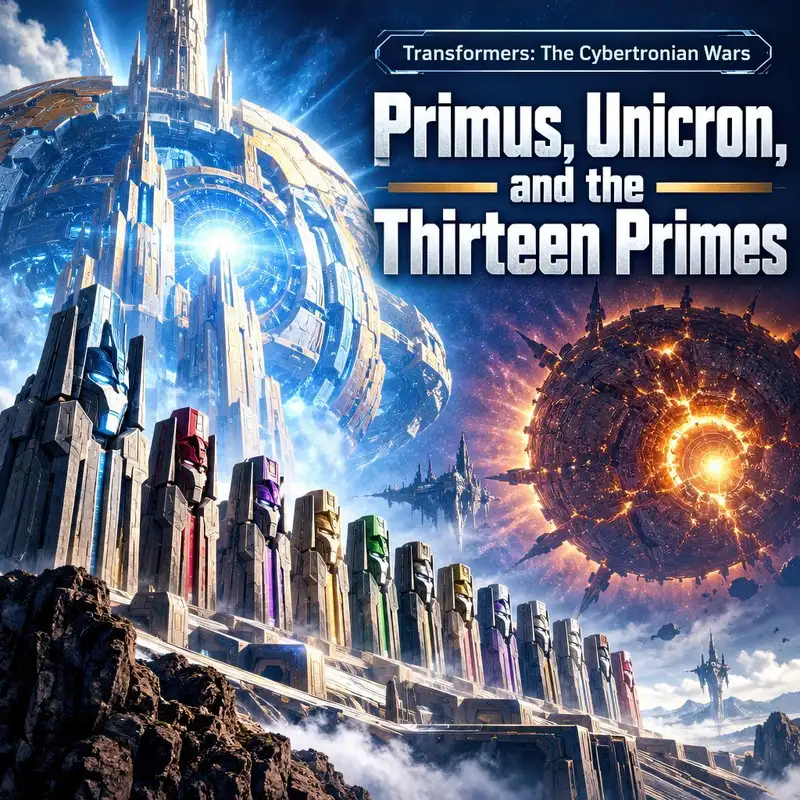
Primus, Unicron, and the Thirteen Primes
Earth begins to convulse. Volcanoes erupt, coastlines buckle, and storms move with a violence that no human government can command or explain. In Transformers: Prime, these disasters are not just a natural emergency. They are the signs of Unicron awakening. The immediate military problem is almost absurd in its scale. Earth is home to billions of civilians. It is also the refuge, battlefield, and supply environment for Autobots and Decepticons. Now it is revealed to be the dormant body of the enemy itself.
That changes every assumption about war. There is no clean target area. No distant fortress can be bombarded without consequence. No conventional victory is possible if the battlefield is also the inhabited body of the threat. Optimus Prime and Megatron, enemies in an ongoing civil war, temporarily cooperate because neither can preserve Earth alone. Their alliance is not reconciliation. It is a ceasefire imposed by extinction. The enemy is too large, too deeply embedded, and too dangerous for either faction to treat as a partisan advantage.
The solution is the Matrix of Leadership, but even that solution comes at a cost. Optimus uses the Matrix to return Unicron to dormancy. Earth survives the immediate crisis. Yet the effort strips Optimus of his memories. A strategic success produces a command and intelligence failure within the Autobot cause. Their leader remains physically present, but much of the experience, judgment, and personal history that made him their leader has been erased. Myth has become an operational fact, and victory has come with a bill.
That episode of Transformers: Prime offers a useful warning before discussing Primus, Unicron, and the Thirteen Primes. These names are not one settled body of franchise lore. They do not describe a single family tree shared by every cartoon, comic, film, game, or toyline. They are recurring ideas, repeatedly rebuilt to answer different questions about creation, destruction, authority, and political memory. A shared name does not guarantee a shared history. A familiar artifact does not guarantee a shared theology.
This is therefore a comparison among separate records. Marvel’s Generation One comics gave Primus and Unicron a cosmic origin story of their own. The Aligned continuity family, especially The Covenant of Primus and Transformers: Prime, developed a more elaborate founder mythology around the Thirteen. Transformers One, released decades later, used familiar names and symbols in a separate film history centered on labor, deception, and stolen legitimacy. These stories echo one another, but they do not combine into a single reliable chronology.
The nineteen eighty-six animated film provides an important contrast. It gave audiences Unicron as a planet-devouring attacker, a being capable of consuming worlds and threatening Cybertron itself. It also established the Matrix as the instrument that allows Hot Rod, transformed into Rodimus Prime, to destroy Unicron from within. That is a complete dramatic story. But the film does not present the later, fuller system of Primus as Unicron’s opposite or the Thirteen Primes as Cybertron’s original founders.
The difference matters because the temptation to fill every gap is strong. Once later stories introduce Primus, the Thirteen, ancient wars, sacred relics, and elaborate histories, it becomes easy to read those ideas backward into the earlier cartoon. But the original animated film did not require that cosmology to make Unicron frightening. Its Unicron was dangerous because he was there, because worlds vanished before him, and because the Autobots lacked an obvious means to stop him. The mythology came later, and it came differently in different branches.
The better question is not which version is the one true explanation of Cybertron. The better question is what each version is trying to explain. Is Cybertron the body of a god, the work of a creator, or a world whose inhabitants later turned founders into sacred ancestors? Is Unicron an invader, a cosmic opposite, a hidden planetary threat, or the shadow cast by political fear? Are the Primes divine rulers, heroic pioneers, failed leaders, or symbols appropriated by those who rule in their name?
Marvel’s Generation One comics supplied one of the most influential answers. In issue sixty-one, The Primal Scream, Primus and Unicron are presented as opposed cosmic beings. The story gives the Transformers conflict a background larger than the Autobot and Decepticon war. Cybertronian history is no longer only a civil war between rival political factions. It is connected to a much older struggle between constructive order and destructive appetite, between a creator associated with Cybertronian life and an adversary associated with annihilation.
In that comic mythology, Primus is deeply connected to Cybertron and to the life that emerged from it. Unicron is not merely another warlord, another weapon platform, or another hostile planet. He is an existential adversary. The conflict between the two gives the setting a cosmological horizon. Cybertron’s wars matter not only because factions compete for territory or energon, but because their world is tied to an ancient struggle whose consequences still move through history.
Yet Marvel’s myth does not erase political responsibility. The existence of Primus does not compel Decepticons to become conquerors. The existence of Unicron does not make every Autobot policy wise. A cosmic origin can explain why a civilization possesses myths of creation and destruction. It cannot excuse the choices made by governments, military commanders, or revolutionaries. The Decepticon war remains a political conflict shaped by ambition, fear, military power, and leadership. The cosmic story enlarges the setting. It does not absolve its inhabitants.
That is one reason the Marvel version endured. It gave Transformers a mythic scale without requiring every battle to be reduced to fate. Primus and Unicron are powerful ideas because they can frame the stakes while leaving room for human, or Cybertronian, agency. Characters can inherit an ancient danger without being puppets of it. They can interpret sacred history, misuse it, doubt it, or attempt to live beyond it. In a long-running war story, that is more useful than a simple declaration that everything was predetermined.
Marvel’s account also belongs to Marvel. It should not be quietly transferred into the American animated continuity because the same names later became familiar across the franchise. The comic and cartoon shared characters, toy designs, and broad concepts, but they developed different histories. Their versions of Cybertron, leadership, death, technology, and ancient origins often diverged. Treating Marvel’s Primus as secret background information for the cartoon does not make the franchise richer. It makes both records less precise.
The Aligned continuity family took the basic opposition between Primus and Unicron and developed it into a founder narrative. In The Covenant of Primus, the conflict is no longer only about two vast cosmic powers. It becomes a story about the creation of a first generation of exceptional Cybertronians. The Thirteen Primes are presented as figures created to oppose Unicron and to establish a civilization capable of surviving the conflict. They are founders, warriors, inventors, travelers, teachers, and, eventually, warnings.
The very idea of the Thirteen answers a strategic question. If a creator faces an adversary of Unicron’s scale, why would the response be a small group of individuals rather than an army? The answer is not industrial. The Thirteen are not a prototype production run. They are not the first battalion of a repeatable military program. Their capabilities, artifacts, and authority are exceptional. They resemble a founding cadre, a coalition assembled for a crisis that ordinary institutions could not yet manage.
That makes them important, but it also makes them politically dangerous. A society that remembers its founders as uniquely gifted may begin to treat later government as legitimate only when it can claim a connection to those founders. An old title becomes more than a rank. It becomes sacred inheritance. A relic becomes more than a tool. It becomes evidence of rightful authority. The distance between history and political theater can become very short when a civilization believes its earliest leaders were chosen by the force that created the world.
The Covenant of Primus is central to this Aligned mythology, but it should not be treated as a neutral encyclopedia. It is an in-universe historical account associated with Alpha Trion, a figure of learning, memory, and cultural authority. That gives the record weight, but it also gives it perspective. Historical documents preserve. They also select. They organize confusion into narrative. They may leave contradictions unresolved, simplify rival accounts, or present ancient events with the moral clarity that later generations wish their founders had possessed.
The names of the Thirteen are often presented as a list, and lists are where analysis goes to die. What matters is not memorizing every founder as if they were entries in a military inventory. What matters is the range of roles the group represents. Prima stands for martial example and early leadership. Vector Prime is associated with time and movement beyond ordinary geography. Alpha Trion represents knowledge, memory, and the preservation of culture. Solus Prime is linked to invention and the making of extraordinary tools.
Other members broaden the picture further. Micronus Prime suggests the importance of smaller Cybertronian forms and communities that can be overlooked by larger powers. Nexus Prime is associated with combination, a reminder that unity can be both physical and political. Onyx Prime connects the founder mythology to beasts, wilderness, and forms of Cybertronian life beyond one urban model. Amalgamous Prime embodies adaptation and transformation. Quintus Prime is tied to creation and expansion. Alchemist Prime carries the language of experimentation, transformation, and difficult knowledge.
Then there are the figures whose presence complicates the entire founding story. Liege Maximo is associated with manipulation, rhetoric, and the corrupting use of influence. Megatronus is linked to betrayal, violence, and the fracture of the original coalition. The final member, often discussed as the Thirteenth, is associated with unity and balance, though the details of that identity have been handled differently across later interpretations. The important point is not to force every variation into one answer. It is to recognize that the founder narrative contains disagreement at its core.
Taken together, the Thirteen are less like a superhero team than a compressed model of civilization. One figure can lead in battle. Another can preserve records. Another can build. Another can travel across impossible distances. Another can bind disparate groups together. Another can deceive. Another can turn grievance, pride, or ambition into disaster. Their legend says that no single form of strength is enough to create a world. It also says that a coalition of exceptional figures can fail if power, trust, and authority are not governed well.
From a military perspective, they are a strategic cadre. Their individual abilities may be extraordinary, but their real importance lies in coordination. A founder who can build a weapon does not automatically create a defense policy. A traveler who can cross time or distance does not automatically create secure communications. A warrior can win a duel without establishing a succession system. A unifier can gather factions for one emergency without giving them a durable constitution. Great individuals can solve immediate problems while leaving institutional ones untouched.
That is why the Thirteen’s internal divisions matter more than their supposed power levels. A civilization built around sacred founders must confront a difficult question. If its greatest leaders were so wise, why did betrayal, manipulation, and conflict emerge among them? The answer cannot simply be that evil appeared from outside. The Aligned myth associates Unicron with destruction, but it also recognizes that ambition and deception can work within the coalition meant to resist him. The danger is not only the enemy beyond the walls. It is the fracture inside the command structure.
Megatronus is especially important because his story turns founder mythology into a warning about political alienation. His association with betrayal and Unicron does not make the lesson merely personal. It illustrates what happens when a coalition treats unity as an assumption rather than a practice. Loyalty cannot survive on titles alone. A leader may possess status, ability, or a legitimate grievance and still choose coercion over persuasion. Once that choice is made, shared purpose can become a weapon used against former allies.
Liege Maximo represents a related problem. Military history is full of leaders who understand that force is not the only means of control. Manipulation of information, fear, memory, and personal ambition can break a coalition before open conflict begins. A manipulator does not need to defeat every opponent directly. It may be enough to make allies distrust one another, to convince a leader that compromise is weakness, or to transform uncertainty into paranoia. The most effective sabotage is often political before it becomes physical.
The founding conflict, as remembered in the Covenant, therefore does not offer a simple tale of pure heroes defeating pure evil. It offers a more difficult pattern. A civilization faces an immense external threat. It creates or receives exceptional leaders. Those leaders possess different skills, priorities, and visions. Their diversity gives them strength. It also creates friction. The crisis can be survived, yet the institutions that follow may inherit scars, rival myths, contested relics, and arguments over who truly represents the founders’ intent.
At this point, myth becomes a form of political infrastructure. The past is not only remembered. It is used. Later leaders may invoke the Primes to justify office, war, technological control, or social hierarchy. A government may claim that it protects a sacred inheritance. An opposition movement may claim that the government has betrayed that inheritance. Both may draw upon the same ancient story. The conflict is no longer about whether the founders existed. It is about who has the right to interpret them.
The relics associated with the Primes intensify that struggle. The Matrix of Leadership is the most famous example, but it is not the only one. Solus Prime’s Forge, the Requiem Blaster, and technologies associated with Vector Prime all suggest a world in which ancient objects retain practical and symbolic value. Such artifacts are not just museum pieces. They can shape military planning, diplomatic authority, research priorities, and public belief. They are strategic assets, but they are not ordinary equipment.
A sacred weapon does not create an industrial base. A unique forge does not mean every city can manufacture its own miracle. A time-related device does not mean a government possesses routine control over time. The gap between possessing a relic and understanding it can be enormous. So can the gap between activating it once and maintaining it safely. A military command that treats an irreplaceable artifact as a standard capability is planning with fantasy rather than logistics.
The same applies to the Matrix. Its value is never only technical. Whoever holds it may claim continuity with the founders, but possession alone does not settle legitimacy. An artifact can be stolen, misunderstood, misused, or turned into theater. It may confirm a leader’s authority for believers while deepening suspicion among those who have seen too many sacred symbols used to excuse poor government. The Matrix can affect a crisis. It cannot replace laws, accountable command, public trust, or competent administration.
Archives matter almost as much as artifacts. A relic without an interpretation may be useless. An archive without the relic can still be politically powerful. Those who control ancient texts, hidden records, or the language of prophecy can decide which histories are remembered as heroic and which are dismissed as treason. In this sense, intelligence work and historical scholarship become closely related. Both depend on access, authentication, context, and the willingness to admit what the evidence does not establish.
Transformers: Prime tests this mythology under emergency conditions. In that continuity, Unicron’s awakening makes ancient religious and historical language suddenly relevant to a modern war. Earth is identified with Unicron’s dormant form, while Cybertron is connected with Primus. The myth is no longer a distant account of cosmic origins. It shapes operational reality. The Autobots cannot simply strike at Unicron’s body because that body is the planet they are trying to protect.
Dark Energon is part of this particular crisis. In Transformers: Prime, it is associated with Unicron’s influence and with corruption, instability, and dangerous power. It should not be treated as a universal fuel category across the franchise. In this story, it matters because it signals that the normal boundaries of Cybertronian warfare have been breached. The Decepticons may seek advantage from it, but the energy source is inseparable from a threat that can consume both factions.
The temporary cooperation between Optimus and Megatron is strategically revealing. Neither leader becomes less hostile to the other. Neither abandons the larger civil war. They cooperate because the survival of Earth, and therefore their ability to pursue any future objective, depends on stopping Unicron’s immediate manifestation. This is alliance politics at its most basic. Former enemies can work together when the alternative is mutual destruction. But necessity can produce coordination without producing trust.
The Matrix resolves the immediate danger by returning Unicron to dormancy. That is a tactical and strategic achievement. The immediate manifestations are halted. The planet survives. The enemy is not permanently destroyed, but the crisis is contained. Yet the cost to Optimus reveals a crucial limitation of sacred technology. The Matrix is not a button that produces victory without consequence. Its use strips him of his memories, including the experience that connects him to his friends, his command, and his own past.
For the Autobots, that creates a difficult command problem. They retain a leader whose body and title remain recognizable, but the continuity of leadership has been damaged. Memory is not merely private experience. In war, it contains relationships, intelligence, lessons learned, obligations, and trust. A commander who loses memory may retain skill while losing the context that tells him whom to trust and why. The organization must then decide whether to protect him, guide him, or expose him to risks he no longer understands.
The civilian dimension is equally important. Humanity survives because the threat is contained, but most humans cannot participate in the decisions that determine their planet’s fate. Earth is defended through secrecy, limited alliances, and knowledge held by a small number of Cybertronians and human partners. That may be necessary in the short term. It also leaves unresolved questions about sovereignty, disclosure, and consent. Saving a world is not identical to governing honestly within it.
Transformers One approaches the Prime mythology from a very different direction. This is not the Aligned continuity’s ancient history. It is a separate animated-film world with its own Cybertron, its own Orion Pax and D-Sixteen, and its own account of the Primes. The central conflict is not a renewed war against Unicron. It is the discovery that a ruling order has used the memory of the Primes to conceal betrayal, enforce hierarchy, and keep much of Cybertron’s population dependent.
In this version, social order is organized around transformation cogs. Those born without them, including Orion Pax and D-Sixteen at the beginning of the film, are assigned dangerous mining labor beneath the city. They are denied the mobility, status, and freedom associated with transformation. This is not just an inconvenience of body design. It is a labor system. Control over transformation becomes control over work, movement, self-presentation, and political possibility.
Energon extraction is tied directly to that system. The miners are told that their labor sustains Cybertron. That claim is not entirely meaningless. Energy does sustain a machine civilization. But the political question is who controls the flow of energy, who controls the tools needed to access it, and who benefits from the labor that produces it. A society can speak endlessly about collective survival while assigning danger, deprivation, and obedience to the same class of people.
The lost Primes occupy a central place in the official story of Transformers One. They are remembered as founders who fought the Quintessons and defended Cybertron. Their memory grants moral prestige to the existing order. Sentinel Prime presents himself as their successor, the guardian of a civilization still living under the shelter of their sacrifice. His authority appears sacred, historical, and necessary. That is exactly why the revelation of his betrayal is politically devastating.
Sentinel did not merely fail the Primes. He concealed the truth of what happened to them and built his regime around a false account of Cybertronian history. He controls access to information, restricts transformation, manages energon extraction, and presents hierarchy as the natural continuation of an honored past. His deception is not only personal corruption. It is an institutional program. The rulers of Cybertron do not just possess weapons and offices. They possess the story that tells workers why those weapons and offices should be obeyed.
This is an intelligence problem before it becomes a battlefield problem. Orion, D-Sixteen, Elita One, and Bee One Twenty-Seven do not begin with a complete political program. They begin with incomplete knowledge. They discover evidence that the public narrative is false. That discovery changes the meaning of everything around them. The mines are no longer simply an unfortunate necessity. The absence of transformation cogs is no longer simply a natural condition. Sentinel’s authority is no longer a burden accepted by a legitimate successor.
The film is careful, in its own dramatic way, to show why historical revelation can be destabilizing. Once an official story collapses, people do not automatically agree about what should replace it. Some seek reform. Some seek justice. Some seek revenge. Some are simply trying to understand how much of their lives has been built around a lie. The exposure of a false ruler can unite a population for a moment, but it cannot guarantee that the coalition will survive the choices that follow.
That is especially important for D-Sixteen’s transformation into Megatron. His experience of exploitation and betrayal is real. His anger is not invented. But the film does not suggest that suffering automatically produces wise leadership. Grievance can become a basis for solidarity, or it can become a justification for domination. The difference lies in how leaders use power once they gain it. A revolution that exposes corruption still has to decide whether it will build accountable institutions or merely replace one ruler with another.
The Matrix has a different political meaning in Transformers One than it has in the nineteen eighty-six animated film or in Transformers: Prime. Here, it is bound to the restoration of Cybertron’s energy and to the exposure of Sentinel’s illegitimate rule. It becomes evidence that the old order did not merely lose contact with its founding ideals. It actively betrayed them. The artifact matters because it reveals a broken relationship between authority, truth, and the material survival of the population.
But even here, the Matrix does not solve every problem by itself. It can restore what Sentinel withheld. It can mark a transition in leadership. It can help prove that the public history was false. Yet the political work remains. Cybertron’s workers have been exploited. Its institutions have been shaped by secrecy. Its future leaders have been transformed by trauma and conflict. Restored energy is essential, but power returning to the grid is not the same thing as justice returning to society.
Across these stories, the Matrix changes function without losing importance. In the nineteen eighty-six film, it becomes the means by which a new Prime defeats Unicron. It is both a source of authority and an anti-Unicron weapon. In Transformers: Prime, it becomes a strategic and spiritual instrument used to contain a planetary threat, but its use exacts a severe cognitive cost. In Transformers One, it becomes proof of rightful succession and a mechanism for restoring a civilization deprived of its energy.
Those are not interchangeable functions. The Matrix does not always choose a leader in the same way. It does not always contain the same wisdom, energy, or weaponry. It does not always defeat Unicron. It does not always guarantee the moral worth of the person who carries it. What remains consistent is the political pressure created by the artifact. It forces societies to ask whether legitimacy comes from inheritance, capability, consent, tradition, or a combination of all four.
The same is true of Primus, Unicron, and the Thirteen. Marvel uses Primus and Unicron to give Cybertron’s history cosmic stakes. The Aligned material turns that conflict into a founder narrative, one in which exceptional leaders, sacred artifacts, and internal betrayal shape later civilization. Transformers: Prime turns inherited myth into a planetary defense emergency. Transformers One turns the memory of the Primes into evidence that an unjust order can preserve sacred symbols while betraying the people those symbols supposedly serve.
That is why cosmic victory is never enough. Unicron may be defeated, destroyed, resisted, or returned to dormancy. The immediate threat may pass. But inequality can remain. Secret institutions can remain. A military command can remain dependent on one leader or one irreplaceable artifact. Workers can remain excluded from political life. Former allies can become rivals. A society can celebrate ancient heroes while repeating the failures that made those heroes necessary in the first place.
Prime status, in these stories, is not automatically constitutional authority. It is not automatic ethical authority either. A title can be inherited, claimed, recognized, forged, or imposed. It can inspire sacrifice, but it can also discourage scrutiny. The danger of sacred leadership is not that history has no value. The danger is that reverence can become a substitute for accountability. A civilization that waits for a perfect founder to return may neglect the ordinary work of building laws, distributing resources, protecting dissent, and limiting power.
The enduring force of these myths lies in that tension. Primus, Unicron, and the Thirteen Primes matter less as one cosmic family tree than as recurring arguments about authority. Marvel made them an explanation for why Cybertron’s wars possessed cosmic stakes. Aligned mythology made them founders whose achievements, failures, and relics shaped later claims to leadership. Transformers One made their memory evidence that a ruling order can preserve sacred symbols while betraying the people those symbols are supposed to protect.
Defeating Unicron may save a world, but it does not by itself create justice, accountable government, or a peace worth inheriting.