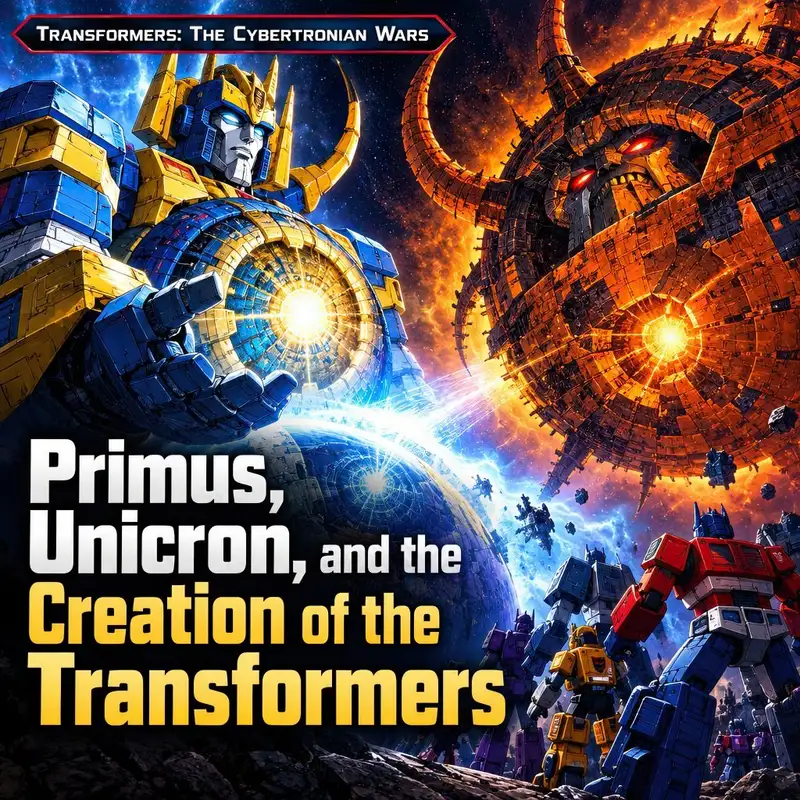
Primus, Unicron, and the Creation of the Transformers [Marvel]
Beneath Cybertron’s battered surface, Grimlock, Jazz, Bumblebee, and the Rescue Patrol found an answer that their war had buried for ages. At the planet’s core waited the Keeper, an ancient guardian who knew why Cybertron existed and why its people could transform. The discovery should have been a strategic windfall. Instead, it became an alarm. The Keeper died. Primus awakened. And the cry of that awakening crossed the void to reach Unicron, the enemy Primus had concealed himself from. In Marvel’s Transformers comics, the search for origins did not bring reassurance. It exposed Cybertron to the threat its creator had spent ages trying to avoid.
This is Marvel comic history, first developed in the British weekly series and then adapted and expanded in the American monthly comic. It is not the creation story told in the Generation One cartoon, where Quintessons claimed a very different role in Cybertronian history. Marvel’s account changed over time, and its early issues do not fit neatly with the later myth. That inconsistency matters. The origin of the Transformers was not a fixed foundation laid down at the beginning. It became a new interpretation of what Cybertronian life meant, and of what the long Autobot-Decepticon war had been distracting them from.
The immediate crisis in “The Primal Scream” was not caused by an enemy fleet crossing known space or by a Decepticon offensive. It came from a buried truth. The expedition into Cybertron’s depths uncovered the Keeper and, through him, Primus. The ancient guardian explained that Cybertron was more than a planet. It was the transformed refuge and dormant body of a being locked in an old struggle with Unicron. But the revelation came with an operational cost. Primus’s awakening was detectable. Cybertron’s location, protected through dormancy and secrecy, was no longer secure.
That is an unusually sharp problem for a creation myth. In many stories, ancient knowledge gives a civilization strength simply because it reveals hidden power. Marvel treats knowledge as more dangerous than that. The Autobots gained intelligence about their own origins, but they also compromised the concealment on which their survival had depended. The source of their identity was also a strategic vulnerability. They had not just found a sacred site. They had opened a channel between Cybertron and an enemy capable of destroying worlds.
The fuller account first arrived in the Marvel United Kingdom story “The Legacy of Unicron!” The British comic had room to develop stories beyond the American series, and this arc gave the franchise one of its most durable ideas. Primus and Unicron were presented as opposing cosmic powers. Primus represented creation and preservation. Unicron represented destruction on a scale that made ordinary conquest seem almost provincial. Their conflict did not begin with the Autobots, the Decepticons, or even Cybertron. Those later factions inherited a struggle already in motion.
The story is often remembered as a clean statement of cosmic history, but it should be handled with some care. The account comes through Unicron, speaking to Death’s Head. That makes it powerful testimony from a participant, not a neutral archive. Unicron has every reason to frame himself and Primus in ways that enhance his own significance. Even so, the narrative establishes a broad framework that later Marvel stories adopt. Two ancient enemies struggled. Neither could easily destroy the other. Their conflict became tied to the physical worlds that would later define them.
In the British version, Primus is associated with the Lords of Light, while Unicron stands as his destructive counterpart. Their battle ends not in a conventional victory but in confinement. Each becomes trapped within an asteroid or planetary prison. This is important because the bodies they inhabit are not mere scenery. The battlefield is transformed into the means of survival. Unicron reshapes his prison into a mobile planetary body, able to travel, consume, and continue his war. A prison becomes a weapon system.
Primus makes a different choice. Rather than simply turning his refuge into a vehicle for his own movement, he transforms it into Cybertron. It becomes a hidden world, a sanctuary, and eventually the home of a new people. Where Unicron turns confinement into predation, Primus turns concealment into creation. That contrast defines much of Marvel’s mythology. Unicron seeks survival through consumption and domination. Primus seeks survival by creating agents who can act where he cannot.
This was the decisive innovation. Primus was not just a godlike ancestor standing at the beginning of a family tree. He was a strategist facing a superior or at least enduring enemy. Cybertronian life was connected to his attempt to continue the war through proxies. The Transformers were not created simply to populate a world. They were meant to be capable of opposing Unicron. Their ability to transform was not just an entertaining feature of their bodies. It marked them as adaptable defenders, able to change form, survive, travel, and fight.
The British story also links Primus to the life-giving power associated with the Creation Matrix. In Marvel, the Matrix is not only a badge of leadership passed from one commander to another. It is bound to the origin and continuation of Cybertronian life. Its power is connected to Primus himself. That connection gives the artifact religious importance, but it also makes it a strategic asset of the highest order. It cannot be treated as ordinary equipment. No factory line can simply replace it if it is lost.
Marvel’s Cybertron, then, is more than a capital world or industrial home planet: it is the transformed existence of Primus. The ground beneath Cybertronian cities is also the body of the being whose hidden struggle shaped their creation. The planet’s energy systems, buried spaces, and sacred depths all acquire a second meaning. A strike against Cybertron is not only an attack on population centers, repair facilities, archives, and infrastructure. It is also an assault on the concealed creator whose body has become the world.
That double identity changes the logic of planetary defense. A conventional government can evacuate personnel from a threatened capital, preserve its fleet, and perhaps continue a war from exile. Cybertron can lose cities and still remain contested, but it cannot easily be abandoned if it is also Primus’s refuge. The defenders are protecting a homeland, a civilization, a strategic base, and a living sacred center at the same time. The value of the terrain cannot be separated from the identity of the people who live upon it.
For ordinary Cybertronians, however, this inheritance raises an uncomfortable question. They did not choose to be born into Primus’s ancient war. The available Marvel evidence supports the idea that Primus created Cybertron and a Transformer race, or an early system that gave life to that race. It does not require the claim that he personally fashioned every individual Cybertronian who came afterward. Whatever the precise process of later population and reproduction, generations of people lived with the consequences of a purpose assigned before they existed.
A people may inherit a strategic mission without consenting to it. That fact does not erase the threat Unicron represents. It does mean that creation itself carries political weight. If the Transformers exist partly as Primus’s defenders, are they obligated to serve him? Can a creator command a civilization? Is reverence the same as political legitimacy? Marvel does not settle those questions by presenting Primus as unquestionably benevolent. His purpose may be protective, but purpose imposed from above is still a form of power.
The myth also does not explain the Autobot-Decepticon war. It tells Marvel readers why Cybertronian life exists in a cosmic sense. It never explains why Cybertronians divided into rival political and military factions, why their institutions failed, or why conflict between them became so destructive. Autobots and Decepticons are not separate species created for opposite roles. They are factions. They share a world, a broad origin, and the burdens of the same inherited history.
That distinction is essential. A common origin does not produce common politics. Nations and movements often invoke shared ancestry when they need unity, yet shared ancestry rarely resolves disputes over authority, inequality, resources, memory, or force. Marvel’s Transformers had a deeper common heritage than most societies could imagine. Their world was literally connected to a single creator. Still, they fought one another. The myth provided identity, but it did not provide a constitutional order, a peace process, or a way to settle factional competition without violence.
There is a grim irony in that. A people created to oppose a universal enemy spent much of its history exhausting itself in civil war. The Autobots and Decepticons developed command structures, armed forces, loyalties, and hardened political identities while the greater danger remained distant. Their war may have had immediate causes that mattered deeply to those who fought it, but the effect was to weaken Cybertron’s ability to respond when Primus’s hidden enemy returned. Civil conflict did not create Unicron. It made the response to him far more difficult.
For that reason, Marvel’s origin myth is more than a grand explanation for where Transformers came from. It is also a criticism of how they used the life they were given. Primus created defenders, but he did not create a unified force that would remain obedient across the ages. Cybertronians developed their own factions and their own political conflicts. They became more than instruments. That independence is morally important, but it also means that survival depends on choices they make under pressure, not just on the intentions of their creator.
The Keeper stands at the center of that tension. He was a guardian of hidden knowledge, preserving Primus’s secret during his long dormancy. In military terms, he functioned as a custodian of a strategic deterrent and as the sole surviving intelligence source for an ancient threat. His task was understandable. If Unicron could not locate Primus, then concealment offered Cybertron protection. Dormancy was not weakness for its own sake. It was a defensive measure designed to deny the enemy a target.
But secrecy concentrated in a single ancient guardian creates its own failure point. The Keeper held knowledge that modern Cybertronians did not possess. When the expedition reached him, the civilization gained access to the truth, but it did so too late and under crisis conditions. There was no broad institution prepared to interpret the information, no visible succession plan for the Keeper’s role, and no established public strategy for the moment when Primus might awaken. The loss of the guardian was also a loss of institutional memory.
The Keeper’s death is therefore more than a dramatic event. It is the collapse of a hidden security system. His testimony cannot be treated as perfect, because he is Primus’s servant and speaks from within that worldview. Yet his death confirms the larger danger. The secret he guarded no longer guards Cybertron. Primus awakens, and the awakening signals Unicron. A defensive posture based on concealment has failed because the protected asset has become active and therefore visible.
The outcome is a familiar strategic dilemma, even in a story about planetary gods. A force can hide a decisive capability, but using it may reveal its location. A state can preserve a secret weapon, but it must eventually decide whether the weapon is more valuable concealed or employed. Primus had hidden himself within Cybertron for ages. Once awakened, he could offer knowledge and power. He could also no longer remain unseen. The advantage of dormancy became the danger of exposure.
Unicron’s detection of Primus transforms the problem from distant mythology into emergency planning. Cybertron can no longer rely on the hope that its ancient enemy remains ignorant of its location. The planet needs a means of defense that is both real and available. That brings the Matrix to the forefront of the American Marvel series. The search later called Matrix Quest is more than a ceremonial journey to recover a symbol of authority: it is an urgent attempt to locate the one asset that may be able to stop Unicron.
The Matrix matters in this continuity because it carries life energy tied to Primus. Its significance is spiritual, historical, and military all at once. But none of those meanings make it easy to use. It has to be found. It has to be secured. It has to be carried by someone capable of reaching the point where its power can matter. Its existence does not spare Cybertron from ordinary strategic problems. An irreplaceable artifact may be powerful, but its very uniqueness creates dependence.
This is the logic of unique-asset warfare. A state can replace some losses through industry, repair, recruitment, or captured supplies. It cannot replace an artifact that exists only once and whose workings are inseparable from its creator. Conventional weapons, however formidable, do not become a substitute simply because the crisis is severe. The Marvel comics do not establish that the Matrix can be reproduced, that a factory can manufacture an equivalent, or that the combined firepower of the Autobots and Decepticons can perform the same function.
The strategic burden therefore falls on access and custody. Where is the Matrix? Who can locate it? Who can transport it? Who can protect it from enemies, accidents, or political misuse? And who can use it when the decisive moment arrives? The Matrix Quest is an expedition, but it is also logistics under existential pressure. The participants are trying to bring a singular capability into a battle before the enemy can bring the battle to Cybertron.
The Matrix also complicates leadership. In other settings, a sacred relic may be kept in reserve while generals direct ordinary forces. In Marvel, the Matrix is too consequential to remain separate from command. It is related to Primus’s life force and becomes the principal means of resisting Unicron. This does not turn its bearer into a mere ceremonial figure. It makes that bearer part of the operational plan. Leadership, mobility, and personal risk become bound together.
That arrangement has obvious vulnerabilities. An army built around a unique artifact can be diverted, deceived, or paralyzed if it loses track of the object. A commander carrying such an asset becomes both an authority figure and a target. The burden of custody can distort every other priority. Yet the alternative is worse. Without the Matrix, Cybertron has no established answer to a threat of Unicron’s scale. The emergency is not solved by discovering the origin story. It is solved, if at all, by acting on its consequences.
When Primus later speaks more directly, he does not do so through an impartial council, a public assembly, or a carefully prepared military command system. He speaks through Emirate Xaaron. Xaaron is already a political figure, a leader with his own standing among Cybertronians. Primus’s use of his body creates a disturbing overlap between personal identity, religious authority, and wartime command. Those listening must determine whether they are hearing Xaaron, Primus, or some unstable mixture of both.
Possession is not a minor detail in this context. If Primus uses Xaaron’s body to issue guidance, then the source of authority becomes unclear. Primus may possess knowledge no ordinary Cybertronian has. He may have a legitimate claim to explain the Unicron threat. But metaphysical knowledge is not the same as consent, and creation is not the same as lawful government. Xaaron’s body becomes a channel for a power that cannot be questioned through ordinary political procedures.
This is one of the sharpest moral edges in Marvel’s account. Primus is fighting for Cybertron’s survival, yet he acts through an individual whose autonomy is compromised. The situation may be desperate, and the threat may be real, but emergency does not make the problem disappear. A society facing annihilation is often tempted to accept any authority that promises survival. Marvel shows how easily a sacred imperative can bypass normal questions about who is empowered to decide, who bears the risk, and who may refuse.
Through Xaaron, Primus offers a fuller explanation of the struggle with Unicron and gathers Autobots and Decepticons on Cybertron. The ancient enemy makes separation between the factions temporarily irrational. Whatever their grievances, whatever their command rivalries, whatever territory or legitimacy they contest, neither side can survive if Unicron consumes their world. Primus names Optimus Prime to lead the combined force. It is a significant moment, but it is not the same as the end of the civil war.
The combined command is a coalition of necessity. It gives Cybertron a chance to concentrate forces against the immediate threat. It does not erase distrust. It never demonstrates that former enemies have accepted the same political program. It never settles questions of justice, representation, security, or the future of Decepticon and Autobot institutions. The coalition solves a tactical and operational problem: it brings divided military resources into a common defense. It does not solve the political problem that created the division.
Such coalitions are often fragile because each participant calculates what will happen after the emergency. A common enemy can suspend rivalry without curing it. Commanders may cooperate while assuming that their partners will become rivals again the moment the danger passes. Soldiers may fight beside one another because there is no alternative, while retaining every grievance that brought them to war. Primus can require unity for survival. He cannot simply manufacture trust from above.
Optimus Prime’s role in this arrangement is therefore more complex than a simple appointment by a creator. He receives operational leadership over a force drawn from factions that have spent a long time fighting each other. His authority rests partly on Primus’s direction, partly on his own standing, and partly on the fact that the crisis leaves little room for competing command. That is enough to organize defense. It is not necessarily enough to establish durable political legitimacy after the battle.
The combined force faces an attacker unlike any normal invasion army. Unicron is not just a powerful commander arriving with superior weapons. He is a world-consuming enemy whose very approach threatens the existence of Cybertron. The comics never provide reliable force totals, fleet inventories, energy calculations, or precise measurements that would allow a neat order of battle. Those missing figures do not weaken the strategic conclusion. Cybertron is defending a single, irreplaceable home against an adversary capable of direct planetary assault.
There is no clear fallback world that can replace Cybertron’s significance. Cybertron contains population, history, infrastructure, and Primus himself. A retreat may preserve some individuals, but it cannot preserve the entire object of defense. This makes the battle fundamentally different from a raid, a territorial dispute, or even a conventional planetary campaign. The defenders are not choosing between holding ground and trading space for time. They are trying to prevent the destruction of the place that makes their civilization possible.
Unicron also represents a form of proxy warfare. In the British material, he attempts to use Galvatron as an agent, though Galvatron’s own will and rivalries complicate that relationship. The point is not that every Marvel Galvatron story follows one identical pattern. It is that Unicron can extend his influence through intermediaries. He does not need to rely only on his own enormous physical form. He can exploit ambitious, damaged, or vulnerable figures within Cybertronian conflicts.
Primus does something similar, though with a different stated purpose. He has the Keeper. He acts through Xaaron. He entrusts the Matrix to Cybertronians who must carry his power into battle. Both cosmic powers depend on others. Neither simply resolves the conflict alone. That dependence makes agency central to the story. The Transformers are created as defenders, but they are not drones. Their choices, loyalties, and failures shape whether Primus’s purpose can be achieved.
When Unicron attacks Cybertron directly, the combined force can resist, but resistance alone does not produce a decisive answer. The enemy’s scale changes the meaning of every defensive action. Firepower may delay, distract, or protect an avenue of approach. It does not by itself destroy an adversary whose body and purpose are planetary in scale. The crisis demands not only force, but an opening. The defenders need a moment in which the Matrix can reach the place where its unique power can be used.
That opening comes in part through Circuit Breaker. She is a human combatant, not a representative of humanity as a whole and not a simple accessory to Cybertronian destiny. Her intervention distracts Unicron at a decisive moment. In military history, major outcomes often turn on actions by participants who were not the principal commanders and who could not have controlled the entire battle. Circuit Breaker does not replace the Cybertronian defense. She changes the local conditions under which its decisive action becomes possible.
Her role matters because it prevents the story from becoming too tidy. Primus supplies the origin and the power associated with the Matrix. Unicron supplies the existential threat. Optimus carries the artifact into danger. But the final opportunity is not arranged by a single perfect plan. It emerges from pressure, improvisation, and intervention by an actor operating from outside the central cosmic struggle. History has a way of refusing to honor the clean hierarchies that myths prefer.
Optimus Prime then enters Unicron with the Matrix. The act is certainly courageous, but courage alone does not explain it. It is a tactical decision shaped by the limits of the available tools. The Matrix cannot do its work from a safe ceremonial distance. Prime must bring it into the enemy’s body. The action converts a strategic asset into a personal mission. The survival of Cybertron depends on a commander accepting a danger that cannot be delegated to an anonymous unit.
The Matrix’s life energy destroys Unicron’s physical form from within. Cybertron survives. But the event should not be reduced to the claim that Primus defeated Unicron through his chosen champion. Primus provided a purpose and a power. Circuit Breaker created a distraction. Prime chose to act and carried the burden of the mission. The coalition held long enough for the opportunity to matter. The victory is not the product of fate operating without people. It is the product of people acting inside conditions shaped by myth.
Nor does the battle establish that every question about Unicron’s survival, recurrence, or identity has ended forever. The destruction of his physical form is decisive for the immediate crisis in issue seventy-five. Later Marvel material and continuations complicate the larger question of what it means for such a being to be destroyed or to return. The important point here is narrower. Cybertron survives the attack because the Matrix is used at the decisive moment. Survival is secured, not explained away.
The victory also does not restore the society that existed before the war. Cybertron has endured civil conflict, institutional division, damaged infrastructure, and the normalization of military identity. The Autobots and Decepticons may cooperate against Unicron, but cooperation under extinction pressure is not the same as reconciliation. A united force can repel an external threat while leaving every internal dispute in place. The end of one battle may be the beginning of a harder argument about who governs, who is forgiven, and what a damaged civilization becomes.
Marvel’s creation myth therefore produces a paradox. It gives Cybertronians a common source, a shared world, and a common enemy. Yet none of those facts automatically create a common politics. Primus’s existence does not answer whether an Autobot command is legitimate. It does not absolve Decepticon violence or settle the grievances that may have drawn followers to them. It does not tell civilians how they should live after armies have made their streets and energy systems part of a permanent battlefield.
A civilization cannot build a stable future solely around artifacts and exceptional individuals. The Matrix can destroy Unicron’s body, but it cannot manufacture trust. Primus can call factions together, but he cannot create a durable settlement simply by declaring a common danger. Optimus can lead a coalition in battle, but military command does not by itself rebuild political institutions. The story’s cosmic scale makes this lesson sharper, not smaller. The more powerful the emergency authority, the more important it becomes to ask what remains after the emergency.
For Cybertronian civilians, the burden is especially severe. They live on a world that is also a weapon, a refuge, and a hidden divine body. Their cities may be places of work, memory, and family, yet they are also strategic terrain in Primus’s war with Unicron. The mythology offers them an exalted origin, but it also risks making their lives subordinate to a conflict they did not initiate. A people can be told that their survival serves a cosmic purpose and still deserve agency over how that purpose is pursued.
Marvel never entirely lets Primus become a simple answer. He is protective, but not politically neutral. He is ancient, but not shown as omniscient in every practical matter. He has immense authority, but authority derived from creation is not the same as consent from the created. His war against Unicron may be necessary, but necessity does not turn every intervention into a model of just governance. The story is stronger because it leaves room for that discomfort.
The same is true of Optimus Prime. His success against Unicron does not mean he is merely carrying out instructions like a machine following code. His decision has meaning because he can choose. The Matrix is powerful, but it does not walk into Unicron on its own. Prime’s action demonstrates the difference between a people created for a purpose and a people reduced to that purpose. He accepts responsibility, but he is not stripped of moral agency by the fact that Primus made the larger conflict possible.
The Primus-Unicron myth places the Autobot-Decepticon war inside a much larger horizon. Their civil conflict is no longer the whole of Cybertronian history. It is a division within a species facing an external danger capable of consuming the world both sides claim to defend. That wider threat does not make Cybertron's politics less important. It makes the consequences of political failure harder to ignore. A people created for a cosmic purpose still need legitimate authority, cooperation, and institutions capable of surviving more than one emergency.
Marvel's creation story therefore works best not as a command to obey destiny, but as a test of what Cybertronians do with the life and power they inherited. Primus gives them a purpose, but not a durable peace. He gives them a world, but not a government capable of protecting it from factional violence. Cybertron survives because individuals improvise, take risks, and cooperate under pressure. The myth makes their politics more consequential by showing that even a civilization created for war must still decide whether it can govern itself well enough to survive one.