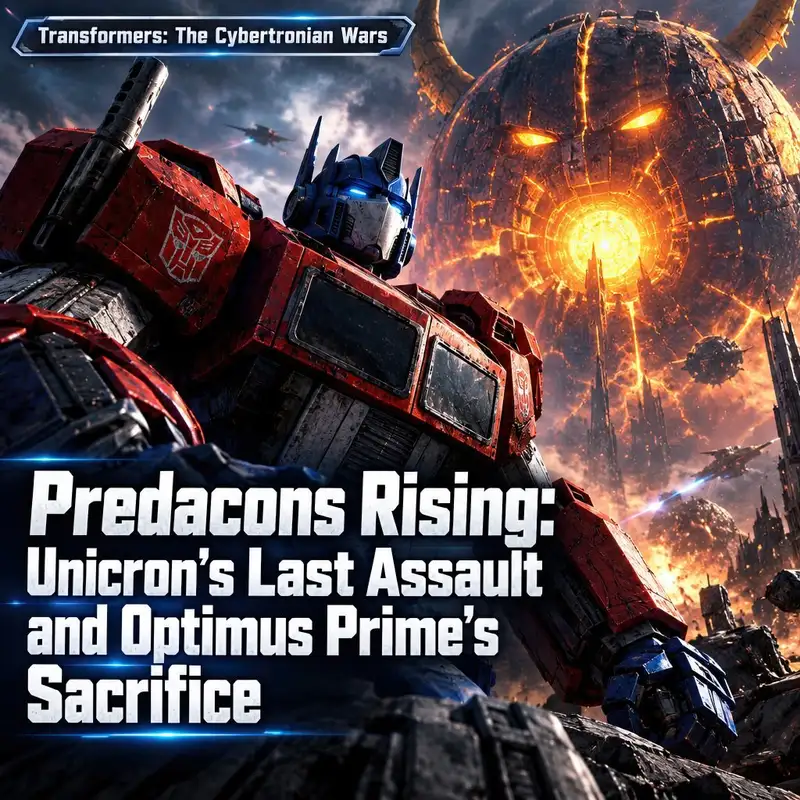
Predacons Rising: Unicron’s Last Assault and Optimus Prime’s Sacrifice
On a restored Cybertron, Optimus Prime promotes Bumblebee from scout to warrior. It is a ceremonial moment, but not a carefree one. The war against Megatron has ended. The planet has been reclaimed. Autobots are returning from Earth, and the survivors can finally speak of rebuilding rather than merely enduring. Optimus also honors the human allies who carried part of that burden, along with Cybertronians lost in the struggle. Yet beneath the ceremony lies the central problem of the new peace. Cybertron is alive enough to celebrate, but not healthy enough to renew itself.
In this Transformers Prime history, the absent AllSpark is more than a lost relic. It is bound to Cybertron’s capacity to generate new life. The planet’s cities, systems, and territory may have been restored after the Omega Lock repaired the physical damage, but a civilization cannot be measured only by repaired structures or military control. It must also be able to sustain a population, pass on a future, and welcome those who have not yet been created. Cybertron has won its territory back. It has not yet recovered its tomorrow.
That distinction shapes everything that follows in Predacons Rising. This is not just an epilogue in which old enemies return for one final battle. It is a story about the dangerous interval after civil war, when the victorious side still has armed opponents, damaged institutions, unfinished grievances, and a population scattered across worlds. The Autobots have defeated Megatron’s regime, but they have not created a settled political order. They are still operating through a wartime command structure, led by a Prime whose authority remains both necessary and unusually personal.
Optimus understands that the tasks of reconstruction cannot be handled by one team standing in one place. Bulkhead is assigned to build a landing platform for returning Autobots. That work may seem modest beside battles with Decepticons and cosmic enemies, but it addresses a real strategic requirement. A returning population needs safe arrival points, routes into cities, facilities for damaged personnel, and some means of reconnecting dispersed communities. Exile ends only when people can physically come home.
Ultra Magnus receives a less peaceful assignment. He is ordered to locate the remaining Decepticon elements, particularly Starscream and Shockwave, while also searching for Predaking. This is the security problem that follows any collapsed regime. Defeating the central command does not erase personnel, weapons, laboratories, ships, intelligence networks, or ambitions. A remnant does not need to be large to be dangerous. It needs concealment, technical expertise, access to resources, and a chance to rebuild before the victors have stabilized their position.
Optimus and Wheeljack take responsibility for the most consequential mission of all. They leave Cybertron to recover the AllSpark from a distant region of space. The division of labor is revealing. Bulkhead works on infrastructure. Ultra Magnus pursues armed remnants. Optimus seeks the means by which Cybertron might create life again. Those are not separate concerns. They are the linked requirements of recovery. People cannot return safely without security. Security cannot endure without functioning infrastructure. And neither victory nor infrastructure can restore a civilization that has lost the ability to renew its own population.
Team Prime is therefore acting less like a conventional field unit and more like an improvised reconstruction command. It has engineers, soldiers, a medic, scouts, and leaders accustomed to survival under pressure. What it does not yet have, at least not on screen, is a fully developed civilian government capable of absorbing every responsibility once carried by military leaders. The war has ended, but demobilization has not. Authority remains concentrated in those who won the conflict, because the conditions for replacing emergency command with durable institutions have not yet been established.
The remaining Decepticons understand that instability creates opportunity. Starscream and Shockwave have survived Megatron’s defeat, and they do not appear to share a single coherent postwar plan. Their partnership is practical. Shockwave possesses scientific knowledge, access to the work of Project Predacon, and the temperament to treat living beings as instruments. Starscream possesses political ambition, survival instincts, and a persistent interest in controlling whatever military assets remain. Together, they hope to recover leverage before the Autobots can turn victory into a stable peace.
Their chosen instrument is Predacon science. Shockwave has created two additional living Predacons, Skylynx and Darksteel, from recovered Predacon remains. The strategic appeal is obvious. A shattered faction with limited manpower cannot easily rebuild a conventional army through recruitment, training, supply, and industrial production. A small number of powerful Predacons offers a shortcut. They are a qualitative force multiplier, capable of changing local balances of power without requiring the Decepticons to restore the institutions they have lost.
But the film does not establish that Starscream and Shockwave have built a complete Predacon army. They have created two new Predacons and hope to use them as the beginning of something larger. That difference matters. The Decepticons are not rebuilding a state. They are attempting to regenerate coercive power before anyone can prevent them. It is a familiar pattern after the fall of a military regime. Scientific projects, hidden weapons, and small elite forces can preserve influence even after formal command has collapsed.
The new Predacons also expose the limits of treating Cybertronian life as military inventory. Skylynx and Darksteel are not drones merely because Shockwave created them for a program. They are living Predacons, and their later choices demonstrate independent will. Shockwave’s project was designed to make them obedient extensions of Decepticon strategy. The result is less controllable. Cybertron’s war has repeatedly shown that a faction can create powerful weapons, but it cannot guarantee that those weapons will remain politically loyal once they understand what has been done to them.
Yet Starscream and Shockwave are not the most dangerous force moving through this unsettled peace. That danger begins on Earth, with Megatron’s body. The Decepticon leader had been defeated, and his body appeared lifeless. In ordinary military terms, that should have been the end of a commander whose rule had defined much of the conflict. Instead, Unicron uses the body as a vessel. He revives and alters it, turning the remains of Megatron into a means of physical action.
This is not a normal return of Megatron, and it should not be confused with another character or another continuity’s version of a transformed Decepticon leader. The body remains Megatron’s body, but the controlling will is Unicron’s. Megatron’s agency is suppressed. His form becomes a weapon through which an older enemy of Cybertron and Primus can act in the material world. The result is disturbing not only because it creates a powerful adversary, but because it turns the defeated leader’s own body into evidence of how complete domination can be.
Unicron’s possession gives the Autobots an immediate intelligence problem. A familiar body appears to have returned, carrying Megatron’s appearance, combat ability, and accumulated symbolic weight. But the question is no longer simply whether Megatron survived. The Autobots must determine who is acting through him, what that force knows, and what it intends to do. A commander who misidentifies the enemy can build the wrong defense. Treating Unicron as merely a revived Megatron would mean misunderstanding both the scale of the threat and the nature of the objective.
Unicron is not trying to restore the Decepticon cause. He is pursuing vengeance against Cybertron and Primus. That distinction transforms the postwar situation. Starscream’s remnant project is dangerous because it could prolong civil conflict. Unicron’s assault threatens the basis on which any Cybertronian society could continue. The security problem is no longer counterinsurgency against surviving Decepticons. It is the defense of the planet itself, and of the life-generating systems that the Autobots are trying to restore.
The first serious blow to Cybertron’s command structure does not come from Unicron directly. Ultra Magnus and Smokescreen encounter Skylynx and Darksteel while carrying out the search for Decepticon remnants. Magnus is badly injured in the fight. The loss is operationally significant. He is not merely another capable warrior. He is the senior Autobot officer assigned to pursue armed holdouts while Optimus is off-world. His incapacitation creates a command gap at precisely the moment when the Autobots can least afford confusion.
Ratchet returns from Earth to treat Magnus. The decision underscores a practical truth that war stories often conceal behind rapid repairs and dramatic recoveries. Even an advanced mechanical civilization depends on specialized medical knowledge, secure facilities, replacement components, and time. Damage severe enough to remove a senior commander from action cannot be solved by determination alone. The Autobots may have regained Cybertron, but their medical and technical capacity remains distributed across worlds. Recovery still depends on people returning from exile and bringing scarce expertise with them.
Bumblebee must take temporary operational responsibility. His promotion at the opening ceremony now acquires a different meaning. It was not just recognition for a loyal scout who had survived the war. It was an acknowledgment that Bumblebee had become capable of larger responsibility. Still, temporary command is not the same thing as succession. Bumblebee is not declared the next Prime, nor is he presented as a formal replacement for Optimus or Ultra Magnus. He is asked to coordinate a team during a crisis because the people above him in the chain of command are absent or wounded.
Bumblebee’s immediate task is complicated by the question of Predaking. The Autobots need to find him, partly because he is a powerful independent actor and partly because his intentions are uncertain. Predaking has reason to distrust the Decepticons, who treated his species as a military experiment. But he also has reason to resent the Autobots. In the previous conflict, the Autobots destroyed the Predacon remains that might have allowed his people to return in greater numbers. From Predaking’s perspective, neither side has earned the right to demand his loyalty.
When Bumblebee, Arcee, Bulkhead, and Smokescreen seek his support, Predaking refuses. His refusal is not simple hostility. It is a political judgment shaped by loss. The Autobots have defeated Megatron, but they cannot expect every survivor harmed during the war to accept their authority merely because the old regime has fallen. Predaking is not an Autobot recruit waiting for a badge. Nor is he an automatic Decepticon subordinate. He represents a living people whose future was treated by both wartime sides as a strategic question.
The distinction between living Predacons and the forces Unicron will later create is essential. Predaking, Skylynx, and Darksteel have grievances, loyalties, and the ability to make choices. Their cooperation with the Autobots, when it comes, is tactical and conditional. It does not erase the history of Project Predacon, the destruction of their brethren, or the question of where they belong in the restored Cybertronian order. A battlefield alliance may be necessary. It is not the same as reconciliation, citizenship, amnesty, or trust.
While this political problem develops on Cybertron, Optimus and Wheeljack reach the Theta Scorpii region in search of the AllSpark. The object is held in a vessel said to have been forged by Alpha Trion, built to endure the dangerous conditions surrounding it. Even in a setting of ancient technology and cosmic artifacts, the recovery mission remains a mission of access and custody. The AllSpark must be located, retrieved, protected, and returned. None of those steps are automatic simply because Optimus knows it is important.
The mission also demonstrates the limits of mobility. Optimus and Wheeljack can travel far from Cybertron, but distance still matters. Their ship suffers damage, and communication with Cybertron becomes disrupted. That disruption creates uncertainty on both ends. The Autobots on Cybertron do not have a complete picture of Optimus’s progress. Optimus does not have immediate access to the changing threat around the Well of AllSparks. A civilization may possess advanced space travel and still face the old military problem of commanders operating with incomplete information.
Recovering the AllSpark is not the same as restoring Cybertron. At first, it appears to be an artifact-retrieval operation. Bring back the vessel, return it to the planet, and the life-generating crisis can be resolved. But the mission’s meaning changes when the AllSpark merges with the Matrix of Leadership inside Optimus. The combined condition turns a question of transport into a question of identity, authority, and sacrifice. The artifact cannot simply be handed over like a captured weapon or stored like a strategic reserve.
Unicron, meanwhile, gains information by force. He confronts Predaking and overpowers him. Through that encounter, he learns of the Predacon graveyard, where the remains of dead Predacons lie. The intelligence failure is not primarily a matter of poor encryption or a careless report. It is embodied knowledge extracted through domination. Predaking carries the memory of his lost people, and Unicron turns that memory into a route toward military power. In war, information is often most vulnerable when it exists inside someone who can be captured, coerced, or broken.
At the graveyard, Unicron converts the casualties of one war into the manpower of another. He reanimates the Predacon remains as Terrorcons. The result is visually and morally different from the survival of living Predacons. These are not restored citizens. They are not a reborn Predacon population capable of choosing its future. They are dead bodies animated through Unicron’s power, directed as an expendable army toward Cybertron’s core.
For Unicron, the Terrorcons solve problems that would cripple a conventional force. He does not need to recruit them, persuade them, train them, or build a political coalition among them. He does not need to address their grievances or sustain their loyalty. They are force generation without consent. The film does not provide numbers, and it does not need to. The operational point is clear. Unicron has created a mass of attackers whose effectiveness comes from his ability to animate and control the dead, not from any functioning military institution.
That advantage also reveals a deep cruelty. Predaking’s people have already been denied a normal future by the destruction of their remains and the violence surrounding Project Predacon. Now their dead are denied rest as well. Unicron turns them into weapons against the world they might have inhabited. For Predaking, the threat is therefore personal in a way it cannot be for the Autobots alone. The Terrorcons are not merely enemy troops. They are the desecrated bodies of a people whose survival has already been placed in doubt.
This changes the terms on which Predaking can refuse cooperation. His distrust of the Autobots does not disappear, and the film does not ask the audience to forget it. But Unicron’s actions create a threat that no living faction can ignore. Predaking, Skylynx, and Darksteel eventually fight beside the Autobots because the alternative is to allow their dead to be used in the destruction of Cybertron. It is an alliance born from necessity, not from political settlement.
Starscream, in particular, remains focused on survival and advantage. He attempts to seize the Nemesis and escape with the resources still available to him. That effort captures the condition of the postwar Decepticon movement. With Megatron gone, there is no stable central authority capable of directing all remaining personnel. The faction fragments into individual calculations. Some seek safety. Some seek power. Some defect. Some continue experiments. Some attempt to preserve military assets for whatever conflict comes next.
The Nemesis becomes the focal point of these competing aims because it is more than a ship. It is a mobile command platform, transport, intelligence node, and source of firepower. In a dispersed conflict, possession of such an asset can mean the difference between being a fugitive and being able to move personnel, equipment, and information across a threatened world. Starscream sees it as a means of escape and future leverage. The Autobots need it as a defensive resource. Neither side treats it as a mere vehicle.
Yet the Nemesis cannot solve the Unicron problem by itself. A warship can delay attackers, move allies, and provide a platform for coordination. It cannot replace the political and biological stakes concentrated at the Well of AllSparks. Nor can it guarantee security when its own command is contested from within. The postwar struggle is full of such limits. Valuable assets matter, but possession is not the same as control, and control is not the same as a strategy for survival.
The battle shifts toward the Well of AllSparks, the route to Cybertron’s core. At the Well, tactical defense and generational survival converge. If Unicron’s Terrorcons break through, the immediate loss would be military. The deeper loss would be civilizational. Cybertron’s ability to recover the AllSpark and renew life depends on preserving access to the planet’s inner systems. The Well is not just another battlefield location. It is the point at which the future of the population becomes vulnerable to the outcome of a defensive action.
The Autobots, living Predacons, and the Nemesis attempt to delay the Terrorcon advance. Their coalition works because each participant brings something the others lack. The Autobots provide organization, knowledge of Cybertron, and the determination to defend the restored world. The living Predacons provide exceptional combat capability and personal stakes in stopping the desecration of their dead. The Nemesis offers mobility and weapons. But a coalition assembled under emergency conditions remains fragile. Shared danger creates cooperation. It does not erase different memories of the war.
The Nemesis is eventually brought down, and Starscream escapes amid the chaos. His escape is strategically frustrating but politically unsurprising. The defense of Cybertron cannot afford to make the pursuit of every remnant its primary mission while Unicron threatens the Well. This is one of the hard choices of war. A commander may know that an enemy survivor remains dangerous and still be unable to pursue him without weakening the defense against the more immediate threat. Starscream’s unresolved fate is part of the cost of fighting on several levels at once.
Predaking, Skylynx, and Darksteel fight alongside the Autobots. Their participation should not be read as a change of faction identity. They do not become Autobots simply because they share a battlefield or attack a common enemy. What changes is the operational calculation. Unicron has made the survival of living Predacons, the dignity of their dead, and the defense of Cybertron temporarily inseparable. The alliance is real, but it is narrow. It is built around stopping a particular threat, not around a completed vision of postwar society.
Civilians remain largely out of sight during this defense, but they are not absent from its meaning. The Well matters because it concerns lives not yet created. A population recovering from long war depends on more than survivors and returning soldiers. It depends on whether there will be future workers, families, thinkers, medics, builders, and citizens. The film’s civilian consequence is generational rather than intimate. It asks the audience to see the defense of the Well not only as the protection of a sacred site, but as the protection of a future public.
The battlefield delay creates time for Optimus to confront Unicron. By then, the AllSpark’s recovery has become more complicated than anyone expected. Unicron appears to seize the vessel containing it, believing that possession will give him the power he seeks. But the container no longer holds the AllSpark in a separate form. Its energy has merged with the Matrix of Leadership within Optimus. The object Unicron takes is not the prize he believes it to be.
Instead, the vessel becomes the means of containing Unicron’s energy. The immediate threat is neutralized. The Terrorcons collapse when Unicron’s control over them ends. This is containment, not a conclusive demonstration that Unicron has been permanently destroyed. The film resolves the assault on Cybertron, but it does not establish that a being of Unicron’s nature can never threaten the world again. What has been achieved is more limited and more important in the moment. The force directing the Terrorcons is removed from the field, and Cybertron survives the attack.
Megatron is freed when Unicron’s hold over his body ends. His response is one of the film’s most significant political moments. He tells Starscream that being controlled by Unicron has taught him the meaning of oppression. He declares the Decepticon cause finished and leaves Cybertron. That statement ends his role as the commanding figure of the Decepticon movement. It does not erase the suffering caused under his leadership, provide legal absolution, or prove that he has become a trustworthy ally.
Megatron’s departure should be understood as abandonment, not redemption completed in a single scene. He has experienced what it means to become a body without agency, a weapon used by another will. That experience gives him a perspective he had denied to many others. But moral recognition is not the same thing as repair. The film does not show him facing those he harmed, rebuilding the institutions he destroyed, or offering a political program for peace. It shows only that he rejects continuing as the leader of the Decepticons.
That is still a major change. The old Decepticon command structure had depended heavily on Megatron’s personal authority. Even when Starscream challenged him, Shockwave pursued separate projects, or other officers acted independently, Megatron remained the central figure around whom the movement organized force. His decision to leave removes that focal point. It does not make every remnant harmless, but it does make the restoration of a unified Decepticon regime less likely in the immediate aftermath.
With Unicron contained and Megatron gone, the story might appear ready to end in victory. But Cybertron’s fundamental problem remains. The AllSpark is no longer absent in the ordinary sense. It has been recovered. Yet it is merged with the Matrix inside Optimus Prime. The very success of the mission has created a condition in which the artifact necessary for Cybertron’s renewal is inseparable from the individual who carries the authority of the old order.
Optimus explains that the AllSpark and Matrix have become one within him. He cannot simply extract the AllSpark, hand it to another custodian, and continue as before. To restore Cybertron’s life-generating function, he must enter the Well of AllSparks and join with Primus. The choice is not presented as a ritual demanded for its own sake. It is a consequence of the merged artifacts and of the planet’s continuing inability to create new life.
Optimus’s decision resolves the immediate artifact problem. The AllSpark has been secured, but it must be returned to the system that can make use of it. More broadly, the choice restores Cybertron’s demographic future. A society that cannot create new sparks is living on borrowed time, no matter how many cities it repairs or enemies it defeats. The sacrifice therefore addresses a threat deeper than the latest attack. It addresses whether Cybertron can become a living civilization again rather than a collection of survivors managing decline.
The political meaning is equally important. Optimus has long been the indispensable center of Team Prime. His authority combines battlefield command, moral credibility, and custody of the Matrix. That combination has helped the Autobots survive. It has also created a danger familiar to any movement organized around an exceptional leader. The more a society depends on one figure to make every decisive choice, the harder it becomes to imagine a future in which institutions, not personal sacrifice, carry the burden of survival.
By entering the Well, Optimus gives up more than physical existence as an individual commander. He gives up the Matrix as the personal symbol of his leadership. The act does not prove that leadership itself is unnecessary. Bumblebee’s temporary command has already shown the need for competent people to make decisions when the senior leader is absent. Rather, Optimus’s sacrifice argues that Cybertron’s future cannot remain permanently tied to a single artifact bearer, however wise or honorable that individual may be.
Optimus’s sacrifice does not complete the peace, and that incompleteness is the point. Optimus can restore the capacity for life, but he cannot personally live every future life Cybertron will create. He can stop Unicron’s assault, but he cannot settle every grievance left by the civil war. He can prevent the AllSpark from remaining trapped within himself, but he cannot guarantee that the generations who follow will use their renewed world wisely. The sacrifice creates the conditions for rebuilding. It does not perform the rebuilding for everyone else.
For Bumblebee, the moment confirms that promotion was not merely ceremonial. He has already carried temporary operational authority during crisis. Now he and the rest of Team Prime must bear a more enduring responsibility. Arcee, Bulkhead, Smokescreen, Wheeljack, Ratchet, and Knock Out each represent different parts of a society still learning how to live after war. They have soldiers, engineers, medical specialists, former enemies, and allies whose loyalties remain conditional. Their challenge is no longer just to defeat an enemy. It is to create a peace that does not require Optimus Prime to return every time it falters.
The Predacons remain part of that challenge. Their battlefield cooperation does not settle their political future. Skylynx and Darksteel were created through Decepticon experimentation. Predaking has lost too much to accept simple assurances. Any genuine reconstruction of Cybertron would have to account for them as living beings with interests of their own, not as weapons to be assigned to whichever faction currently claims victory. The same principle applies to former Decepticons. Knock Out’s defection suggests that a postwar order must make room for individual change without pretending that all responsibility has vanished.
Optimus enters the Well of AllSparks and becomes one with Primus. Cybertron’s ability to generate new life is restored. The ending is solemn because it is not a conventional triumph. No enemy army is simply defeated by superior firepower. No political problem is solved by a speech. Instead, the planet gains the possibility of renewal because its greatest wartime leader accepts that he cannot remain both the custodian of the old order and the gateway to the new one.
Predacons Rising therefore treats Optimus Prime’s sacrifice as a reconstruction strategy as much as an act of courage. The civil war’s end had restored territory. Unicron’s defeat had preserved the planet from immediate destruction. But only the return of the merged AllSpark and Matrix to Cybertron’s core could restore the future in its fullest sense: the capacity for new lives, new communities, and a society no longer defined only by those who survived the war.
The burden left to Cybertron is difficult precisely because Optimus has made it possible. The surviving Autobots must build institutions strong enough to function without a single irreplaceable leader. The Predacons must decide whether cooperation can become something more durable than necessity. Former Decepticons must confront the collapse of the cause that once gave them identity. And civilians, returning exiles, and future generations must inherit a world whose renewal has been purchased at extraordinary cost. Cybertron is restored not when one Prime saves it again, but when its people learn to carry the future together.