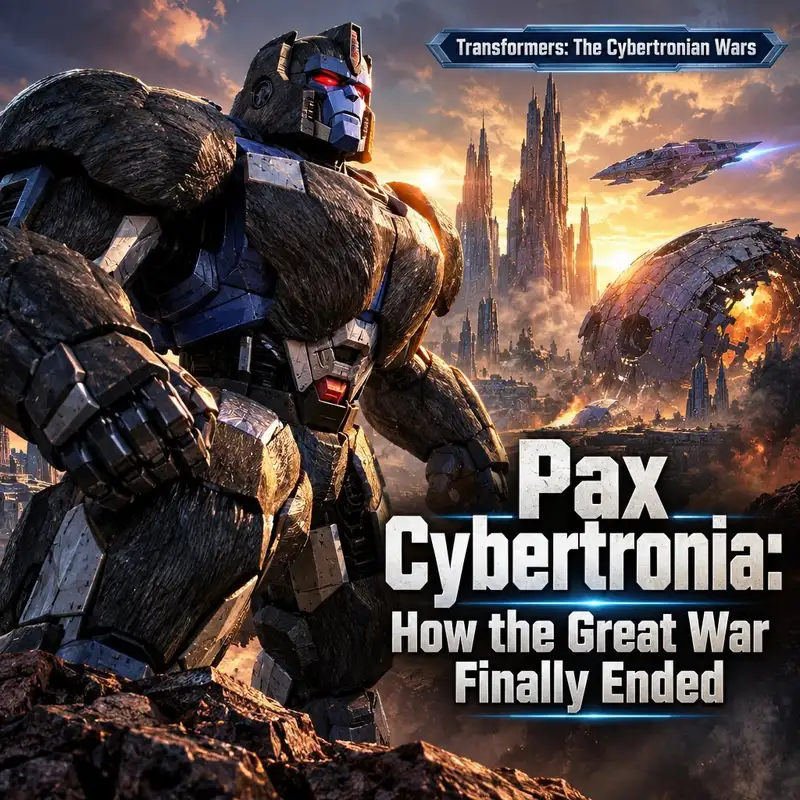
Pax Cybertronia: How the Great War Finally Ended
Ravage arrives with the manner of an officer executing a lawful warrant. He names the Pax Cybertronia, invokes the authority of the Predacon Alliance, and places Megatron under arrest. On its face, the moment is almost reassuring. The ancient Autobot-Decepticon war is over. Its successors possess recognized institutions, legal procedures, and agents empowered to restrain a rogue commander. Even a former Decepticon can operate inside the postwar system.
Then the scene becomes less reassuring. Ravage is more than a police officer from a settled society. He is part of a covert Predacon operation. The leaders behind him are not at open war with the Maximals, but neither are they reconciled to Maximal authority. They are managing risk, concealing intentions, and preparing for possibilities that the official peace is meant to prevent. The treaty exists. So does the conflict that survived beneath it.
That is the central difficulty of Pax Cybertronia. In the Beast Wars animated continuity, it is the name of the settlement that ended the Great War between the Autobots and Decepticons. Yet the series does not show its signing. It provides no full treaty text, identify every negotiator, or reconstruct the final campaign that forced the defeated side to accept peace. What it gives us instead is more revealing in some ways. It shows the treaty still governing political life centuries later, at the moment its limits become impossible to ignore.
Pax Cybertronia ended a war so old and destructive that later generations remembered it mostly through inherited loyalties, fragments of history, and the political order it left behind. The Maximals descended from the victorious Autobots. The Predacons descended from the defeated Decepticons. Those names describe successor populations and political identities, not separate biological species that happened to inherit an old quarrel. The war changed institutions, technologies, and public assumptions, but it did not erase the memory of who had won and who had lost.
The Great War in this continuity should remain broad. Beast Wars speaks of an immense ancestral conflict, one that extended far beyond a single city, battlefield, or planet. It was more than a local dispute between a few familiar commanders. It became the defining catastrophe from which the later Maximal and Predacon age emerged. But the television record does not give us a complete military history of that conflict. It does not establish every front, every campaign, or the exact means by which the Decepticons were defeated.
That limitation matters. It prevents us from treating Pax Cybertronia as the tidy final chapter of a fully documented war. The settlement is better understood as an aftermath. It is the structure built after one side lost the ability to continue open conflict on acceptable terms. In civil wars, that can be enough to stop armies from fighting. It is not always enough to create a shared understanding of justice, legitimacy, or national belonging.
The Beast Wars pilot establishes that Maximals and Predacons had lived in peace for centuries before the Beast Wars Megatron began his rebellion. That is a substantial achievement. Centuries without open war suggest more than a pause between campaigns. They suggest that the postwar order had institutions, habits, and enough authority to make renewed conflict difficult, dangerous, and politically abnormal. A faction could still dream of conquest, but it could not simply mobilize a planetary war machine and expect the rest of society to accept it.
The exact length of that peace is less certain than it is often made to sound. Licensed expanded material has described an interval of roughly three hundred years and has offered more detailed ideas about a postwar peace code. Those materials are useful context for how the setting was later developed. They are not a substitute for what the animated series actually establishes. The screen record is clear on the important point: the peace lasted a long time. It is not clear on every constitutional mechanism that sustained it.
That distinction is more than a technicality. It changes how we judge the settlement. We cannot claim to know the treaty’s borders, reparations, force limits, disarmament provisions, or political guarantees because the series does not show them. We can say that Pax Cybertronia had enough recognized authority for Ravage to invoke it during an arrest. We can say that it supported a political order in which Maximals held effective power and Predacons continued to exist as a distinct public identity.
Peace, in other words, did not mean political neutrality. The Maximals were the normal custodians of Cybertronian order. Their institutions had inherited the legitimacy of victory. The Predacons were not erased, but they operated within a world shaped by Decepticon defeat. That is the strongest conclusion supported by the series. It does not prove that every Maximal lived comfortably, that every Predacon suffered exclusion, or that all postwar policy was designed as punishment. It does show an unequal political inheritance.
The phrase victor’s peace is useful here, provided it is used carefully. A victor’s peace is not necessarily a treaty imposed at literal gunpoint, and it is not automatically unjust in every respect. It is a settlement in which the winning side controls the institutions that define security, legality, public memory, and acceptable political action. Pax Cybertronia appears to have had that character. The Maximals did more than survive the Great War. They became the authority against which later Predacon conduct was measured.
That arrangement could produce real stability. The victorious side had an interest in preventing the return of open warfare. Former enemies had an incentive to accept a legal order rather than face renewed devastation. Communities that had endured a long conflict may have preferred even an unequal peace to another generation of mobilization, destruction, and loss. A settlement does not have to satisfy everyone to stop a war. It has to make the alternatives appear worse.
But stability is not reconciliation. Reconciliation requires more than the defeated side accepting the winner’s institutions. It requires some workable answer to the question of political dignity. Can former enemies participate in public life without renouncing their memory of defeat? Can they retain identity without retaining an ambition to reverse the war? Can the victorious side protect itself without treating every descendant of the defeated faction as a permanent security risk? Pax Cybertronia seems to have answered some of those questions, but not all of them.
The existence of Predacon institutions is significant. The Predacons are not presented as scattered remnants hiding in ruins. They have an alliance, senior leadership, agents, and political interests. They are part of the postwar order, even if they do not dominate it. That suggests the peace allowed some degree of organized Predacon public life. The alternative would have been permanent extermination, endless insurgency, or a purely underground movement. The series gives us a more complicated arrangement.
At the same time, the political structure shown in Beast Wars suggests that Predacon identity carried a burden Maximal identity did not. Maximals represented continuity, legality, and the settled outcome of the Great War. Predacons inherited the history of the defeated Decepticons. Any Predacon ambition for greater influence could be interpreted, fairly or unfairly, through the memory of Decepticon conquest. That kind of inherited suspicion can be difficult to escape, especially when some political leaders continue to think in terms of eventual reversal.
Licensed expanded setting material goes further, portraying Maximal dominance and Predacon restriction in greater detail. It is reasonable to treat that material as supplementary evidence of the broader political idea behind the Beast Era. But the basic problem exists even without a detailed list of restrictions. A peace built around the security of the victors will tend to limit the strategic freedom of the defeated side. Those limits may be necessary. They may also become the source of lasting resentment.
For ordinary Cybertronians, the consequences would have depended on status, location, occupation, and factional history. The animated series does not give us enough direct civilian evidence to describe daily Maximal or Predacon life in detail. We should not invent neighborhoods of permanent poverty, universal persecution, or uniform privilege. What can be said is simpler. Political inequality affects more than officeholding. It affects access to security institutions, public trust, historical legitimacy, and the confidence that one’s community will be heard before it is treated as a threat.
That is why Ravage matters so much. He is not just an old character returning for a dramatic appearance. He is evidence of how Pax Cybertronia handled the defeated side. Ravage had been a Decepticon in the ancient war. By the time of Beast Wars, he had received amnesty and was operating as a Predacon agent. The exact process by which he was remade into his later form is less important than the political fact of his continued service.
Amnesty is one of the hardest tools available to a postwar government. Without it, peace may become impossible. A defeated faction cannot easily surrender if surrender means that every veteran, intelligence officer, technician, and former official faces destruction or permanent exclusion. At the same time, granting amnesty creates anxiety among the victors. Former enemies may retain skills, relationships, ideological commitments, and knowledge of old networks. They may also retain legitimate grievances about how the war ended.
Ravage embodies that tension. He is useful precisely because he carries experience from the earlier conflict. He understands the language, memories, and instincts of the Decepticon past. He can operate in dangerous political territory because he belongs to that history without being entirely outside the new order. Yet that same background makes him a reminder that reintegration does not erase identity. A former combatant may accept amnesty without forgetting what was lost.
The postwar state, whether Maximal or Predacon in its immediate administration, would have faced a familiar problem. It needed people like Ravage. A society cannot always rebuild after a long war by discarding everyone who served the losing side. It needs technicians, officers, intelligence specialists, administrators, and workers who know how damaged systems function. But using them creates a permanent argument about loyalty. Are they citizens? Are they probationers? Are they necessary experts? Are they latent enemies?
The series never establishes that Ravage was constantly watched, coerced, or universally distrusted. It would be wrong to claim that. What it does establish is that he remains tied to a world of classified missions and political suspicion. His role is not that of a peaceful civilian enjoying a settled reconciliation. He is an operative sent into a crisis created by another Predacon. That is a narrow but revealing form of reintegration. The old war’s personnel have been incorporated, but the old war’s methods remain useful.
Ravage’s arrest of Megatron therefore contains an irony. It looks like the treaty enforcing itself. A former Decepticon, acting under Predacon authority, invokes Pax Cybertronia against a Predacon renegade. The postwar order appears strong enough to discipline its own dissidents. But the operation also reveals the fragility behind that strength. Ravage is acting in a contest shaped by hidden agendas, competing loyalties, and long-term political calculation. The peace has not removed clandestine power. It has made clandestine power more important.
Behind Ravage stands the Predacon Alliance and its senior leadership, the Tripredacus Council. The council is not the same thing as every Predacon, and it is not identical to Megatron’s expeditionary force. This distinction is crucial. Too often, the Beast Wars conflict is reduced to a simple Maximal-Predacon binary, as though every member of each side shared one policy and one objective. The Council demonstrates that the Predacons had internal politics, rival strategies, and institutional concerns.
The Tripredacus Council behaves less like a field headquarters and more like a political and intelligence authority. Its members worry about exposure, diplomatic consequences, and the danger posed by Megatron’s independent actions. Their problem goes beyond his disobedience. His rebellion threatens to force the entire Predacon political movement into a confrontation before its leaders are ready, and perhaps before they can deny responsibility for what happens.
That concern tells us something important about Pax Cybertronia. The treaty had created a system in which open aggression carried costs. A Predacon leadership body could not simply announce that it intended to restart the Great War. Such a declaration would place it in direct opposition to Maximal authority and expose it to retaliation. It might also alienate Predacons who had adapted to the peace or who did not share Megatron’s appetite for catastrophic risk.
The Council’s response is therefore indirect. It uses compartmentalization. It dispatches a capable operative. It attempts to contain a liability without making every political purpose public. This is the behavior of an institution operating under strategic constraint. It cannot move openly, so it moves through deniable channels. It cannot admit every ambition, so it preserves uncertainty. It cannot fully trust a renegade, but it may still hope to exploit the opportunities he creates.
None of this proves that every Predacon was secretly preparing rebellion. It proves something more precise. A portion of Predacon leadership believed that the peace should be managed as a temporary strategic condition rather than embraced as a final moral settlement. That is a major difference. A society can endure political opposition. It has much more difficulty enduring institutions that publicly recognize the existing order while privately preparing to overturn it when conditions improve.
In historical terms, Pax Cybertronia begins to resemble a long period of constrained rivalry. The phrase cold war is not an in-universe label, and it should not be forced too far. There is no reason to assume that Cybertronian politics mirrored any single human conflict. But the analogy helps explain the structure. Open mass warfare had become unacceptable. Competition continued through intelligence work, strategic technology, covert action, historical narrative, and preparation for a future crisis.
In the immediate fight, covert operations allowed small groups to act without mobilizing armies. A specialist agent could pursue a rogue commander, steal data, sabotage a system, or recover a dangerous artifact while preserving the appearance of normal peace. Across the campaign, secrecy reduced the need for public logistics, visible force concentrations, and formal declarations. A mission could be disavowed if it failed, or quietly exploited if it succeeded.
For the wider war, deniability was a form of political protection. The Predacon Alliance could maintain its place within the treaty order while ensuring that some options remained available beyond it. That did not make the arrangement stable in a deeper sense. It made it manageable. The difference matters. A stable peace rests on trust, legitimacy, and durable institutions. A manageable rivalry rests on restraint, fear of consequences, and the hope that one side can gain advantage without provoking disaster.
The danger of that system went beyond the possibility of open war. It was that secrecy rewarded the most reckless actors. A cautious leadership must calculate risk, maintain deniability, and preserve a future bargaining position. A rogue can ignore all of that. He can gamble that a single spectacular action will overturn the system before anyone else can respond. The more dissatisfied he is with gradual political change, the more attractive such a gamble becomes.
That is the position occupied by the Beast Wars Megatron. He must be distinguished from the original Decepticon leader whose legacy shaped the ancient war. This Megatron is a later Predacon. He inherits a political memory of Decepticon defeat, but he is more than reenacting another individual’s biography. His rebellion is rooted in the postwar world of Pax Cybertronia, where Predacon grievance exists beside Predacon institutions and where the open restoration of conquest remains politically dangerous.
In the pilot, Megatron presents himself as the heir to an unfinished cause. He implies that Predacons have not abandoned the ambition to overthrow Maximal dominance. Yet his conduct quickly reveals that this is not a collective political program in any ordinary sense. He steals advanced mobility, leads a small force outside recognized authority, and pursues a plan that risks consequences far beyond his own followers. He speaks in the language of restoration, but he acts as a personal warlord.
That distinction should not be lost. A settlement can favor the victors and still leave real resentment among the defeated. The existence of resentment does not prove that a particular rebel is a trustworthy representative of everyone who shares it. Megatron turns inherited defeat into an argument for temporal assassination and personal rule. His project goes beyond trying to improve Predacon political standing. It is to rewrite history so completely that the foundations of the existing order disappear.
The difference becomes clear when he reaches prehistoric Earth and discovers the dormant Ark. The Ark contains the original Autobot and Decepticon warriors from the ancient conflict, including the original Optimus Prime. To Megatron, this is not an archaeological discovery. It is an operational target. If he can destroy the Autobots before they awaken and alter the course of the Great War, then the Maximal future may never exist.
This is political revisionism carried to its most extreme form. Rather than contesting the legitimacy of the postwar order through institutions, alliances, or public argument, Megatron seeks to eliminate the history that produced it. The appeal is obvious to someone who sees defeat as an intolerable injustice. If the past itself is the source of Maximal authority, then changing the past appears to offer a shortcut around every present constraint.
But it is also a confession of weakness. A movement confident in its ability to persuade, organize, and govern does not need to murder its ancestors in their sleep to gain political dignity. Megatron’s plan requires the destruction of people who cannot defend themselves and the erasure of a future populated by beings who had no role in the original war. It is not liberation from the settlement. It is domination through historical annihilation.
His own language makes the personal ambition clearer. Megatron does more than seek a Predacon future. He seeks a future in which he stands at the center of power. The old Decepticon cause becomes a source of legitimacy for his own command. That is a familiar pattern in revolutionary politics. A leader invokes a real injury, identifies himself with a dispossessed community, and then treats opposition to his personal authority as opposition to the cause itself.
The Maximals’ response also reveals a structural weakness in Pax Cybertronia. Their knowledge of the Ark and the ancient conflict is incomplete. To them, parts of the Great War have become legend. They know enough to recognize that the past matters. They do not possess complete control over its records, locations, or vulnerabilities. Megatron, by contrast, has made historical knowledge into a weapon. He understands that the Ark is more than a relic. It is a pressure point in the legitimacy of the entire postwar era.
Historical memory has military value. It identifies old infrastructure, dormant weapons, forgotten routes, buried archives, and unresolved loyalties. It can also shape political identity. A population that remembers only a simplified version of the past may be vulnerable to anyone who claims access to the hidden truth. That does not mean the Maximals deliberately erased history. The available evidence supports uncertainty and loss, not a proven conspiracy of suppression.
Long wars are difficult to remember honestly. Their records are damaged, classified, mythologized, or absorbed into factional stories. Victors may emphasize liberation and survival. Defeated communities may emphasize betrayal and humiliation. Later generations may inherit symbols without understanding the conditions that produced them. Pax Cybertronia appears to have created enough distance from the Great War for normal life to continue, but that distance also left the past open to manipulation.
Megatron exploits precisely that gap. He does not need every Predacon to agree with his interpretation of history. He needs a target, a theory of causation, and enough followers to act before his opponents understand the danger. The dormant Ark offers all three. It condenses the old war into a single vulnerable site. If he can strike it, he can turn historical uncertainty into a decisive operational act.
The plan is extraordinary, but its practical limits are ordinary. Megatron’s force has advanced mobility through transwarp technology, allowing it to cross distances and pursue objectives that would otherwise be beyond the reach of a small renegade expedition. In strategic terms, transwarp is a force multiplier. It allows a commander with limited political backing to bypass normal geography, avoid conventional force balances, and appear where larger institutions are not prepared to respond.
Yet mobility is not sustainment. A ship capable of extraordinary travel still requires energy, repairs, functioning systems, and a viable route home. During the struggle around the Ark, energon becomes strategically important because Megatron’s force cannot simply depart whenever it wishes. Its ship is depleted. Its options are narrowed by fuel and recovery. The campaign’s grand historical objective is therefore tied to a basic logistical problem: a force far from secure support cannot survive on audacity alone.
This is one of the most useful military lessons in the Beast Wars story. Advanced technology can change the scale of a raid. It can allow a small force to threaten a much larger political order. It does not automatically create the means to hold territory, replace losses, repair damaged personnel, or govern a population after victory. A transwarp-capable expedition can begin a crisis. It cannot by itself build a durable state.
Megatron’s strategy has another weakness. It depends on secrecy so completely that success and survival become difficult to separate. If he returns openly to Cybertron, he faces the political consequences of acting outside Predacon authority. If he fails, the Council can distance itself from him. If he succeeds too visibly, he may trigger exactly the Maximal response that the long period of restraint was designed to avoid. His operational daring is therefore inseparable from political isolation.
The same is true of the Tripredacus Council. Its covert activity may preserve options, but it also prevents open accountability. Leaders who cannot state their aims publicly cannot easily build broad legitimacy for them. They must rely on specialists, compartmentalized knowledge, and agents whose loyalty may be uncertain. Ravage’s mission demonstrates the value of such methods, but it also demonstrates their danger. A clandestine apparatus can contain a rogue only if the rogue remains more vulnerable than the apparatus itself.
Pax Cybertronia had nonetheless accomplished something substantial before Megatron’s rebellion. It had halted open Maximal-Predacon war for centuries. It had created legal authority recognizable across factional lines. It had allowed successor identities to exist rather than demanding immediate biological or cultural assimilation. It had incorporated at least some former Decepticons through amnesty. It had made renewed conventional conquest difficult enough that even ambitious Predacon leaders preferred preparation and secrecy to open mobilization.
Later events in Beast Machines belong to a more distant stage of this continuity and should not be used to overwrite the evidence of Pax Cybertronia. The question here is narrower. Why did the Great War end without producing a stable reconciliation? The answer is not that the treaty was false. Ravage’s authority proves that it was real. The answer is that the treaty solved the problem of open war more effectively than it solved the problem of shared political belonging.
That brings us back to the arrest. Ravage invokes Pax Cybertronia because the treaty has become more than a memory. It is law. It has outlived the original combatants. It has survived technological change, new factional identities, and centuries of political adjustment. It gives an agent from the defeated tradition the authority to arrest a rebel who claims to speak for that tradition. In that moment, the postwar order demonstrates both its durability and its complexity.
But Ravage’s presence also demonstrates what the order could not erase. He carries the memory of the Decepticon past into the Predacon future. The Tripredacus Council uses the machinery of peace while preparing for possible conflict. Megatron uses the language of inherited grievance while pursuing a personal bid for domination. The Ark, buried in Earth’s past, becomes a strategic target because the descendants of the Great War have never entirely escaped the political power of its history.
Pax Cybertronia did not fail because it could not make everyone forget the war. No serious peace can demand that. It failed, or at least remained incomplete, because memory was never fully joined to a political arrangement that all sides could treat as legitimate. The Maximals had reason to fear renewed conquest. The Predacons had reason to remember that their ancestors had been defeated and constrained. Those facts could coexist peacefully for centuries, but only as long as restraint remained stronger than the desire to reverse the past.
Megatron shattered that restraint. He did not prove that Pax Cybertronia was meaningless. He proved that a durable legal order can still be vulnerable to actors willing to gamble with history itself. His rebellion was possible because the treaty had created rules, institutions, and strategic limits worth evading. It was dangerous because the unresolved injuries of the old war could still be converted into loyalty, secrecy, and violence.
The settlement therefore deserves neither simple celebration nor simple dismissal. It ended a galaxy-spanning war and gave Cybertronian civilization time to recover. It replaced open conquest with law, managed rivalry, and at least partial reintegration. Those are major achievements. But it also left Maximal control at the center of the postwar order, left Predacon identity tied to defeat, and left historical memory vulnerable to those who promised restoration without responsibility.
Pax Cybertronia ended the Great War because it made renewed conventional conflict politically and strategically unacceptable for centuries. It did not create a shared postwar identity. Its stability depended on Maximal control, Predacon restraint, amnesty, and a carefully managed distance from the ancient conflict. Those measures bought time and prevented immediate catastrophe, but they left resentment, secrecy, and myth available to leaders who could turn inherited defeat into a new war.
A lasting peace requires more than stopping armies. It requires institutions in which former enemies can live without needing to reverse history to regain political dignity.