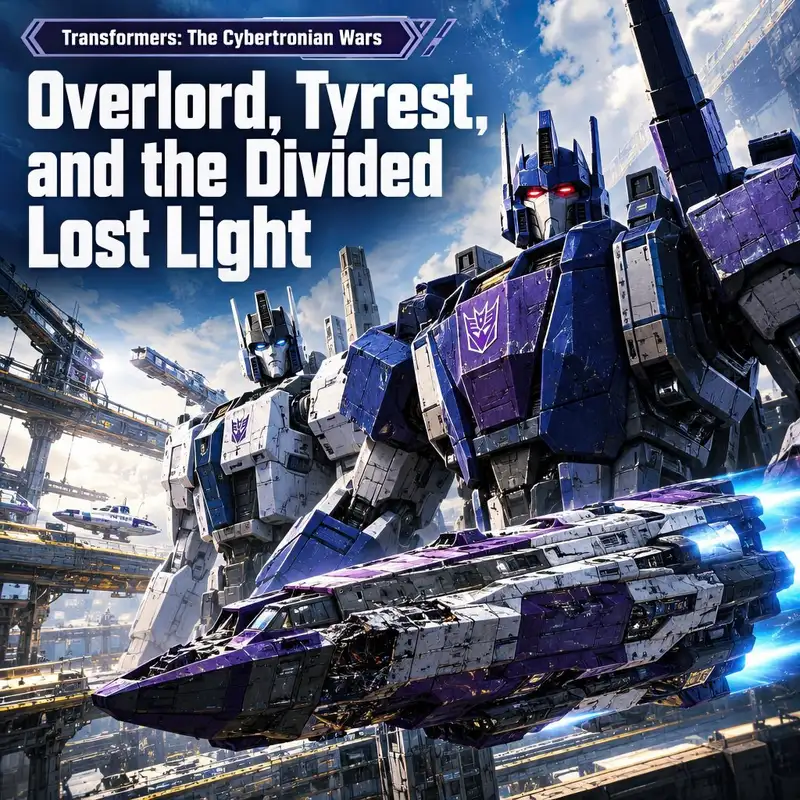
Overlord, Tyrest, and the Divided Lost Light
Chromedome enters Overlord’s mind expecting to find a weapon manual. The prisoner lies incapacitated inside a specially built slow-time cell, hidden deep within the Lost Light. Outside that chamber, the ship continues its postwar expedition toward the Knights of Cybertron. Most of the crew does not know that one of the Decepticon cause’s most devastating survivors is aboard. The plan is narrow, secret, and superficially practical. Extract the knowledge that made Overlord a Phase Sixer, then use it to understand an enemy technology that had terrorized entire worlds.
In the 2005 I D W continuity, that decision exposes a basic contradiction in the Lost Light’s mission. The ship presents itself as an exploration vessel, a place for veterans and civilians to seek something beyond the Great War. In practice, it is also a hospital, a prison, an archive, a refuge, a command post, and a community carrying unresolved injuries. It has left Cybertron physically. It has not escaped the institutions, habits, and fears created by the war.
Overlord is more than a dangerous captive. He is evidence of what the Decepticon war machine could build when conquest became the point of policy. Phase Sixers were deployed against worlds that resistance could not reasonably save. Their role was not conventional occupation or ordinary battlefield victory. It was devastation on a scale meant to end political resistance before it could organize. Overlord’s history at Garrus-Nine, the prison world devastated in the events of Last Stand of the Wreckers, gives him a particular place in Autobot memory. He is a survivor of a system designed to make survival unlikely for everyone around him.
Prowl sees a strategic opportunity. If Chromedome can use mnemosurgery, a specialized form of memory access and alteration, to examine Overlord’s mind, the Autobots may learn how Phase Sixers were created. That knowledge could matter in a future war, or in preventing the return of one. It is not an irrational objective. Postwar governments often want the technical record of atrocities, whether to understand them, defend against them, or quietly preserve capabilities they claim never to use.
The problem goes beyond the plan’s danger. Dangerous intelligence work can sometimes be necessary. The problem is that this operation has no transparent political authority, no meaningful oversight, and no credible plan for failure. Prowl encourages Rodimus to take Overlord aboard. Rodimus approves. Drift supports the effort. Brainstorm contributes technical expertise. Chromedome provides the rare skill that makes the intrusion possible, while the Duobots help maintain the hidden operation. A small circle turns an exploration ship into a clandestine detention site.
Each participant can tell himself that the secrecy is temporary and necessary. The crew would panic. The mission is too important. Overlord cannot be allowed to remain unexplored. Those arguments are familiar because they are not always false. But secrecy does not become responsible merely because those who keep it believe their motives are sound. The more people excluded from a dangerous decision, the fewer people are available to recognize its weaknesses, challenge its assumptions, or prepare for its consequences.
The slow-time cell seems to solve the immediate security problem. It creates a mismatch in perception. A prisoner inside experiences time at a different rate from the outside world. In theory, that gives the operators control. They can observe, enter, and withdraw before the captive can meaningfully respond. It is an elegant containment concept, the sort of solution that encourages confidence because it is technically sophisticated. Yet it depends on a far more basic condition. The people using it must retain control of the prisoner’s mind, the cell’s access systems, and the moral boundaries of the operation.
Chromedome’s entry into Overlord’s memories is therefore not the inspection of a static archive. Memory, in this continuity, is not just data stored in a harmless compartment. It is part of personhood. Mnemosurgery can heal, alter, conceal, and violate. Its practitioners work in territory where intelligence collection, medicine, coercion, and identity overlap. Chromedome enters Overlord’s past seeking the procedure that made him what he is. Instead, he encounters a mind shaped by violence, humiliation, defeat, and an extraordinary capacity to turn suffering into domination.
Overlord’s memories include the legacy of Garrus-Nine and his own transformation into a Phase Sixer. The details matter less than the lesson. The Decepticons did not create him through a simple process of adding weapons to an otherwise ordinary soldier. They created a figure whose body, psychology, and mission had been integrated into a doctrine of terror. A Phase Sixer was not intended to hold territory, negotiate surrender, or build a state. He was a strategic threat meant to make resistance feel futile.
That makes the Lost Light’s operation more reckless than it first appears. The crew is not interrogating a conventional prisoner of war, and not even interrogating an ordinary intelligence officer. They are entering the mind of someone whose survival depends on recognizing weakness and using it without restraint. The team assumes that incapacitation means helplessness. It assumes that memory access is one-directional. It assumes that the technical architecture surrounding the cell is more important than the relationship of trust between the people who authorized it.
Overlord reverses the intrusion. The details of how he does so are less important than what he gains. He acquires the access code to the cell. Chromedome becomes trapped in the slow-time chamber. The intelligence operation has achieved the opposite of its intended result. The Lost Light has gained no secure understanding of the Phase Sixer program. Overlord has gained timing, initiative, and a vulnerable specialist whose perception of events has been radically distorted.
The slow-time cell does more than hold Chromedome in place. It separates him from the normal rhythm of the ship’s emergency. From his perspective, events outside are compressed. The distinction is operationally important. A containment system can control an individual’s movement without controlling the wider battle. It can slow one victim’s experience without slowing the consequences of command failure. The cell becomes a trap for the person who trusted it most.
Once Overlord escapes, the crew pays for the secrecy surrounding his presence. They have no rehearsed response because they did not know a response was needed. They have no shared threat assessment because the threat was confined to a privileged group. The Lost Light has weapons, medical staff, security systems, experienced veterans, and formidable individuals. What it lacks is prepared cohesion. Its defenses must assemble after the attack has begun.
Pipes activates the emergency alarm. It is a basic act of duty, but basic acts can matter in a shipboard crisis. Alarms are not glamorous. They do not defeat an attacker. They create the possibility that scattered personnel can become a force. Pipes pays for that action with his life. His death makes clear that Overlord’s escape is not a contained security breach or a technical malfunction. The prisoner is conducting an internal assault against a densely populated vessel.
Overlord attacks Ratchet and Drift, then faces an increasingly desperate response from the crew. The Lost Light’s spaces are not designed for this kind of engagement. A ship is full of corridors, systems, medical areas, pressure boundaries, and personnel who may not be combatants. Heavy weapons can damage the attacker, but they can also threaten everyone dependent on the vessel’s integrity. Every defensive action must weigh the immediate need to stop Overlord against the danger of turning the ship itself into a casualty.
Ultra Magnus joins the defense and is stabbed through the spark. At this point in the story, the crew largely understands Magnus through the imposing armor and office he embodies. He appears to be the Lost Light’s stern legal and military authority, a figure whose presence promises order when Rodimus’s command style becomes improvisational. Overlord’s attack shows the limit of that promise. Institutional authority can stabilize a crisis, but only when the institution understands the threat it faces and has not been bypassed by its own leaders.
The release of Fortress Maximus raises the stakes further. Maximus is not a reserve weapon pulled from storage without consequence. He carries the trauma of Garrus-Nine, where he served as warden and where Overlord’s violence became inseparable from the failures of Autobot detention and punishment. Setting him against Overlord is tactically understandable. It also forces a survivor of the prison world back into contact with the person most associated with its destruction. The Lost Light is trying to solve one wartime disaster by reopening another.
Maximus cannot simply erase that history through strength. Overlord defeats him, and the fight moves back toward the slow-time cell. This is the point where the ship’s earlier choices become most visible. The cell was built as a secret advantage. It now becomes the focal point of survival. The systems meant to protect the crew are no longer neutral infrastructure. They have become part of the battle, and the people who understand them best are either injured, trapped, or carrying secrets from one another.
Rewind’s role is decisive. He frees Drift’s sword from the doorway, giving Chromedome the means to act from inside the cell. Chromedome jettisons the chamber into space. The immediate effect is to remove Overlord from the Lost Light and halt the internal assault. Rewind appears to die with him. At this stage of the ship’s history, the crew has no reason to treat that loss as temporary, qualified, or easily repaired. A friend, archivist, and partner is gone because a concealed intelligence operation failed.
Tactically, the crew survives. Overlord is expelled from the ship, and the assault ends. Operationally, the result is far worse than a simple victory. The Lost Light’s medical capacity has been strained. Its internal security has been exposed. Its command relationships have been compromised. Several personnel have been forced into combat without warning. The ship has learned that its own facilities can become weapons against it, and that some of its leaders were prepared to risk the entire community without its knowledge.
The personal cost falls hardest on Chromedome. Rewind’s apparent death is more than a casualty report. Their relationship had made memory and history central to their life together. Rewind preserves records. Chromedome works on the mind itself. After the attack, Chromedome considers using mnemosurgery to erase his memories of Rewind. The impulse is understandable. If memory can be altered, grief may look like another form of damage awaiting treatment.
Brainstorm intervenes with Rewind’s final recorded message. The intervention matters because it rejects an easy technological answer to a moral wound. Erasing grief would not restore Rewind. It would not change the operation that killed him. It would simply remove the evidence of a relationship from the person still living with its consequences. The war has taught many Cybertronians to see bodies as repairable systems and memory as editable material. The aftermath asks whether recovery can mean something more than removing pain.
Rodimus responds to the crisis by publicly banishing Drift. Drift had participated in bringing Overlord aboard, and he does bear responsibility. Yet the punishment is selective. Rodimus does not initially reveal his own approval of the operation. Prowl’s role remains in the shadows. Chromedome’s participation was necessary, though his role is complicated by coercion, professional obligation, and the catastrophe that followed. Discipline becomes theater when it isolates one visible culprit while protecting the people who made the decisive choices.
This is not a minor command error. The Lost Light is supposed to be learning how to live after war. Postwar institutions require more than the removal of an enemy threat. They require accountability that applies upward as well as downward. By blaming Drift while concealing his own role, Rodimus reproduces an old wartime habit. Leaders reserve the right to make secret decisions, while subordinates absorb the political cost when those decisions fail.
Then Ultra Magnus disappears from medical care. His departure is not treated as a routine absence. The wounded enforcer has left behind a trail that draws the Lost Light toward an anomaly and, beyond it, Luna One. A ship already unsettled by concealed responsibility follows its legal authority into a place where law has been twisted into an instrument of purification.
Luna One is a supposedly lost Cybertronian moon, hidden behind an anomaly and preserved as a kind of buried archive. Its discovery does not produce the wonder of a clean archaeological find. The surface holds an immense concentration of dormant or unborn sparks. The exact origin, status, and intended purpose of that reservoir are not fully settled by the evidence available to the crew. What is clear is that Luna One contains a vast and politically consequential remnant of Cybertronian life and history.
The Lost Light’s scan awakens the sparks. Brainstorm also identifies one with unusual power, a point-one-percenter spark. In this continuity, point-one-percenters are rare Cybertronians associated with exceptional capability. But the important point is not a contest of power levels. The moon is full of potential lives and old systems whose political meaning remains uncertain. The Lost Light has arrived in a place where ancient technology, social history, and moral authority are all buried together.
The crew is not given time to study the discovery. Giant Legislators board the Lost Light and overwhelm its defenders. These are not ordinary soldiers with independent judgment or local initiative. They are mass-produced enforcement instruments, valuable because they can impose centralized will at scale. Their arrival turns the moon into a hostile operational environment before Rodimus can establish control of the situation.
On the surface, Rodimus’s landing party encounters Lockdown’s mercenaries. Ratchet is captured by Pharma. Rodimus himself is eventually imprisoned. The crew is physically divided across the moon, the ship, detention areas, and medical spaces. The Lost Light loses initiative because it enters unfamiliar territory with fragmented command, incomplete intelligence, and wounds that have not yet been acknowledged. The earlier crisis with Overlord had already weakened trust. Luna One converts that weakness into a larger vulnerability.
The crew expects an ambush. What it finds is a prosecution. Chief Justice Tyrest controls Luna One, and he charges the Lost Light with crimes against creation. Skids is central to the accusation. Tyrest regards him as a major criminal, but the charge is not limited to Skids’s individual actions. Tyrest claims the right to judge the crew’s moral worth, the legitimacy of their origins, and their eligibility to continue existing.
This is not ordinary criminal jurisdiction. A court can investigate conduct, evaluate evidence, assign responsibility, and impose proportionate punishment. Tyrest’s system does something else. It begins with an imagined category of contamination and works backward toward extermination. It treats identity as proof. It treats origin as guilt. It turns a legal title into permission to eliminate anyone who falls outside a purified social order.
Star Saber serves Tyrest as a militant ally. His presence complicates the conflict because he is tied to the Circle of Light, an order associated with the Knights of Cybertron. The Circle offers a very different spiritual and philosophical inheritance from Tyrest’s. Its members may be fighters, but their existence demonstrates that belief in ancient Cybertronian tradition does not automatically produce Tyrest’s theology of punishment. The division here is not between faith and reason. It is between a tradition that recognizes moral agency and one that converts belief into domination.
Among the prisoners is Minimus Ambus, the individual connected to Ultra Magnus’s disappearance. His presence reveals that the familiar figure of Magnus has never been quite what the Lost Light assumed. The answer is not that Magnus was a fraud or that Minimus was simply hiding in armor. The armor is the office. It is a system of legal identity, continuity, authority, and intimidation. Multiple individuals have worn it. Minimus Ambus is the current bearer.
That arrangement changes the meaning of Ultra Magnus’s authority. The armor gives the office a public face that outlasts any individual occupant. It allows the institution to present itself as unbroken, implacable, and larger than the person inside. In some circumstances, that continuity could be useful. A legal system needs consistency. A military command needs recognizable authority. But the arrangement also creates distance between the individual’s conscience and the role he must perform.
Tyrest had recalled Minimus Ambus to Luna One. His intention was not to preserve the independent authority represented by Magnus. He meant to replace it with Legislators and with Star Saber. The difference is fundamental. Magnus, however rigidly, still embodied judgment exercised by a person within an office. Legislators obey. Star Saber enforces. Tyrest’s ideal system has no need for discretion, doubt, or humane interpretation. It seeks authority without conscience.
The replacement plan reveals what Tyrest thinks institutions are for. He does not reject law because law restrains him. He wants a more absolute law, one that reaches beyond actions and into origins. In his system, a person does not need to commit a crime to become punishable. It is enough that the person was made through a process Tyrest has decided marks them as morally suspect.
That process is cold construction. In the 2005 I D W continuity, constructed-cold Cybertronians are beings whose bodies were created to house artificially generated sparks. The production method is real. It belongs to the history of Cybertronian industry, policy, and social organization. It has consequences for how people were created, classified, and controlled. But the existence of a production system does not establish that those produced by it possess lesser moral worth, defective character, or an inherited tendency toward wrongdoing.
Tyrest claims precisely that. He argues that constructed-cold Cybertronians are more prone to sin. His claim is ideological, not scientific fact. It transforms a historical and industrial distinction into a permanent biological accusation. It allows him to erase individuality. A constructed-cold Autobot, Decepticon, civilian, medic, official, criminal, or child becomes, in Tyrest’s logic, the same kind of target. Their conduct no longer matters because their existence has been declared evidence against them.
Tyrest’s doctrine is made more disturbing by his own complicity. He was involved in the policy that created the constructed-cold population he now condemns. Rather than confront that responsibility honestly, he converts guilt into purification. He imagines that exterminating those associated with the system will atone for his role in it and grant him entry into Cyberutopia, the idealized destination he associates with the Knights of Cybertron. His belief is not a legal argument. It is a theology of self-exoneration built from mass death.
The political danger lies in how efficiently this logic removes restraint. A judge who accepts individual guilt must investigate evidence. A government that recognizes personhood must distinguish civilian from combatant, victim from perpetrator, and reform from revenge. Tyrest needs none of that. His category is broad enough to encompass a population distributed across the galaxy. He has taken a past production policy and turned it into a death sentence with no appeal.
Getaway’s connection to Skids adds another layer to the moon’s history. Getaway explains that he and Skids had once tried to force Tyrest to resign through mental manipulation. Their action does not justify Tyrest’s program, nor does it prove that every opponent of Tyrest was morally clean. It shows how damaged institutions produce desperate methods. When lawful removal appears impossible, dissidents may turn to covert coercion. That choice can deepen mistrust even when the institution they oppose is itself corrupt.
The Lost Light now faces a question that is smaller in scale than Tyrest’s planned extermination but closely related to it. Can a community survive when its members no longer trust the institutions meant to protect them? Rodimus hid Overlord. Prowl treated the ship as a convenient platform for intelligence work. Drift became the visible scapegoat. Minimus served an office whose history he could not fully control. Skids and Getaway had tried to alter a judge’s mind. The crew has not entered Luna One as a united body. It has carried its fractures there.
The fighting unfolds across several fronts. Cyclonus, Whirl, and members of the Circle of Light resist Star Saber and the Legislators. Their purpose is more than to win a duel. They must prevent Tyrest’s enforcement apparatus from sealing every route, capturing every dissenter, and reducing the conflict to an execution process. Resistance buys time. In a crisis shaped by a centralized weapon, time is a strategic resource.
Dai Atlas, the former leader of the Circle of Light, is killed by Star Saber. The death demonstrates the depth of Star Saber’s break with his former comrades. This is not an external invader crushing an unfamiliar community. It is a former member of a shared tradition helping turn that tradition against itself. The Circle’s resistance is therefore military and ideological. It rejects the claim that loyalty to ancient belief requires submission to Tyrest’s authority.
Ratchet and First Aid face a different expression of the same moral collapse. Pharma had once been a medical officer. On Luna One, medicine has become coercion, experimentation, and bodily control. Ratchet is captured, and his head and spark are removed from his body. The act is more than gruesome. It demonstrates how completely Pharma has severed medical skill from consent. A healer possesses intimate knowledge of vulnerability. Without ethics, that knowledge becomes a uniquely powerful form of domination.
First Aid and Ratchet escape by turning Ambulon’s mutilated body into a weapon. The moment is not a celebration of ingenuity. It is a survival measure born from Pharma’s violation of another person’s body. The emergency solution works because the characters are forced to use the material evidence of abuse against its perpetrator. In a different setting, medicine restores autonomy. Here, it has been distorted so thoroughly that escape requires confronting the damage directly.
Lockdown’s mercenaries add another political dimension. Their role reminds the crew that postwar conflict is not neatly divided between Autobots and Decepticons. Contract violence thrives wherever authority fragments and old wars leave valuable technology, vulnerable prisoners, and factions willing to pay. Mercenaries do not need to share Tyrest’s theology or Pharma’s obsessions. They only need a client, a contract, and an environment where force can be outsourced.
The resistance gradually reunites enough of the crew to move toward Tyrest’s control center. By then, the conflict has clarified itself. Overlord had represented hidden violence brought aboard under the language of intelligence. Tyrest represents violence made public and legal under the language of creation, purity, and judgment. One threat was concealed beneath an exploration ship. The other has built an entire court around the idea that some lives may be condemned before they act.
Then Tyrest activates the universal killswitch. The effect is immediate and vast. Constructed-cold Cybertronians across the galaxy collapse or suffer catastrophic harm. The story establishes the weapon’s reach through its consequences, but does not provide a reliable measure of range, technical mechanism, production scale, or casualty total. What matters is that Tyrest has found a way to attack a dispersed population through the circumstances of its creation.
This makes the killswitch strategically different from a battlefield superweapon. A conventional weapon targets forces, cities, installations, or supply systems. Tyrest’s weapon targets a classification. It does not distinguish soldier from civilian, official from dissident, guilty from innocent, or friend from enemy. It turns the industrial history of a person’s birth into a vulnerability that can be exploited at a distance.
The civilian implications are immense. Any constructed-cold Cybertronian is vulnerable regardless of present allegiance or personal conduct. A former Decepticon may collapse beside an Autobot medic. A civilian may suffer beside an official. Someone who never participated in the war may be condemned by an institution that claims to be correcting it. Tyrest has erased the distinction between justice and collective punishment so completely that individual moral status no longer exists.
The countermeasure comes from a flaw in Tyrest’s assumptions, not from superior force. Tailgate has cybercrosis, a degenerative condition that has damaged his hearing. The relevant frequency does not affect him in the same way it affects the others. What Tyrest regarded as weakness becomes an unexpected form of resistance. Tailgate disables the mass-suggestion weapon, restoring the crew’s ability to act.
Cyclonus defeats and blinds Star Saber, who escapes. The encounter ends Star Saber’s immediate offensive role without offering a simple moral resolution. Star Saber’s fall does not heal the Circle of Light or restore Dai Atlas. It does, however, prevent Tyrest’s militant interpretation of tradition from becoming unchallenged. The Circle survives as evidence that belief can resist authoritarian certainty rather than serve it.
The killswitch still has to be reversed. Perceptor determines that Rodimus’s half of the Matrix contains the necessary spark-code. In this continuity, the Matrix is more than a ceremonial badge of leadership. It contains capabilities and information with real strategic importance. One of those functions has guided the Lost Light’s search for the Knights of Cybertron. Using it to reverse Tyrest’s weapon risks Rodimus’s life and destroys the map that had given the expedition its direction.
Rodimus makes the choice to save the affected population. It is his best decision in this crisis because it accepts a cost he cannot shift onto someone else. He does not preserve the mission asset and ask others to pay for the consequences. He does not define success as the survival of his command authority. He recognizes that an expedition seeking a better future cannot justify leaving an entire category of people to die in order to protect its own objective.
The reversal succeeds. Constructed-cold Cybertronians harmed by the killswitch are restored. The strategic threat has been defeated, but the price is real. The Lost Light loses the Matrix map central to its search for the Knights. The crew has preserved lives by sacrificing a purpose of the voyage. That is not failure. It is a recognition that a mission can become morally empty if it values an abstract destination over people endangered in the present.
Survival creates the conditions for confession. Rodimus admits that he helped bring Overlord aboard. Prowl challenged his courage, and Rodimus allowed that challenge to shape a decision that should have required sober judgment. The admission does not place every responsibility on Rodimus alone. Prowl encouraged the operation. Drift participated. Chromedome’s expertise made it possible. The ship’s wider culture accepted wartime secrecy as a normal tool. But Rodimus held command, and he had hidden his role while punishing Drift.
Overlord and Tyrest divide the Lost Light in different ways. Overlord represents violence concealed inside a community that claims to have moved beyond war. Tyrest represents violence made respectable through office, ritual, and legal vocabulary. One arrives through a secret prison and an intelligence gamble. The other through a court that mistakes origin for guilt. Both expose the same postwar failure. A society cannot truly leave civil war behind while it preserves hidden detention, treats trauma as disposable memory, turns authority into unquestionable identity, or judges people by the circumstances of their creation.
The Lost Light’s real victory is not that it defeats two enemies. It is that its leaders are finally forced to admit what the war has made them.