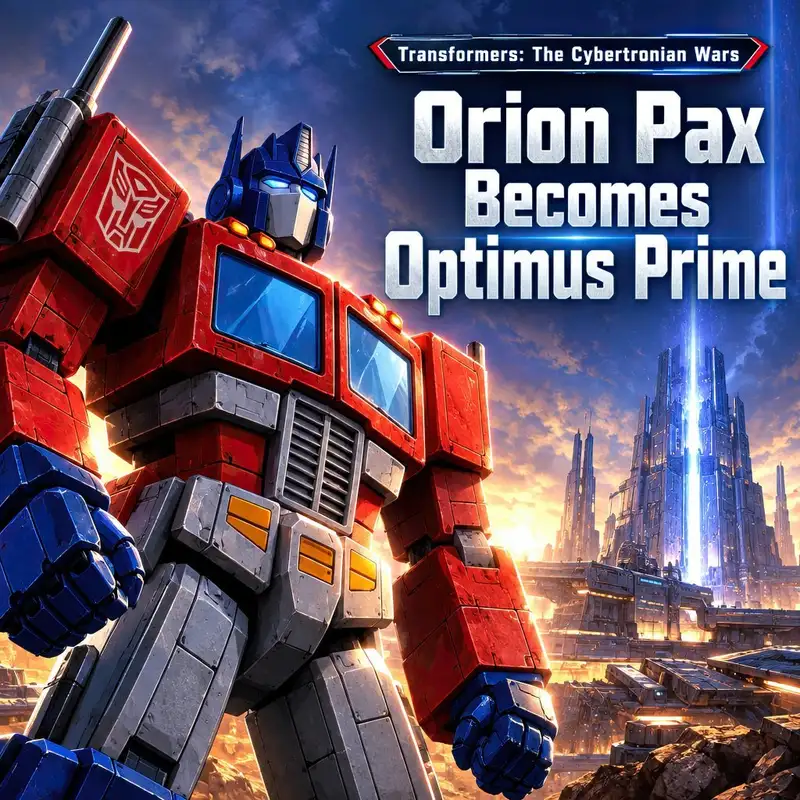
Orion Pax Becomes Optimus Prime
In the mines beneath Iacon, the workers did not lack strength. They lacked choice. They could haul Energon through unstable tunnels, endure cave-ins, and keep a city alive beneath Cybertron’s surface. But they could not transform. Without transformation cogs, the devices that made Cybertronians able to change form, they had restricted mobility, limited work, and almost no say in the order that governed them. Sentinel Prime promised that the Energon crisis would end. Until then, the miners were expected to dig, obey, and wait.
This is the world of Transformers One, a separate Cybertronian history from the older animated series, comics, and films that have also told versions of Optimus Prime’s origin. Here, Orion Pax begins not as a soldier, a statesman, or a chosen leader. He is a cogless miner in a managed society whose rulers have made inequality appear natural. His path to becoming Optimus Prime begins with a very practical question: why should some Cybertronians be free to move through the world while others are built to remain beneath it?
That question carries more weight than it may first appear to. Transformation is not just a combat feature in this version of Cybertron. It affects where someone can go, what work they can do, how they can escape danger, and whether they can define a life beyond the function assigned to them. A worker without a cog is not just missing an upgrade. That worker is confined by a political arrangement expressed through the body itself.
Iacon’s underground order rests on Energon. The city needs it to function, and its scarcity gives Sentinel Prime’s regime a ready-made excuse for discipline. When a society is told that survival requires sacrifice, the immediate question is always whose sacrifice will be demanded. In Iacon, the burden falls heavily on the miners. They are essential, but not empowered. Their labor is public necessity. Their freedom is treated as a luxury for some later day.
Sentinel’s authority is not presented as naked military occupation. He is celebrated as a Prime, a figure associated with Cybertron’s lost grandeur and with the promise of future renewal. That image matters. A ruler who can present himself as guardian, rescuer, and heir to a heroic past does not need to explain every restriction. He can ask the population to trust that someone else understands the crisis better than they do.
But systems of control are rarely held together by force alone. They depend on routine. They depend on the exhausted worker who has no time to investigate the world beyond the next shift. They depend on institutions that make hierarchy feel older than memory. And they depend on the belief that the people at the bottom are unlucky, rather than deliberately kept there.
Orion Pax does not accept that belief. He is curious to the point of recklessness, impatient with official explanations, and willing to turn a minor rule violation into an expedition. Those traits make him troublesome long before they make him important. He has no title, no formal command, and no transformation cog. Yet he possesses a kind of influence that the Iaconian system has difficulty measuring. He can persuade others to move.
That is Orion’s first form of leadership. Not authority granted from above, but momentum created among equals. He sees a sealed door, a restricted archive, or a suspicious piece of evidence and asks whether the prohibition itself is the point. He is not always careful. He does not always understand the risk he creates for others. But he refuses to let the boundaries of his assigned life become the boundaries of his imagination.
His closest companion in this early period is D-16, another cogless miner. At this stage, D-16 is not Megatron. He is Orion’s friend, his partner in trouble, and in many ways his counterweight. He is more cautious about the world as it is, more impressed by established authority, and more vulnerable to the emotional force of betrayal when that authority proves false.
The friendship matters because it prevents an easy reading of what follows. Orion and D-16 do not begin as representatives of eternal opposing factions. They share the same restricted social position. They work under the same system. They endure the same limitations. They both learn that their society has been built on deception. Their eventual break comes not from one of them discovering injustice while the other remains blind. It comes from a disagreement over what justice requires after the truth is known.
Orion’s dissatisfaction first becomes politically significant when he begins looking for evidence. His first real weapon is not a blaster or a transformation mode. It is the suspicion that Cybertron’s official history is incomplete. A regime can tolerate occasional grumbling. It has more difficulty surviving when its subjects begin comparing its story to the records it has tried to hide.
The historical material Orion encounters presents an account of Primus, the ancient Primes, the Matrix of Leadership, Cybertron’s declining Energon, and a war involving the Quintessons. In the film, these are not neutral textbook facts delivered by an outside historian. They are part of the world’s contested memory. The past has been preserved, distorted, buried, and recovered through records that different characters have reasons to interpret in different ways.
That distinction is important. The film does not require us to assume that every ancient record contains a complete and infallible account of Cybertronian history. It does show that Sentinel Prime has benefited from a monopoly over what Iacon knows about its past. When political power controls the archive, ignorance is not an accident. It becomes part of the machinery of rule.
Orion discovers a damaged message connected to Alpha Trion, a figure associated with the old order of the Primes. The message is incomplete enough to create uncertainty and compelling enough to make inaction impossible. It suggests that the official story has left something out. For Orion, that is enough. He does not yet possess the full evidence needed to overturn Sentinel’s authority. But he has reached the point at which obedience has become intellectually impossible.
There is a familiar pattern in political history here. A government can survive hardship, shortages, and unpopular decisions for a long time if people believe those decisions are unavoidable. The situation changes when the hardship appears manufactured, concealed, or imposed by leaders who claim to be solving it. The discovery of hidden information does not by itself produce a revolution. It does, however, make the old explanations increasingly difficult to maintain.
Orion’s response is not to build an army. He assembles a small and very improvised investigative group. D-16 joins him. B-127, another worker with more enthusiasm than restraint, becomes part of the mission. Elita-1 becomes involved after confronting them, bringing a level of competence and discipline that the group otherwise badly lacks.
Their expedition is unauthorized in every sense that matters. They have no official clearance, no formal intelligence support, and no military transport assigned to them. They have local knowledge, stubbornness, a fragmentary lead, and a willingness to leave the geography Sentinel’s system has taught them to accept. It is not an elegant operation, but a necessary one.
Elita’s role is especially revealing. Orion can identify a problem, but he tends to treat urgency as a substitute for planning. Elita understands that a mission still has to be completed by living participants. She provides discipline without becoming an obedient defender of the system. Her presence reminds us that resistance is not sustained by inspiration alone. It also requires competence, caution, and someone willing to ask whether the plan has any chance of getting its participants home.
B-127 brings energy and improvisation, but his humor should not obscure his place in the operation. He is one of the workers drawn into a search for truth that the authorities never intended them to conduct. In a controlled society, curiosity can look unserious to those in power right up until it becomes organized.
Leaving Iacon means leaving more than a city. It means passing beyond the political map created by Sentinel’s regime. Underground life has narrowed the population’s sense of what Cybertron is. The surface is dangerous, unfamiliar, and associated with histories that have been removed from public life. Yet the journey reveals that Iacon’s confinement has never been entirely physical. The limits imposed on the miners are also limits on what they are permitted to know.
The group eventually finds Alpha Trion, a surviving Prime and a custodian of evidence that Sentinel has suppressed. Alpha Trion’s existence alone is a political shock. Sentinel’s public image depends on his position as the remaining guardian of Cybertron’s heroic inheritance. The presence of another Prime, especially one connected to the hidden past, weakens that carefully constructed claim.
More damaging still is what Alpha Trion reveals about Sentinel’s rise. The film establishes that Sentinel betrayed the original Primes and entered into a secret arrangement with the Quintessons. He did not preserve Cybertron from disaster through wise leadership. He concealed the circumstances of its decline while using the crisis to consolidate his own authority.
The details matter because the betrayal is not just personal. Sentinel did not just wrong a few former allies. He transformed a planetary emergency into a system of political dependence. Energon scarcity became the justification for labor discipline. The absence of transformation cogs became a permanent limitation imposed upon the workers who kept Iacon alive. History became a managed resource, distributed only in forms that protected the ruler.
The Quintessons are part of this revelation, but the film does not provide a complete military history of their civilization or a full explanation of their political aims. What matters here is the bargain Sentinel made and the conditions it produced. He has cooperated with an outside power while presenting himself to Iacon as its protector. He has treated Cybertron’s population as labor to be administered rather than citizens entitled to understand the terms under which they live.
For that reason, the discovery becomes more than a personal grievance. Orion and his friends now possess evidence of a legitimacy crisis. Sentinel’s authority rests on false stewardship. His public story says that he carries the burden of survival for the people. The hidden record suggests that he helped create the burden and then built his rule around it.
Still, truth does not liberate anyone by itself. Evidence locked away in a ruin cannot change Iacon. A hidden message cannot repair a worker’s body, move a population, or defend a witness. The group has learned what is wrong with their society. They still lack the means to return, expose it, and survive the reaction of those who benefit from the old order.
Alpha Trion gives them those means by providing transformation cogs taken from fallen Primes. The moment is presented with the excitement of discovery, but its deeper meaning is not just that four characters receive new capabilities. For the first time, Orion, D-16, Elita, and B-127 gain bodily autonomy that Iacon’s social system had denied them.
They transform. They move through the world in ways that had been impossible only moments earlier. They gain new options for pursuit, escape, reconnaissance, and combat. The change is dramatic because it is physical, but it is political because it exposes the artificiality of the old hierarchy. The miners were never incapable of transformation because of some natural inferiority. They were deprived of the means.
A transformation cog in this setting is therefore both technology and citizenship. It alters what a Cybertronian can do, but it also alters what that Cybertronian can imagine becoming. A society that confines one group to labor while reserving movement and power for another does not just distribute resources unequally. It assigns different horizons to different lives.
The tactical consequences are immediate. The group can travel more effectively, evade danger, and meet threats with capabilities they did not previously possess. But these new abilities do not turn them into a trained army. They have not suddenly acquired a chain of command, an industrial base, or a complete plan for remaking Cybertron. They have gained options. What they do with those options becomes the central question.
For Orion, transformation reinforces a belief he already possessed. He sees the cogs as proof that the people of Iacon have been denied something that belongs to them. Power should expose the lie and enable wider freedom. For D-16, the same discovery becomes inseparable from the anger of having been deceived, restricted, and used. The cogs do not create the difference between them. They reveal it.
Both now understand that Sentinel’s regime is corrupt. Both have reason to hate it. Both have seen evidence that their lives were shaped by a betrayal hidden above their heads. Yet shared suffering does not produce one inevitable politics. A movement can begin with the same grievance and divide sharply over whether its purpose is public liberation, personal retribution, or the replacement of one ruling circle with another.
Orion’s instinct is to bring the truth back to Iacon. He wants the population to see what Sentinel has concealed and to take part in judging the system that has governed them. This is not weakness or hesitation. It is a recognition that a political order cannot be made legitimate merely because its enemies deserve defeat. If the people are denied the truth at the moment of liberation, they remain dependent on whichever armed leader claims to know what must happen next.
D-16’s anger is understandable. Sentinel’s betrayal is not abstract history to him. It explains why he and Orion were kept underground, why they were denied transformation, and why a Prime whom he admired was nothing like the figure presented to the public. The emotional force of that discovery should not be minimized. Betrayal by a revered authority can make restraint appear like complicity.
But D-16 begins to treat punishment as the primary form of justice. His focus narrows from changing the system to making Sentinel pay for what he has done. That shift is consequential. Justice requires accountability, but vengeance has a different logic. It measures success by the suffering of the enemy and by the satisfaction of the injured. It does not necessarily ask what institutions will prevent the next betrayal.
The conflict between Orion and D-16 is therefore not a simple contrast between idealism and realism. Orion understands that Sentinel must be confronted. D-16 understands that deception cannot be answered with polite appeals. Their disagreement is over what should replace Sentinel’s rule. Orion believes that liberation must restore agency to the population. D-16 increasingly believes that history has given him the right to seize control and impose judgment.
That argument becomes more dangerous when D-16 gains armed followers. The High Guard is an organized force associated with the older Prime order. It is not a neutral civic institution waiting to be directed by whoever makes the best speech. It has its own traditions, leaders, grievances, and combat capacity. Anyone who wins its loyalty gains more than allies. They gain the beginnings of a coercive political instrument.
D-16 defeats Starscream and gains practical authority over the High Guard. The film never establishes a detailed order of battle, force size, or planetwide military campaign. What it does show clearly is the transfer of influence. D-16’s standing now rests not only on his history as a miner or his outrage at Sentinel’s betrayal. It rests on combat prestige, charisma, and the ability to offer a direction to warriors ready for action.
This is one of the oldest hazards of revolutionary politics. An armed formation can be indispensable in overthrowing a corrupt order. It can also become the center of gravity around which the new order is built. Once followers are loyal primarily to a commander, rather than to a public process or shared law, the overthrow of a tyrant may simply open a contest over who gets to inherit the machinery of command.
D-16 offers certainty. Sentinel has betrayed Cybertron. The guilty must be punished. Strength must replace weakness. These claims have force because they answer a real wound. They also make it easier to treat disagreement as cowardice, procedure as delay, and public judgment as an obstacle to decisive action.
Orion has less to offer in the short term. He cannot promise that exposing the truth will be clean, quick, or emotionally satisfying. He cannot guarantee that a population emerging from deception will agree on what should happen next. His position is harder to sell because it requires patience at the very moment when anger feels most justified.
But Orion understands something D-16 is beginning to forget. A people who are liberated only by orders from above remain vulnerable to the next leader who claims necessity. Removing Sentinel is only part of the goal. The larger objective is to prevent Cybertron from continuing to depend on a single figure who controls its history, its bodies, and its future.
The return to Iacon brings the conflict into the open. The group does not come back merely to settle a personal score. They return carrying evidence that can break Sentinel’s control over public reality. His regime has depended on the population believing that the Energon crisis, the absence of cogs, and the official account of the Primes are all parts of a fixed and unavoidable world.
Orion insists that the people must see the evidence. Sentinel must be confronted not only as an enemy to defeat, but as a ruler whose legitimacy must be stripped away in front of those he has deceived. This is strategically important as well as morally important. A ruler’s security apparatus can be formidable, but it becomes brittle when its own justification collapses.
The struggle over information is central. Sentinel has held power partly by defining the past and therefore defining the limits of the present. Orion’s answer is to make the hidden history public. If the miners learn that their conditions were imposed through betrayal, they can no longer be treated as passive recipients of Sentinel’s protection.
D-16 sees the same moment differently. To him, Sentinel’s guilt is already established. There is no need to wait for collective judgment. There is only the need to punish the traitor before he can escape, manipulate the situation, or continue to rule through deception. This is not an irrational concern. Tyrants often survive because their opponents hesitate at decisive moments.
Yet D-16’s solution is not just decisive action against a dangerous leader. He wants personal control over the verdict. He wants to make the execution itself the foundation of a new authority. In that moment, liberation begins to collapse into seizure of power. The public is no longer the subject of its own history. It becomes an audience for the ascension of a stronger ruler.
Orion stands in the way. He does so not because he forgives Sentinel, and not because he believes betrayal should go unanswered. He intervenes because he sees that D-16 is about to reproduce the governing logic they set out to destroy. Sentinel treated Cybertron’s people as objects to be managed. D-16 is beginning to treat them as spectators whose future can be decided by the strength of his arm.
The immediate outcome is brutal. D-16 mortally wounds Orion. The act marks the final break between them. He has crossed from opposition to Sentinel into a willingness to destroy anyone who limits his claim to power, even the friend who shared his suffering and helped reveal the truth.
D-16 then removes the transformation cog associated with Megatronus Prime from Sentinel and takes the name Megatron. The gesture is more than a change of name. It is an appropriation of symbol, body, and authority. D-16 does not just defeat a false Prime. He claims a new identity through possession of power taken from another.
That choice reveals the difference between D-16 and Orion with unusual clarity. Both have been denied autonomy. Both have been betrayed by a ruler who used Cybertron’s past as a tool of control. But D-16 responds by treating power as something to be seized, embodied, and enforced. He takes what he believes history owes him, and he begins building authority around that act of possession.
Orion loses the immediate confrontation because he refuses to make victory identical with revenge. That refusal is costly. It does not spare him pain. It does not protect him from betrayal. It does not guarantee that the population will immediately understand the danger before it. Moral restraint is not a shield against force. Sometimes it means accepting personal risk to prevent a political victory from becoming something worse.
Orion falls into Cybertron’s core. What follows is among the film’s most explicitly sacred moments. The scene involves Primus, the Matrix of Leadership, Alpha Trion, and the presence of the Primes. The film establishes the outcome clearly: Orion is restored, elevated, and recognized as Optimus Prime. It is less interested in providing a technical manual for exactly how each element of that process operates.
That restraint matters. The Matrix should not be read as a universal device with identical powers in every Transformers story. Nor does this moment mean that mystical recognition alone resolves the political problems of Cybertron. What the film presents is a continuity-specific union of restoration, reformatting, spiritual judgment, and public succession.
Orion does not emerge as a different person who has replaced the miner he once was. The qualities that made him Orion Pax remain visible. His curiosity, compassion, defiance of unjust limits, and willingness to act for others are not erased. The change is not personality replacement. It is the same individual taking on a transformed body, a new title, and a responsibility that reaches far beyond his own life.
The Matrix confirms rather than creates the decisive quality in Orion. Before he receives it, he has already chosen to place the future of Cybertron above his own immediate safety. He has refused to let the defeat of Sentinel become a private act of vengeance. He has acted for the greater good at the moment when doing so offers him no personal advantage.
For that reason, Orion becoming Optimus Prime is more than a physical upgrade. A stronger body, a new mode, or an ancient artifact does not by itself create a leader. Power can increase the consequences of existing character. In D-16’s hands, newly gained power becomes a means of domination. In Orion’s hands, it becomes an obligation to restore agency to others.
There is still a distinction to preserve. Sacred legitimacy is not the same thing as political legitimacy. Being chosen by the Matrix may establish Optimus as worthy in the moral language of the film, but his authority must still be demonstrated through action. Cybertron has been ruled by a Prime who used a revered title to conceal betrayal. Optimus can only prove that he is different by refusing to repeat Sentinel’s methods.
His return provides that proof in its first and most important form. Optimus defeats Sentinel and ends the ruler’s immediate control over Iacon. But he does not treat the victory as the private property of a new elite. The transformation cogs are restored to the wider population. The capability once monopolized by the regime is no longer held back from the miners who sustained it.
This is the decisive political act of Optimus Prime’s emergence. The restoration of transformation does not just give Cybertron more potential defenders. It changes the civic status of those who had been confined beneath Iacon. They can move, choose, adapt, and participate in a society no longer built on their bodily restriction.
The military implications are real. A population with greater mobility and capability is harder to dominate through a narrow ruling class. The old system had concentrated practical power in those allowed to transform and command. Restoring cogs redistributes that power. It creates new possibilities for travel, work, self-defense, and collective action.
But the act is not a finished reconstruction program. The film never provides a detailed constitution, a complete plan for Energon distribution, or a full account of how Cybertron will rebuild its institutions after Sentinel. Removing a ruler is one task. Repairing a society shaped by scarcity, deception, and imposed inequality is another. The first can happen in a moment of crisis. The second requires time, law, trust, and institutions capable of surviving the leaders who create them.
Megatron and the High Guard are exiled. In that departure, the political split becomes institutional. The Autobots and Decepticons are born not as separate species or eternal cosmic categories, but as opposing responses to the collapse of Sentinel’s order. One side is organized around the claim that power should be used to restore wider freedom. The other is organized around Megatron’s authority, grievance, and readiness to impose his own vision through force.
The later Autobots and Decepticons will not remain pure reflections of this founding moment. Movements outgrow their origins, attract new motives, and force people into choices they never expected to make. But the beginning still matters. Optimus Prime's first defining use of authority is to return mobility and agency to those who had been denied both. Megatron's first defining use of power is to destroy restraint and claim the right to decide Cybertron's future through force.
That is the divide Transformers One leaves behind. Orion Pax becomes Optimus Prime not because he possesses the greatest strength, but because he refuses to let liberation become another system of control. Restoring the transformation cogs frees Cybertron's people to move through their world as full participants. It also exposes the next problem immediately. Removing a tyrant can break an old order in a day. Governing the freedom that follows, while preventing grievance from hardening into another form of domination, will be much harder.