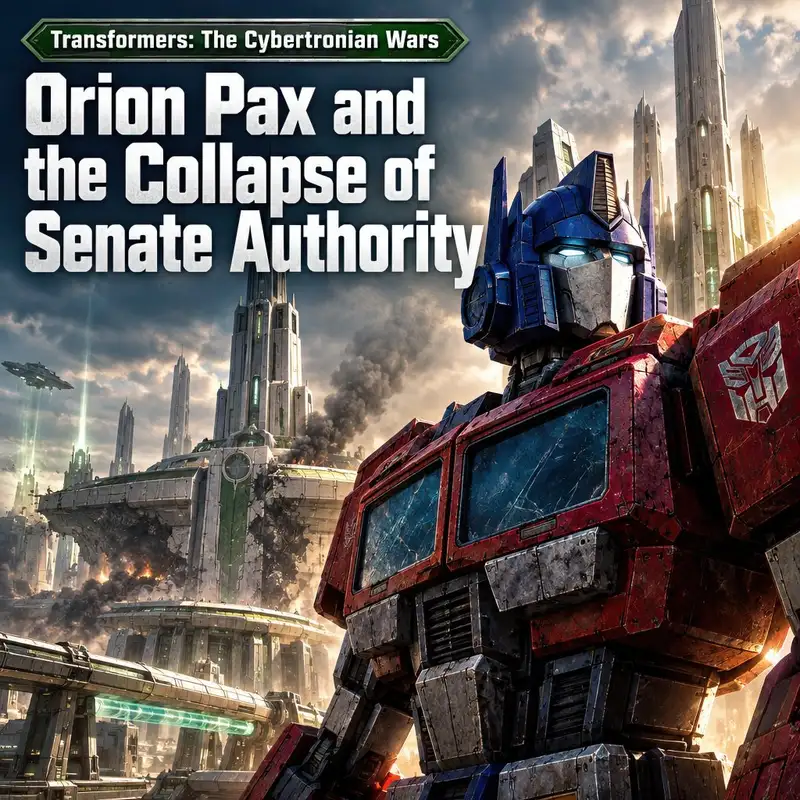
Orion Pax and the Collapse of Senate Authority
Nyon was already under pressure when Zeta Prime’s Vamparc Ribbon entered the picture. The city was politically divided, economically strained, and caught between Decepticon activity, neutralist resistance, state security operations, and civilians trying to remain alive amid a spreading civil war. Zeta’s answer was more than to defeat armed opponents. He intended to draw vast quantities of energy from Cybertronian populations and use that energy to power a weapon. The people of Nyon were no longer citizens with claims on their government. They were becoming fuel.
That is the point at which Orion Pax’s political journey becomes clearest. He was still connected to the authority of the state. He still understood the danger posed by Megatron’s Decepticons. He still believed that law, order, and organized defense mattered. But he had reached a question no conscientious officer can avoid for long. What remains of lawful authority when the government’s survival plan requires treating its own population as an expendable resource?
This is the history of the I D W continuity that began in two thousand five, not the later I D W reboot, and not the history told in Transformers One. Here, Orion Pax was not a miner discovering a hidden destiny, nor a lifelong companion of Megatron before their political break. He began inside Cybertron’s governing system, as a police officer and security figure. His path toward becoming Optimus Prime ran through the collapse of that system, and through his growing refusal to confuse obedience with legitimacy.
The Senate did not lose authority in one day. It did not become illegitimate only when its chambers were attacked, its members were killed, or Sentinel Prime fell to Megatron. Those events made the collapse visible. The deeper collapse had begun earlier, when the Senate’s institutions stopped functioning as instruments of public order and became instruments for preserving hierarchy, silencing dissent, and protecting themselves from accountability.
Cybertron’s old political system combined the authority of the Senate with the authority of the Primes. The precise constitutional relationship between those institutions is not fully laid out in the surviving record. We do not have a complete charter, a reliable map of every office, or a clear account of how every senator reached power. What matters is more basic. The Senate claimed to govern Cybertron. The Prime system embodied formal leadership. Together, they held the language of law, stability, continuity, and civilization.
But formal authority is not the same thing as practical control, and neither is the same as moral legitimacy. A government may possess laws, security forces, courts, prisons, archives, and public ceremonies. It may still lose the confidence of those it governs if those institutions are used to protect privilege rather than justice. By the time Cybertron’s prewar crisis became an open conflict, the Senate retained much of the machinery of rule. What it lacked was a convincing reason for large parts of the population to believe that the machinery served them.
The social order was shaped by function. In this continuity, assigned role, alternate mode, social expectation, and opportunity were deeply connected. Cybertronian identity was more than personal. It was institutional. Some citizens had places of prestige, political access, and useful careers. Others found their roles constrained by systems that treated function as destiny. A being designed, assigned, or classified for one purpose could discover that changing course was not a matter of individual ambition. It was a challenge to the assumptions on which the society had been built.
That did not mean every citizen lived the same life, every official embraced the system, or every person excluded by it became a revolutionary. It does mean that Cybertron’s political crisis was rooted in more than personal rivalries at the top. The Senate governed a society in which status was distributed unevenly, advancement was restricted, and deviation could be treated as a threat to order rather than evidence that the order needed reform.
A system like that can survive dissatisfaction for a long time. It can absorb complaint, reward loyal intermediaries, and classify criticism as a local grievance. It becomes much more fragile when it begins to treat criticism itself as disloyalty. Once every reformer can be accused of aiding extremists, and every dissatisfied citizen can be viewed as a potential insurgent, the government loses the ability to distinguish between an enemy and a warning.
Orion Pax encountered that problem from within the state. He was not initially an outsider attempting to destroy the Senate. He was part of the security order that defended it. That position gave him a close view of how authority operated when it was under pressure. He saw not just disorder, but the ways in which officials used the fear of disorder to justify actions that deepened the crisis.
In later accounts of the prewar years, Orion interrupts a Senate session and publicly condemns corruption. The act brings his own arrest. That sequence matters because it reveals the limits of internal dissent. Orion was not yet leading an armed movement. He was not attempting to seize a city, sabotage a military installation, or release prisoners. He was challenging the political conduct of those who claimed to govern in the public interest.
The Senate’s response was revealing. A state that can answer public criticism only through detention is announcing that it has confused its own survival with the survival of the society. Arrest may remove an inconvenient voice from a chamber. It does not answer the charge. In fact, it often confirms it.
Orion’s release did not mean the system had corrected itself. It meant that he had allies within it, including a senator who understood that Cybertron’s crisis could not be solved by pretending it did not exist. That senator was Shockwave, before the identity later associated with that name had been stripped of much of its original political and moral character.
Prewar Shockwave was more than the cold scientific figure familiar from later stages of the war. He was a senator and an internal critic of the social system. His concerns overlapped with Orion’s, but the two should not be treated as identical reformers with one shared program. Orion’s experience was shaped by law enforcement and public order. Shockwave’s was shaped by politics, by the treatment of those who did not fit approved social functions, and by the failures of a state that preferred conformity to justice.
Shockwave offered support to Cybertronians whose unusual abilities or identities placed them outside accepted categories. In a society built around function, such people were politically inconvenient. They exposed the weakness of a system that claimed every citizen had a proper place, then punished those whose existence did not fit the available boxes. The issue was more than administrative. Classification determined who could be trusted, who could advance, who could receive protection, and who could be treated as disposable.
The Senate’s crisis also reached into the realm of memory and historical legitimacy. The surviving material links Orion and Shockwave to a conspiracy involving the memorial of Nominus Prime. The details emerge across stories written at different times, and not every element fits together with perfect precision. What remains clear is the political pattern. The government or elements within it were willing to manipulate violence, fear, and public symbolism in order to produce support for stronger repression.
A false-flag operation is more than a covert attack. It is an attempt to control how a population understands danger. It tells citizens that the state alone can protect them, while concealing the state’s own role in manufacturing or exploiting the threat. It turns grief into authorization. It transforms fear into a demand for surveillance, detention, emergency powers, and fewer questions.
For a government already struggling with legitimacy, this is an especially destructive habit. It may produce a short-term rally around authority. But it also makes trust impossible. Once the public learns, suspects, or even plausibly fears that security incidents are being manipulated, every future warning becomes compromised. Genuine threats are easier to dismiss. Genuine extremists find it easier to recruit. Honest security personnel become associated with dishonesty they did not create.
Shockwave’s fate showed how far the Senate’s coercive system could go. He was captured and subjected to empurata, a punitive physical alteration of the body. He was then subjected to shadowplay, a process of memory and personality manipulation. These were not ordinary disciplinary measures. They were political technologies. They did more than remove a dissenter from office. They altered the dissenter’s body, identity, and capacity for independent moral judgment.
The importance of that punishment lies in what it says about the state that imposed it. A government confident in its legitimacy can confront opposition through argument, procedure, investigation, or even lawful punishment when actual crimes occur. A government that remakes a political opponent into someone else has crossed into a different category. It is no longer defending public order. It is asserting ownership over the minds and bodies of those within its reach.
For Orion, this was a lesson in the danger of assuming that institutions are justified because they are institutions. Law can be an instrument of protection. It can also be an instrument of hierarchy. Security can protect civilians from violence. It can also become the means by which a ruling order protects itself from reform. The distinction depends on accountability, restraint, and whether citizens are treated as persons with rights or as risks to be managed.
While the Senate was trying to contain dissent, Megatron was turning discontent into organization. His movement did not arise from nowhere. It gained strength because the social inequalities and exclusions of Cybertron were visible, lived, and politically exploitable. Workers, marginalized citizens, and those denied meaningful influence could recognize the truth in a movement that named the Senate’s failures.
Megatron’s early appeal rested partly on his ability to speak plainly about a system that had become difficult to defend. He was associated with exploited labor, gladiatorial combat, and political writing. Those sources of authority mattered in different ways. Labor connected him to those who bore the cost of Cybertron’s economy without sharing equally in its rewards. His gladiatorial reputation gave him public visibility and a reputation for strength. His writings transformed anger into a political story.
A successful revolutionary leader does more than identify injustice. He explains why it exists, who benefits from it, and what must be destroyed to end it. Megatron offered such an explanation. The Senate was corrupt. The functionalist order was oppressive. The old system could not reform itself. Those claims found support because the Senate’s own conduct had made them credible.
That credibility should not be confused with a blank check for everything the Decepticon movement later became. A grievance can be real while the methods chosen in its name are cruel, reckless, or authoritarian. A movement can begin by challenging exclusion and end by creating new systems of domination. In Megatron’s case, the transition from political dissent to armed organization was not an accidental side effect. It became central to his strategy.
The Decepticons were more than a spontaneous crowd of angry citizens. They developed networks, discipline, intelligence capabilities, sources of patronage, and access to coercive force. That required organization. It required people who could gather information, coordinate action, move supplies, identify targets, communicate securely, and exploit the weaknesses of the state.
Soundwave’s role reminds us that revolutions are not sustained by speeches alone. Information is power. Surveillance, infiltration, data theft, controlled communication, and the ability to discover what an opponent fears can matter as much as battlefield strength. A state that relies heavily on secrecy is particularly vulnerable to those who can penetrate or manipulate its information systems.
Senator Ratbat’s involvement adds another layer. Political collapse often creates strange alliances between ideologues, opportunists, financiers, intelligence operators, and figures who assume they can use radical movements for their own purposes. Such people often discover too late that violence, once organized, does not remain obedient to the interests that helped release it.
The Senate appears to have tried, at various points, to manage the crisis through intimidation and manipulation rather than meaningful reform. But the tools used to contain dissent could also feed it. Arrests proved the system’s intolerance. Covert operations proved its dishonesty. Public fear gave militants an argument for armed self-defense. Elite corruption demonstrated that access to power was not governed by merit or law, but by privilege and connection.
This was the Senate’s strategic failure. It treated the political middle ground as a security problem. That narrowed the space in which reformers, neutrals, local leaders, and dissatisfied citizens could act without being forced toward one extreme or another. A government cannot defeat an insurgency merely by naming it. It must separate those committed to violence from the wider population whose grievances make violence attractive. The Senate did the opposite.
When criticism became subversion, citizens had fewer safe ways to criticize. When reform became disloyalty, reformers lost the ability to work openly. When security institutions were used for political punishment, ordinary people learned to fear the institutions meant to protect them. Some withdrew into silence. Some fled. Some sought private arrangements for survival. Some concluded that only radical change could break the system.
This did not mean that all dissenters became Decepticons, or that all civilians supported Megatron. It meant that the Senate had made it easier for Megatron to claim that no lawful alternative remained. That was a political victory before it became a military one.
The intelligence consequences were severe. A state that equates all opposition with extremism becomes less capable of identifying actual extremists. Its security services begin producing reports that confirm what leaders already want to believe. Every critic looks like an enemy. Every warning about state abuse looks like enemy propaganda. The government becomes easier to manipulate because it has trained itself not to listen.
By the time open violence spread, the Senate still had weapons, prisons, officers, and institutional symbols. But it no longer possessed the trust required to make those tools politically effective. Force can compel compliance. It cannot by itself restore belief. And without belief, every security operation risks becoming another act of recruitment for the opposition.
The decisive collapse came when the Senate itself was attacked, imprisoned Decepticons were released, and the old security order failed at the point where it was supposed to be strongest. The Senate had claimed to embody stability. Yet it could not protect its own center of power. It had built surveillance systems, punitive institutions, and political controls, but those instruments did not prevent its enemies from reaching the heart of the regime.
Sentinel Prime’s death at Megatron’s hands marked the destruction of the old order’s visible leadership. It was a tactical and symbolic victory for the Decepticons. Megatron had defeated a Prime. The Senate had been shattered. The state’s claim to exclusive control of coercion had collapsed. Prisons could be opened. Armed supporters could be mobilized. Iacon and other centers of power could be contested by force.
But tactical victory did not answer the political question of succession. Megatron had shown that the old regime could be broken. He had not shown that Cybertron had accepted a new constitutional order. Seizing the institutions of a fallen state is not the same as building a government. Control of a city, a prison, or a military formation can decide an operation. It cannot automatically produce legitimacy among the population expected to live under the new authority.
That is one of the tragedies of political collapse. The fall of a discredited regime may feel inevitable. The future that replaces it is not. A society can reject an unjust order without agreeing on what justice should look like afterward. The destruction of the Senate opened a vacuum. Megatron was prepared to fill it with Decepticon power. Others were prepared to resist that outcome. The civil war was no longer merely a rebellion against an old system. It was becoming a conflict over what Cybertron would be.
Zeta Prime emerged from that vacuum as an emergency successor. A New Senate existed in some form, but it did not function as an independent center of political authority. Zeta’s wartime command dominated the system. The language remained familiar. Order had to be restored. The Decepticon uprising had to be suppressed. Cybertron needed unity, security, and decisive leadership.
The problem was that Zeta’s program preserved the old regime’s habits while stripping away what restraints remained. Emergency authority can be necessary in a genuine crisis. A government facing armed attack cannot behave as though no danger exists. But emergency power becomes corrosive when it treats every limit as an obstacle and every civilian cost as acceptable. The question is not whether a state may defend itself. The question is what it becomes while doing so.
Under Zeta, military necessity increasingly replaced political accountability. The New Senate was not necessarily abolished by a single formal act. It was made subordinate to the needs of wartime command. Authority flowed from the ability to mobilize force, deploy specialized units, control information, and define who counted as a threat. The state could still use the vocabulary of legality while making law answer to the priorities of the commander.
Orion Pax returned to service during this period, after rebuilding and changes that later sources do not always present with perfect consistency. The exact sequence of bodies, assignments, and transitions is less important than his political position. Orion was once again serving a Prime-led authority. He was once again participating in operations against Decepticon-linked activity. But he was no longer the same officer who had assumed that the state’s purpose was self-evident.
His earlier experiences had changed the terms of his loyalty. Orion could recognize the threat posed by Megatron’s movement without believing that every action against it was justified. He could understand the importance of security without accepting that security gave a commander unlimited rights over the population. He could serve in an organized force while questioning whether its strategic objectives were compatible with the society it claimed to defend.
Zeta possessed substantial military capability. The Omega Destructor units demonstrated concentrated power, specialized design, and the ability of the emergency state to field systems built for overwhelming force. But military capacity is not a substitute for legitimacy. A force can destroy an enemy position, break a blockade, seize a district, or intimidate a city. It cannot make a population trust a government that sees them as obstacles, suspects, or sources of energy.
That contradiction became most visible in Nyon. Urban conflict is rarely simple. A city may contain armed cells, smugglers, dissidents, neutral political groups, hungry civilians, local officials, black-market networks, and people who merely want to avoid being noticed. Treating all of them as one enemy is operationally convenient. It is also usually wrong.
Nyon was associated with Decepticon support and with resistance to the central government, but that did not make every resident a combatant. Nor did it mean that everyone opposing Zeta was loyal to Megatron. The population included people caught between forces that both claimed to be saving Cybertron while demanding sacrifices from those least able to refuse.
Orion’s operation in Nyon took place under conditions shaped by deception. Zeta’s command used events on the ground to justify a broader assault and to advance the Vamparc Ribbon program. The logic was familiar. Instability in the city could be presented as proof that harsher measures were necessary. Violence could be used to authorize more violence. Civilians living amid the disorder could be reclassified as part of the problem.
Hot Rod’s actions exposed another reality. The city faced hunger and energy scarcity. His effort to secure energy for residents was humanitarian, but it was also politically significant. A government that cannot ensure access to basic sustenance, then condemns desperate populations for seeking it elsewhere, is not solving a security crisis. It is helping create one.
Energon in this context was more than fuel. It was life, labor, mobility, repair, and survival. Whoever controlled it could influence not only armies but civilian behavior. A shortage could create dependency. A rationing system could become a political weapon. A promise of supply could buy loyalty. A denial of supply could turn entire neighborhoods into desperate territory.
The Vamparc Ribbon took that logic to its most extreme form. Its operational value depended on extracting extraordinary amounts of energy from Cybertronian lives. Zeta’s plan did more than require a power source. It required a population to be treated as one. The weapon converted citizens into an energy reserve, and political resistance into a reason to take even more.
That made it strategically self-defeating as well as morally indefensible. A weapon powered by collective punishment may create immediate military advantage. It may terrify opponents and demonstrate the regime’s willingness to escalate. But it also creates resistance faster than it can create consent. Every family threatened by extraction, every district marked as expendable, and every neutral who sees the policy carried out has a reason to doubt that the government is defending Cybertron at all.
The Vamparc Ribbon also revealed the weakness of Zeta’s theory of victory. He assumed that greater force could solve a political problem. If Decepticon activity continued, apply more power. If Nyon resisted, draw more energy. If civilians obstructed the program, classify them as collaborators. If officers questioned the mission, demand discipline. That is not a strategy for restoring a society. It is a strategy for making every unresolved grievance more violent.
For Orion, the break with Zeta was not sudden sentimentality. It was the result of accumulated evidence. He had seen corruption protected by official power. He had seen internal reform crushed through bodily punishment and memory alteration. He had seen the Senate fall because it mistook coercion for authority. Now he was watching Zeta repeat the same pattern under the language of emergency defense.
Orion’s standard for legitimate command had changed. A government could not claim to protect Cybertron if it sacrificed Cybertronians as raw material for its weapons. A security operation could not be lawful merely because it had a Prime’s authorization. A city could not be treated as enemy territory simply because it contained enemies. And an officer’s duty could not be reduced to carrying out orders whose purpose had become collective punishment.
This was the point at which Autobot identity began to separate from simple service to whoever held Prime authority. The Autobots had emerged from institutions connected to the old state. Many had training, equipment, command habits, and ideas of duty shaped by that background. But a military organization cannot become a moral alternative merely by changing the name of its commander. It needs a different political basis.
For Orion, that basis was beginning to take form. Force had to be accountable. Civilians had to be protected even when they were politically suspect. Command had to serve a purpose beyond its own survival. Authority had to accept limits, especially when fear made unlimited power seem tempting.
That position did not make Orion naïve about Megatron. He had no reason to assume that the Decepticons would become democratic reformers merely because they opposed Zeta. Megatron’s movement had already developed its own hierarchy, intelligence apparatus, discipline, and willingness to use violence as a political tool. The two sides could oppose the same ruler without sharing the same objective.
The assault on Iacon created such a narrow convergence. Orion and his forces needed to stop Zeta’s program and prevent further mass violence. Megatron wanted to destroy the remaining Prime-centered order and seize the advantage created by its collapse. Both could act against Zeta. Neither had reason to trust the other beyond that immediate purpose.
Megatron’s betrayal of Orion confirmed the nature of the alliance. Once Zeta was removed, Megatron turned on the force that stood between him and wider control. The betrayal was not a surprise in the shallow sense that it revealed a hidden friendship had failed. There had been no political reconciliation to betray. It demonstrated that the immediate convergence had always been temporary.
Megatron could identify the Senate’s failures with great clarity. He could mobilize people against caste, exclusion, and elite corruption. But the destruction of the old system did not restrain his ambition. The revolution that had drawn strength from opposition to oppression was becoming another project of command through force. The Senate had treated dissent as treason. Megatron increasingly treated opposition to Decepticon rule as an obstacle to be crushed.
Orion’s apparent death and encounter with the Matrix brought a new form of authority into the crisis. The Matrix transformed him into Optimus Prime. It is tempting to read that event as a simple spiritual endorsement of the old order, as though the Matrix had looked upon the Senate’s history and declared it righteous. The political evidence does not support that interpretation.
That authority was powerful, but it was limited. Becoming Optimus Prime did not instantly rebuild Cybertron’s government. It did not end the war. It did not secure Iacon, disarm the Decepticons, resolve the grievances that had helped create them, or erase the damage done by the Senate and Zeta’s regime. A symbol of leadership can unify a coalition. It cannot, by itself, repair a broken political culture.
Strategically, Cybertron entered a different war. Megatron’s Decepticons could present themselves as the force that had shattered an oppressive order, even as they moved toward their own authoritarian command structure. Optimus and the Autobots could present themselves as defenders of civilians and opponents of tyranny, but they had to prove that their authority would not just reproduce the old habits under a new emblem.
For civilians, especially those in cities like Nyon, the lesson was harsher. State security could make them expendable. Revolutionary warfare could make them expendable. Hunger, energon scarcity, occupation, and urban violence did not pause while leaders argued over the future of Cybertron. The people most affected by the collapse were often those with the least influence over the decisions that produced it.
Orion Pax became Optimus Prime not because Cybertron’s institutions had succeeded, but because they had failed so thoroughly that lawful authority had to be imagined again. The Senate lost its claim to rule when it made law serve hierarchy and repression. Zeta Prime proved that emergency power can preserve the weapons of a state while destroying the purpose for which a state exists. Megatron proved that a justified revolt can become another form of domination.
Optimus Prime’s significance begins there. He did not restore the old order. He inherited the harder task of building authority worthy of obedience, authority constrained by the protection of civilians, accountable in its use of force, and unwilling to save Cybertron by sacrificing the people who lived on it.