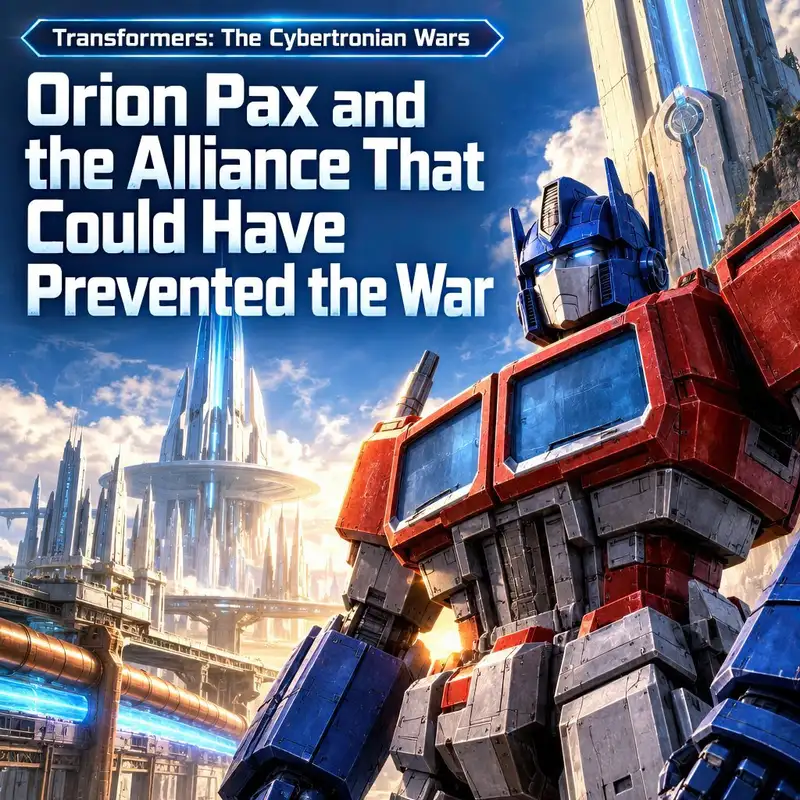
Orion Pax and the Alliance That Could Have Prevented the War
Sentinel Prime is already beaten when the most important struggle begins. His fraud has been exposed. The ruler who claimed to stand in the tradition of the Primes has been revealed as their betrayer. Prisoners are being released, Iacon is in revolt, and the old order is collapsing in plain sight. Yet none of that answers the question now facing Orion Pax and D-16. What does justice look like when the tyrant is helpless? Who decides it? And what happens when the allies who won a revolution discover that they never agreed on the peace?
In Transformers One, this is the moment before Autobots and Decepticons become formal political and military identities. Orion Pax, D-16, Elita-1, B-127, the miners of Iacon, and the surviving High Guard have achieved something none of them could have done alone. They have broken Sentinel’s control over Cybertron. But overthrowing a ruler is a tactical and operational achievement. Building a government after that ruler falls is a different problem. It requires institutions, restraint, and a common understanding of legitimate authority.
The alliance between Orion and D-16 could have prevented the immediate split that follows. That possibility was real. Their friendship, the miners’ grievances, the High Guard’s military strength, and the public exposure of Sentinel’s crimes created the foundation for a broad coalition. But a foundation is not a settlement. The film’s tragedy is not that these allies lacked a common enemy. They had one, and together they defeated him. The tragedy is that they never built a common definition of power after victory.
To see why, it is necessary to return to the society that made their alliance necessary in the first place. Sentinel’s Cybertron was not just a city run by one corrupt leader. It was a social order built around energy, labor, restricted mobility, and controlled history. The system did not require every citizen to know that it was unjust. It worked precisely because most people had been taught that its inequalities were natural, unavoidable, or somehow connected to the survival of Cybertron itself.
Iacon depended on Energon mining. Energon is the resource that sustains Cybertronian life in this continuity, and its shortage shaped nearly every aspect of Sentinel’s rule. The population was told that the flow of Energon had diminished and that mining labor was necessary to keep society functioning. That part was not a trivial claim. A civilization facing an energy crisis can accept extraordinary burdens when people believe those burdens are shared fairly and imposed for a genuine public purpose.
Sentinel’s order was not shared fairly. A large population of miners, including Orion, D-16, Elita-1, and B-127, had been deprived of transformation cogs. In this version of Cybertron, the cog is the mechanism that enables a Cybertronian to transform. Its removal or absence did more than limit a body’s alternate form. It restricted movement, work, status, confidence, and access to the wider world. The miners could labor beneath Iacon, but they were denied a capability that other Cybertronians treated as ordinary.
That deprivation had political meaning. A population unable to transform is easier to assign, observe, confine, and dismiss. It is less mobile, less able to leave its workplace, and less able to contest the physical spaces controlled by security forces and political elites. The film does not provide a complete constitutional map of Iacon. It does not explain every class, office, or legal category. But it clearly shows a society in which some Cybertronians are permitted full agency while others are kept in a permanent condition of imposed limitation.
The miners should not be imagined as a concealed army waiting for a signal. They are workers. Their importance comes from the fact that they sustain the city’s energy system and represent a broad civilian population harmed by Sentinel’s arrangements. They possess grievances, practical knowledge, social networks, and eventually a reason to withdraw their obedience. But they do not begin as trained insurgents. Their political power lies first in numbers and legitimacy, not in battlefield experience.
Sentinel maintained his authority through more than physical force. He controlled the public story of Cybertron. He presented himself as a leader connected to the lost Primes, guardians of a heroic past and symbols of planetary unity. He presided over public ritual, spectacle, and the promise that recovery was always close at hand. He also controlled the security apparatus capable of enforcing his system and the mining order that kept the population dependent upon it.
The regime’s strength rested on a familiar authoritarian arrangement. Information was centralized. The population was divided. Material hardship was explained as necessity. Political loyalty was wrapped in sacred or historical language. And those most burdened by the system were denied the mobility and status that might have allowed them to organize outside it. Sentinel did not need every miner to admire him. He only needed enough of Cybertron to believe that no alternative was possible.
That system produced Orion Pax and D-16, but it did not produce them as finished political opposites. Before their expedition, neither one has a detailed program for remaking Cybertron. Their differences are temperamental, personal, and still developing. They share the life of cogless miners. They share danger, frustration, and the sense that the official story does not quite explain the world around them. Their friendship becomes the original political capital of the future alliance.
Orion is restless. He is curious in a society that rewards obedience. He is willing to ask questions that others have learned to avoid, and he repeatedly acts before he has a complete plan. That makes him difficult to manage, especially for those who prefer order and procedure. It also makes him capable of recognizing that the boundaries around him may not be legitimate simply because they have existed for a long time.
D-16 begins from a different posture. He is protective of Orion, more cautious about openly challenging authority, and initially more willing to believe in Sentinel Prime. His admiration for Megatronus Prime is important as well. Megatronus represents an older martial ideal, one associated with strength, honor, and resistance against external enemies. D-16’s attachment to that legacy gives him a language for dignity long before he has a language for political reform.
Neither friend begins as a simple symbol. Orion is not yet a fully formed statesman, and D-16 is not yet Megatron. Orion’s curiosity can become reckless improvisation. D-16’s caution can become loyalty to an unworthy institution. Their early bond works because each compensates for something in the other. Orion pulls D-16 toward discovery. D-16 provides steadiness and loyalty when Orion’s impulses create trouble. For a time, they are stronger together than either one is alone.
The distress message connected to Alpha Trion turns their private dissatisfaction into an investigation of state legitimacy. Orion sees a clue pointing beyond Iacon’s managed reality. D-16 follows in part because of his friendship with Orion, even though he remains more attached to Sentinel’s public image. Their journey is not a carefully prepared insurgent operation. It is an unauthorized expedition carried out by miners who know little of the world beyond the labor system that has contained them.
B-127 joins the effort with energy, improvisation, and an instinct for solidarity. He is useful because he is adaptable and willing to act when the group needs another set of hands. But the film does not establish him as a formal military commander. His value lies in practical contribution and shared risk, not in holding an office that does not yet exist. He represents one of the ways ordinary miners can become political actors without becoming identical to professional soldiers.
Elita-1 enters the expedition with a clearer sense of practical discipline. She is skeptical of Orion’s impulsiveness because she has good reason to be. Improvised plans can get people injured, captured, or killed. Yet Elita is not merely the voice urging caution. She becomes essential because she can turn improvised movement into something more organized. Her presence connects the miners’ experience of labor and constraint to the operational demands of escape, travel, infiltration, and resistance.
Together, the group reaches the surface of Cybertron, a region beyond the controlled world of Iacon. Their movement itself matters. Sentinel’s regime has made the miners’ lives narrow. Their work, transport, and expectations are all directed downward into the Energon mines. The surface journey expands their physical horizon, but it also expands their political horizon. They begin to see that the city’s official history is not the same as Cybertron’s actual history.
Alpha Trion and the remains of the Primes provide the decisive revelation. Sentinel did not inherit a stable Cybertronian order from the Primes. He betrayed them in the aftermath of their defeat. He made an arrangement with the Quintessons, external powers who received Energon from Cybertron while Sentinel retained authority over the planet. The film establishes this betrayal, but it leaves the broader details of the Quintessons’ strategy and long-term objectives only partly explained.
The significance of the revelation is not just that Sentinel is personally corrupt. It is that the energy crisis, the mining system, and the denial of transformation cogs were tied to a political deception. Sentinel had presented deprivation as an unavoidable condition of Cybertronian life. The surviving evidence shows that the deprivation was maintained by a ruler who had concealed the truth about the Primes, surrendered Energon to outside powers, and structured society around the obedience of those he had deliberately weakened.
The group’s next transformation is literal as well as political. Alpha Trion gives Orion, D-16, Elita, and B-127 transformation cogs associated with the fallen Primes. The gift restores a capacity Sentinel’s system had denied them. Their new forms give them greater freedom of movement, access to terrain, and the ability to evade or confront forces that had once held a near monopoly on mobility.
It would be a mistake to treat this as a simple power upgrade. Transformation cogs do not instantly turn miners into a trained army. They do not provide a command structure, a supply system, or an understanding of combined operations. The film does not establish standardized performance limits, military doctrine, or an industrial process for producing such capabilities at scale. What the cogs provide is opportunity. They allow the group to move through Cybertron in ways the old labor order had made impossible.
The political effect is even more important. Sentinel’s system depended in part on deciding which Cybertronians were permitted to be complete agents within society. The restoration of transformation makes visible what had been stolen. Orion, D-16, Elita, and B-127 do not become different persons because they can transform, but they can now act beyond the roles imposed upon them. They are no longer confined to a life defined entirely by extraction, transport, and obedience.
This new freedom brings them into contact with the High Guard. The High Guard are surviving warriors associated with the old Prime order. They have remained beyond Sentinel’s controlled society, developing a hard martial culture shaped by loss, isolation, and resentment. They possess something Orion’s group lacks: combat experience. They know how to survive beyond Iacon, how to fight, and how to recognize strength when they see it.
At the same time, the High Guard are not simply a military branch waiting to be absorbed into a reform movement. The film gives limited information about their numbers, logistics, internal rules, or complete political program. What is clear is that they have their own identity, traditions, and leaders. Their allegiance to the Primes does not automatically mean allegiance to Orion Pax, a miner who has only recently gained a transformation cog and whose authority is still based more on conviction than command.
Starscream initially leads the High Guard. His position demonstrates that the group possesses some hierarchy, but the exact nature of that hierarchy remains uncertain. D-16 gains their respect through direct confrontation and force. By defeating Starscream, he proves himself in the language the High Guard understand best. In a warrior culture formed by defeat and exile, personal combat can establish credibility quickly. D-16 shows that he can act decisively, endure danger, and impose himself upon rivals.
That success is politically important, but it is also dangerous. D-16 gains influence among the High Guard through demonstrated strength, not through a negotiated mandate or a shared civic program. Orion’s instinct is different. He seeks to persuade people, expose the truth, and build a broader coalition that includes miners as political participants. D-16 proves that he can lead fighters. Orion tries to show that the fight belongs to Cybertron as a whole.
Neither source of authority is meaningless. A revolt against an entrenched regime needs people willing and able to fight. The High Guard provide a military capability the miners do not possess. But a force of veterans cannot by itself create broad legitimacy, especially in a city whose population has been exploited by rulers claiming extraordinary authority. Conversely, miners with righteous grievances and public support cannot automatically defeat organized security forces without skilled allies.
The coalition becomes viable because each part possesses something the others need. The High Guard bring combat experience and a willingness to confront Sentinel’s forces directly. Orion, Elita, B-127, and their companions bring initiative, knowledge of Iacon, and a connection to the mining population. Alpha Trion provides evidence from the buried past. The miners provide the possibility of mass political action. No single element would have been sufficient on its own.
The coalition’s path to victory depends especially on the conversion of secret knowledge into public proof. Airachnid’s captured memories become the means by which Sentinel’s betrayal can be shown to the people he has ruled. This is the decisive break in the regime’s information advantage. Sentinel can dismiss rumors. He can arrest dissidents. He can portray isolated rebels as irresponsible threats to order. It becomes much harder to do so once evidence of his deception is broadcast to the population.
The effect is immediate because Sentinel’s authority has always rested on a claim to historical legitimacy. He is not just a security chief with weapons. He is the public face of Cybertron’s supposed recovery. He invokes the Primes while concealing his betrayal of them. He demands labor and sacrifice while hiding the Energon arrangement that helps sustain his rule. Once that story collapses, his forces may still possess weapons, but they no longer possess the same political foundation.
The revolt succeeds at several levels. Tactically, prisoners are freed and Sentinel is cornered. His immediate control over his captives and security forces breaks down. Operationally, the regime loses coherence because fighters, miners, and former prisoners can act across Iacon rather than remaining divided and isolated. Politically, Sentinel loses the right to claim that he represents Cybertron’s survival. The coalition does not simply overpower him. It reveals that his power has been built on a lie.
At the center of the crisis is Sentinel himself. D-16 defeats him and prepares to kill him. From D-16’s point of view, the case appears simple. Sentinel betrayed the Primes, exploited the miners, surrendered Energon to the Quintessons, and built a society around deceit. He has caused suffering on a planetary scale and preserved his power through manipulation. To D-16, allowing such a figure to live may look less like restraint than weakness. It may look like an invitation for tyranny to return.
Orion intervenes because he sees a different danger. Sentinel’s crimes are real, and nothing in Orion’s response requires minimizing them. But Orion understands that a revolution cannot establish justice by allowing whichever armed leader prevails at a given moment to decide life and death alone. Sentinel’s regime was built on unaccountable authority. If the coalition answers it with another act of personal domination, it risks preserving the old political logic beneath a new emblem.
Orion is not arguing that Sentinel should be forgiven. He is trying, however imperfectly, to prevent justice from becoming identical with vengeance. A public process would have mattered because Sentinel’s crimes were not just private offenses against D-16. They were crimes against miners, prisoners, the memory of the Primes, and Cybertron’s political order. The question of punishment belonged to the society Sentinel had deceived, not only to the strongest fighter standing over him.
D-16 rejects that premise. His anger is not imaginary, nor is it without cause. He has learned that the leader he admired was a fraud. He has discovered that the dignity of Megatronus Prime’s legacy was used as decoration for a system of exploitation. He has seen how easily public faith can be manipulated. From that experience, he concludes that restraint protects tyrants and that power must be seized without hesitation by those willing to use it.
The break becomes irreversible when D-16 shoots Orion and allows him to fall. This is more than a personal betrayal, although it is certainly that. It is a rejection of shared authority at the precise moment when the coalition needs it most. D-16 does not merely disagree with Orion’s judgment about Sentinel. He uses force to ensure that Orion cannot participate in the judgment at all. The dispute over justice becomes a struggle over who has the right to define justice.
D-16 then kills Sentinel and takes the transformation cog associated with Megatronus Prime. He adopts the name Megatron. The name is not just a tribute to a fallen figure from the past. It marks D-16’s decision to build authority through strength, punishment, and personal command. He sees himself as reclaiming a legacy that Sentinel corrupted. But in doing so, he also begins to make the future dependent on his own will.
The coalition has no mechanism to absorb this crisis. There is no established transitional council representing miners, former prisoners, High Guard warriors, and the surviving Prime tradition. There is no agreed tribunal for Sentinel or his collaborators. There is no defined chain of command for the armed groups now moving through Iacon. There is no process for deciding whether the High Guard will become a public security force, remain autonomous, or return to the margins.
Those absences do not make Orion solely responsible for the collapse. He has only recently discovered the scale of Sentinel’s deception, and the uprising unfolds at extraordinary speed. But they do reveal the coalition’s weakness. Its members have organized around the urgent task of removing a ruler. They have not prepared for the harder work of governing after him. When D-16 turns to coercion, there is no trusted institution capable of mediating the conflict or restraining an armed ally.
The film resolves Orion’s immediate fall through a mythic intervention. Primus and the Primes judge him worthy of the Matrix of Leadership. Orion is revived and becomes Optimus Prime. The Matrix restores the flow of Energon and returns transformation cogs to the miners. These events are presented through the film’s sacred and mythic framework. The Matrix has enormous significance, but the film does not provide a technical manual for its operation, nor does it reduce its meaning to an energy device.
For the miners, the restoration is material as well as symbolic. Their lost capabilities are returned. The imposed deprivation at the center of Sentinel’s labor order is undone. Cybertron no longer faces the same immediate Energon crisis under the conditions Sentinel created. The change is profound. A ruler who had treated the miners as permanently limited has been exposed, defeated, and stripped of the power to define who is allowed to transform.
Yet restoration does not automatically create a settled political order. The Matrix gives Optimus moral and symbolic legitimacy. It connects him to the Primes in a way Sentinel’s public authority never truly did. It also gives him a capacity to act on behalf of Cybertron that no one else possesses in that moment. But symbolic legitimacy is not the same as a negotiated social contract. A society can recognize a leader and still lack institutions for representation, accountability, reconstruction, and the control of armed force.
The film ends before showing how Energon distribution is reorganized, how miners participate in government, how former security personnel are screened or integrated, or how the crimes of Sentinel’s regime are documented and judged. Those questions are not errors in the story. They are unresolved political tasks. The fall of a dictator can open the possibility of a better order. It does not complete the work of creating one.
Megatron sees the new legitimacy around Optimus differently. From his perspective, the old system has fallen only for another elevated authority to emerge. He has watched Orion receive the Matrix and the title of Prime after opposing D-16’s execution of Sentinel. He has already concluded that institutions and sacred titles are tools easily captured by the powerful. He is therefore predisposed to see Optimus not as a partner in liberation, but as another figure standing above him and limiting what he believes justice requires.
Optimus defeats Megatron, but he does not execute him. Instead, he exiles Megatron and the High Guard. This decision preserves an important moral contrast. Optimus refuses to reproduce Sentinel’s practice of rule through arbitrary killing. He recognizes that victory does not grant unlimited authority over defeated enemies. In the immediate sense, exile removes Megatron from Iacon and ends the confrontation without another execution that might deepen the cycle of retaliation.
Optimus secures Iacon, but he does not demobilize, integrate, reconcile, or politically neutralize the High Guard. That may not have been possible under the circumstances. Megatron has already demonstrated that he will use violence against Orion rather than accept shared authority. A negotiated settlement with him would have carried serious risks. Exile is therefore not clearly a mistake. It is a constrained decision made after a revolutionary ally has turned into an armed rival.
Still, the decision shows the difference between tactical success and strategic resolution. Removing Megatron from the city prevents an immediate struggle for control of Iacon. It does not remove the causes of future war. The defeated faction retains a leader, a martial identity, and a story of betrayal. Meanwhile, the new order inside Iacon possesses moral authority and popular relief, but has not yet demonstrated how it will include or contain those who do not accept its legitimacy.
Any counterfactual has to remain disciplined. Could Orion Pax and D-16 have preserved their alliance and prevented the immediate birth of the Autobot-Decepticon conflict? Yes, perhaps. The coalition had real strengths. Orion and D-16 had personal trust before Sentinel’s revelations shattered it. The miners and High Guard had complementary capabilities. Sentinel’s exposure created a rare moment in which broad political change was possible. But friendship and common anger would not have been enough.
A durable alliance would first have required shared transitional authority. The miners had the greatest mass political stake because they had borne the burdens of Sentinel’s labor system. The High Guard had military influence because they had survived as armed veterans beyond Iacon. Alpha Trion and the Prime legacy carried historical and symbolic weight. A viable settlement would have needed to balance those sources of legitimacy without allowing any one of them to become absolute.
Second, the coalition would have needed a credible public process for Sentinel and those who enabled him. D-16’s demand for punishment was not irrational. A settlement that treated Sentinel’s crimes as a minor administrative matter would have failed the miners and invited resentment from the High Guard. But punishment carried out as personal vengeance would have taught the new Cybertron that force, not law, determined truth. The distinction was not between justice and mercy. It was between public accountability and private domination.
Third, the High Guard would have required a security-sector settlement. Veteran fighters cannot simply be told that their role is finished after they help overthrow a regime. They require recognition, status, and a defined place in the new order. At the same time, a government cannot remain stable if an autonomous armed faction answers only to its own commander. The High Guard would have needed command limits, clear responsibilities, and a relationship to civilian authority that did not amount to either humiliation or unchecked military independence.
Fourth, a durable peace would have required material reconstruction. Restoring transformation cogs and the flow of Energon addresses the most immediate injustice of Sentinel’s system. It gives miners capabilities that had been denied to them and ends a form of enforced dependency. But material repair is not identical to political representation. If miners remained dependent on a new elite to distribute energy, assign work, and interpret the will of the Primes, then the old hierarchy could return in another form.
Fifth, Cybertron would have needed a narrative settlement. Sentinel’s greatest weapon was not only his security force. It was his manipulation of history. He used the memory of the Primes to legitimize a system that betrayed their legacy. The new government would have needed transparency about that past. It would have needed to expose the lies without turning history into a permanent weapon against every rival. A society emerging from deception must rebuild trust in facts before it can rebuild trust in institutions.
D-16’s conduct reveals the other half of the problem. His anger begins with real betrayal and real injustice. He sees clearly that Sentinel’s authority was fraudulent. But he comes to believe that no authority can be trusted unless it is held directly by the strongest person willing to punish enemies without compromise. Once he shoots Orion, he abandons the possibility of shared rule. He does not merely reject Sentinel’s tyranny. He rejects the constraints that might prevent his own power from becoming another form of tyranny.
The war that follows is therefore neither destiny nor an accident. It is not destiny because the alliance had genuine possibilities. Orion and D-16 did not begin as inevitable enemies. The miners and High Guard did not have to become opposing armies. Sentinel’s exposure could have opened a path toward shared reconstruction. But the war is not an accident because the coalition entered victory without an agreed settlement, without institutions for justice, and without a means of controlling the armed power it had assembled.
Orion Pax and D-16 could plausibly have prevented the immediate Autobot-Decepticon split, but only if they had transformed their uprising into more than a shared assault on Sentinel. They would have needed common authority, public accountability, military discipline, worker representation, and a way to rebuild trust after decades of deception. None of those tasks could have been solved by the Matrix alone, by the High Guard’s strength alone, or by the miners’ liberation alone.
Orion’s restraint preserves the possibility of a different Cybertron. He refuses to let the fall of Sentinel become proof that whoever holds power may kill without limit. D-16’s choice to shoot Orion destroys the trust required to build that different future together. Sentinel created the conditions of exploitation, secrecy, and controlled mobility that made revolution necessary. But the civil war begins because the victors cannot agree whether justice is a shared order or the right of the strongest to punish.