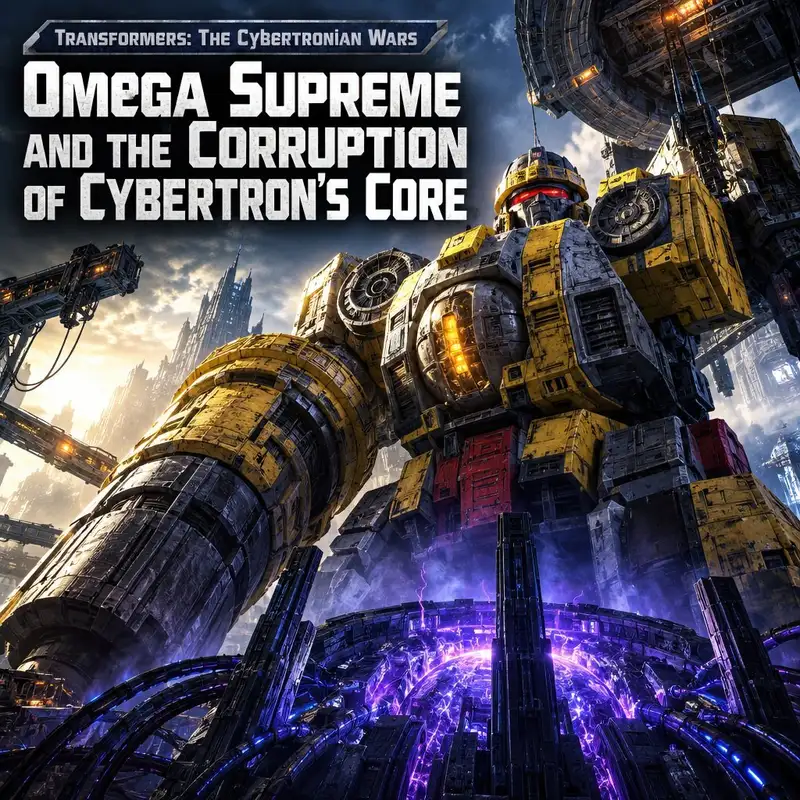
Omega Supreme and the Corruption of Cybertron’s Core
Omega Supreme fell beneath Iacon not because the Decepticons had simply found a weapon powerful enough to knock down a guardian, but because they had discovered what that guardian actually was. In High Moon Studios’ War for Cybertron, Omega Supreme stood between Megatron and the planet’s Core. He was a battlefield defender, certainly, but also the living authority required to reach Cybertron’s deepest systems. When he was driven into the lower levels of the planet, the Decepticons had done more than win an engagement. They had begun to dismantle the security architecture of an entire civilization.
The distinction matters. A fortress can be bypassed, surrounded, or reduced. A guardian who is also part of the access system presents a different problem. Megatron could not just march an army into the Core. He needed a chain of access, and every link in that chain had to be captured, broken, or turned against its original purpose. The campaign against Omega Supreme was therefore not an isolated duel with an exceptionally durable Autobot. It was a struggle over who could command Cybertron’s life-support system.
The setting here is the Cybertronian civil war depicted in the console and PC version of War for Cybertron. It belongs to the broader Aligned project, but the game’s own campaign controls this account. Its Dark Energon, its Omega Supreme, and its final crisis at the Core should be understood on the game’s terms. This is a pre-Earth war, fought while Cybertron is still the center of both factions’ political ambitions and industrial power. Neither side has yet accepted that their homeworld may become impossible to inhabit.
Megatron’s objective was larger than battlefield victory. He wanted command over Cybertron itself. In a conventional campaign, that might mean taking cities, destroying enemy formations, securing mines, or forcing a political surrender. Megatron pursued all of those pressures where they served him, but Dark Energon offered something more ambitious. It promised a means to corrupt systems rather than merely capture them. If Cybertron’s internal energy network could be bent to Decepticon control, then the planet might become an instrument of Decepticon rule.
That ambition began with a resource problem. Dark Energon was powerful, unstable, and dangerous to handle. The game presents it not as ordinary fuel, but as a corrupting substance with military and political value precisely because it could alter the systems exposed to it. A limited cache could enable raids, experiments, or a temporary advantage. It could not, by itself, sustain a planetary campaign. Megatron needed more than possession. He needed access, transport, production, and a way to apply this dangerous resource against targets that conventional firepower could not reliably overcome.
The first crucial figure in that supply problem was Starscream. Before he became part of Megatron’s force, Starscream held control over an orbital Dark Energon facility and possessed knowledge that Megatron lacked. His position was not simply that of a subordinate waiting for a new master. He was a guardian of a strategic resource, and his decision to cooperate with Megatron was opportunistic. It gave Megatron access to a rare capability, but it did not create a stable or unified Decepticon political order. It created a partnership built on utility, fear, and the expectation that power would be shared only as long as both parties found it useful.
Megatron’s raid on the orbital facility demonstrated an old military principle in an unfamiliar setting. A resource is not strategically decisive merely because it exists. It becomes decisive when an organization can extract it, move it, protect it, process it, and employ it faster than its opponent can disrupt the chain. Dark Energon in storage was a prize. Dark Energon linked to Decepticon production and operations became a campaign capability. Megatron was not collecting an artifact for prestige. He was building the means to alter the balance of the war.
The Energon Bridge was central to that change. Once activated, it allowed raw Energon to reach the Decepticon production system. The exact mechanics matter less than the strategic function. The bridge connected source and industry. It reduced dependence on a single captured reserve and gave the Decepticons a more durable supply arrangement. A faction that can keep its weapons, repairs, transport, and manufacturing systems functioning has options that a raiding force does not. It can choose where to concentrate. It can sustain pressure. It can recover from losses that would otherwise end the offensive.
This did not mean that Megatron had solved every logistical problem. Dark Energon remained hazardous and exceptional. Nothing in the game suggests that it became a routine fuel, safe for general consumption or easy to integrate across Cybertronian society. But it gave Megatron a tool that ordinary Energon did not. He could use it not only to empower his own forces, but to compromise the systems on which his enemies depended. That made Dark Energon especially useful against fixed infrastructure, defensive networks, and guardians designed around predictable sources of power.
With a supply route established, Megatron faced the next problem. Cybertron’s Core was not open to an army simply because that army possessed weapons and energon. It was protected by an access architecture. The route ran through Iacon, the Omega Key, Omega Supreme, and the Omega Gate. To reach the Core, Megatron had to understand the logic of that system and then reverse it. His target was not just territory. It was the authority to enter the part of the planet that governed the conditions of life across it.
Iacon mattered because it was an Autobot political and defensive center. The city represented more than a concentration of troops. It was a place where command, legitimacy, security, and strategic infrastructure met. When Megatron attacked Iacon, he was attacking an institution as much as a location. A successful assault could weaken Autobot field forces, but it could also sever their ability to protect the systems that gave their government practical meaning.
Zeta Prime led the Autobots through this phase of the crisis. His defeat was therefore more consequential than the loss of one commander in battle. It removed established leadership during a planetary emergency and opened a gap between Autobot authority and Autobot capability. A council may retain the legal power to appoint leaders, issue orders, and preserve continuity. It cannot restore destroyed defenses by decree. Zeta’s loss created a command transition at the same time that Megatron was driving toward Cybertron’s most vital internal systems.
The artifact taken from Iacon was called the Omega Key, but its name could mislead anyone expecting a simple mechanical device. It was not a key that opened the Omega Gate on its own. Its role was to summon or activate the being who could do that. The key brought Omega Supreme into the conflict. In effect, it activated the final obstacle Megatron had to overcome. The Decepticons had seized an important piece of the system, only to reveal the guardian built into that system’s defense.
This was a moment where intelligence mattered more than spectacle. Megatron’s force understood that the Omega Key did not grant instant entry to the Core. It called forth Omega Supreme, and Omega was designed to prevent precisely the kind of intrusion Megatron intended. The Decepticons had gained access to the challenge, not access to the prize. They now had to defeat a guardian whose strength, defensive systems, and knowledge of the approach made a direct assault deeply unattractive.
Omega Supreme’s power was operational rather than merely visual. His scale allowed him to dominate the immediate battlespace. His defensive systems made the approach to the Core dangerous. His presence also imposed a command problem on the Decepticons. A small strike team could not treat him like an ordinary opponent. They could not assume that concentrated fire would be enough, or that a brief engagement would prevent him from returning to his defensive role. Omega was not simply hard to destroy. He was positioned to deny movement through the terrain that mattered most.
A larger force might have changed the local balance, but committing a full army to the lower levels of Cybertron would have introduced other problems. The routes were restricted. The objective was sensitive. The Decepticons needed access to the Core, not indiscriminate destruction around it. They also needed to avoid creating damage that could block their own route. Megatron therefore relied on a coordinated assault group, including Soundwave and Breakdown, supported by the systems the Decepticons had captured along the way.
Soundwave’s contribution is significant because it shows that Omega’s defeat was not achieved through Megatron’s personal power alone. The Decepticons studied the guardian’s defensive arrangement and exploited weaknesses in the environment around him. Captured Autobot turrets became part of the ambush. That was a practical use of enemy infrastructure. Fixed defenses are normally strongest when they are integrated into the plans of the force that built them. Once seized, their fields of fire, power systems, and positions can become liabilities for the original defenders.
The tactical lesson is not that fixed defenses are inherently weak. It is that they require secure command, secure identification, and a reliable understanding of who controls the surrounding terrain. Omega could withstand tremendous pressure, but he could not make every firing angle irrelevant. The Decepticons used the geometry of the battlefield to concentrate attacks against exposed systems. They made the approach itself hostile to the guardian. A smaller force compensated for its lack of mass by exploiting prepared positions and better local information.
When Omega was first brought down into Cybertron’s lower levels, Megatron had achieved an important tactical result. He had removed the immediate obstacle between his force and the deeper route to the Core. But he had not yet gained control of Omega Supreme. He had not even necessarily made the guardian permanently incapable of fighting. The distinction between disabling an asset and controlling it is essential. In a war involving repairable, adaptable Cybertronians, an enemy who falls may return with a different configuration, a different plan, or a renewed connection to the systems that sustain him.
Omega did return. In robot mode, he continued the fight, and the Decepticons faced a second operational problem. Omega could draw power from Energon batteries and recover his combat effectiveness. That support relationship made sense for a guardian operating near vital planetary infrastructure. A defender stationed at a fixed access point needs more than armor and weapons. He needs a protected means of sustaining operations. Yet the same support system that gives a defender endurance can become a vulnerability if an enemy can predict and compromise it.
Megatron’s force responded by turning Omega’s recovery cycle against him. First, they disabled exposed defensive systems that could interfere with the operation. Then they identified the Energon reserves on which Omega depended. The batteries were corrupted with Dark Energon. When Omega drew power from them, the corruption entered his systems. This was not just a stronger attack. It was counter-repair warfare. The Decepticons had found a way to make recovery itself dangerous.
The comparison is not exact, but the military function is familiar. An army that relies on a depot, a repair yard, or a medical station may be vulnerable if those facilities are sabotaged, contaminated, or captured. The danger does not always come from an attack on the frontline. It can come from an attack on the system that restores the frontline after damage. Omega’s dependence on nearby Energon reserves gave him resilience, but it also created a point where the Decepticons could trade their scarce Dark Energon for an effect disproportionate to its quantity.
Omega’s size intensified that problem. He was difficult to conceal, difficult to reposition quickly through confined terrain, and dependent on systems large enough to support him. His role was built around persistence at a known location. That made him formidable as a guardian and vulnerable as a fixed strategic asset. A mobile strike team could study his pattern, maneuver around exposed systems, and choose when to exploit the infrastructure he required. The battle was not a referendum on whether Omega was strong. It was an argument about whether strength could survive a compromised support network.
Once Dark Energon had weakened Omega, Megatron crossed a more serious line. He did not merely leave the guardian damaged. He forced Dark Energon into him and used the corruption to compel access to the Omega Gate. Omega Supreme was a sentient being. His body was not just a piece of equipment that could be repurposed without consequence. The Decepticons turned a guardian into a coerced instrument, using his own role and systems against the planet he was built to defend.
The chain of access was now complete. The Omega Key activated Omega Supreme. Omega Supreme could open the Omega Gate. The gate led to Cybertron’s Core. Each stage depended on the previous one. Megatron’s achievement was not just that he defeated a powerful Autobot. He penetrated a layered defense system by capturing its activation mechanism, defeating its guardian, corrupting its power supply, and coercing the guardian into performing the final access function.
This was infrastructure warfare in its most ambitious form. Megatron did not need to occupy every city, defeat every Autobot unit, or establish a functioning civilian government before reaching the Core. He had found a route around the normal sequence of conquest. If the Core could be controlled, then the planet’s systems might compel obedience more effectively than an army could. The Decepticons could claim not only military superiority, but authority over the conditions under which Cybertronian society operated.
At the Core, Megatron introduced Dark Energon into the planet’s internal system. The game presents the Core as a sentient or semi-sentient planetary entity, not merely a mine, reactor, or computer terminal. Its exact nature should not be simplified beyond that. What matters strategically is that it was bound to Cybertron’s condition. To corrupt the Core was to compromise the system on which the planet’s broader life and energy depended.
The effects gave Megatron the appearance of total victory. Conventional defenses had been bypassed. The Autobot guardian had been coerced. The route to the deepest planetary system was open. The Core itself was infected. From the Decepticon point of view, political and military power seemed finally to converge. They were no longer merely contesting cities and supply lines. They appeared to command the machinery beneath every city, every supply line, and every defensive position.
But possession of a system is not the same as control over its consequences. A ruler can seize a power grid, a water system, or a transport network and still discover that the network cannot sustain the population if it has been damaged beyond safe operation. Megatron’s strategy assumed that Cybertron’s internal systems could be made to serve Decepticon victory. It did not adequately account for the possibility that corrupting those systems would destroy the basis for any durable victory at all.
For Cybertronian civilians, this was not an abstract dispute over ancient power. A planetary system in crisis threatens energy access, repair, mobility, shelter, industrial work, and social continuity. The game does not provide a census of individual civilian experiences, and there is no reason to invent one. But the consequence is clear. A world that cannot sustain its population cannot be politically stabilized by changing who controls its military command. The conflict had moved beyond the question of who would govern Cybertron. It had become a question of whether Cybertron could continue to support anyone.
The Autobot response began from a position of severe disadvantage. Zeta Prime was gone. Iacon had been struck. The Decepticons had breached a defense thought to protect the planet’s deepest systems. Under those conditions, the Autobot High Council elevated Optimus. At this point in the game’s history, Optimus was an Autobot commander, not an already unquestioned planetary leader. His elevation was both a political act and an emergency measure. The council needed someone who could exercise command when the established order had been shattered.
That recognition mattered, but it did not solve the military crisis. Political legitimacy can clarify responsibility. It can give a commander the authority to act, coordinate survivors, and speak for an institution in danger of collapse. It cannot restore a guardian, purge corruption, or reopen a route through enemy-held territory. Optimus inherited a system already in failure. His task was not to reclaim a stable Cybertron from Megatron. His task was to determine what could still be saved.
The mission to the Core required a limited but demanding operation. Optimus, Ironhide, and Warpath had to reach an approach now converted into a Decepticon stronghold. They had to break through a defended route, free Omega Supreme from Decepticon control, protect Ratchet while he carried out repairs, and restore enough of the guardian’s function to regain access to the Core. None of those tasks could be treated as incidental. A successful assault without repair would leave Omega unable to perform the function the Autobots needed. Repair without security would expose Ratchet and the damaged guardian to renewed attack.
Ironhide and Warpath represent the practical requirement for combat support. Optimus’s authority and decision-making mattered, but neither could substitute for the team needed to force a path through defenses. The objective demanded fighters who could secure terrain, hold off Decepticon pressure, and create the time required for technical work. In this kind of operation, firepower is valuable because it protects access to the specialist who can restore the critical system.
Ratchet’s role is equally important. Recovering Omega did not mean Omega was immediately ready for service. The guardian had been damaged, corrupted, and used by the enemy. Restoring him required technical knowledge, time, and protection. That is the often overlooked reality of Cybertronian war. Repair is not magic simply because damaged bodies can sometimes be restored. It depends on personnel, functioning equipment, available parts or energy, a secure work area, and enough time to complete the task before the enemy intervenes.
The Autobots achieved a tactical success when they freed Omega and secured the route. They achieved an operational success when Omega could once again provide the access the Decepticons had stolen. Yet recovering the gate did not reverse the central disaster. The Core had already been infected. The Autobots had regained the ability to speak with Cybertron’s deepest system, but they had not regained a healthy planet. Their victory was necessary, but it was not sufficient.
The Core’s diagnosis transformed the meaning of the campaign. Dark Energon corruption could not just be removed as though it were a localized malfunction. The damage had reached too deeply into the planetary system. The Core concluded that it had to reboot. That process would purge the corruption, but it would also leave Cybertron cold, barren, and unable to sustain its population for millions of years. The exact scale of energy loss or the number of people affected is not established with useful precision. The strategic conclusion, however, is unmistakable. Cybertron could survive only by becoming temporarily unlivable.
This was the point at which Megatron’s apparent total victory became a strategic catastrophe. He had sought to make the Core enforce Decepticon dominance. Instead, the Core’s recovery required a shutdown that denied normal life to both factions. The Decepticons had seized the machinery of the planet, but they had not gained a functioning world to rule. Military possession had failed to become political control because the system being possessed was inseparable from the survival of the population.
Optimus faced the opposite kind of decision. He could not preserve Cybertron in its existing state. That option was already gone. The choice was between allowing corruption to spread unchecked or accepting a reboot that would preserve the possibility of future recovery while imposing immediate civilizational displacement. The Core bestowed upon him a portion of its power and the Matrix of Leadership. In this moment, the Matrix was not merely an honor or a badge of rank. It represented a transfer of responsibility during a crisis in which no outcome was clean.
The political weight of that transfer should not be overstated into a universal myth about every Matrix in every Transformers continuity. In this account, its importance lies in the decision it accompanies. Optimus receives authority at the moment when authority means accepting loss. He is not given a restored planet, a decisive army, or a simple instrument for defeating Megatron. He is given responsibility for a people whose world can no longer sustain them in the near future.
That is why the Core’s reboot matters beyond its immediate technical effect. It changes the strategic purpose of the war. Before the reboot, both Autobots and Decepticons can still imagine victory as control of Cybertron. After the reboot begins, the urgent problem becomes survival beyond Cybertron. The conflict will continue, but the homeworld that gave both factions their industrial base, political center, and cultural foundation can no longer function as it did. The war becomes a struggle conducted in the shadow of displacement.
For civilians, soldiers, engineers, medics, and political institutions, that consequence is immense. Evacuation is not a simple military withdrawal. It requires ships, routes, command decisions, energy, repair capacity, protection for noncombatants, and some answer to the question of who is entitled to leave and where they can go. It creates opportunities for panic, coercion, abandonment, and factional exploitation. The game establishes the beginning of that crisis, not a neat completion of it. Cybertron does not empty overnight, and the civil war does not end because the planet begins shutting down.
The conditions created here lead toward the later evacuation struggle depicted in Fall of Cybertron, but this campaign should not be reduced to a prologue for that later story. Its own significance is clear. Megatron’s Dark Energon offensive demonstrates how a faction can seek victory by attacking not only enemy soldiers, but the systems that make a society possible. It also shows why this approach can become self-defeating. Infrastructure is not neutral ground. It is connected to the people, industry, energy, repair, and political order that any victor must eventually sustain.
The levels of outcome make the contradiction plain. Tactically, the Decepticons defeated Omega Supreme, breached the route to the Core, and infected it. The Autobots later freed Omega and regained the route. Operationally, Megatron’s network of Dark Energon supply, captured access systems, and corruption disrupted Cybertron’s defenses at their foundation. The Autobots restored access, but they could not restore normal planetary function. The damage had moved beyond what a battlefield counterattack could repair.
Strategically, Megatron won access to the world he wanted to dominate while helping render that world incapable of supporting his rule. Politically, Zeta Prime’s death created a leadership crisis, and Optimus’s elevation gave the Autobots a new center of legitimacy during catastrophe. For Cybertron’s population, the result was neither a Decepticon peace nor an Autobot restoration. It was the prospect of a homeworld forced into shutdown and a people facing long-term exile.
Omega Supreme stands at the center of that history because he embodied all three levels of the conflict. He was a combat asset capable of stopping a strike force. He was an access mechanism capable of opening the Omega Gate. And he was a living safeguard within Cybertron’s planetary defense system. Defeating him mattered because he was not just one defender among many. He was the final guardian whose body, authority, and function connected the outer war to the Core itself.
Megatron turned Cybertron’s Core into a weapon by building a chain. He acquired Dark Energon. He connected resource access to Decepticon production. He attacked Iacon’s protective authority. He seized the Omega Key. He studied and ambushed Omega Supreme. He corrupted the guardian’s recovery system. He forced Omega to open the gate. Then he introduced corruption into the planetary system that sustained Cybertronian life. Each step depended on the last, and none of them was enough alone.
The campaign proved that a revolutionary army could seize the machinery of a civilization without first conquering every part of that civilization. It also proved that domination of essential infrastructure can become a form of self-destruction when the infrastructure is inseparable from the people one intends to rule. Omega Supreme was the gate, but the Core was the prize, and the corruption of that prize left both sides fighting over a world that could no longer sustain the civilization they claimed to be saving.