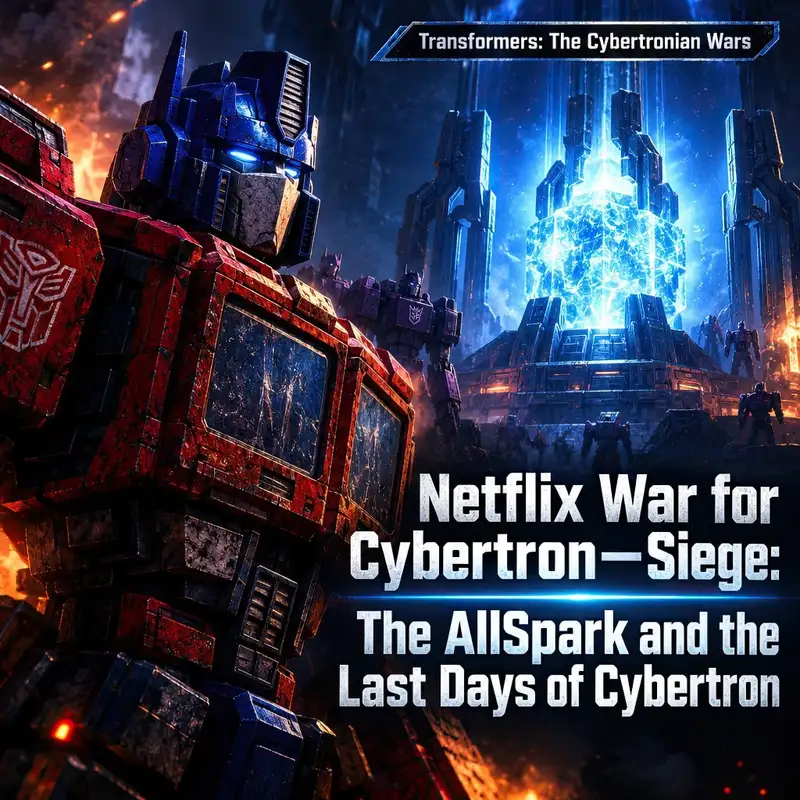
Netflix War for Cybertron—Siege: The AllSpark and the Last Days of Cybertron
Megatron’s offer of peace arrives when peace is already difficult to imagine. Cybertron is scarred by a civil war that has consumed its energy reserves, damaged its cities, and divided its people into armed camps. The Decepticons hold the initiative. The Autobots survive through dispersed resistance, anchored by the Ark and by a command structure under constant pressure. In Netflix’s War for Cybertron Trilogy, Siege presents this moment not as the beginning of war, but as its exhausted final phase on Cybertron.
Megatron proposes a treaty to Optimus Prime, but the proposal is not a bargain between equal political movements. It asks the Autobots to accept Decepticon supremacy. It promises an end to organized resistance, not a settlement that protects opposing beliefs, independent command, or the people who have refused Megatron’s rule. Optimus rejects the offer because he recognizes the distinction. A war can end when enemies negotiate limits on power. It can also end when one side loses the ability to remain itself. Megatron is offering the second kind.
The distinction matters because both leaders understand that Cybertron may not survive much more fighting. Energon is scarce. Military positions have become difficult to maintain. Damaged soldiers require parts, skilled labor, and secure repair facilities that neither side can treat as unlimited. Communications and transportation are vulnerable. Territory may still be claimed on a map, but a ruined outpost or a disconnected city cannot contribute much to a war effort. The crisis is no longer simply about winning another battle. It is about whether a functioning Cybertronian society can be recovered at all.
Ultra Magnus sees that danger clearly. He is not content to measure success by whether the Autobots can frustrate Megatron for another day. In his view, the survival of Cybertronian life may matter more than a military victory that leaves no viable planet to govern. That concern does not make him naïve. It makes him attentive to the strategic fact that resistance, however principled, cannot ignore the condition of the society for which it fights. The difficulty is that Megatron’s terms make survival inseparable from submission.
The AllSpark turns that already severe political crisis into something more dangerous. In Siege, it is presented as the source of Cybertronian life and power. The series does not fully explain its cosmological origin, and it does not require the audience to import another continuity’s account of Primus, Vector Sigma, or any other sacred or technological system. What matters here is direct and immediate. The AllSpark is bound to Cybertron’s ability to sustain its people. Whoever controls it gains influence over the future of the planet itself.
That makes it more than a resource stockpile. A mine can be seized, defended, sabotaged, or eventually reopened. A refinery can be rebuilt. The AllSpark is different because it stands at the intersection of energy, life, and political authority. Its possession would give Megatron a material advantage, but also a means of changing the terms under which opposition can exist. The Decepticon plan is not just to defeat the Autobots in the field. It is to use the AllSpark to reformat them into Decepticons.
Reformatting, in this context, is not ordinary repair or a voluntary change of body. It is a program of coercive conversion. It would eliminate Autobot resistance by changing the people who make that resistance possible. Megatron’s language remains the language of unity. He presents the continued existence of Autobots as the obstacle preventing Cybertron from becoming whole again. But the practical meaning of his unity is political homogeneity, enforced through the destruction or remaking of those who disagree with him.
Megatron claims that Optimus and the Autobots corrupted that legacy. In his telling, they have protected division, weakness, and the remnants of an unjust system. But revolutionary language can remain emotionally powerful even after a movement has changed its character. A leader who began by condemning oppression may later define all opposition as sabotage. A call for equality may become a demand for obedience. Siege does not require us to doubt that Cybertron had real grievances. It asks us to observe what Megatron does with power once he possesses it.
Ultra Magnus tries to discover whether the war can still be stopped before the AllSpark becomes the instrument of that power. He voluntarily surrenders to Megatron in the hope of opening negotiations. It is a serious gamble. Magnus offers the Decepticons a chance to treat an Autobot commander as a political interlocutor rather than as a target. He is betting that the cost of continued war has become obvious enough that Megatron might accept an end to the conflict short of annihilation.
Megatron imprisons Magnus and subjects him to interrogation. The treatment is politically revealing. Magnus is not handled as a representative of a legitimate opposing constituency, nor even as a captured commander whose surrender might create diplomatic opportunity. He is treated as an intelligence asset and a security threat. The Decepticon state that Megatron is building has little room for an opposition that retains independent judgment. Dissent is not something to be persuaded, represented, or outvoted. It is something to be broken.
Shockwave’s role deepens the danger. He provides evidence that the AllSpark exists and that it can support Megatron’s plan to reformat the Autobots. Shockwave does not just supply a weapon. He helps turn an ideological ambition into a strategic program. The distinction is important. Megatron provides the political objective: a Cybertron without Autobot opposition. Shockwave identifies a means by which that objective can be pursued at a scale ordinary battlefield victory cannot provide.
Magnus understands the implication and secretly warns Autobot Command. But the warning does not travel through an empty battlefield. It moves through networks watched by Soundwave, the Decepticons’ intelligence and communications specialist. Soundwave detects the transmission. The Decepticons do not just suppress it. They use it. They turn Autobot concern about the AllSpark into an opportunity to shape Autobot movement, draw forces into the open, and preserve Decepticon control of the initiative.
The result is an ambush near Iacon. The Autobots believe they are moving toward the AllSpark. Instead, they find concentrated energon and a prepared trap. The episode does not establish detailed force numbers or a conventional order of battle, but its operational meaning is plain enough. The Decepticons have converted superior information into positional advantage. They know what the Autobots are seeking, where they are likely to go, and how to make that urgency work against them.
The cost is not abstract. Impactor is critically damaged. Cog is badly injured. In a machine civilization, battlefield damage can take many forms, but repair still depends on time, facilities, parts, security, and trained personnel. A wounded soldier who remains on the field may be captured, destroyed, or cut off from the support needed to recover. The Autobots withdraw under pressure, carrying away losses that their already strained organization can ill afford.
Bumblebee secures the energon from the site, and that matters. The mission is not a total failure. But it is not the success the Autobots needed. They have acquired a resource while losing personnel and revealing the depth of their interest in the AllSpark. This is one of the grim features of late-war operations. A force may achieve its immediate task and still worsen its broader position. Material gained has to be weighed against damaged troops, exposed plans, and an enemy now more certain of what matters most.
Optimus therefore chooses denial over possession. His plan is not to build an Autobot government around the AllSpark or to use it as a retaliatory weapon against the Decepticons. He decides that it must be removed from Cybertron before Megatron can seize it. This is a strategic choice made under coercion. The Autobots are not selecting the ideal future. They are selecting the least catastrophic option they can still execute.
Elita One forces the moral problem into the open. Removing the AllSpark may protect the Autobots from reformatting, but what will it do to Cybertron? If the AllSpark is the source of the planet’s life and power, taking it away could endanger everyone who remains behind. That includes Autobots unable to depart, neutrals, civilians, wounded personnel, and even Cybertronians aligned with the Decepticons who have no control over Megatron’s decisions. Denial is not a clean strategy simply because it prevents a worse weapon from falling into enemy hands.
The choice also reveals the difference between Megatron’s and Optimus’s concepts of political survival. Megatron seeks a Cybertron made stable by the elimination of difference. Optimus is prepared to risk the loss of the planet’s sustaining artifact rather than allow that future to be imposed. Neither leader can promise an easy recovery. But their strategic aims are fundamentally different. Megatron wants control over Cybertronian identity. Optimus wants to preserve the possibility that Cybertronians may remain more than one faction, more than one opinion, more than one answer to the war.
An evacuation plan sounds simple only when its requirements are hidden. In practice, the Autobots need to accomplish several linked tasks at once. They must locate and retrieve the AllSpark. They must repair a damaged Spacebridge. They must prepare the Ark for launch. They must obtain enough raw energon to power that launch. And they must conceal these preparations long enough to act before Megatron can concentrate his forces against them. Failure in any one of those tasks can unravel the whole operation.
Wheeljack identifies the remains of a Spacebridge that may provide the Autobots with a route off Cybertron. A Spacebridge is more than a door that opens because a commander wishes it to. In Siege, the damaged system has to be found, assessed, repaired, powered, and activated. It is an infrastructure project under wartime pressure. Its value is enormous because it changes geography. It offers a way to send the AllSpark beyond Megatron’s immediate reach, and it creates an escape corridor for the Ark.
Ratchet becomes central to that effort. He had once worked as an engineer and weapons designer before becoming a medic. By the time of Siege, he is reluctant to return to military engineering. That reluctance is not cowardice or indifference. It reflects an understanding of what technical labor becomes during war. A designer may build a system for defense and later see it used to sustain destruction. A medic works at the opposite end of the process, receiving the damaged bodies that military decisions produce.
The crisis leaves Ratchet with no comfortable separation between those roles. Repairing the Spacebridge is military work. It enables an evacuation, but it also enables a contested withdrawal and the removal of the AllSpark from Cybertron. Ratchet agrees because Megatron’s reformatting plan threatens everyone. His decision is not an embrace of war. It is an acceptance that technical expertise has become necessary to prevent a more complete form of domination.
Wheeljack faces a related problem with the Ark. The ship cannot simply rise from a damaged planet on determination alone. It requires raw energon. This is a reminder that the AllSpark, however central, does not erase ordinary logistics. A civilization may possess a sacred or life-giving artifact and still lack the practical fuel to launch a transport, power a repair bay, or move personnel away from a collapsing front. Strategic survival depends on both the irreplaceable object and the unglamorous supply chain.
That need sends Bumblebee, Arcee, and Cog into the Sea of Rust, where Soundblaster controls a criminal trading post with access to a valuable raw-energon supply. The presence of such a market says much about the condition of Cybertron. Scarcity creates intermediaries. When official distribution systems fail or become dominated by military priorities, nonaligned brokers can gain power by controlling stockpiles, routes, and information. Their allegiance may be less to a faction than to the continuing value of what they possess.
Soundblaster is not a Decepticon officer in the normal chain of command, nor is he an Autobot ally. He is part of the wartime economy that grows in the gaps between formal institutions. Such actors can be useful, dangerous, or both. They may supply desperate civilians, sustain criminal networks, serve military clients, or shift their terms according to who seems likely to prevail. The raw energon mission is therefore not a side excursion. It shows that the Autobots’ escape rests partly on resources controlled outside their political authority.
Meanwhile, another team moves through the Sea of Rust toward the AllSpark, guided in part by Jetfire. The operation has to be synchronized. The AllSpark cannot be retrieved too early if there is nowhere secure to send it. The Ark cannot launch without energon. The Spacebridge cannot serve its purpose until it is functioning. The longer these tasks remain incomplete, the more likely the Decepticons are to identify the pattern. In war, complicated plans often fail not because one component is impossible, but because several components must succeed at nearly the same moment.
Optimus also seeks help from the Guardians, ancient defenders that include Omega Supreme. His appeal is understandable. When the ordinary balance of forces has become hopeless, leaders look for reserves of authority, power, or legitimacy beyond their own exhausted institutions. The Guardians appear capable of changing the military equation. But they initially refuse to intervene. They define the conflict as a dispute between factions and decline to choose a side.
That refusal is frustrating, but it has a logic. Ancient authority does not automatically produce political wisdom. The Guardians may see themselves as protectors of Cybertron rather than arbiters of every contest among Cybertronians. Yet neutrality in a civil war is not without consequences. By refusing to act while one side prepares to erase the other through reformatting, the Guardians leave the immediate burden of resistance on forces already at a severe disadvantage.
Ultra Magnus does not survive long enough to see whether that calculation changes. Megatron takes him to the Tarn-Hauser Gate memorial, believing that it will lead him to Autobot Command. Magnus has deceived him. Even in captivity, he has denied Megatron the information he wanted. The act is a final assertion that Autobot resistance has not become merely a matter of preserving individual leaders. It is preserving the ability of others to continue resisting after those leaders are gone.
Megatron kills Magnus. The death is more than the removal of a battlefield opponent. It is the failure of Magnus’s attempt to establish a political space between total war and surrender. He offered himself in the hope of saving Cybertronian lives. Megatron answered by using the encounter to pursue command information and then eliminating him when that effort failed. The episode makes clear that Megatron’s system has no durable place for independent military authority, even authority that seeks peace.
Magnus’s death triggers the transfer of the Alpha Trion Protocols to Bumblebee. The Protocols appear through an Alpha Trion simulacrum in Bumblebee’s mind and provide historical knowledge, strategic information, and guidance, including the location of the AllSpark. They are valuable, but they are not an omniscient command system. They do not automatically solve the war, replace leadership, or guarantee sound judgment. Their importance lies in the way they preserve knowledge across the death of a commander.
That transfer makes Bumblebee an unexpected carrier of institutional memory. He begins Siege as a neutral scavenger, without a faction badge and without a clear commitment to the Autobot cause. Neutrality, in his case, is not proof that the war has spared him. It is a survival position in a world where the major factions have turned much of the planet into a battlefield. He lives amid the wreckage of their struggle and initially resists being drawn into it.
The Protocols make that distance harder to maintain. Bumblebee now carries information that both sides would consider strategically important. More importantly, he encounters the political stakes of the conflict in direct form. The question is no longer whether he wishes to wear an Autobot symbol. It is whether he can remain outside a war when one side intends to remake or destroy those who refuse its authority. His eventual decision to support Optimus is a choice of responsibility, not a simple conversion to factional enthusiasm.
Jetfire’s path is similarly political, though different in origin. He leads the Seekers for Megatron, and he is not presented as somebody who suddenly adopts the Autobots’ entire worldview. His break comes after witnessing Megatron’s killing of Ultra Magnus and learning that Megatron intends to destroy the Autobots as a population. For Jetfire, this is evidence that the Decepticon cause has crossed a line. It has ceased to be a revolution against oppression and become a regime that requires the elimination of political difference.
Jetfire defects at considerable risk. Defection is not a ceremonial act. It means abandoning a command, losing the protection of former allies, and becoming vulnerable to the forces one once led. After he is shot down by his former side, he joins Optimus’s resistance. His presence gives the Autobots useful knowledge and mobility, but its greater significance is moral and political. Megatron’s coercive unity weakens his own coalition because it turns even committed supporters into potential targets of suspicion.
Impactor represents another form of the collapsing middle ground. He remains a Decepticon and does not become an Autobot merely because he joins the mission surrounding the AllSpark. His loyalty is shaped by an oath to protect Cybertron. That oath has become difficult to honor within either faction’s immediate priorities. Megatron is willing to risk the planet’s institutions and people in pursuit of total control. Optimus is preparing to remove the AllSpark, an act that may save resistance but endanger the world left behind.
The same complexity shapes Elita’s role. She is not just Optimus’s subordinate. She is a senior commander who challenges the evacuation plan and later takes responsibility for those who remain. Her skepticism does not weaken the Autobots. It gives their deliberations a seriousness Megatron’s command structure lacks. A force can be slower when it allows disagreement, and that can be a real military disadvantage under attack. But it can also prevent the organization from mistaking one leader’s preference for the whole society’s interest.
Shockwave seeks to turn Bumblebee’s inherited knowledge into a vulnerability. He deploys a virus through the host of the Alpha Trion Protocols. The attack is carefully chosen. It does not aim only at one individual’s memory. It exploits the connections between personal systems, Autobot mainframes, communications, security networks, cloaking systems, and wider Cybertronian infrastructure. In a highly connected civilization, the line between a military network and a civilian system may be thin, old, or functionally nonexistent.
The virus spreads through those shared systems. Its effect is not just to inconvenience the Autobots during a battle. It damages the structures that allow a society to coordinate movement, secure facilities, hide vulnerable personnel, share information, and sustain daily activity under crisis. Shockwave recognizes that the attack will harm Cybertronian infrastructure beyond the immediate Autobot target set. He accepts that cost because degrading the resistance matters more to him than preserving the systems on which the wider planet depends.
The virus also destroys the Alpha Trion Protocols. This is a loss of memory as well as capability. The Protocols contain historical knowledge and strategic guidance inherited from an earlier revolutionary generation. Their destruction does not erase every surviving account of Alpha Trion or every memory held by individual Cybertronians. But it removes a concentrated archive at the moment when the Autobots most need reliable continuity between the past and the decisions of the present.
The irony is severe. Megatron claims Alpha Trion’s revolutionary legacy, yet his campaign destroys one of the mechanisms through which that legacy can be remembered and interpreted independently. Authoritarian movements often preserve the symbols of a revolution while attacking the institutions, records, and people capable of questioning how those symbols are used. The past becomes useful only when it can be reduced to a slogan. Any fuller memory becomes a threat.
As the operation reaches its final phase, the AllSpark is recovered and Megatron recognizes Optimus’s intention. The Decepticon leader understands that the Autobots are not preparing to use the artifact against him on Cybertron. They are preparing to deny it to him by sending it away. That realization brings the war’s political argument into a single contested objective. The AllSpark is no longer hidden potential. It is the immediate prize around which both sides must concentrate their remaining strength.
Megatron launches a full attack. In the immediate fight, the purpose is direct: seize the AllSpark, prevent the Ark’s departure, and destroy or capture the Autobots involved in the evacuation. Operationally, he must close the escape corridor before the Spacebridge can remove the artifact from the planet. Strategically, he needs the AllSpark because without it his vision of final Decepticon unity remains incomplete. He may control territory, but he cannot yet control the future source of Cybertronian life.
Optimus faces the opposite problem. He does not need to defeat the entire Decepticon military in this battle. The Autobots cannot plausibly expect that. They need time. They need enough time to keep Megatron from taking the AllSpark, enough time to send it through the Spacebridge, and enough time to launch the Ark. This is the logic of a withdrawal under pressure. The operational objective is not conquest. It is the preservation of a route long enough for a limited but decisive movement to occur.
The confrontation between Optimus and Megatron is therefore more than a personal duel between familiar rivals. It is a contest between two political futures. Megatron sees the AllSpark as the means to end pluralism by force. Optimus sees its removal as the means to prevent that outcome, even if doing so places Cybertron in deeper immediate danger. Neither future is painless. But only one preserves the possibility that those outside Megatron’s command can remain themselves.
Bumblebee’s role in the final struggle matters because he has become evidence that Cybertronian allegiance need not be fixed by origin, badge, or survival instinct. He began outside the formal conflict. He inherited the Protocols, lost them to Shockwave’s attack, and still chose to stand with the Autobots. His commitment cannot restore the archive that was destroyed, but it demonstrates that memory is not only stored in systems. It also survives through decisions made by people who understand what is at stake.
The Autobots hold Megatron off long enough to prevent his immediate seizure of the artifact. Their success should not be overstated. They do not destroy the Decepticon army. They do not liberate Cybertron. They do not create a stable defensive perimeter around the planet. What they achieve is narrower and, in the circumstances, essential. They deny Megatron the one instrument that might have allowed him to turn battlefield dominance into permanent control over Cybertronian identity.
Omega Supreme then intervenes. His action is significant precisely because it is not a formal Guardian mobilization. The Guardians had refused to take sides in the factional conflict. Omega acts independently. He emerges as a powerful force against the Decepticons and gives the Autobots the time they need to move toward the Ark and the Spacebridge. His intervention changes the immediate military balance, but it does not transform the Guardians into an Autobot alliance or settle the political argument they had declined to resolve.
Omega’s role demonstrates both the value and the limits of exceptional power. A giant defender can delay an assault, disrupt an enemy advance, and create space for evacuation. But even such a force cannot repair the political collapse that produced the war. He can buy time. He cannot make Megatron accept pluralism, restore damaged infrastructure, replenish exhausted energon systems, or reconcile populations that have learned to see one another as existential enemies.
The AllSpark passes through the Spacebridge. This is the decisive act of denial. Optimus does not keep it for the Autobots on Cybertron. He sends it beyond Megatron’s reach, accepting uncertainty about where the artifact’s removal will lead and what Cybertron will endure without it. The choice deprives Megatron of the reformatting power he sought, but it also confirms Elita’s warning. The planet is being asked to bear another burden imposed by the war’s final crisis.
The Ark launches afterward. Its departure is an operational success achieved through engineering, supply acquisition, improvised alliances, battlefield delay, and the willingness of several figures to act against their former identities or professional boundaries. Ratchet repairs what must be repaired. Wheeljack prepares the ship. Bumblebee and the others obtain energon from a criminal market. Jetfire supplies knowledge and assistance after breaking with Megatron. Omega creates the opening. None of these actions alone would have been sufficient.
Elita remains on Cybertron to protect those who cannot leave. Her decision prevents the evacuation from becoming a story in which the departing Autobots simply abandon the planet and call that strategy victory. Somebody must remain with the resistance, the stranded, and the civilians exposed to Decepticon control. Her position is deeply difficult. She inherits a damaged world, a continuing enemy occupation, weakened infrastructure, and a political struggle that the Ark’s departure has not resolved.
The immediate outcome can be stated plainly. Tactically, the Autobots prevent Megatron from taking the AllSpark during the final assault. Operationally, they activate the repaired Spacebridge, move the artifact through it, and launch the Ark before the Decepticons can close the escape route. Strategically, Megatron is denied the power to reformat the Autobot population, but he retains control of Cybertron and remains the dominant military force on the planet.
Politically, neither side achieves reconciliation. Megatron’s version of unity is exposed as domination because it depends on remaking or destroying those who refuse him. Optimus preserves the possibility of Autobot survival and political difference, but he does so through departure. His strategy protects an element of Cybertronian freedom while leaving Cybertron itself occupied, divided, and vulnerable. That is not a contradiction in his character. It is the tragedy of the options left to him.
For Cybertron’s civilians and remaining communities, the future is still bleak. Siege does not provide a complete civilian chronicle or reliable casualty totals. It does establish enough to understand the condition of the planet: devastated territory, damaged outposts, energy insecurity, disrupted communications, broken infrastructure, criminal control of vital supplies, and populations left behind as military forces fight over the means of survival. Changing possession of an artifact does not immediately restore any of those systems.
The Ark’s departure is therefore not the end of the war. It is an admission that the war can no longer be decided on Cybertron by conventional means without granting Megatron the power to erase his opposition. The AllSpark crisis has transformed the conflict. What began as a contest for territory and command becomes a choice between forced unity and a perilous act of refusal. Optimus prevents Megatron from defining Cybertron’s future through reformatting and extermination, but saving Cybertronian freedom first requires leaving Cybertron behind.