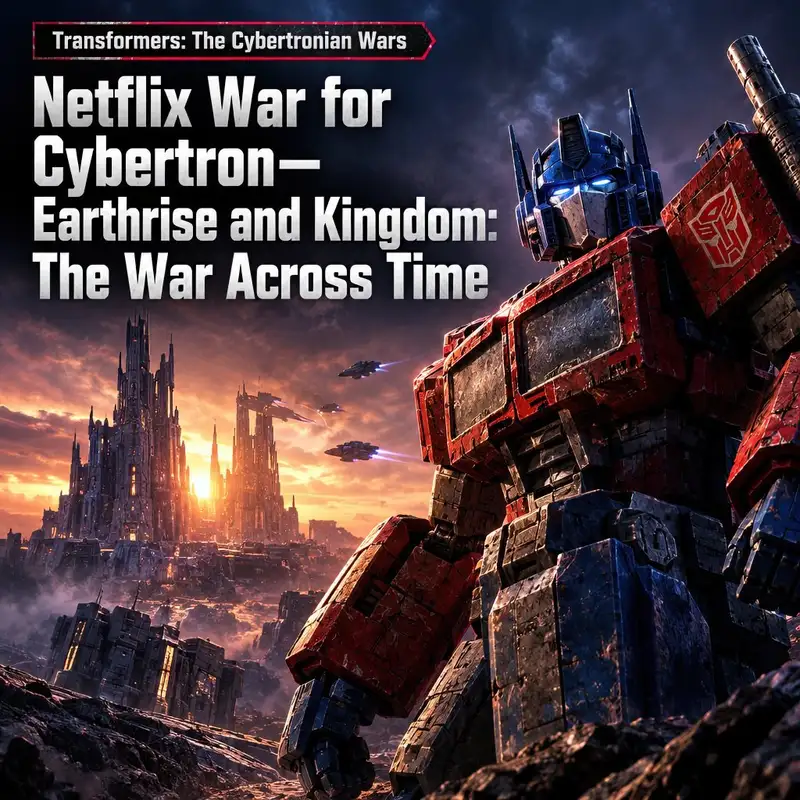
Netflix War for Cybertron—Earthrise and Kingdom: The War Across Time
Megatron has won Cybertron, and the victory is already failing. His forces hold the cities, the prisons, and much of the surviving infrastructure. The Autobots are scattered, hunted, or fleeing. Yet the planet beneath that occupation is losing the capacity to support anyone. The AllSpark is gone. Energon reserves are failing. Systems that once sustained Cybertronian life are falling silent. A ruler can seize a capital. He cannot govern a dead world.
This is the Netflix War for Cybertron Trilogy, in its Earthrise and Kingdom chapters. It is not the history of the earlier War for Cybertron games, and its Maximals and Predacons are not automatically the same people or factions from the nineteen nineties Beast Wars television series. Here, the conflict begins after Cybertron has already been wrecked by civil war. The question is no longer simply who will rule. It is whether there will be a Cybertron left to rule at all.
The object at the center of that crisis is the AllSpark. In this continuity, it is more than a revered relic or a weapon of last resort. Its absence threatens the life of the planet itself. That gives it two meanings at once. It is a condition of collective survival, and it is the greatest possible political prize. Whoever controls it could shape Cybertron’s future. But if no one returns it in time, neither Autobots nor Decepticons will have a future to shape.
That contradiction governs Earthrise. Optimus Prime sent the AllSpark away during the preceding struggle because he feared what Megatron might do with it. Denying his enemy control was a defensible military decision. It prevented a victorious Decepticon government from gaining an instrument that might have made its power permanent. But the decision also separated Cybertron from the system it needed to survive. Optimus did not choose safety. He chose a risk that seemed less catastrophic than allowing Megatron to own the future outright.
The result is a war in which both leaders are trapped by the consequences of their own choices. Megatron’s conquest has given him possession of a dying planet. Optimus’s resistance has denied Megatron the AllSpark, but it has also turned recovery of that artifact into an urgent expedition across space. Neither side can simply pause the war and solve the energy crisis. Trust has already been destroyed. Each assumes, with reason, that the other would use relief as leverage.
For ordinary Cybertronians, that strategic argument is not abstract. A failing Cybertron means dwindling energy, damaged cities, interrupted repair, restricted movement, and the prospect of evacuation into an uncertain void. It also means that the distinction between military target and civilian infrastructure becomes harder to maintain. A power grid, a transport route, or a repair facility may sustain both a population and an army. In such conditions, every faction can claim necessity. That does not make its choices harmless.
Optimus takes the Ark in pursuit of the AllSpark. The ship is more than transport. It becomes an improvised government in exile, a command platform, an archive, a shelter, and a fragile lifeline for Autobots who no longer possess a secure homeland. The mission aboard it is often framed in personal terms, as another contest between Optimus and Megatron. Strategically, it is broader than that. The Ark carries the possibility that Cybertron can be restored, but it also carries the possibility that the war will follow the survivors wherever they go.
The AllSpark’s removal changes the center of gravity of the conflict. Before it left Cybertron, territory and political authority mattered most. Afterward, mobility and information become decisive. The side that can find the artifact, reach it, secure it, and return it has a chance to determine not only the next battle but the survival of the civilization. This is why the Ark’s journey matters. It is not an adventurous detour from the war. It is the war’s new strategic axis.
That does not make the Ark invulnerable or self-sufficient. Deep-space operations impose their own limits. A ship needs navigation, energy, repair, secure communications, and reliable knowledge of where it is going. A damaged vessel cannot simply transform its way out of every problem. The farther the Autobots travel from Cybertron, the more their mission depends on systems they cannot easily replace. Their cause remains morally urgent, but urgency does not solve sustainment.
Back on Cybertron, Elita-One confronts the other side of the crisis. She leads resistance operations against Megatron’s occupation while the principal Autobot force is absent. Her authority is practical rather than clearly constitutional. She commands because she can still organize fighters, preserve contacts, and act under pressure. In a collapsing society, that kind of authority can matter more than formal titles. It is also dangerous. Resistance leaders must make decisions quickly, often with incomplete information and no reliable promise that help is coming.
Elita’s efforts to free prisoners show the limits of describing the war only through the actions of famous commanders. Occupation is maintained through detention, fear, and control of movement. Prisoners are not just absent soldiers who might be returned to the battlefield later. They are evidence of a system trying to reduce the enemy’s capacity to act while demonstrating its own power over the population. Liberation operations can restore personnel and morale, but they also expose resistance networks and invite retaliation against those left behind.
The resistance faces a bleak problem. Even if it weakens Megatron’s rule, it cannot restore Cybertron by itself. The AllSpark is elsewhere. A successful raid may free captives, seize supplies, or disrupt Decepticon control, but none of that repairs the planetary emergency. Elita’s position therefore illustrates the hard distinction between tactical resistance and strategic solution. She can keep the Autobot cause alive. She cannot, from a damaged and occupied world, guarantee that Cybertronian life will endure.
Megatron faces a parallel dilemma, though not the same moral one. He controls the planet, but control does not erase responsibility for those who remain on it. The Decepticons also need energy, transport, repair, and a future beyond the ruins. At first, the Nemesis appears connected to evacuation. That is a rational response to a civilization facing extinction. Ships offer a way to preserve personnel when territory can no longer sustain them. But evacuation also forces a commander to decide who gets space, who is left behind, and whether departure becomes abandonment.
Megatron’s plans shift when the location of Optimus and the Ark becomes known. Project Nemesis ceases to be only a survival measure and becomes a means of pursuit. That decision reveals the war’s central pathology. Megatron cannot separate the survival of Cybertron from the defeat of Optimus Prime. He sees the AllSpark not just as a means to save the planet, but as the means to secure a final Decepticon victory. In that framework, saving Cybertron and dominating Cybertron become inseparable.
That assumption narrows his choices. A leader who thinks only in terms of defeating a rival may turn every resource toward pursuit, even when a broader evacuation or stabilization effort is needed. The Nemesis gives Megatron strategic reach. It does not give him unlimited capacity. It requires energy, personnel, navigation, and a mission that can justify its cost. Every moment spent chasing the Ark is a moment when Cybertron’s remaining population is still living under the shadow of collapse.
The war expands further when the Ark encounters the Fortune, a mercenary vessel whose crew does not share either faction’s larger political goals. Mercenaries thrive where survival, information, and transportation have become commodities. They are not necessarily loyal to the cause that hires them. Their value lies in access, local knowledge, and willingness to operate where regular forces cannot. Their danger lies in exactly the same qualities. A mercenary’s commitment lasts only as long as the calculation that supports it.
Doubledealer’s role matters because he turns information into operational power. In a dispersed conflict, knowing where the Ark is can be more valuable than possessing another squad of soldiers. Coordinates, routes, damaged systems, and command intentions allow an enemy to concentrate forces where they otherwise could not reach. Betrayal in this setting is not just personal drama. It alters the map. Once Megatron learns enough about Optimus’s movement, the Nemesis can transform a pursuit that seemed impossible into an imminent threat.
The widening conflict also brings the Quintesson-linked Deseeus into the struggle. Deseeus is more than another Decepticon asset or an Autobot opponent. His hostility grows from a separate grievance against Transformers. That matters because it breaks the comforting assumption that every participant in the war is fighting over the same political future. The Autobots want survival without Decepticon domination. Megatron wants control of the AllSpark and the authority it might secure. Deseeus seeks revenge. Those objectives can overlap temporarily, but they do not create a stable coalition.
By the time the Ark, the Nemesis, the Fortune, and Deseeus are converging around the AllSpark, the original civil war has become a multi-sided contest across a wider theater. That does not make the Autobot-Decepticon conflict irrelevant. It remains the force pulling nearly every decision toward escalation. But the war is no longer controlled by its original belligerents alone. Outside actors now exploit the crisis, and every new participant increases the chance that the AllSpark will be damaged, lost, or captured by someone unable to use it responsibly.
The series makes that danger more complicated through the Dead Universe. Optimus becomes separated from the main struggle and encounters Sky Lynx there. Sky Lynx offers him a vision of what may follow if the conflict between Optimus and Megatron continues on its current course. The warning is important, but it should not be treated as a neutral historical archive. It is a vision shaped by a strange environment and incomplete knowledge. It presents a possible future, not a timetable carved into the structure of reality.
Its value lies in what it forces Optimus to confront. He has been fighting to prevent Megatron from controlling the AllSpark. The vision broadens that objective. It suggests that defeating Megatron in the immediate sense may not be enough if the habits of war, revenge, and absolute command remain unchanged. A leader may win possession of the decisive artifact and still create the conditions for another catastrophe. The future, in this warning, is not a reward waiting to be claimed. It is a consequence waiting to be made.
Megatron receives a different form of future knowledge through Galvatron. Galvatron is not a detached observer. He is a future version of Megatron, entangled with the designs of Unicron and attempting to influence the present. That makes his information politically dangerous. A warning from an ally can be useful. A message from one’s future self, especially one seeking to preserve his own existence, is something else. It is intelligence with an agenda.
Galvatron’s presence weaponizes foreknowledge. He offers Megatron a future in which power appears to have been achieved, but that achievement is bound to ruin, coercion, and service to a larger destructive force. Megatron is tempted because the information confirms what he wants to believe. It suggests that his struggle against Optimus is more than a contest of the moment, but the path toward a destiny already validated by history. That is precisely why the message is so useful to Galvatron and so dangerous to Megatron.
The problem with future intelligence is not that it is always false. It is that it can be true in the wrong way. A possible outcome may reveal genuine dangers while concealing the decisions that produced it. A future actor may accurately describe events while omitting the cost of preserving them. And a commander who treats information about the future as a script can become easier to manipulate than one who knows nothing at all. Knowledge does not eliminate uncertainty. It often gives uncertainty a more persuasive voice.
Earthrise ends with an operational failure shared by nearly everyone involved. The AllSpark is not secured. The pursuit does not deliver a clean Decepticon victory, an Autobot recovery, or a mercenary escape. Instead, the competing forces collide in a disaster that carries the Ark, the Nemesis, and the wider conflict toward Earth. It is a fitting end to a campaign driven by urgency without coordination. Every participant seeks control. No one achieves control over the consequences.
The arrival on prehistoric Earth changes the war’s geography and its political meaning. The combatants are no longer operating near Cybertronian cities, repair networks, or familiar routes. They have no secure bases, no established civilian authority to support them, and no reason to expect that the new environment will be forgiving. Earth is not yet a refuge in any settled sense. It is an unfamiliar theater where damaged forces must survive long enough to resume a mission that has become even more urgent.
Then the war becomes a conflict across time. The Autobots and Decepticons encounter the Maximals and Predacons, future Cybertronian factions shaped by the consequences of the earlier struggle. Their arrival makes the long-term effects of the civil war visible. The future is no longer a warning glimpsed through a vision or described by Galvatron. It is standing in front of the present, armed, suspicious, and carrying the scars of a history that has not yet fully occurred.
The Maximals and Predacons of Kingdom should be understood on the terms of this series. They are future factions connected to the struggle over Cybertron’s decline and restoration. They are not automatically imported from another continuity simply because familiar names, beast forms, and historical echoes appear. Their role here is not to recreate an earlier television story. Their role is to show what happens when a civil war survives long enough to become inheritance.
That inheritance is not only biological or organizational. It is political. Future factions carry old symbols, old grudges, and old assumptions about who belongs on which side of history. They have been shaped by a Cybertron whose decline continued after the AllSpark failed to return. Scarcity, instability, and factional memory have become part of their world. The present-day Autobots and Decepticons are therefore confronted with a difficult fact. Their war has already produced descendants who understand the conflict as the condition of their existence.
The beast modes of the Maximals and Predacons have practical value in prehistoric terrain. They offer mobility, concealment, and adaptation in a world whose environments and life forms differ sharply from Cybertron. But their military importance should not be overstated as though alternate modes alone decide the campaign. A form that allows movement through forest, rock, or open ground still requires energy, judgment, reconnaissance, and coordination. Transformation changes options. It does not remove the need for strategy.
Optimus Primal and the Maximals find common cause with Optimus Prime and the Autobots because their interests overlap. They want a future in which Cybertron survives. They also understand that the present conflict can destroy the conditions under which their own history exists. This cooperation is meaningful, but it is not reconciliation between all inherited factions. The Maximals are not just reinforcements for the Autobots. They are future people defending the possibility of their own existence.
On the other side, Predacon Megatron approaches the contemporary Megatron with the Golden Disk. The disk is one of the most consequential pieces of intelligence in the campaign. It contains knowledge about Megatron, his history, his strategies, and possible future developments. In the hands of a commander already inclined to view the war as a contest of destiny, such information is enormously valuable. It can reveal routes, motives, weaknesses, and opportunities that opponents do not yet understand.
Yet the Golden Disk is not an omniscient answer to every question. Its contents are filtered through the circumstances of the future that produced it, and through the intentions of those presenting it. A record can be accurate and still be misleading. It can tell a commander what happened without explaining why alternatives failed. It can show him a path toward power while hiding that the path leads toward dependence, destruction, or betrayal. Historical intelligence is never neutral merely because it is old.
Megatron combines the Golden Disk’s information with data from Teletraan One, the Ark’s intelligence system. Together, those sources give him an advantage in locating the AllSpark. The combination is significant because it shows how future knowledge and present infrastructure can reinforce each other. The disk provides strategic direction. Teletraan One provides access to current data. Neither source alone is enough. Intelligence becomes useful when it can be connected to a force capable of acting on it.
But this advantage also deepens Megatron’s vulnerability. The more he relies on information associated with Galvatron’s future, the more he risks acting within Galvatron’s design. That is the trap at the center of Kingdom. Megatron believes he is acquiring tools to defeat Optimus. Galvatron is trying to ensure that the present follows a route that preserves the future from which he came. The same data that empowers Megatron may be guiding him into someone else’s strategic framework.
The alliances that form around this struggle are therefore very different in character. The Autobots and Maximals cooperate because survival requires coordinated action. Their partnership has an ethical and historical dimension, but it is still shaped by necessity. The Decepticons and Predacons cooperate through a mixture of ideological affinity, shared hostility toward Optimus, and immediate opportunity. Their relationship is not a seamless union between past and future. It is a coalition of forces that believe they can gain from the same crisis.
Starscream’s dealings with Blackarachnia reveal another layer of instability. Their relationship is limited and interest-driven. Neither is acting as a disinterested guardian of a larger political settlement. Yet their choices expose fractures within the Decepticon camp. Starscream understands, at least in part, that the pursuit of power by Megatron and Galvatron can become a threat to everyone around them. Ambition does not disappear in an emergency. It changes shape. A rival may become a spoiler, a collaborator, or an opponent depending on which outcome seems least ruinous.
This is why the final coalition matters. It is not built on trust, shared institutions, or a negotiated vision of peace. It is built on the recognition that Galvatron and Nemesis Prime represent an outcome in which the future itself is consumed by the war. Autobots, Decepticons, Maximals, and Predacons do not become one people. They become, briefly, participants in a common act of self-preservation. Their unity is real enough to win a battle, but not deep enough to settle the political conflict beneath it.
The AllSpark itself resists being treated as simple cargo. Its defenses disrupt perception and function, complicating every attempt to reach it. That detail matters because it prevents the artifact from becoming a passive object passed from one claimant to another. The AllSpark shapes the campaign. It imposes risk, confuses assumptions, and frustrates the belief that possession alone equals mastery. A force may locate it and still be unable to use it safely. It may seize the prize and discover that the prize is failing.
Optimus regains the Matrix and reaches the AllSpark, but the achievement does not complete the mission. He learns that the AllSpark is dying. That transforms the strategic problem again. Finding it is only partial mission success. Securing it is still insufficient. The artifact must be returned to Cybertron before its failure becomes irreversible. The campaign now depends on speed, cooperation, and the ability to move through a collapsing political and temporal situation without allowing any one faction to sabotage the larger objective.
This distinction between recovery and restoration is central to the trilogy’s argument. Military organizations are often good at seizing things. They are less often prepared to restore the systems around those things. The Autobots and Decepticons have spent much of their history fighting over control: control of cities, energy, information, and symbols of legitimacy. The AllSpark crisis exposes the limits of that mindset. No faction can preserve Cybertron merely by holding the artifact at gunpoint.
Galvatron and Nemesis Prime arrive as the clearest embodiment of the possible future that must be rejected. They are not ordinary reinforcements and not just alternate-universe counterparts who happen to resemble familiar leaders. They are future forms of Megatron and Optimus Prime, tied to Unicron’s destructive purpose and seeking to shape the present in ways that preserve their own future. Their intervention makes the temporal stakes concrete. If they succeed, history does not just continue. It hardens into a catastrophic pattern.
The exact mechanics of time in this story remain deliberately unclear. The series does not provide a complete rulebook explaining every connection among visions, future factions, the Golden Disk, and the arrival of Galvatron and Nemesis Prime. What it does establish is enough for the political analysis. The future can act on the present. It can manipulate commanders through fear, ambition, and selective knowledge. And it can demand that present-day actors choose whether survival means preserving what came before or breaking from it.
Nemesis Prime is especially important because he demonstrates what happens when leadership becomes detached from the values that once justified it. He is a future image of Optimus stripped into an instrument of domination. Galvatron performs a similar role for Megatron. Each is a warning that military identity can outlive political purpose. A leader who begins by claiming to save a people may become the mechanism through which that people is consumed. The future versions do not erase the choices of the present. They sharpen them.
Megatron’s reversal is therefore the decisive political moment of Kingdom. He rejects Galvatron’s future rather than preserving it at Cybertron’s expense. That does not make him an Autobot, and it does not absolve him of the occupation, coercion, and violence already associated with his rule. It means that he recognizes a boundary even his pursuit of power cannot cross. If Galvatron’s future requires Cybertron’s destruction or subordination to Unicron, then preserving that future is not victory. It is annihilation disguised as destiny.
The decision is significant because it comes from Megatron’s own recognition of interest and identity. He does not surrender his rivalry with Optimus. He does not accept an Autobot political order. He chooses, instead, to reject a future in which his own older self has become part of a force hostile to Cybertronian survival. That is a narrow but necessary choice. It creates the possibility of joint action without producing political conversion.
In the immediate fight, the combined forces defeat Galvatron and Nemesis Prime. Operationally, their cooperation makes it possible to resume the urgent task of returning the AllSpark. Strategically, Cybertron is given another chance to live. These are substantial achievements. But they should not be mistaken for political resolution. The coalition defeats a common existential enemy. It does not agree on who should govern Cybertron, how the Decepticon movement should be held accountable, or whether the institutions that failed before the war can be rebuilt.
The return to Cybertron is thus not a triumphal restoration of the old world. The AllSpark’s recovery allows the planet’s life to return. Elita-One, who held the resistance together through occupation and decline, is present for that restoration. The sparks of fallen Cybertronians also contribute to the renewal. Their role gives the moment moral weight. Cybertron is restored not only through the actions of surviving commanders, but through the memory and continuing presence of those who did not live to see the result.
Even here, the series avoids the idea that repair erases loss. Restoring Cybertronian life does not undo imprisonment, displacement, damaged trust, or the destruction of communities. It does not automatically restore every body, every relationship, or every institution. A civilization can regain power and still remain politically broken. The AllSpark can revive the planet, but it cannot by itself answer who owns the cities, who controls the security forces, who returns from exile, or who is allowed to define the history of the war.
For civilians, restoration ends the immediate extinction crisis, but it begins a harder period. Survivors must live with the memory of occupation and resistance. Former prisoners must find their place in a society that changed while they were confined. Communities that endured scarcity must decide whether the return of energy will be shared fairly or controlled by those who held power during the emergency. Even the simple act of rebuilding infrastructure carries political meaning. A repaired city can reproduce the inequalities that helped make war possible.
The ending offers no completed constitution, no clear demobilization plan, and no settled process for accountability. Megatron and his followers depart rather than entering a stable political settlement with the Autobots. That departure prevents an immediate confrontation, but it is not the same as disarmament or reconciliation. A force that leaves the capital with its leadership intact has not ceased to be a force. The war has been interrupted by survival. Its underlying claims and resentments remain in place.
This is where Earthrise and Kingdom differ from a simpler story of artifact recovery. The AllSpark is returned. Cybertron lives. The immediate crisis is resolved. But the episodes insist that survival is not the same as peace. A society can escape extinction and still lack the institutions required to prevent another civil war. It can share a planet while remaining divided by memory, authority, and unresolved responsibility for what happened when that planet began to die.
Time travel, in this story, is not an escape from history. It is history made unavoidable. The Maximals and Predacons arrive as future inheritors of a conflict that the present has failed to settle. Galvatron and Nemesis Prime arrive as corrupted consequences of leadership without restraint. The Golden Disk turns historical memory into a weapon. Every temporal element forces Optimus and Megatron to confront the same question from a different direction: what will their war produce if no one changes its course?
Optimus learns that moral purpose cannot rest only on denying the enemy a weapon. It must also include restoring the conditions under which people can live. Megatron learns, however briefly, that conquest has limits when it threatens the survival of Cybertron itself. The future factions learn that preserving their existence may require cooperation with ancestors they cannot fully trust. None of them receives a clean answer. They receive a chance to prevent the worst answer from becoming permanent.
Earthrise and Kingdom therefore turn the War for Cybertron into a struggle over civilizational inheritance. The AllSpark becomes political prize, survival system, failing objective, and instrument of restoration. The future becomes intelligence, warning, temptation, and enemy force. The coalition succeeds because every side can recognize extinction when it arrives. It fails to become peace because rejecting extinction is not the same as reconciling the war that made extinction possible.