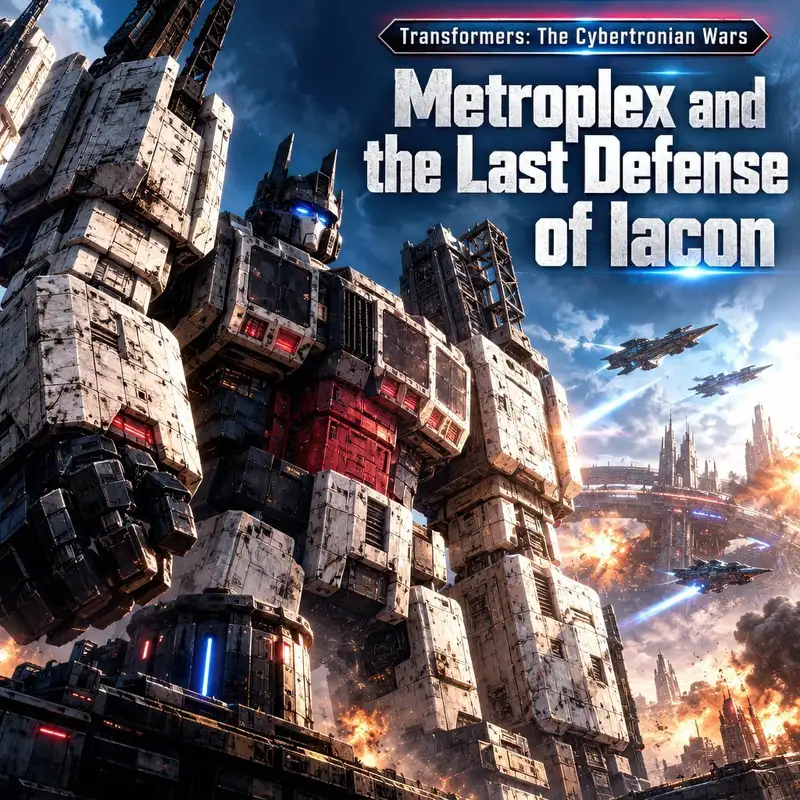
Metroplex and the Last Defense of Iacon
The Ark is trying to leave a dying world, and it is still not safe. Decepticon fire is closing around the transport. The Autobots on board are not departing from a secure spaceport under a negotiated ceasefire. They are attempting to break contact with an enemy that wants the ship destroyed before it can carry away the last organized core of Autobot resistance. Cybertron is failing beneath them. The war has already consumed the conditions that made ordinary defense possible. What remains is a race for time, energy, and survival.
This is the High Moon Studios history told in Transformers: Fall of Cybertron. It is not the Generation One story of Metroplex and Autobot City, and it is not the later Netflix War for Cybertron trilogy. Here, Metroplex enters the war during Cybertron’s final collapse, when Iacon is still a battlefield but no longer a capital that the Autobots can confidently preserve. His intervention is immense, but its importance is often misunderstood. Metroplex does not save Cybertron. He helps ensure that enough Autobots can escape it.
The game begins close to the end of that process, with the Ark under attack during its attempted departure. Then the story moves back several days, to the defense of Iacon and the events that made the launch possible. That framing matters. It tells us that the defense was never simply a conventional effort to hold territory. The Autobots were already preparing to abandon the planet. Their military task was to keep the evacuation system alive long enough for withdrawal to become possible.
That changes the meaning of victory. A force defending a city normally seeks to retain the city, protect its population, preserve its government, and deny the enemy political control. The Autobots at Iacon could still fight for streets, installations, and access routes. But the real center of gravity had shifted to the Ark. If the ship was destroyed, the Autobots could lose not only a battle but the personnel, records, command capacity, and future options required to remain a coherent faction.
Cybertron’s wider condition made that choice unavoidable. The planet was suffering from earthquakes, violent electrical storms, and an intensifying shortage of Energon, the resource that sustained Cybertronian life, industry, repair, transport, and war. A civilization built around energy-intensive bodies and vast machinery can endure hardship for a long time. It cannot indefinitely ignore the collapse of its power system. Every damaged soldier requires attention. Every functioning weapon requires power. Every transport needs a route, a crew, and enough energy to move.
The Decepticons and Autobots were therefore fighting within a shrinking strategic system. The question was not just who controlled the next fortification. It was who could still sustain organized operations after the planet’s infrastructure began to fail. Mines, refineries, transmission networks, repair facilities, transit corridors, and launch systems all mattered. A force could win an engagement and still lose the war if it no longer possessed the industrial base to replace losses, repair its wounded, or fuel its remaining ships.
Iacon appears in the game as contested urban and industrial ground under Autobot defense. The story does not provide a complete civic history of the city during these final days. It does not establish a reliable population count, a detailed municipal government, or a full record of civilian evacuation. That absence should not be mistaken for evidence that the civilian consequences were small. Urban warfare on a planet suffering energy collapse leaves little room for normal life. But the game’s focus remains on the military emergency, and the evidence is strongest there.
For civilians, technicians, laborers, and noncombatants still caught in the wider collapse, the danger would not have come only from direct fire. It would also have come from failing power, damaged transit, interrupted repair access, collapsing public order, and the knowledge that both major factions were increasingly focused on military survival. The game does not show a formal civilian evacuation authority directing the city’s fate. What it shows is a civilization whose final political decisions are being made under battlefield pressure.
The Decepticon offensive understood the situation clearly enough. Megatron did not need to conquer every corridor of Iacon before the Autobots could leave. He needed to prevent the Ark from departing. Destroy the transport, disable its launch systems, or reduce its crew and defenders below a viable level, and the Autobot remnant could be trapped on a dying planet. That was a more efficient objective than a slow block-by-block occupation of every remaining Autobot position.
The immediate instrument of that strategy was the Decepticon warp cannon network. These weapons could fire on the Ark from positions that were difficult for the defenders to reach and dangerous to ignore. The exact technical workings of the cannons are not fully explained, and there is no need to invent yields or ranges for them. Their military role is plain. They were artillery directed against the Autobots’ only practical means of strategic escape.
That made the operation a counter-battery problem. The Autobots could defeat visible Decepticon troops around the Ark and still fail if the cannons remained active. Infantry, armored units, and local defenders could hold a perimeter for a time. They could not guarantee the survival of a large transport under sustained fire from protected enemy positions. The battle around the Ark was therefore not decided by who occupied the most ground. It was decided by whether the Autobots could identify, reach, and eliminate the systems threatening launch.
Optimus Prime had to manage that problem while the rest of Cybertron was coming apart. In this branch of the Aligned continuity, he is not portrayed as a commander who can direct every Autobot on the planet by personal decree. He commands through available teams, specialists, communications, and immediate relationships. Perceptor, Ironhide, Warpath, Bumblebee, Ratchet, and other Autobots contribute to the wider defense and evacuation effort. Yet the game does not establish a complete order of battle, and it would be false precision to pretend otherwise.
What is clear is that Optimus has moved from a war-winning posture to a survival posture. His objective is no longer the defeat of Decepticon power across Cybertron. That objective has become unattainable with the resources available. Instead, he must preserve people, equipment, command continuity, technical knowledge, and enough military capability to survive beyond the planet. It is a painful form of command. A leader who organizes an evacuation is admitting that the territory under defense cannot be held indefinitely.
This does not make the decision cowardly or passive. Withdrawal can be an active operation requiring discipline, deception, rear guards, engineering support, medical recovery, and the willingness to abandon positions that soldiers may have fought to defend for generations. But it is still a concession. Every resource assigned to the Ark is a resource not assigned to rebuilding Iacon. Every defender withdrawn to protect the ship is one less defender available to hold the city. The Autobots were preserving a future by accepting the loss of their present.
Optimus needed something that could alter the local balance quickly. Ordinary Autobot units could delay the Decepticons, screen the Ark, and contest access routes. They could not easily break a prepared artillery network while under pressure from a larger offensive. The solution came not from a new factory line or a reinforcement fleet. Cybertron no longer offered that kind of abundance. It came from an ancient capability buried within the city itself.
Following a mysterious signal through an old urban complex, Optimus reaches an internal mechanism and activates it. The city structure around him begins to transform. Out of that ancient mass emerges Metroplex, an Autobot Titan. The game presents this revelation as a discovery and awakening, not as the routine deployment of a known unit. Metroplex is not simply another soldier reporting for duty. He is a singular legacy system, a walking city-sized presence with military power far beyond the remaining defenders around the Ark.
The precise relationship between Metroplex and Iacon should be handled carefully. The game depicts him emerging from an ancient city complex, but it does not provide a complete technical or political explanation of where Metroplex ends and the larger city begins. It does not establish that he is literally all of Iacon, nor does it describe him as a municipal institution with a known civilian population inside him. The important fact is more limited and more consequential. A dormant Titan becomes available when the Autobots are desperate for force they cannot otherwise replace.
The game also gives only fragments of Metroplex’s prior history. It identifies him as an ancient Autobot Titan, but does not provide a full account of Titan society, a formal chain of command, or a detailed biography explaining why he slept beneath the city. What it does show is cooperation. Metroplex answers Optimus’s call and acts alongside him in defense of the Ark. That relationship is operationally decisive, even if the exact constitutional authority behind it remains unexplained.
The difference matters because Titans are easy to misunderstand as automatic solutions. Metroplex is not a factory, a reserve army, or a renewable strategic resource. His awakening does not prove that the Autobots can activate a fleet of similar beings, build replacements, or call on ancient weapons whenever a battle goes badly. He is valuable precisely because he is exceptional. In a collapsing industrial system, the rarest asset is often not the one with the largest gun. It is the one that cannot be replaced after it is spent.
Metroplex transforms the immediate battle. He provides overwhelming local firepower, physical reach, and mobility over shattered urban ground. He can engage Decepticon positions that would be difficult for smaller Autobots to assault directly. He can break through defenses, absorb attention, and force the enemy to reconsider positions that had been secure against conventional counterattack. His appearance is also psychologically disruptive. An attacking force accustomed to pressing a weakened defense suddenly faces a defender that changes the scale of the battlefield.
But spectacle should not obscure doctrine. Metroplex matters because he allows the Autobots to shift from static defense to offensive counter-battery action. Before his awakening, the Autobots are largely reacting to Decepticon pressure around the Ark. Afterward, they have an asset capable of pushing toward the cannon network itself. The purpose is not just to destroy Decepticons in large numbers. The purpose is to reach the weapons that can still stop the evacuation.
The game places the player in control of Metroplex’s actions through Optimus, but that should not be read too literally as a complete account of command technology. It does not establish that Optimus pilots Metroplex, remotely controls every movement, or possesses a universal method for directing Titans. The narrative establishes coordination between the two. That is enough. In military terms, Optimus supplies mission focus. Metroplex supplies the force needed to act on it.
Even so, Metroplex is not invulnerable. He is one immense asset operating in damaged urban terrain against an enemy that can concentrate fire and exploit fixed objectives. His size gives him reach, but it also makes him impossible to conceal. His importance makes him a priority target. And his singular nature creates a dangerous asymmetry. The Autobots gain extraordinary capability while he is active, but they also risk losing a resource that no repair depot or industrial complex can readily replace.
The counter-battery mission begins with success. Metroplex and Optimus advance against the Decepticon warp cannons and destroy two of the three threatening the Ark. Each destroyed cannon reduces the danger to the evacuation system. Each one also demonstrates the value of the Titan’s intervention. The Autobots are no longer merely surviving under fire. They are degrading the enemy’s ability to prevent launch.
Yet the operation also reveals the cost of concentration. To destroy fixed artillery, the Autobots must drive toward known objectives. That gives the Decepticons opportunities to focus their own response. A counter-battery force is often exposed because it has to close with weapons that may be defended by infantry, heavy units, terrain, and supporting fire. Metroplex can smash through much of that resistance, but he cannot make the mission risk-free. The closer he comes to the final cannon, the more clearly he becomes the decisive target.
At the last cannon, Metroplex is struck and knocked offline. The game establishes the effect but does not provide enough evidence to define the exact weapon, its yield, or the precise nature of his damage. What matters operationally is immediate. The Autobot advantage contracts in an instant. The walking city that had turned the battle outward is no longer moving. The mission reverts to a much more familiar and much more dangerous form of small-force assault under enemy pressure.
This is the vulnerability of super-heavy assets. Their presence can reorganize an entire operation around their strength. But once they are disabled, the force that depended on them may be exposed in the very place where it committed itself most deeply. Metroplex’s temporary loss does not erase what he has achieved. Two cannons are gone. The Ark is safer than before. But the final threat remains, and the defenders have already spent much of their available momentum reaching it.
Optimus presses on without him. It is the sort of decision commanders make when stopping may be as dangerous as continuing. The final cannon still threatens the Ark. The larger evacuation timetable is still moving. Decepticon forces remain active. Yet continuing alone also exposes the limits of leader-centered improvisation. Optimus can provide resolve, direction, and battlefield skill, but he cannot replace Metroplex’s mass, firepower, or physical protection through personal determination.
The Decepticons capture Optimus before he can finish the mission. This is a local reversal with larger implications. The Autobot commander is not only a fighter. He is central to the coordination and legitimacy of the evacuation. His capture threatens to disrupt command at the moment the defenders need it most. It also offers Megatron a symbolic triumph. Removing Optimus from the battlefield could have turned the defense of the Ark into a crisis of leadership as well as firepower.
Metroplex returns before that crisis can fully develop. He reactivates, tears into the final cannon structure, and confronts Megatron directly. It is one of the clearest examples in the game of a Titan changing a battle’s immediate terms. Metroplex rescues Optimus from a position of defeat, eliminates the remaining artillery threat, and forces the Decepticon leader out of the immediate area. The local result is real. The Ark’s defenders have broken the assault aimed at preventing its preparation.
Megatron’s defeat, however, is temporary and local. He survives. Decepticon command survives. Their wider military capacity survives. Their control of territory, infrastructure, and remaining war assets is not erased because their leader has been driven from one battlefield. This is an essential difference between a dramatic confrontation and a strategic decision. A leader can be defeated in person without the system that supports his war being defeated with him.
The shock also affects Decepticon internal politics. Starscream attempts to assert authority during the crisis, showing that battlefield disruption can expose rivalries within a leader-centered command structure. His move is not important because it confirms a franchise stereotype. It matters because it reveals a practical weakness in Decepticon cohesion. A system built around Megatron’s personal authority can be forceful while he is present, but moments of uncertainty invite competing claims to command.
That said, Starscream’s maneuver does not create an Autobot victory by itself. It does not dissolve Decepticon discipline across Cybertron or produce a negotiated collapse. Internal rivalry matters most when it can be converted into institutional fracture, loss of control, or operational paralysis. At Iacon, the immediate Decepticon attack is disrupted. The larger enemy war machine remains dangerous enough to pursue the Autobots beyond the planet itself.
Metroplex has therefore accomplished several things at once. Tactically, he has shattered Decepticon forces around the immediate objectives, helped destroy the warp cannon network, restored the Autobots’ ability to act, and driven Megatron from the confrontation. At the mission level, he has protected the Ark long enough for evacuation preparations to continue. At the operational level, he has given the defenders time and temporary freedom of movement in a battle that had been closing around them.
But none of those achievements restore Cybertron. Metroplex does not reopen depleted Energon wells. He does not repair the planet’s damaged power grid. He does not rebuild factories, restore transport networks, replace lost personnel, or make urban infrastructure safe. He does not establish a secure civilian government in Iacon. He does not produce a new fleet, create protected supply routes, or remove Decepticon power from the wider world. The Titan changes the battle because he is powerful. He cannot reverse collapse because collapse is larger than a battle.
That is why the phrase last defense of Iacon requires care. It sounds like a final stand for possession of the city. In practice, it is a final defense of the means to leave the city. The Autobots are defending an evacuation corridor, a shipyard function, a launch sequence, and the people needed to operate them. Iacon remains important because it is where the Ark can still be protected and prepared. It is not being preserved as a functioning Autobot capital.
The political consequences are severe. The Autobots retain their cause, their leadership, and a measure of military cohesion. They do not retain sovereignty over Cybertron. Territorial control depends on more than courage and battlefield success. It requires the ability to govern, supply, repair, communicate, protect civilians, and enforce authority over time. By the final phase of Fall of Cybertron, the Autobots can no longer do those things at planetary scale. Their victory at Iacon is a victory of continuity, not of restoration.
The next danger makes that even clearer. The Ark still needs enough Energon to leave Cybertron. It still needs functioning systems, a crew, and time under conditions of enemy pressure. The Decepticon threat also expands beyond the city fight. Trypticon is converted into the Nemesis, a Decepticon warship and superweapon capable of pursuing the fleeing Autobots. The problem is no longer only whether the Ark can get off the surface. It is whether departure simply carries the war into space.
This is the basic reality of evacuation under pursuit. A transport clearing a ruined planet has not necessarily escaped. It may only have exchanged one battlefield for another. The Ark is not a neutral refugee vessel protected by law or distance. It is the core transport of a still-active military and political movement. Megatron has every reason to hunt it. If the Decepticons can destroy it after launch, the loss of Iacon will be followed by the destruction of the Autobot remnant.
The Ark’s needs are logistical before they are heroic. It needs power. It needs systems that can survive departure. It needs personnel capable of operating, repairing, defending, and navigating it. It needs enough time to gather those necessities while Decepticon pressure continues. This is why the earlier destruction of the warp cannons matters so much. Metroplex has not won the war, but he has helped preserve the conditions under which the Autobots can attempt the next phase of survival.
The cost of that survival becomes clear when Metroplex makes his final contribution. The Ark lacks sufficient Energon to escape Cybertron safely. Metroplex transfers his own Energon into the vessel. The game treats this as his apparent destruction or death in this narrative. It does not provide a complete technical account of his spark’s final condition, and there is no basis for claiming a universal rule about Titan mortality. What is certain is that the Autobots lose Metroplex as an active defender.
His sacrifice is strategically different from his assault on the warp cannons. During the defense of Iacon, Metroplex uses force to remove an enemy threat. In the final transfer, he becomes a resource. His stored Energon is converted into the mobility the Ark requires. He is no longer merely the Autobots’ greatest weapon on the field. He is their emergency reserve, spent so that the survivors can move beyond a world that can no longer sustain them.
That is sacrifice understood as logistics. It is not a mystical reversal of defeat. It does not restore the city. It does not revive Cybertron’s industry. It does not protect everyone who may remain behind. It does not remove the Nemesis from pursuit. What it does is make launch possible at the critical moment. The Autobots preserve a mobile remnant because an irreplaceable Titan gives up the energy that might otherwise have sustained his own continued existence.
The industrial meaning is as important as the personal one. Metroplex cannot simply be replaced by ordering another unit from a functioning assembly line. Cybertron is in no position to reproduce ancient Titans, even if the Autobots understood how. The transfer therefore represents the consumption of capital accumulated across a civilization’s past. When a state spends its last strategic reserve merely to evacuate, it is acknowledging how little of its former industrial power remains available.
There is also a moral dimension, though it should not be sentimentalized. Metroplex’s sacrifice matters because it preserves persons and possibilities. The Ark carries more than weapons. It carries survivors, institutional memory, technical capacity, and the chance that the Autobots may remain something more than scattered fugitives. The decision does not redeem the devastation around Iacon. It gives those who escape a future in which the war, and perhaps Cybertronian society itself, can be contested again.
The Ark departs, but the departure is not liberation. The Decepticons pursue. Cybertron is left behind. The Autobots have escaped immediate destruction, yet they have lost the planet that gave their political cause its home, its industry, and much of its population. A faction can survive in exile. It can resist, recruit, adapt, and return. But exile changes it. Command becomes more concentrated. Supply becomes more precarious. Every repair and every loss acquires greater weight.
Metroplex’s intervention therefore has to be judged at several levels. He succeeds tactically because he breaks the immediate Decepticon assault, destroys the artillery threatening the Ark, rescues Optimus, and forces Megatron away from the decisive position. He succeeds at the mission level because the Ark remains viable long enough to complete its preparations. He succeeds operationally because the Autobots gain time, room to maneuver, and a temporary reprieve from encirclement.
He fails only if the standard is impossible. No single Titan could restore a dying planet’s energy economy, repair base, industrial network, civilian order, and territorial government. Metroplex could win an action. He could not recreate the strategic conditions that had already been lost. The Autobots leave because the defense has succeeded in its actual purpose. They do not stay because no battlefield triumph has made staying sustainable.
That is the hard distinction at the center of Iacon’s last defense. A city can be defended without being saved. A commander can win the engagement and still order withdrawal. A people can preserve its future while losing its homeland. Metroplex gives the Autobots the strength to reject immediate annihilation, but he cannot give them back the world beneath their feet.
The Ark’s flight under Decepticon pursuit is therefore not the image of a clean escape. It is the image of a force carrying defeat, survival, and unfinished political purpose into the unknown. Metroplex ensures that the Autobots do not vanish with Iacon. His sacrifice transforms the battle from a struggle for possession into a struggle for continuity, leaving the Autobots with a future even as Cybertron slips beyond their control.