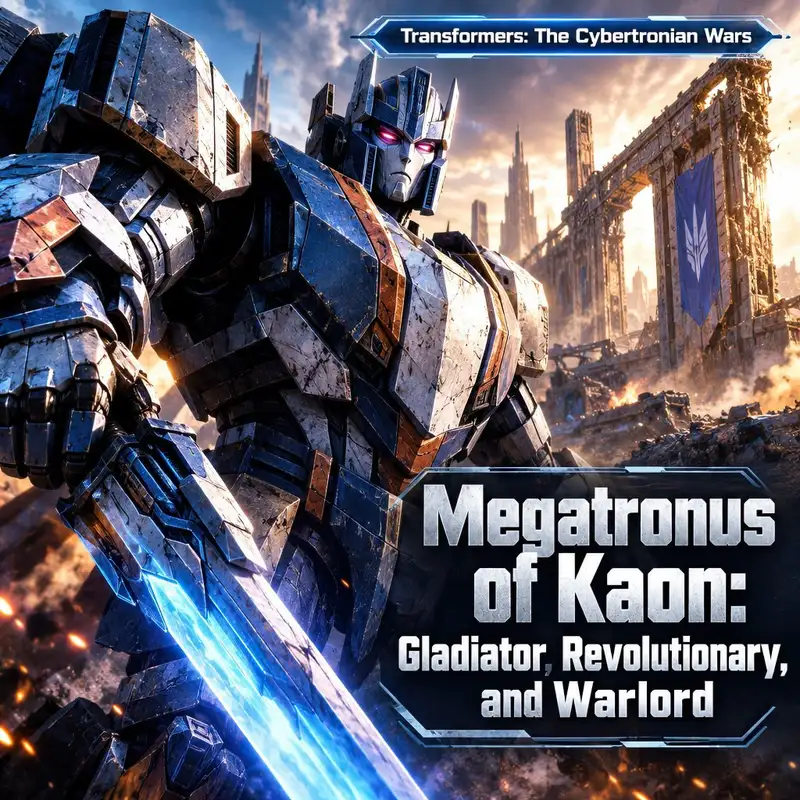
Megatronus of Kaon: Gladiator, Revolutionary, and Warlord
The High Council had heard two men condemn the same failing order. Both saw corruption. Both saw inequality. Both believed Cybertron had drifted away from the justice it claimed to represent. Yet when they stood before the Council, their remedies could not have been more different. Megatron demanded violent overthrow and the mantle of Prime for himself. Orion Pax argued for autonomy and justice without making personal rule the price of reform. The Council chose Orion. In that instant, a political alliance broke apart, and Cybertron’s crisis moved toward civil war.
This is the history of Megatron in Transformers: Prime, within the broader Aligned family. It is not the story of the ancient Megatronus Prime, one of the original Thirteen, though the future Decepticon leader deliberately took that ancient name for himself. It is also not the biography of the gladiator Megatron from the I D W comics, nor the miner called Dee Sixteen in Transformers One. This Megatron began as Megatronus of Kaon, a public challenger to a compromised political order.
His defeat before the High Council mattered for more than the loss of an office. Cybertron’s institutions already suffered from a shortage of trust. A ruling body can preserve procedure while losing legitimacy among those who believe the procedure exists mainly to protect entrenched power. Megatron understood that weakness. He had built his reputation outside the corridors of Iacon, in Kaon, where the language of strength carried unusual political force.
Kaon was associated with gladiatorial combat, and Megatronus emerged from its arenas as a celebrated fighter. The available screen record does not provide a full social history of the city. It does not establish its population, its precise economic structure, or the formal rules that governed every arena. What it does establish is more important to Megatron’s rise. Kaon gave him a public stage, and that stage gave him an audience prepared to hear a challenge to Iaconian authority.
The arena was not just a place of combat. It was a place where status could be won before a crowd. A successful gladiator demonstrated courage, endurance, skill, and the ability to survive direct confrontation. In a society where many Cybertronians felt excluded from meaningful influence, those qualities could become political capital. Megatronus did not need an official appointment to become known. His fame traveled by reputation, spectacle, and the powerful impression that he could confront dangers which more respectable figures preferred to discuss at a safe distance.
That kind of reputation can be politically useful, but it also carries a risk. Arena combat teaches an audience to admire victory, physical dominance, and the humiliation of an opponent. Those are not automatically the same things as judgment, restraint, or the patient construction of institutions. A warrior can expose a corrupt order with great clarity and still misunderstand what it takes to replace that order. Megatronus’s public authority began in a setting where force was visible, immediate, and persuasive.
His followers were not necessarily motivated by one simple grievance. Some may have identified with the anger directed at Cybertron’s hierarchy. Some may have admired his defiance. Some may have seen opportunity in a movement that promised to overturn old ranks. Others may have concluded that a powerful new leader offered greater security than a weak old system. Political movements seldom recruit from a single social class or a single emotion. Resentment, hope, fear, ambition, and loyalty can all travel under the same banner.
Kaon therefore mattered as more than Megatron’s hometown. It became a symbol of an alternative political identity. Iacon represented official authority, records, councils, and the accumulated prestige of the established order. Kaon represented a source of power that did not require approval from that order. When Megatronus spoke against corruption, he spoke with the credibility of someone who had not been formed by the institutions he criticized.
That criticism found an unexpected listener in Orion Pax. Before he became Optimus Prime, Orion worked as a clerk in the Iacon Hall of Records. His position placed him close to the official memory of Cybertron. He was not a battlefield commander or a political celebrity. He was an observer of documents, decisions, and the gap between what institutions claimed to be and how they actually behaved.
The record presented in Transformers: Prime makes clear that Orion had become disturbed by Cybertron’s corruption and inequality. That fact is important because it prevents a simplistic reading of the prewar crisis. Discontent did not exist only among those outside the ruling structure. Even someone employed within Iacon’s administrative world could see that the system was failing people. Megatronus did not invent Cybertron’s divisions. He gave them an especially forceful voice.
A society can survive criticism. In fact, criticism is often one of the mechanisms by which a society corrects itself. The danger begins when officials mistake criticism for disloyalty, or when reformers conclude that no restraint is legitimate because the existing system is compromised. Cybertron’s late Golden Age appears to have reached precisely that dangerous point. Its institutions retained authority, but they no longer inspired enough confidence to contain the anger gathering beyond their walls.
Related Aligned material offers a more detailed picture of social hierarchy and political exclusion, but the Prime screen account should remain the controlling record here. It establishes the essential facts without resolving every administrative detail. Cybertron was unequal. Its government was corrupt enough to alarm Orion Pax and empower Megatronus. The old order had created conditions in which a radical challenger could become credible.
That does not mean every Cybertronian regarded the government in the same way. Some may have benefited from it. Some may have feared collapse more than injustice. Some may have believed reform was possible if pursued through lawful channels. Others may have found the entire system beyond repair. This variety matters because civil wars do not begin when everyone agrees that society is broken. They begin when enough people agree that force is the only remaining way to decide what comes next.
Megatronus and Orion Pax initially offered the possibility of a coalition across Cybertron’s divide. The Kaonian gladiator had public influence, personal courage, and a language of revolt. Orion had institutional knowledge, moral seriousness, and a belief that the system could be changed without reproducing its abuses. Their connection was close enough to be remembered as mentor-like or brother-like, though the exact emotional boundaries of that relationship need not be overstated.
What united them was a diagnosis. Both saw a society in which authority had become detached from justice. Both objected to corruption. Both believed Cybertron needed a different future. The later war between Optimus Prime and Megatron can make their early partnership seem inevitable in retrospect, as if they were always destined to become enemies. The evidence suggests something more tragic. They were allies because they shared a real concern. They became enemies because they disagreed over what justice required once power was within reach.
Megatronus appears to have believed that the old order could not be reformed because it would never willingly surrender its privilege. From that premise, violent overthrow could seem not only practical but morally necessary. If a political system excludes people from real influence, then procedure can look like camouflage for permanent domination. A council may claim legitimacy while using its own rules to protect the very inequalities that provoke revolt.
Orion’s answer was not a defense of corruption. He did not become a supporter of the old system simply because he rejected Megatron’s methods. His concern was deeper. A just society could not be built merely by replacing one set of rulers with another. If reform meant autonomy and justice, then it required principles that could survive the ambitions of whichever individual held power at the moment.
This was a disagreement about methods, but it was also a disagreement about the nature of political authority. Megatronus placed growing faith in decisive action, confrontation, and the power of a leader willing to break the old structure. Orion placed greater faith in a political order that could recognize the dignity and agency of Cybertronians beyond its ruling circle. Neither man possessed perfect knowledge of where the crisis would lead. Yet both were already revealing the assumptions that would shape the war.
Megatronus’s choice of name was part of that political transformation. By taking the name of an ancient Prime, he invoked a powerful source of historical and symbolic authority. The gesture did not prove that he possessed sacred entitlement. Nor did it make him the same being as the ancient Megatronus Prime. It was a claim. It suggested that the gladiator from Kaon could stand against the established elite not as an outsider begging for recognition, but as a figure worthy of a greater destiny.
Later, he shortened the name to Megatron as he entered formal political struggle. The change marked a shift in role. A gladiator can become a symbol of resistance without offering a complete program for government. A political claimant must do more. He must explain not only what he opposes, but who will rule, by what authority, and under what limits. Megatron’s answer increasingly placed himself at the center of Cybertron’s future.
This is one of the recurring dangers of revolutionary politics. A leader may begin by attacking an unjust hierarchy, then gradually present personal leadership as the only alternative to that hierarchy. The cause and the individual become inseparable. Criticism of the leader becomes criticism of the movement. Opposition becomes proof of corruption. Political reform becomes impossible to distinguish from the leader’s own ascent.
The High Council hearing brought that tension into the open. Megatron and Orion did not merely offer different speeches to an audience of officials. They offered rival paths out of Cybertron’s crisis. Megatron called for violent overthrow and demanded to become the next Prime. Orion argued for a different vision, one grounded in autonomy and justice rather than in the seizure of power by force.
The Council’s decision to elevate Orion Pax was consequential. It granted him the Prime mantle and transformed him into Optimus Prime. The choice created a new source of authority at precisely the moment when Cybertron’s old political authority was under challenge. The Council had not solved every social problem merely by selecting a new leader. Its prior failures did not disappear. Its procedures did not become automatically just because the outcome favored Orion.
Still, the choice established that Megatron had lost a political contest. The question was what he would do with that defeat. A leader committed to reform might continue organizing, press for change, build alliances, or hold the new Prime accountable to the ideals he had articulated. A leader committed above all to personal authority sees defeat differently. He sees it as proof that the process itself is illegitimate because it did not produce his victory.
Megatron treated Orion’s elevation as betrayal. That judgment was not just an emotional reaction between former allies. It became the political logic of the conflict that followed. Orion had not merely disagreed with him. In Megatron’s view, Orion had joined the corrupt system. The High Council had not just made a choice. It had confirmed that justice would never be granted without force. Once that interpretation took hold, compromise became not merely difficult but dishonorable.
This was the turning point. Cybertron’s crisis was no longer only about corruption, inequality, or reform. It became a struggle over who possessed the right to define Cybertron’s future. Megatron’s answer was increasingly direct. The one who could seize and hold power would prove that he deserved it. That logic converted a political disagreement into a contest of armed command.
The result was the formation of the Decepticons. Autobots and Decepticons were not separate species. They became political and military factions within Cybertronian society. Their identities emerged from the civil war and hardened because of it. To become a Decepticon was not necessarily to share every motive Megatron possessed. It meant entering a movement that increasingly defined itself through opposition to Optimus Prime, the Council’s authority, and the institutions associated with the old order.
The transition from protest to armed movement could not have happened through rhetoric alone. Any rebellion that intends to challenge a planetary government requires organization. It needs recruitment. It needs communications. It needs access to weapons, energon, transport, repair facilities, secure locations, and people capable of coordinating operations. It needs ways to recover damaged personnel before they are captured or destroyed. It needs information about its enemy and some ability to conceal its own plans.
The available television record does not provide a complete account of how the early Decepticons acquired all of these capabilities. It does not offer a reliable campaign map, precise force totals, or a detailed inventory of mines, factories, ships, and arsenals. That absence should not be filled with invented history. What can be said is that Megatron’s movement became durable because it developed from political opposition into an organization able to sustain force.
That transformation carried political consequences. An armed movement faces pressures that a protest movement does not. Weapons must be distributed. Communications must be secured. Decisions must be made quickly. Suspicion of infiltration grows. Leaders must decide who receives scarce energon, who gets repaired first, who is trusted with sensitive information, and who is permitted to question strategy during an emergency. In such conditions, centralized authority can appear efficient. It can also become difficult to challenge.
Megatron’s own command style encouraged that centralization. His authority rested heavily on personal charisma, battlefield reputation, and the perception that he alone could lead the Decepticons to victory. This gave the movement a powerful focal point. Followers who distrusted the old political class could rally around a leader who seemed unafraid of decisive action. But it also created a basic weakness. A movement built around one commander has trouble separating its goals from that commander’s interests.
Soundwave illustrates one side of this structure. He was among Megatron’s early loyal followers and became an essential intelligence and communications asset in the later Decepticon war effort. His importance was not just technical. Information is political power. The ability to monitor signals, intercept communications, observe opponents, and protect one’s own networks gives a commander advantages that extend far beyond the battlefield.
A force fighting a civil war must know where its opponents are, which facilities remain loyal, which routes are open, which messages are genuine, and which allies may be wavering. Intelligence can protect a movement from surprise. It can also enable surveillance of its own members. The same systems that detect enemy infiltration can discourage internal dissent. Under a leader who increasingly equates disagreement with betrayal, information control becomes a tool of political discipline.
Starscream reveals the other side of Megatron’s command problem. He became a senior Decepticon commander, but his ambition remained an enduring source of rivalry. His presence demonstrates that the Decepticons were never a perfectly unified ideological bloc. Even a movement organized around one powerful leader attracts those who believe they may eventually inherit, manipulate, or replace that leader.
Megatron could use ambitious subordinates. They brought skill, initiative, and military capacity. But they also exposed the instability of a leader-centered system. If authority depends primarily on personal power, then every senior commander must calculate whether loyalty remains profitable. Formal institutions can establish succession, constrain rivalry, and distribute responsibility. Personal rule often suppresses those mechanisms because they appear to threaten the leader’s control.
The early Decepticon movement therefore contained a contradiction from the beginning of the war. It denounced a political order that concentrated authority among a privileged few, yet it increasingly depended on the authority of one commander and a small circle of armed followers. Its rhetoric could speak for the excluded. Its military structure required obedience, secrecy, and control. The longer the conflict continued, the harder it became to preserve space for independent political judgment.
Not every Decepticon joined for the same reason. Some may have believed in Megatron’s original critique of Cybertronian inequality. Some may have been drawn by the prospect of power or advancement. Some may have entered through personal loyalty. Some may have joined after the war had already narrowed the choices available to civilians and soldiers alike. Others may have served because the Decepticons controlled the territory, energy, or security on which they depended.
This is how civil wars consume civic identity. In the beginning, a Cybertronian might object to the Council without endorsing Megatron. Another might respect Optimus Prime while still believing the old system deserved severe reform. War makes such distinctions dangerous. Once armed factions define the political field, neutrality can look like disloyalty to both sides. The citizen becomes a recruit, a suspect, a supplier, a refugee, or an obstacle.
For Megatron, military success offered a way to validate his political claim. If the Decepticons could challenge the established order, seize facilities, defeat opponents, and survive counterattack, then force itself seemed to prove that Megatron had been right. But battlefield capacity and political legitimacy are not the same thing. An army can destroy an institution without knowing how to govern what remains. It can seize a city without restoring trust inside that city.
Sustained conflict required more than courage and ideology. Cybertronian forces needed energon. They needed maintenance and repair. They required weapons and replacement parts. They needed secure transport, protected communications, and places where damaged personnel could be recovered. A wounded Cybertronian was not simply removed from a battlefield. Depending on the damage, survival might depend on how quickly comrades could reach them, whether repair equipment was available, and whether their essential systems remained recoverable.
These necessities made infrastructure a strategic prize. A faction that could access energy sources, repair facilities, transport networks, archives, communications nodes, and manufacturing capacity gained more than a tactical advantage. It gained the ability to keep fighting. The war therefore became a contest for the material systems that allowed Cybertronian society to function. Political revolution turned into industrial conflict.
The details of that process remain incomplete in the Prime screen record. We should resist the temptation to describe a neat sequence in which Megatron captured a particular mine, then a factory, then a fleet, then a city. The evidence does not support that kind of precision. Yet the broader conclusion is unavoidable. The Decepticons could not become a major war machine without gaining or coercing access to the systems that sustained one.
That requirement changed the relationship between the movement and the population it claimed to represent. A revolutionary organization can ask for support. An army at war must demand supplies, labor, information, and obedience. It may requisition energon. It may restrict movement. It may punish suspected collaboration. It may monitor communications. It may decide that civilian hardship is an unfortunate but necessary cost of victory. Each decision can be justified as temporary. Together, they can create a new system of domination.
Megatron’s original grievance did not make that outcome inevitable. Other choices were possible. He could have accepted limits on his own authority. He could have built institutions that represented the groups whose anger had elevated him. He could have treated Orion’s selection as a political defeat rather than a personal insult requiring armed revenge. He could have demanded reforms while retaining an independent movement capable of holding the new Prime accountable.
Instead, the conflict increasingly rewarded the qualities Megatron had displayed in Kaon. Strength became a political language. Defeat became intolerable. A rival’s success became humiliation. The ability to compel obedience became evidence of leadership. In a war, these traits can produce rapid decisions and immediate gains. They can also make peace impossible, because peace requires accepting that authority may be divided, questioned, and limited.
This is why Megatron can accurately be described as a warlord in his mature phase, even if that was not his formal title. A warlord is not just a strong military commander. The term describes a leader whose authority rests increasingly on armed followers, personal loyalty, coercive control, and the continuation of conflict. His power does not depend primarily on accountable institutions. It depends on his ability to command and on the belief that only he can deliver victory.
Megatron’s priorities changed accordingly. Ending corruption was no longer sufficient. Defeating Optimus Prime became central. Controlling Cybertron became central. Demonstrating that Megatron, rather than the Council’s chosen Prime, deserved to rule became central. The cause that had drawn support from real social grievances was gradually absorbed into a personal struggle for supremacy.
On the battlefield, the Decepticons became capable of fighting their opponents. Across a widening campaign, they developed the means to sustain operations over time. Strategically, the civil war destabilized Cybertron itself and drove the struggle beyond its original political setting. But those military achievements did not create a durable answer to the question that had begun the crisis. How should Cybertron be governed, and for whose benefit?
The political answer within Megatron’s system was increasingly simple. Cybertron should be governed by Megatron because Megatron could take it. That answer may sound brutally clear, but clarity is not the same as legitimacy. It makes no provision for dissent except submission. It offers no durable succession except rivalry among subordinates. It turns every compromise into weakness and every independent institution into a potential enemy.
The civilian cost of such a system is not always visible in the moments of combat that dominate wartime memory. It lies in the pressure to choose sides, the loss of repair and energy access, the fear of surveillance, the danger of being accused of disloyalty, and the destruction of ordinary civic life. A population may begin by supporting change and find itself trapped inside permanent mobilization. The emblem above the city changes, but power remains concentrated and accountability remains absent.
Later events in Transformers: Prime show how far Megatron’s political transformation traveled. By the time the war reaches Earth, he is no longer a reformer confronting a corrupt Cybertronian council. He is the long-term commander of a dispersed Decepticon military force. His strategic interests include exceptional weapons, ancient technology, and sources of power that promise advantage over both Autobots and rivals within his own command.
Dark Energon provides one of the clearest examples. In this continuity, Dark Energon is identified as the blood of Unicron. It is not ordinary energon, and it is not simply a more efficient fuel. Megatron seeks it because it offers extraordinary military possibilities. It can empower dangerous projects, and its use is connected to the reanimation of the dead. Such capabilities carry immediate tactical appeal. They can produce forces that ignore normal expectations of survival and attrition.
But exceptional power has a political cost. A commander who relies on unique, hazardous resources becomes more dependent on secrecy, coercion, and personal control. Dark Energon does not build accountable institutions. It does not repair the social legitimacy that civil war destroys. It magnifies the reach of a leader willing to use it, while deepening the gap between that leader’s objectives and the safety of the people caught beneath them.
Megatron’s willingness to embrace Dark Energon is therefore not just evidence that he became more dangerous. It reveals a change in political character. The former critic of a corrupt order now pursues victory through a substance tied to Unicron, using methods that place military advantage above restraint. His concern is no longer how Cybertron might become just. His concern is how Megatron can prevail.
That evolution should not erase the failures of the order he opposed. Cybertron’s inequality and corruption were real enough to trouble Orion Pax, a figure who would later become Optimus Prime. Megatron’s appeal was not created from nothing. He found a society already divided by distrust, exclusion, and the sense that official institutions had stopped serving the people they claimed to represent.
Nor should Optimus Prime’s selection by the High Council be treated as a complete solution. The Council’s choice gave Orion a mantle of authority, but it could not automatically heal the social wounds that made Megatron persuasive. A leader may be morally serious and still inherit institutions damaged by years of corruption. A reformist vision may be more just than a revolutionary one and still struggle to satisfy those who have lost faith in gradual change.
The decisive point is that Megatron made several choices after his grievance had become politically credible. He defined justice as his own accession to power. He defined Orion’s disagreement as betrayal. He defined the Council’s refusal to elevate him as proof that all limits on his authority were fraudulent. Then he defined military victory as the only acceptable test of Cybertron’s future.
Those decisions transformed a movement against exclusion into a war machine that could not tolerate limits on its leader. The Decepticons became more than opponents of a corrupt political order. They became an armed system in which the original grievance justified continuing mobilization, concentrated command, surveillance, coercion, and the pursuit of victory at almost any cost.
Megatronus of Kaon did not merely lose a revolution to Optimus Prime. He turned a struggle over Cybertron’s future into a war in which his own command became the future he could no longer imagine without.