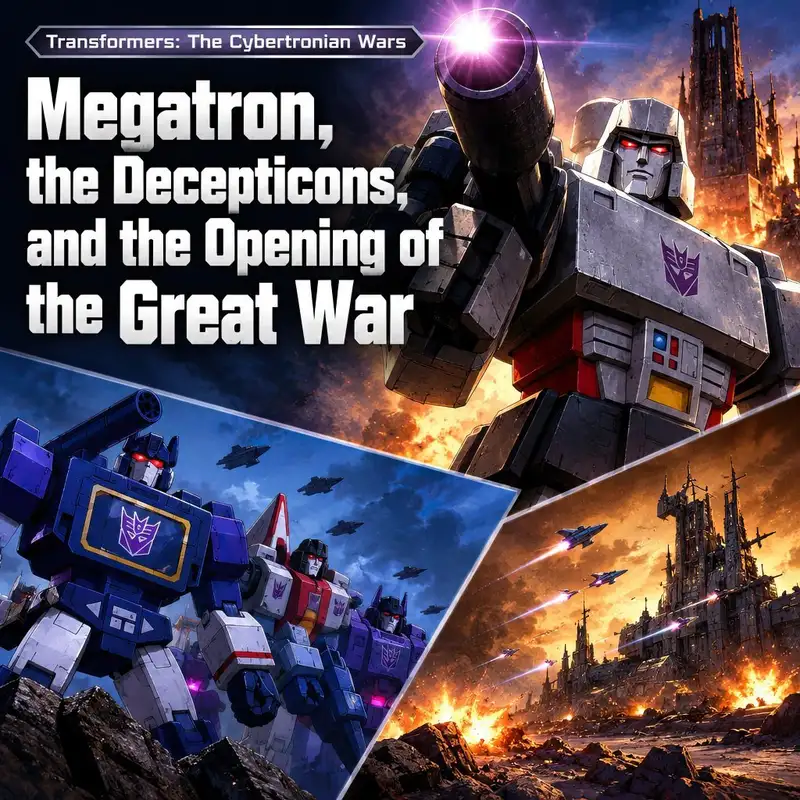
Megatron, the Decepticons, and the Opening of the Great War
At Mining Outpost C-12, the immediate issue was not ideology. It was employment, status, and survival. Senator Decimus arrived to tell the miners that they would be replaced. Officially, other work would be found for them. In practice, the announcement told a labor force already living under a rigid hierarchy that it was disposable. When one worker protested, an Autobot security officer answered with lethal force. That shot did more than kill a miner. It demonstrated what the state believed order was worth.
In this version of Cybertron’s history, Megatron did not arrive at C-12 with a complete revolutionary army, a polished manifesto, or a plan to found the Decepticons. He was one worker among others who had been told that the system no longer had a place for them. His response to the shooting was immediate and physical. He attacked Decimus. During the struggle, the security officer was killed. The death appears unintended, and Megatron reacts with shock rather than triumph.
That distinction matters. The first violence in this sequence comes from the state. Megatron’s first recorded killing comes amid a chaotic confrontation, not a carefully prepared act of revolutionary theater. But history rarely pauses to preserve such distinctions. Once security forces and workers are fighting, intention becomes less important than consequence. The miners are defeated, arrested, and placed on a prison transport bound for Penal Facility H-3, known as the Rig.
Tactically, the authorities had contained the disturbance. The outpost was secured, its workforce subdued, and the apparent ringleaders removed. Yet repression had also assembled a group of angry, desperate prisoners and given them a shared experience of state violence. Cybertron’s rulers had not solved the problem of labor displacement. They had converted it into a security problem and then attempted to ship that problem elsewhere.
The question is not whether C-12 justified a planetary war. It did not. The question is what kind of opposition a political order creates when it answers economic dispossession with armed force, detention, and silence. Megatron’s later choices remain his own. But the state that confronted him at C-12 had already demonstrated that peaceful dissent had little protection when it threatened established power.
This was the prewar Cybertron of the I D W continuity that began in two thousand five, not the Cybertron of the original animated series, the later I D W reboot, or Transformers One. The broad record describes a society governed by a Senate whose authority had become compromised by corruption, surveillance, censorship, and coercive institutions. It was a civilization with immense technical capacity and deep political decay.
Later stories add important context. They describe a succession crisis, political murders, manipulated public institutions, and a government prepared to disappear or neutralize inconvenient dissent. The precise sequence of every Prime, senator, and secret program is not entirely smooth across the later prewar material. That is a problem for historians, but the larger condition is clear enough. Cybertron’s political system had lost much of its credibility before Kaon erupted.
The Autobots of this period should not be confused with the later Autobot resistance. At the opening of this story, Autobot security personnel are principally part of the state’s enforcement apparatus. Some may have acted from a sincere belief in public order. Others served a system that had become increasingly difficult to defend. A badge, faction symbol, or official title did not automatically make them villains. It did make them responsible for the methods of the government they protected.
The Senate’s failures did not make Megatron inevitable. Corrupt states produce many responses: reform movements, labor action, underground journalism, exile, sabotage, apathy, and collaboration. An unjust order does not by itself create an army capable of replacing it. To become dangerous, a rebellion needs sanctuary, money, weapons, repair facilities, communications, recruits, and leaders willing to make decisions that ordinary political life would forbid.
The prison transport Longshot became the first real test of whether the miners could become something more than victims of a failed protest. Megatron and the other detainees seized the vessel and escaped. The operation did not create a mass movement. It created a mobile cadre, a small group of fugitives who had broken the state’s attempt to isolate them and now needed somewhere to survive.
The escape also reveals a recurring problem in internal security. Arresting dissidents is only decisive if the state can hold them, identify their networks, and prevent their release from becoming propaganda. The Longshot did the opposite. It gave Megatron a dramatic escape, demonstrated the weakness of the authorities, and sent the fugitives toward the city most capable of turning disorder into organized violence.
That city was Kaon. It was not just a backdrop for gladiatorial combat. Kaon offered what every underground movement needs: dense infrastructure, criminal networks, places to hide, and a population with limited confidence in distant authority. Its illegal arenas and black markets were already systems of exchange outside respectable law. Security forces could raid an outpost. Controlling an entire city built around unofficial power was a different problem.
Fugitives also have practical needs. They need shelter, repairs, energon, contacts, transport, weapons, and places where damaged personnel can be treated without being reported to the authorities. Kaon could provide those things. The city’s underground economy was not a romantic refuge for the oppressed. It was an environment in which exploitation, violence, and opportunity existed side by side. That made it useful to Megatron.
The move to Kaon was therefore an operational turning point. The state had intended to remove a group of miners from public life. Instead, it had placed them beyond easy reach of legal institutions and within a city whose unofficial institutions could sustain them. Megatron had escaped punishment. He still had not built a political organization. But he had reached the ground on which one could be built.
Kaon’s gladiatorial pits taught him the next lesson. Violence could be more than self-defense. It could be spectacle. It could create reputation, revenue, fear, and followers. In the arenas, combat was not just a private contest between two fighters. It was a public performance before audiences accustomed to seeing status decided by force. Megatron learned to use that audience.
His rise through the pits was rapid and brutal. He fought, killed opponents, and defeated the leaders of the arena operation. This was a moral and political transformation. At C-12, violence had erupted under pressure. In Kaon, Megatron began to choose violence as a means of command. He did not just survive the criminal world. He took control of part of it.
It would be too simple to say that oppression made him what he became. Cybertron’s ruling order helped create the conditions in which someone like Megatron could gain support. It did not compel him to turn fear into a governing principle. Kaon offered him choices. He chose to build authority through domination, public humiliation, and the promise that those excluded from the old order could become powerful by helping destroy it.
The pits also provided economic and technical infrastructure. Gladiators needed repairs. Arenas needed construction, power, security, and a flow of participants. The Constructicons matter here not because they were recognizable names in the background, but because they represented the practical labor required to keep a violent enterprise functioning. A movement cannot fight for long on slogans and personal combat alone. It needs builders, mechanics, and spaces it can defend.
This was the beginning of a crude industrial base. The Constructicons did not create a planetwide military production system, and the record does not support claims of mass weapon manufacture. What they did provide was more immediate and more valuable to an underground force: repair capacity, construction skill, and the ability to adapt criminal infrastructure for political violence. A functioning workshop can matter more than a grand speech when a fugitive movement is trying to survive.
The arena also served as a recruiting station. It drew fighters, spectators, gamblers, criminals, and those who had been denied influence through official channels. Not all of them wanted the same thing. Some wanted status. Some wanted revenge. Some wanted income. Some were drawn to Megatron’s defiance of the Senate. A movement gains strength not because every recruit shares a philosophy, but because a leader can make different ambitions serve one command.
Megatron’s authority became increasingly personal. He was the fighter who had survived state repression, escaped imprisonment, conquered the pits, and challenged anyone who questioned him. That gave him charisma, but charisma alone is fragile. It has to be translated into organization. The next stage of the Decepticon rise came when Kaon’s underground power met the corruption of Cybertron’s elite.
Senator Ratbat was not a revolutionary. He was an establishment figure who saw disorder as something to exploit. He appears to have sought profit, leverage, and political advantage, not the destruction of the entire system to which he belonged. That calculation was common to declining regimes. Powerful people often believe they can manipulate radicals, criminal networks, or security crises without being consumed by them.
Ratbat’s connection to Megatron ran through Soundwave. In this opening phase, Soundwave was far more than a battlefield specialist. He served as an intermediary, intelligence organizer, recruiter, and supplier. Through Ratbat’s network, he could provide access to black-market weapons, information, and specialized operatives. That made him indispensable. Megatron could inspire fighters. Soundwave could help them find targets, evade surveillance, and coordinate action.
Here, the Senate’s corruption became strategically decisive. A government can survive public anger more easily than it can survive elite betrayal. Ratbat’s willingness to use underground violence for private advantage compromised the state’s ability to respond coherently. The same political class that claimed to defend order was helping arm the forces most capable of destroying it. The arrangement was cynical, but not stable.
Soundwave’s loyalty did not remain with Ratbat. That shift is important. Elite sponsorship can help a movement begin, but it does not guarantee elite control once the movement has its own armed followers and its own sources of legitimacy. Ratbat believed he was using Megatron. Megatron and Soundwave built a network that could eventually use Ratbat, discard him, or turn against the entire Senate.
The Decepticon cause now had fighters, technical support, weapons channels, intelligence, and a base in Kaon. What it lacked was reach. A force confined to underground arenas and city streets can challenge local authority. It cannot easily threaten a planetary government. That changed when Soundwave introduced Megatron to Starscream, Thundercracker, and Skywarp.
The three flyers gave the movement a capability it had not previously possessed. Flight meant reconnaissance beyond the ground routes of Kaon. It meant rapid movement over urban obstacles. It meant the ability to strike targets that a street force could not approach without warning. It also meant that Megatron’s organization could begin to choose the place and timing of its attacks rather than merely reacting to security raids.
Starscream’s role in this phase should also be kept in its proper setting. He was an operational conspirator, not just a future symbol of internal rivalry. His ability to move between factions, gain access, and participate in deception would become central to the next stage of the conflict. Thundercracker and Skywarp provided additional mobility and military presence, though the story does not require that they be assigned the later personalities other accounts sometimes give them.
The Seekers also altered Megatron’s political imagination. Kaon no longer had to be the limit of his ambitions. With intelligence support and aerial movement, the old order’s centers of power were no longer distant abstractions. They became reachable targets. The difference between an uprising and a war is often the moment when insurgents gain the ability to strike beyond their own neighborhood.
Megatron now began to gather gladiators, workers, criminals, and other alienated Cybertronians into an open assembly. The crowd was not a single social class and not a unanimous political body. It contained people with different grievances and different expectations. What united them was not a detailed program for government. It was the conviction that the existing order had failed them and that Megatron offered a path out through force.
His rhetoric transformed Cybertron itself into an arena. That was a revealing choice of metaphor. An arena is not a republic. It is a place where participants are judged by survival, victory, and the ability to dominate an opponent before a crowd. Megatron no longer spoke as a worker demanding protection from arbitrary displacement. He spoke as a leader preparing to conquer the entire planet.
Senator Decimus was abducted and brought before the assembly. His presence gave the gathering a human, or rather Cybertronian, face for the system Megatron opposed. Decimus had announced the replacement of the C-12 workforce. He could be presented as a symbol of elite indifference and state cruelty. But the purpose of the abduction was not judicial accountability. It was political theater.
Public punishment can create solidarity among followers by turning a complex system into one visible enemy. It can also eliminate the distinction between justice and revenge. Decimus was not being brought before an independent tribunal. He was being displayed before an armed movement whose leader had learned the political value of spectacle. That was a warning to every official who still believed Megatron’s revolt could be treated as a local criminal disturbance.
The assembly also shows Megatron beginning to delegate authority. Rumble and Frenzy were assigned to Soundwave’s command. This was still a small and highly personal organization, but it was no longer merely a collection of admirers around one fighter. Delegation created the beginning of command relationships. Soundwave handled intelligence and specialized operations. Others could carry out orders without Megatron standing beside them.
That development made the movement more capable, but it also made it more dangerous. A faction can be broken by capturing one leader only if its followers have no independent capacity to communicate or act. By the time of the rally, the Decepticon network had already become more resilient than the authorities understood. The raid that followed would demonstrate the difference between tactical success and strategic success.
Prowl and Sentinel Prime led the Autobot Security Services against the gathering. Their raid captured Megatron and many of his followers. In immediate military terms, it was a substantial achievement. The state had identified a hostile assembly, disrupted its leadership, and prevented the public execution of Decimus. A government facing an armed conspiracy could hardly ignore such a threat.
Sentinel Prime represented the coercive face of the prewar order. He was the official commander responsible for restoring security in Kaon. Prowl operated beneath him as a security officer with a more controlled and methodical approach. The distinction should not be exaggerated into a simple moral divide. Both served the existing state. Yet Prowl’s concern with discipline and collateral consequences suggests that even within the security apparatus, there were different ideas about how force should be used.
The problem was that the raid targeted the visible center of the movement while leaving much of its hidden structure intact. Soundwave was not caught in the same net. The intelligence network survived. The weapons channels survived. The city’s criminal infrastructure survived. Ratbat still possessed political influence. The state had seized prisoners, but it had not dismantled the system that had made those prisoners dangerous.
The raid also failed politically. It could remove an armed faction from a room. It could not restore legitimacy to a government associated with corruption, economic coercion, and lethal enforcement. Every arrest risked confirming Megatron’s claim that the Senate could only defend itself through force. That did not make his claim wholly true. It did make it persuasive to those who had already lost faith in the institutions around them.
Ratbat then used his connections to secure Soundwave’s release. This was the final demonstration of how compromised the state had become. A senator could manipulate legal processes to protect an asset tied to an increasingly violent underground movement. Ratbat may have believed that he was preserving his leverage. In reality, he was helping preserve the machinery of his own destruction.
The decisive operation would not be another street fight in Kaon. It would strike the Senate itself. Starscream appeared to offer information in exchange for freedom. To the Senate, this looked like the familiar logic of factional division. A rebel could be induced to betray his comrades. A dangerous movement could be broken by exploiting ambition. It was a reasonable possibility, but in this case it was a deception.
Starscream’s apparent defection gave the Decepticons access to the political center of Cybertron. Soundwave was already free. Their coordination turned the Senate’s own assumptions against it. The governing body that had survived public unrest, labor anger, and internal corruption now found itself vulnerable to an assault from within its security perimeter. The state had treated the revolt as a containment problem. The Decepticons treated it as a war for power.
The attack on the Senate was not just an assassination or a raid for prisoners. Starscream and Soundwave killed councilors, freed Megatron and the other captives, and armed the Decepticon force. The available record does not establish precise casualties, and it would be careless to claim that every senator shared Ratbat’s degree of corruption. What is clear is that the operation destroyed the remaining political center of the old order.
That was the irreversible break. The Senate had been corrupt, compromised, and increasingly incapable of reform. Its destruction did not purify Cybertron. It removed the institution that still claimed the authority to legislate, negotiate, or contain the crisis. The Decepticons did not replace the Senate through public consent, constitutional change, or a coalition of reformers. They destroyed it through coordinated political murder.
This is the point at which the uprising became open civil war. Before the Senate massacre, Megatron’s movement could still be described as a violent insurgency rooted in a city, a criminal economy, and a set of real social grievances. Afterward, it had struck directly at planetary government, liberated its own armed cadre, and made coexistence with the existing order far less likely.
The moral significance is as important as the strategic one. Megatron had exposed the bankruptcy of Cybertron’s ruling institutions. He had also chosen a method that made armed hierarchy the foundation of his alternative. The Senate’s crimes did not justify the massacre. The act did not establish justice for the miners of C-12. It demonstrated that Megatron’s movement was prepared to treat mass political killing as an instrument of rule.
Once freed, the Decepticons seized weapons and launched a citywide assault on Kaon. Communications with Iacon were disrupted. This was not just a dramatic detail. Disrupting communications isolates local defenders, delays reinforcement, confuses command, and makes every report less reliable. A security force that cannot coordinate across a city is reduced to a collection of separate units responding to separate emergencies.
Kaon favored the insurgents. Its underground routes, decentralized criminal districts, and preexisting unofficial networks made it difficult for the security services to concentrate their strength. The Decepticons knew where to find support, supplies, and concealment. They had already turned arenas into gathering points and repair sites. Now those same spaces could serve as bases, command posts, and arms caches.
Urban warfare also complicates the use of superior firepower. Security forces may possess heavier equipment, but they must identify targets, protect civilians, maintain communications, and avoid destroying the city they claim to govern. The story never provides a detailed account of Kaon’s civilian population or casualties. It would be wrong to invent one. Yet the broader consequence is plain. Residents who had lived under economic insecurity now lived inside an armed struggle for control of their city.
Sentinel Prime responded by deploying Apex armor, a heavily armed combat system intended to restore tactical balance. This was the state’s emergency answer: apply superior force, defeat the leader, and reestablish order through a decisive battle. It was not an irrational response. Megatron had become the central figure of the uprising. Defeating him could have shattered the Decepticons’ confidence and removed their strongest symbol.
Megatron defeated Sentinel. The immediate result was the collapse of Sentinel’s effective command in Kaon. The source presents him as incapacitated, and later clarification indicates that he survived, though severely damaged and profoundly affected by the defeat. What matters for this battle is not whether he should be counted among the dead. It is that he could no longer direct the defense at the decisive moment.
Prowl assumed practical command and ordered a withdrawal. That decision can look like defeat, because it was defeat. But it was also an attempt to preserve surviving forces rather than allow them to be destroyed in a city the Autobots could no longer effectively control. A commander’s task is not always to hold ground at any cost. Sometimes it is to recognize that the operational situation has failed and prevent a tactical loss from becoming annihilation.
The Decepticons now held Kaon. Tactically, they had defeated the security forces in the city. Operationally, they had gained territory, weapons, repair infrastructure, and a base from which to expand. Their victory also gave Megatron something less tangible but no less important: a myth of inevitability. He had escaped the state, conquered the pits, survived capture, destroyed the Senate, defeated Sentinel, and taken a major city.
Such myths can be militarily useful. They draw recruits, intimidate opponents, and make a leader’s commands appear to be the direction of history rather than the choices of one individual. They are also dangerous. A movement organized around one leader’s apparent invincibility becomes less able to question him, correct him, or negotiate when conditions change. Megatron’s authority had become stronger. It had also become more authoritarian.
After the seizure of Kaon, Megatron’s followers adopted the name Decepticons. A name matters because it creates a durable identity. The miners of C-12 had been workers facing replacement. The gladiators of Kaon had been fighters seeking survival and status. The prisoners of the Longshot had been fugitives. Under the Decepticon name, these different groups became part of a single political and military project.
The new identity also changed the movement’s objective. The Decepticons were no longer defined by a grievance against Decimus or a demand for security in one mining outpost. They were preparing to conquer Cybertron. That shift from protest to conquest is the essential transformation of the opening war. A faction can begin by opposing injustice and end by treating the domination of everyone else as proof that its cause was right.
Megatron’s command was still deeply personal. His combat reputation and ability to command loyalty mattered greatly. But his power was no longer merely charismatic. Soundwave’s intelligence and communications network gave the movement coordination. The Seekers gave it reach. The Constructicons gave it technical support. The gladiatorial world gave it recruits and infrastructure. Captured weapons gave it firepower. Kaon gave it a defended political center.
That is how a revolt becomes an army. Not all at once, and not through a single inspiring speech. It happens through the accumulation of capabilities. A leader gains followers. Followers need shelter and repair. Repair crews need protected facilities. Facilities need information and supply. Supply requires access to markets, criminal networks, or captured stockpiles. Fighters need mobility. Mobility creates new targets. Each success enlarges the range of possible action.
The civilian meaning of Kaon’s fall remains less fully documented than the careers of its leaders. We should not claim that every resident felt liberated, terrified, or loyal to one side. Cities do not possess one opinion. Some inhabitants may have welcomed the humiliation of the Senate’s security forces. Others may have feared the violence of armed gladiators. Many may simply have wanted power, safety, and access to repair facilities. Civilian life rarely fits cleanly into a revolutionary emblem.
What can be said is that urban residents now found themselves subject to armed rule. The destruction of the old government did not automatically create accountable local authority. The Decepticons had demonstrated their ability to seize control. They had not demonstrated an ability to build public institutions that protected people who did not join them. The difference between overthrowing a state and governing a society would become one of the central problems of the war.
Later I D W stories complicate the image of Megatron as only a miner whose political consciousness began at C-12. In the later account known as Chaos Theory, Megatron is associated with political writing, activism, and ideas that influenced Orion Pax before Orion became Optimus Prime. That material broadens the ideological background. It suggests that Megatron’s critique of Cybertronian inequality had a history beyond one workplace confrontation.
The accounts do not fit together perfectly in every detail, and there is no need to manufacture a seamless private biography where the published history remains layered. Megatron Origin remains the controlling account of the Kaon uprising, the formation of the Decepticons, and the opening of the Great War. Later material helps explain that Megatron had ideas as well as rage. It does not erase the choices he made once he acquired power.
Those choices shaped the war at every level. Tactically, the security forces lost Kaon. Operationally, the Decepticons gained a base, weapons, mobility, intelligence support, and a recognizable command structure. Strategically, the Senate’s destruction opened the path to a planetary conflict by eliminating the institution that might still have mediated, legislated, or contained the crisis.
Politically, the old order fell because it had become unable to reform itself without threatening the interests of those who ruled it. But the Decepticons did not replace corruption with representative government. They replaced a failing hierarchy with an armed movement built around personal command, clandestine networks, and conquest. The political vocabulary of justice remained useful. The practical machinery of power was coercion.
Soundwave, the Constructicons, the Seekers, Ratbat, Prowl, and Sentinel each reveal a different part of the system coming apart. Intelligence and communications matter as much as battlefield strength. Repair and construction become strategic assets. Air mobility turns a local uprising into a wider threat. Elite corruption hollows out the state's ability to defend itself. Security forces can contain an incident, but they cannot repair the legitimacy lost when institutions answer disposability and protest with violence.
The miners of C-12 began with economic insecurity and lethal repression. By the fall of Kaon, that grievance had become part of a planetary conflict threatening cities, institutions, and civilians far beyond the original outpost. Cybertron's rulers failed because they could no longer reform a system that treated too many of its people as expendable. Megatron then turned that failure into something worse, building an alternative order around spectacle, clandestine networks, and conquest. The Decepticons did not merely inherit a broken state. They chose to make destruction of that state the foundation of their own power.