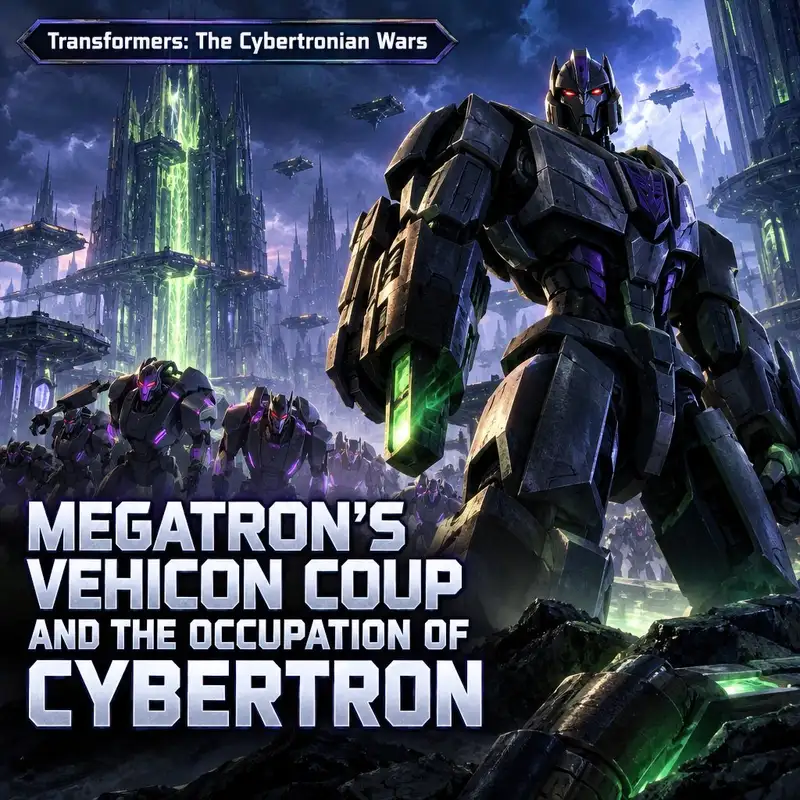
Megatron’s Vehicon Coup and the Occupation of Cybertron
When Optimus Primal, Cheetor, Rattrap, and Blackarachnia return to Cybertron in Beast Machines, they do not arrive at a capital under siege or at a battlefield where friendly forces are holding a shrinking perimeter. They awaken beneath their own world with damaged memories, altered bodies, and no reliable way to transform as they once did. Above them, Cybertron is still active. Its systems move, its streets carry traffic, and its factories operate. But the life of the planet has been removed from public view.
The machines pursuing them look Cybertronian. They move through familiar cities and use familiar infrastructure. Yet they are not a civic population, a police force answerable to a government, or even an army of ordinary soldiers. They are Vehicons, centrally controlled occupation drones. Their presence tells the returning Maximals something before they understand it. Cybertron has not merely changed hands. Someone has reorganized the planet so thoroughly that its people no longer appear to exist.
This is the Beast Era screen continuity, following the events of Beast Wars. The Megatron at the center of this story is the Predacon fugitive who fought Optimus Primal on prehistoric Earth. He is not the Decepticon leader from Generation One, and his war is not a continuation of the old Autobot and Decepticon conflict. His coup is a separate catastrophe, built around a specific opportunity: a defeated prisoner reaches a vulnerable homeworld before the force that captured him can return.
The Maximals begin at an extreme disadvantage. They do not know who controls Cybertron, what has happened to its population, or whether any friendly authority survives. Their memories of the return voyage are incomplete. Their Transmetal bodies and abilities are gone. Even basic transformation has become uncertain and painful. They are pursued by forces with local superiority, surveillance coverage, established bases, and access to the entire industrial landscape.
That is the operational shock at the heart of Beast Machines. The Maximals are not an expeditionary army arriving to retake a world. They are a scattered group of survivors entering a completed occupation. Their first task is not liberation. It is intelligence. They must learn what happened, identify what remains alive, and avoid being absorbed into the system hunting them.
The available record does not show Megatron’s coup in full. At the end of Beast Wars, he is a prisoner aboard the Maximals’ vessel as they leave prehistoric Earth for Cybertron. By the beginning of Beast Machines, he has escaped, reached Cybertron ahead of them, and established a regime powerful enough to dominate the planet. The transition matters, but it is largely missing from the screen history.
We do not see the precise moment of his escape. We do not receive a complete timetable for his arrival. The series provides no technical history of every weapon, virus, factory, or control system he later commands. That absence has encouraged many later explanations, but the television story itself is more restrained. It establishes the result. Megatron got there first, and he used that lead to seize control before the returning Maximals could understand the danger.
For a military historian, that does not make the coup unknowable. It means the coup must be reconstructed from effects. Cybertronian transformation has been disrupted. Bodies lie inactive or stand empty. Sparks, the essential life-bearing component of Cybertronian personhood in this continuity, have been seized and stored. The streets are patrolled by drones. Production facilities support the occupier. A floating fortress acts as the center of command. Megatron’s operation was not a conventional invasion in which one army fought another across a visible front.
It was closer to a decapitation-and-control operation. He attacked the conditions that allow a society to act as a society. He removed mobility, communication, identity, and public presence. A state can survive the loss of a battle. It may even survive the loss of a capital. It cannot easily survive when its population is physically separated from its bodies and deprived of the ability to organize, speak, travel, or resist.
The central weapon in Megatron’s takeover is more than firepower. It is a system that interferes with transformation and enables the seizure of sparks. In Beast Machines, a Cybertronian body is not the whole person, but neither is it an irrelevant shell. The body provides movement, perception, labor, defense, and presence in the world. The spark carries life and identity. Separate the two, and you do more than disable an opponent. You turn a citizen into a captive consciousness and leave the public world occupied by empty hardware.
The series never establishes the fate of every individual Cybertronian. It does not give a population count, a list of victims, or a detailed account of who was captured where. It would be inaccurate to say that every Cybertronian was killed. That is not what the occupation system does. Its horror lies elsewhere. Megatron preserves the population in a form he can control while stripping it of political and physical agency.
This is why Cybertron feels so silent. The streets are not empty because everyone fled into the wilderness. The ordinary life of the planet has been interrupted at a deeper level. There are no visible civic institutions, no public argument, no independent labor, no neighborhood defense, no functioning government appealing to its citizens. There are only patrol routes, industrial facilities, command signals, and bodies whose persons have been removed.
Megatron has not just defeated an enemy leadership. He has made citizenship impossible. A Cybertronian without access to a body cannot cast a vote, maintain a facility, organize a resistance group, protect a family, travel to a refuge, or simply occupy public space. The population becomes a resource held in reserve by the conqueror. In that sense, spark extraction is both a biological assault and a political weapon.
It also changes the meaning of occupation. In many wars, an occupier needs collaborators, police, local administrators, supply agents, and some degree of civilian compliance. Megatron’s regime largely bypasses that problem. He does not need a broad social coalition because he has removed the society that could refuse him. He replaces participation with automation and public life with command architecture.
That architecture takes the form of the Vehicon state. Tank Vehicons, Cycle Vehicons, and Aero Vehicons perform different battlefield and security functions, but their common feature is more important than their body shapes. They are not ordinary Decepticons under a new flag. They are not a citizen army with personal loyalties, private grievances, or political rights. They are instruments of Megatron’s will, built and deployed through the industrial systems of Cybertron.
Their role is broad. They patrol cities, pursue fugitives, guard facilities, transport force where it is needed, and maintain the visible coercive presence of the regime. Their mobility gives Megatron reach across terrain and urban space. Their numbers make it difficult for a handful of survivors to hold ground. Their lack of ordinary individuality gives them an advantage in obedience. A Vehicon drone does not need to be persuaded that a patrol is unpopular, that a commander is reckless, or that a civilian has a claim on its conscience.
That efficiency comes at a cost. A force built for compliance has limited capacity for initiative. It can execute a system well when the system knows what to do. It is less effective when it encounters deception, unfamiliar terrain, contradictory orders, damaged communications, or a problem no central planner anticipated. Megatron gains a force that can enforce silence. He does not gain a force that can build a resilient political community.
The physical center of this system is Megatron’s floating control fortress. From there, he directs Vehicon operations through a vast control interface. The fortress is more than a headquarters. It is the visible expression of his theory of rule. Cybertron is to be governed from above, through a single command structure that sees, directs, produces, and punishes. The planet’s complexity is reduced to a management problem.
The fortress also reveals a practical weakness. Centralized control requires nodes. Nodes require power, protection, maintenance, communications, and access to factories. A ruler may claim to have eliminated disorder, but if his patrols, production lines, and surveillance systems depend on a limited number of facilities, then those facilities become targets. A planet-wide occupation can appear invulnerable until a small enemy learns where its command routes run.
Megatron’s ideology explains why he is willing to impose such a system. He presents organic life as corruption and uncontrolled individuality as weakness. His ideal Cybertron is technologically pure, ordered, and free of the unpredictability associated with organic transformation. This is more than a tactical preference for drones. It is a political vision in which difference, autonomy, and change are treated as threats to be removed.
His hostility is not limited to the Maximals. Optimus Primal is the immediate rival, but Megatron’s project is larger than revenge. He wants to remake Cybertron in a form where independent life cannot challenge him. Organic systems represent growth, uncertainty, renewal, and relationships beyond central control. Those are precisely the things his regime cannot tolerate.
The contradiction is obvious, and it is revealing. Megatron condemns individuality, yet he relies on individual sparks. He rejects the uncontrolled identity of Cybertronian life, but he takes captured persons and uses them as military assets. He seeks a world of technological purity, but he cannot create all the judgment, experience, and tactical imagination he needs from anonymous drones alone.
This is more than an inconsistency in the design of the Vehicon army. It is familiar authoritarian logic. Individuality is condemned when it resists power. It becomes valuable when it can be extracted, altered, and placed in service of power. The problem, from Megatron’s perspective, is not that minds exist. The problem is that minds might belong to themselves.
That is why the Vehicon Generals matter. Tankor, Jetstorm, and Thrust are more than upgraded drones with more weapons and better armor. They are built around captured sparks belonging to Rhinox, Silverbolt, and Waspinator. Megatron has taken former individuals and reshaped them into commanders. In doing so, he creates a layered occupation system. Anonymous Vehicons provide scale. The generals provide the ability to plan, pursue, improvise, and lead.
Tankor carries traces of Rhinox, the thoughtful Maximal scientist and engineer. Jetstorm is linked to Silverbolt, whose former identity was defined by loyalty and moral conviction. Thrust contains Waspinator’s spark, though that connection is initially buried beneath a new personality and function. Their altered forms are not simple disguises. They are evidence that Megatron has made personhood itself part of his military inventory.
The generals also show why complete identity suppression is difficult. Memories, habits, moral instincts, trauma, and belief do not disappear as neatly as a body can be reformatted. Tankor gradually recovers aspects of Rhinox’s consciousness. But he does more than revert to the Rhinox the Maximals remember. He remains shaped by what has been done to him and by the ideology he has accepted. His case is important because it resists an easy story of restoration.
A recovered spark is not automatically restored political judgment. A returned memory does not erase manipulation. A person who has been imprisoned, reformatted, and used as a weapon may not emerge unchanged. Beast Machines treats identity as contested terrain. Megatron can alter bodies and constrain consciousness, but he cannot entirely eliminate the past. The resistance can recover fragments of what was lost, but it cannot assume that every fragment returns in the same form.
Jetstorm’s connection to Silverbolt creates a similar problem for Blackarachnia. Her desire to recover him is personal, but it also has strategic meaning. Every recovered individual is proof that Megatron’s system is not final. The regime depends on the claim that it has transformed Cybertron beyond reversal. If a general can be reclaimed, if a spark can be reunited with a body, then the occupation is not an irreversible new order. It is a condition that can be broken.
Megatron’s use of the generals exposes another weakness. He wants commanders with experience, but experience includes judgment. It includes loyalty formed before his regime. It includes the ability to compare his orders with another idea of Cybertron. A leader who centralizes command may find that the very officers capable of solving hard problems are also capable of recognizing when the system has become destructive.
Against this occupation, the Maximals receive help from the Oracle. The Oracle is an ancient guiding intelligence connected to Cybertron’s deeper transformation. It reformats Optimus Primal and his companions into techno-organic bodies, giving them a form of life that Megatron did not anticipate and cannot easily classify within his mechanical order.
The Oracle should not be treated as an all-knowing government waiting underground to resume rule. It provides no complete campaign plan, a political constitution, or a guarantee of success. Its guidance is often difficult, partial, and demanding. The Maximals still have to make decisions under pressure. They still disagree. They still misunderstand what has happened. They still have to survive long enough to turn strange new abilities into practical resistance.
Their techno-organic forms matter because they break Megatron’s categories. His regime depends on a sharp division between controlled machinery and forbidden organic life. The Maximals become a living challenge to that division. They are Cybertronian, but not in the form his occupation system expects. They can move through spaces designed for his drones while operating according to different principles of growth, adaptation, and connection.
That does not make them invincible. Their new bodies create uncertainty. Their transformation is no longer a familiar routine. Their physical and emotional states are unstable. They must learn what they have become while being hunted. In the early stages, their advantage is not superiority in a conventional fight. It is that the Vehicon system has difficulty understanding an enemy that does not fit its assumptions.
The resistance begins underground because the surface belongs to Megatron. Underground movement gives the Maximals concealment, cover, and access to neglected spaces beyond the regular rhythm of patrols. It also forces them to accept a limited objective. They cannot hold cities. They cannot defeat every pursuing force. They cannot announce themselves as a government in exile and expect the population to rally, because the population is imprisoned.
Instead, they gather information. They test enemy capabilities. They identify routes. They learn which systems are automated, which facilities matter, and where the occupation is weakest. This is the slow work of resistance. It is less dramatic than a frontal assault, but it is what allows a small force to remain alive against a larger one.
The Maximals gradually discover that the real objective is more than the defeat of Megatron. It is the restoration of Cybertron’s people. The abandoned bodies and imprisoned sparks change the moral and strategic meaning of the war. A victory that removed Megatron but left the population disembodied would not restore Cybertron. It would only replace one empty command structure with another.
Rattrap’s technical work becomes significant in this context. He is more than repairing equipment for the next fight. He is helping develop the possibility of reconnecting sparks and bodies. The series provides no complete engineering manual for that process, and it should not be reduced to a simple plug-and-play procedure. What matters is the principle. Liberation requires more than destroying drones. It requires restoring persons to the ability to act in the world.
Blackarachnia’s efforts to reach Silverbolt carry the same implication on an individual level. The occupation has converted a relationship into a security problem. Megatron has made a loved one into an enemy commander. Recovering Silverbolt is therefore both intimate and political. It asks whether a person can be reclaimed from a system designed to remake loyalty itself.
This shift in objectives gives the Maximals a clearer strategic purpose. At first, they are an escape force. Then they become an intelligence network. Eventually, they become a restoration movement. Their goal is not to seize territory for its own sake. It is to break the mechanisms that keep Cybertron’s population absent from its own world.
The distinction matters because Megatron’s regime is strong at territorial control. His drones can dominate streets, factories, and visible approaches. But his legitimacy is almost nonexistent. He has not built consent. He has not negotiated a social order. He has not even preserved a population capable of accepting or rejecting his rule. His power is real, but it is entirely coercive.
Numerical superiority does not settle such a war when the larger force depends on fixed infrastructure and centralized coordination. Megatron can manufacture more drones. He can deploy more patrols. He can restart damaged production. But every additional drone increases his dependence on the factories, power systems, repair facilities, and command signals that make the drone useful.
The Maximals cannot match that industrial depth. They do not become a conventional army. They cannot produce an equivalent fleet of bodies or occupy Cybertron city by city. What they can do is choose the terms of contact. They use concealment, infiltration, local knowledge, sabotage, and the enemy’s own predictability. A patrol route is an advantage for the patrol commander until the resistance has mapped it. A factory is a source of strength until it becomes a target. Surveillance is useful until the enemy learns how to exploit its blind spots.
The resistance also expands beyond its original four members. Botanica brings scientific knowledge and a relationship to Cybertron’s emerging organic systems that Megatron cannot reproduce through purely mechanical administration. Her presence matters because the conflict is not only about who controls factories. It is about what kind of world Cybertron can become. Megatron wants an ordered machine planet under a single will. Botanica represents the possibility of growth and interdependence beyond his design.
Noble, a feral and unstable figure connected to the conflict between organic and technological existence, adds another kind of unpredictability. Megatron’s system is built to classify threats, assign them a category, and destroy or absorb them. Noble resists easy classification. That makes him dangerous to the occupier even before his role becomes decisive.
These allies do not give the Maximals a mass army. They give them diversity. In a war against a rigid system, diversity can be a military asset. Different skills, different forms of life, and different ways of understanding Cybertron make it harder for centralized command to predict the next move.
Megatron recognizes that his initial command structure has limits. In the Sparkwar conflict, he activates Obsidian and Strika, Vehicon generals with greater military experience and a more conventional understanding of organized warfare. They are more than another wave of drones. They bring command presence, tactical confidence, and the ability to coordinate operations beyond the reflexive pursuit patterns of the earlier Vehicon forces.
Their arrival is an attempt to correct a genuine weakness. Megatron’s regime has strength in scale and obedience, but it lacks flexibility. Obsidian and Strika can assess a battlefield, organize an attack, and respond to resistance with more than programmed repetition. They represent an effort to combine centralized political control with decentralized military competence.
But this solution creates a familiar problem. Competence brings judgment, and judgment creates the possibility of disagreement. Obsidian and Strika are committed to Cybertron. Their loyalty is not necessarily identical to loyalty to Megatron’s personal project. As the consequences of his rule become clearer, the distinction becomes unavoidable.
This is one of the most important political fractures in the occupation. Megatron has fused himself with the state. To oppose him is, in his view, to oppose Cybertron. But other commanders can reach a different conclusion. They may believe that serving Cybertron requires removing the ruler who has converted its people into stored sparks and its cities into drone corridors.
The regime cannot reliably distinguish obedience to Cybertron from obedience to Megatron because Megatron refuses to recognize the distinction. Every institution in his system exists to reflect his will. That makes dissent appear as betrayal. Yet when a ruler identifies himself completely with the world he governs, he also makes it possible for loyal servants to become opponents once they decide the world and the ruler are no longer the same thing.
The struggle reaches its critical point inside Megatron’s fortress, where the spark containment system is located. Here the occupation becomes visible in its most concentrated form. The collected sparks are more than prisoners. They are the suppressed political life of Cybertron. The fortress contains command authority, military coordination, and the population’s stolen capacity for personhood.
Megatron’s plan is to absorb those sparks into himself and become a unified, supposedly perfect being. This is the final expression of his political project. He no longer wants merely to hold every spark captive. He wants to incorporate them into one command will. Difference will not be tolerated, negotiated, or even stored. It will be dissolved.
The plan also shows the emptiness of Megatron’s promise of order. A society is not made stable by reducing every person to a component of one ruler. A command system can centralize information, but it cannot replace consent with absorption and call the result unity. Megatron seeks not community but possession.
The resistance disrupts this attempt through a combination of sacrifice, technical opportunity, and attack on the command process itself. Noble gives his life in the effort to stop Megatron’s transformation. Nightscream’s sonic attack disrupts the critical moment. The Maximals seize the fortress temporarily, and with it they gain access to the system holding Cybertron’s sparks.
The immediate tactical result is the capture of a command node. The operational result is more important. Vehicon coordination is disrupted. The regime’s ability to impose a single will across the planet is weakened. The strategic result is greater still. The possibility of restoring Cybertron’s people becomes real because the resistance has reached the machinery that made their absence possible.
But taking the fortress does not end the war. Megatron retains industrial depth. He can restart Vehicon production. He can mobilize remaining forces. He can exploit confusion, fear, and the fact that the resistance is still small. The occupation system is damaged, not instantly erased. A regime built on factories and command networks can survive the loss of one headquarters if it has enough redundant capacity elsewhere.
The final campaign therefore depends on denying Megatron the ability to rebuild the same system. The Maximals use cloaking, sabotage, and deception to disrupt drone factories and confuse the enemy’s command structure. They do not defeat the Vehicons by meeting them in an open conventional battle. They attack the relationship between production, control, and deployment.
This is where centralized occupation becomes brittle. A drone factory needs power, equipment, raw materials, and a command network that can assign its output. A commander cut off from reliable information may still have weapons, but he cannot use them efficiently. A force built for strict control may become confused when the hierarchy is disrupted and its opponents can appear from unexpected directions.
Megatron makes one final effort to turn control of the sparks into personal invulnerability. He occupies Optimus Primal’s former Optimal Optimus body and absorbs the captured sparks. The act gives the final confrontation its mythic scale, but its meaning remains political. Megatron is trying to make himself the sole container of Cybertronian life. He has moved from ruling a population to claiming the right to embody it.
Optimus Primal’s response is not a normal victory parade. He drives Megatron into Cybertron’s organic core. Both are destroyed in the process, and the result is a techno-organic reformatting of the planet. Cybertron changes at a planetary level. The captured sparks are restored, the Vehicon system is broken, and the world emerges from the occupation in a radically altered form.
This is liberation, but it is not a conventional postwar settlement. There is no detailed reconstruction conference, no mapped demobilization plan, no complete account of new institutions, and no assurance that every question of identity or governance has been solved. The final transformation is extraordinary, tied to Cybertron’s deeper organic and technological nature. It is not a standard counterinsurgency method that another resistance force could reproduce by following a manual.
What has been defeated is Megatron’s central premise. He believed that Cybertron could be perfected by removing autonomy, suppressing organic life, imprisoning sparks, and concentrating every meaningful decision in himself. For a time, that strategy works. It gives him control of the planet without requiring a visible conventional war against every citizen.
But control is not legitimacy. Automation is not political stability. A factory can build bodies, but it cannot create a society. A drone can patrol a city, but it cannot replace the civic life removed from that city. Captured minds can provide expertise, but they retain the possibility of memory, judgment, and refusal. The very individuality Megatron tries to erase becomes the source of the resistance he cannot fully predict.
Megatron’s coup succeeds because he does not need to defeat Cybertron in a long, conventional campaign. By disrupting transformation, extracting sparks, and converting the planet’s industry into a centrally commanded Vehicon system, he makes organized civic resistance appear impossible. Yet that apparent perfection is also his strategic weakness. His regime can manufacture drones and enforce silence, but it cannot create legitimacy, independent judgment, ecological renewal, or a durable political community. The small resistance prevails because it restores the autonomy Megatron’s system demanded that Cybertron surrender.