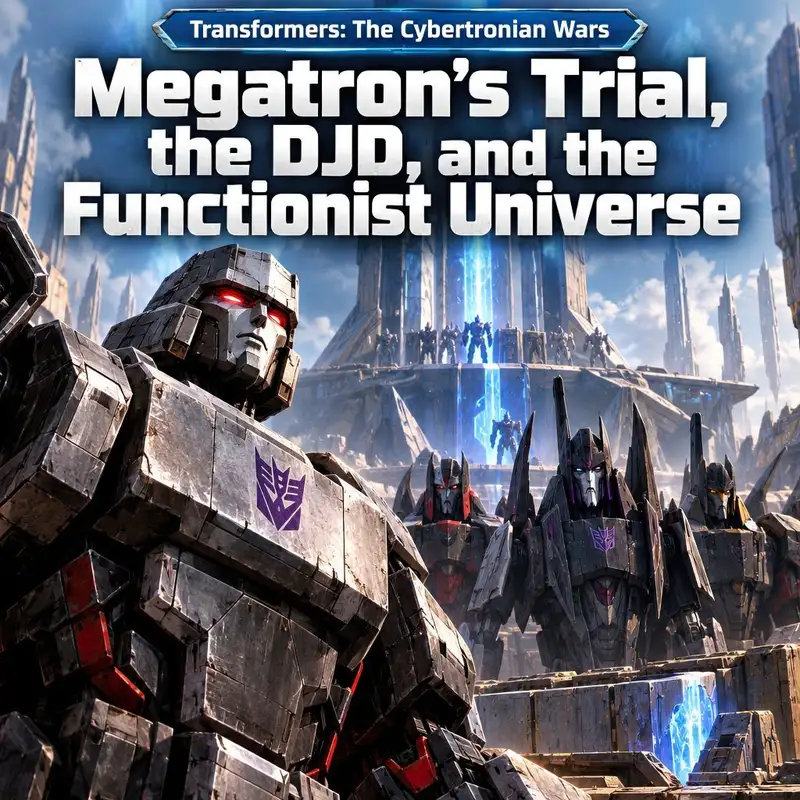
Megatron’s Trial, the DJD, and the Functionist Universe
Megatron stood before a public court wearing an Autobot insignia. In the IDW history that began in two thousand five, this was not a costume change meant to erase a past. It was a legal and political contradiction made visible. The former Decepticon leader had surrendered after Dark Cybertron and declared himself an Autobot. Yet the court record attributed the war he had led to roughly four point six billion Transformer deaths, and at least one hundred billion deaths among other lifeforms. Those were prosecution-era figures within the story, not an independently verified census. They were still large enough to define the problem. What could a society do with the architect of such a war?
The question went beyond whether Megatron had changed. He had changed, at least in important ways. He no longer spoke as though conquest were liberation, and he no longer treated the Decepticon cause as a private instrument of command. But postwar justice cannot rest on a leader’s current self-description. The issue was whether remorse could matter without becoming an escape route from responsibility. Cybertron had survived the war, but survival was not peace. Its institutions, population, and political language had all been shaped by a conflict that Megatron helped begin, direct, and prolong.
The trial therefore became a test of the new order’s legitimacy. A state that executed its defeated enemies without process might satisfy anger, but it would inherit the habits of arbitrary power. A state that treated vast suffering as an unfortunate byproduct of complicated history would betray those who had endured the war. Megatron’s case was unusually difficult because it was not only about one commander. It was about the movement he built, the army that followed him, and the system of fear that learned to function in his name.
Megatron’s original appeal rested on a genuine crisis in Cybertronian society. Prewar Cybertron was divided by status, function, access, and political power. Those assigned low-value roles had fewer opportunities to shape the government that regulated their lives. The old order presented social hierarchy as stability. To many who lived beneath it, stability looked more like permanent exclusion. Megatron’s writing and public presence gave that grievance a language. He argued that a civilization organized around inherited function and elite authority had confused order with justice.
That critique mattered because it attracted people who did not begin as monsters or imperialists. Some wanted representation. Some wanted dignity for laborers and those trapped by social classification. Some wanted a break with an exhausted political class. Others were drawn to Megatron’s charisma, his anger, or the possibility that a rigid civilization could finally be made to move. The Decepticon movement was not born as a simple appetite for destruction. It drew strength from failures that the established order had refused to repair.
But a grievance does not control what is done in its name. Megatron’s movement became militarized, centralized, and increasingly dependent on his personal authority. Opposition became treason. Reform became conquest. Military necessity became a justification for terror, occupation, and the destruction of political alternatives. By the time the Decepticons had become an interstellar war machine, the original critique of inequality had been fused to a command system that could not tolerate independent judgment. Megatron did not personally commit every crime of the war. He was still accountable for creating and leading the institutions that made those crimes possible.
That is the meaning of command responsibility in this history. A leader cannot claim credit for a movement’s victories while treating its atrocities as the work of subordinates who misunderstood him. Megatron recruited commanders, shaped doctrine, rewarded loyalty, and made the Decepticon identity inseparable from military domination. The details of his prewar life are told from several angles across the IDW continuity, and they do not form a perfectly frictionless biography. The larger pattern is clear enough. He transformed political dissent into a force capable of overthrowing a society, then into an army that could not imagine an end to war except through total victory.
The court that received him after Dark Cybertron was itself an improvised institution. Chief Justice Tyrest was unavailable, so Optimus Prime presided. Prowl served as principal prosecutor. Ultra Magnus was assigned to Megatron’s defense. Those roles mattered because each represented a different answer to the postwar problem. Optimus was not there to certify Megatron’s moral recovery. He was there to insist that a society claiming to have escaped tyranny must submit even its worst enemy to a recognizable process.
Prowl represented another pressure, one that could not just be dismissed as vindictiveness. He had lived through the war as a security officer, commander, and survivor of a system in which hesitation could cost worlds. From that perspective, executing Megatron could appear less like revenge than like a necessary guarantee. A former warlord with Megatron’s intelligence, symbolic power, and network of former followers was not an ordinary defendant. Leaving him alive seemed to create a continuing strategic risk. Prowl’s argument carried the hard logic of a state trying to prevent its own collapse.
Ultra Magnus defended Megatron, but defense was not forgiveness. Magnus was a legalist and a disciplined officer. His role was to ensure that procedure applied when procedure was most difficult to sustain. That distinction is central. A defense advocate does not have to approve of the accused. He has to ensure that judgment is based on evidence, jurisdiction, and law rather than the emotional force of an atrocity ledger. If the postwar government could discard those principles when Megatron was in the dock, it would establish a precedent available to every future faction with enough power to invoke emergency.
The proceedings did not resolve cleanly because Megatron found a legal opening connected to the Knights of Cybertron. The Knights were absent, and their unresolved jurisdiction gave him room to argue that the trial could not properly conclude until he accompanied the Lost Light expedition searching for them. It was an extraordinary maneuver, and it frustrated anyone who wanted a direct verdict. But it was not an acquittal. It was not a pardon, and it was not amnesty. The charges remained. The trial had been delayed by a question of authority that postwar Cybertron had not expected to confront.
That outcome changed little on the battlefield. No territory changed hands, no army surrendered, and no weapons system was dismantled. Politically, however, it mattered. The emerging peace accepted the burden of law even when law produced an uncomfortable delay. That did not heal the wounds of the war. It did establish that the new order would have to defend its legitimacy through more than the victory of the Autobots. The unresolved trial then moved from a courtroom to a starship, where Megatron would be judged less by speeches than by conduct under pressure.
Aboard the Lost Light, Megatron became captain of a mission whose crew had abundant reasons to distrust him. The ship was not a prison transport, nor was it a conventional warship with a simple chain of command. It was an expeditionary community, pursuing the Knights of Cybertron and carrying individuals whose loyalties, losses, and political beliefs had been formed in the Great War. Megatron possessed immense experience. He understood fleet operations, Decepticon strategy, deception, and the psychology of command. None of that created consent.
His authority was therefore weak in the most important sense. He could issue orders, but he could not assume they would be accepted as legitimate. The Autobot insignia on his chest did not make him an Autobot in the eyes of those who had fought his forces, buried friends because of his campaigns, or survived Decepticon occupation. The Lost Light’s manpower was limited, its mission uncertain, and its internal politics volatile. A captain who ruled through fear would merely reproduce the system from which he claimed to have broken.
For Megatron, this made redemption a practical discipline rather than a declaration. He had to show restraint when coercion would have been easier. He had to accept scrutiny from people who had every reason to believe he was manipulating them. He had to contribute to a collective mission without converting it into a new Decepticon hierarchy. None of that erased the past. It did, however, create a standard by which change could be measured. If Megatron could not operate without intimidation, then his renunciation of the Decepticons meant very little.
The Lost Light also exposed a deeper problem. Megatron might leave Decepticon command, but the Decepticon system did not disappear because he changed allegiance. Its officers, soldiers, warlords, secret programs, and habits of rule had survived the war in scattered form. Some followed new commanders. Some pursued private power. Some continued to treat Megatron as the permanent source of Decepticon legitimacy. The most terrifying of these remnants was the Decepticon Justice Division, a body created to enforce ideological obedience within the movement itself.
The Decepticon Justice Division was not an ordinary field unit. It was not designed to seize territory, hold a defensive line, or defeat the Autobots in open battle. The DJD was an internal-security and terror organization. Its purpose was to find Decepticons who had strayed from doctrine, broken faith with Megatron’s cause, or otherwise become examples that the regime believed it needed to make. Its power came from intelligence, infiltration, secrecy, torture, and exemplary violence. It was the armed expression of a movement that had become afraid of its own dissenters.
Tarn led the division. Around him stood Vos, Kaon, Helex, and Tesarus, with Nickel serving as the group’s medic. Their individual capabilities mattered in combat, but their true significance was institutional. They were specialists in enforcement. They investigated, hunted, punished, and made punishment memorable. The DJD’s violence was intended to travel farther than its members could. A Decepticon did not need to encounter the division personally to understand the warning. Fear became a communications network, cheaper than trust and more immediate than law.
Megatron bore a direct responsibility for that institution. He conceived the DJD and recruited its original members. That fact makes it impossible to discuss the division as a later distortion for which he had no connection. The unit emerged from his own wartime leadership, from the assumption that the Decepticon cause required not only military discipline but ideological purity. When a revolutionary movement begins to treat disagreement as contamination, it eventually needs someone to identify the contaminated. The DJD became that instrument.
This is why its targets mattered. The division was not defined by hunting Autobots. It hunted Decepticons. It punished those inside the faction who had independent loyalties, doubts, ambitions, or interpretations of the cause. Such organizations often present themselves as guardians of unity. In practice, they destroy the very political agency that a revolutionary movement may once have claimed to defend. A cause that cannot survive criticism no longer relies on persuasion. It relies on fear, surveillance, and the public destruction of anyone who might demonstrate that alternatives exist.
The DJD also shows how institutions can become more doctrinally rigid than their founders. Megatron’s later rejection of the Decepticons did not persuade Tarn that the old system had been wrong. It convinced Tarn that Megatron had become a traitor to his own revelation. The division had been built around the notion that Megatron’s word defined truth. Once he revised himself, the DJD faced a choice. It could follow the living Megatron into uncertainty, or it could preserve an idealized, frozen Megatron who could never admit error.
The later revelation that Tarn was Glitch gave that conflict a personal dimension. Tarn’s identity was not known from his earliest appearances. It became clear only later, when the story showed the distance between the person Glitch had been and the executioner Tarn had become. Glitch had once been a follower of Megatron. By the time he led the DJD, that loyalty had been transformed into something harsher than personal devotion. Tarn had made Megatron’s early doctrine sacred, permanent, and immune to revision.
That is why Tarn cannot be reduced to a sadistic subordinate. He is an ideological product. He believes that the leader’s original vision matters more than the leader’s later conscience. He sees personal change as betrayal because his own identity depends on denying that change is possible. In Tarn’s worldview, the Decepticon cause is not a political program that can be reconsidered. It is a total doctrine. Anyone who deviates, including Megatron, must be purged so that the doctrine can remain pure.
Megatron’s conflict with Tarn therefore was more than a fight between a former commander and a disobedient lieutenant. It was an encounter with the part of his legacy that he could neither command nor simply disown. He had helped create a culture in which violence was proof of conviction, obedience was proof of virtue, and ideological enforcement was proof of loyalty. Tarn carried that culture to its logical extreme. The leader who had once demanded absolute commitment now faced followers who considered repentance a capital crime.
Institutions built on purification are especially difficult to dismantle because they turn uncertainty into evidence of guilt. A commander may dismiss a subordinate, but that does not dismantle the habits of suspicion that empowered the subordinate in the first place. A leader may renounce terror, but victims still carry its memory, and enforcers may still treat terror as sacred duty. Megatron could kill Tarn. He could not undo the conditions that made Tarn possible. That limitation became painfully clear during the crisis known as The Dying of the Light.
The conflict centered on Necroworld, where the Lost Light’s personnel were isolated and vulnerable. The DJD pursued Megatron with a force designed to overwhelm not only bodies but morale. The wider situation was complicated by Getaway’s political maneuvering, by the presence of Overlord, and by Deathsaurus’s Decepticon forces. These were not components of one coherent command. They were rival centers of violence, each carrying its own priorities. The danger went beyond losing a battle. It was that divided leadership and conflicting agendas would make organized resistance impossible.
The DJD enjoyed psychological advantages as much as military ones. Its reputation had been cultivated over years of internal terror. It understood how to make fear disrupt decision-making, how to turn past associations into present vulnerabilities, and how to force opponents to spend energy on survival rather than planning. The Lost Light’s people faced an enemy that knew Megatron’s past, understood Decepticon methods, and believed it possessed a moral mandate to destroy the captain they had come to regard as an apostate.
Necroworld was therefore a force-concentration problem. The stranded personnel could not rely on a stable rear area, unquestioned command, or easy reinforcement. Their opponents included powerful individuals and larger Decepticon formations whose objectives did not always align. In such circumstances, a battle can be lost before the first exchange of fire if participants cannot agree on what success means. Survival, extraction, revenge, restoration of Decepticon authority, and ideological purification were all competing objectives in the same theater.
Megatron’s confrontation with Tarn carried the weight of that history. Tarn claimed to represent Megatron’s truest legacy. Megatron had to confront the fact that this claim was not invented from nothing. The DJD had been born from policies he authorized and from a political culture he helped create. Yet the confrontation also established a boundary. Tarn’s version of Decepticonism could not be allowed to claim ownership over the future simply because it preserved the most violent features of the past.
Tarn was killed, and the DJD was destroyed or neutralized in the broader battle. Tactically, that was a decisive result. A specialized terror apparatus had been removed from the field. Its ability to hunt, interrogate, and terrorize Decepticon dissidents was broken. Strategically, the result was narrower. Destroying a unit does not revive those it murdered. It does not erase the fear that made the unit effective, and it does not dissolve the political fragmentation that the Great War had left behind. The DJD’s defeat ended an organization. It did not settle Megatron’s debt to history.
Then the Lost Light encountered a different and even more unsettling question. What would Cybertron have become if Megatron had never existed? The answer appeared in a divergent universe, later known as the Functionist Universe. The exact metaphysical mechanics of that divergence are not fully explained. What the record establishes is that this was a branch of history in which Megatron never came into being. It was not the default timeline, not the true timeline, and not a simple correction to the universe from which the Lost Light came.
The absence of Megatron did not produce peace. It removed one revolutionary leader, one Decepticon movement, and one catastrophic war. But the old system he had opposed did not become humane simply because it was spared the Decepticon revolution. Instead, Functionism hardened. A social ideology that assigned worth through designated purpose became the organizing doctrine of the Functionist Council. In this universe, a Cybertronian’s alternate mode and supposed function were treated not as aspects of a person, but as political classifications enforced by the state.
The Council’s rule was bureaucratic rather than charismatic. It did not need a single warlord’s personal magnetism when it possessed systems of classification, surveillance, and population management. Functionism offered a brutal form of certainty. Every being had a place. Every place had a prescribed utility. Those who did not fit, whose modes appeared redundant, threatening, or inconvenient, could be recalled, reassigned, erased, or destroyed. The language of efficiency concealed a regime built on persecution.
The mass recalls were not administrative tidiness. They were operations of political violence. They turned bodily form and assigned function into grounds for elimination. In a society of transforming beings, alternate mode is more than equipment. It affects work, movement, self-understanding, and social role. To declare a mode useless was to declare a person disposable. The Functionist state made that judgment on an industrial scale, converting ideology into a mechanism for controlling who could remain visible, mobile, and alive.
The Anti-Vocationist League emerged in response. Its existence is essential to understanding the parallel universe. The Functionist regime did not rule an unresisting population. It faced underground opposition, escape networks, dissenters, and former insiders who had come to recognize what the Council had become. Nine-of-Twelve, once connected to the Council’s world, became an important intermediary. Such figures reveal a vulnerability common to authoritarian systems. Their institutions may appear seamless from outside, but they depend on individuals who can become disillusioned, fearful, compromised, or willing to help the persecuted.
The resistance also faced a practical problem. It could not defeat the Council merely by declaring Functionism immoral. It had to move people, secure information, create safe routes, and survive in a society where official classification could become a death sentence. Its struggle involved evacuation as much as combat. Every targeted community posed questions of shelter, transport, identification, and trust. A government that controls registration, production, and public language can turn ordinary administration into an instrument of war against its own population.
The Council’s plans around Rung showed how completely it had fused social doctrine with industrial power. Rung was presented through a false gigantic mining alternate mode, a piece of manipulation designed to prove that his existence fulfilled the regime’s idea of useful function. That apparent mode was not his ordinary, original form. It was part of the Council’s political theater. Functionism needed visible proof that every being could be categorized, assigned, and exploited according to state purpose.
The deeper reality concerned photonic crystals. Rung’s actual relationship to their production gave the Council access to a resource with immense significance. These crystals could store artificial sparks for cold construction, allowing new Cybertronian bodies and minds to be produced through an industrial process. The Council intended to combine this capability with sparks from Vector Sigma and material harvested by Luna 2. The goal was more than to improve the economy or replace wartime losses. It was to manufacture an army aligned with Functionist authority.
This was military-industrial totalitarianism in its clearest form. The regime’s social sorting created categories of useful and useless bodies. Its control of production turned those categories into labor policy and extermination policy. Its access to artificial sparks and cold construction promised a controlled population of new soldiers. The Council did more than want to govern Cybertron. It wanted to make governance reproducible, scalable, and exportable. Bureaucratic classification became weapons procurement. Persecution became force generation.
The civilian consequences were immense even when the story’s attention shifted toward larger strategic threats. People faced persecution because their bodies, modes, or assigned roles did not satisfy the state. Communities were displaced. Resistance cells had to organize escape and concealment. Production itself became coercive, because the Council’s industrial ambitions rested on treating persons and resources as components in a system rather than participants in a society. The loss was not only physical. Functionism attacked identity by insisting that the state, not the individual, could determine what a life was for.
Megatron initially had reasons to leave this universe. It was not his Cybertron, and he had no right to assume that his presence would solve its crisis. More importantly, he understood what happened when he made himself the center of a political movement. But the Functionist Universe also confronted him with a chance to act differently. Here was an authoritarian system built around the very forms of social exclusion he had once condemned. The question was whether he could oppose it without recreating his own model of coercive revolution.
He chose to remain. He joined the Anti-Vocationist League, accepted command responsibilities, and made contact with that universe’s Orion Pax. This was not a retroactive pardon. It did not convert past crimes into necessary steps toward a better future. It did demonstrate a different kind of political choice. Megatron could have treated the parallel universe as someone else’s problem, or as an opportunity to prove his superiority. Instead, he committed himself to a resistance whose purpose had to be broader than his own authority.
That distinction mattered. The old Megatron had built a movement around personal command, ideological certainty, and a willingness to subordinate other lives to victory. The resistance against Functionism required coalition, restraint, and the protection of people who did not need to become Megatron’s followers in order to deserve safety. It required evacuation as well as attack, and political cooperation as well as military skill. The irony was sharp. Megatron fought the system he had once opposed, but he had to do so without claiming that only Megatron could save Cybertron.
Redemption, in that sense, became responsibility without entitlement. Megatron could contribute his experience. He could take risks. He could lead when leadership was needed. He could not demand that these actions erase the past or compel trust. His presence remained morally difficult because the victims of his own war had not disappeared. The Functionist crisis did not prove that he was innocent. It proved that he understood, at least more clearly than before, that resisting domination means more than replacing one ruler with another.
The Functionist Council eventually converted domestic repression into inter-universal war. Its Cybertron transformed into a gigantic mechanism modeled on Primus, and the Grand Architect’s God Gun breached the barrier between universes. The result was spectacular, but spectacle should not obscure the operational reality. The Council had built its power on a dense structure of dependencies. Its planetary transformation required coordinated systems. Its army program depended on Vector Sigma, photonic crystals, Luna 2, and centralized control. Its ability to project force across realities rested on infrastructure that could be targeted.
The Council’s objective was more than territorial conquest. It sought to impose Functionism by purging non-Cybertronian life. This was an expansionist ideology that treated difference itself as a security threat. A regime that had already classified inconvenient Cybertronians as disposable now extended that logic beyond its own world. The intended purge revealed the endpoint of its doctrine. If function determines worth, then those outside the approved system possess no protected claim to existence.
This is a recurring weakness of authoritarian industrial systems. Their scale can make them appear invulnerable. They have vast production capacity, centralized command, and the ability to coordinate violence across enormous distances. But their control is often concentrated in narrow technical and institutional chokepoints. If the systems that coordinate production, power, and command can be disrupted, the regime may lose the capacity to convert numerical or physical strength into political control. The challenge is recognizing those dependencies before the enemy can adapt.
The defeat of the Functionist Council came through that kind of system disruption. Luna 1 forced the transformed planet back into planetary form. That change exposed access to Cybertron’s twelve hot spots, sites that could be used against the infrastructure sustaining the Council’s rule. Twelve replica Matrices were opened simultaneously. The resulting overload struck Vector Sigma, destroying the Council’s command structure and breaking the system on which its invasion depended.
The result operated on several levels at once. Tactically, the defending forces defeated critical command infrastructure. Operationally, the inter-universal invasion collapsed because its power source, coordination, and planetary configuration could no longer sustain the campaign. Politically, Functionist rule was broken. But liberation was not the same as reconstruction. A population shaped by surveillance, persecution, forced classification, and displacement would still have to rebuild trust, institutions, and ordinary life. Destroying the Council removed a regime. It did not automatically repair the society beneath it.
After the crisis, the Lost Light was decommissioned, and Megatron was arrested again. The legal problem postponed after Dark Cybertron had returned. His service, his conduct aboard the ship, his opposition to Tarn, and his role in the Functionist conflict all mattered as evidence of change. None of them annulled the crimes for which he had originally faced trial. The narrative leaves the original Megatron’s final sentence unresolved between execution and indefinite imprisonment.
A quantum duplicate of the Lost Light and its crew continues elsewhere, but that development does not establish that the original Megatron escaped justice. It is a parallel outcome, not a clean legal answer. Rodimus’s testimony further complicates the record because he falsely claims that Megatron opened the final Matrix. The lie is an act of loyalty, perhaps even mercy, but it also shows how difficult justice becomes when friends try to intervene on behalf of someone whose past remains unbearable.
The IDW story does not let Megatron escape history simply because he changes. His trial insists that peace requires accountability. The Decepticon Justice Division demonstrates that authoritarian violence can become more loyal to a leader’s doctrine than the leader himself. The Functionist Universe shows that Megatron was not the sole cause of Cybertron’s oppression, because the institutions he opposed could become even more systematic and exterminatory without him. Redemption, in this history, is not a clean verdict. It is the choice to resist domination without claiming that present service cancels past crimes.