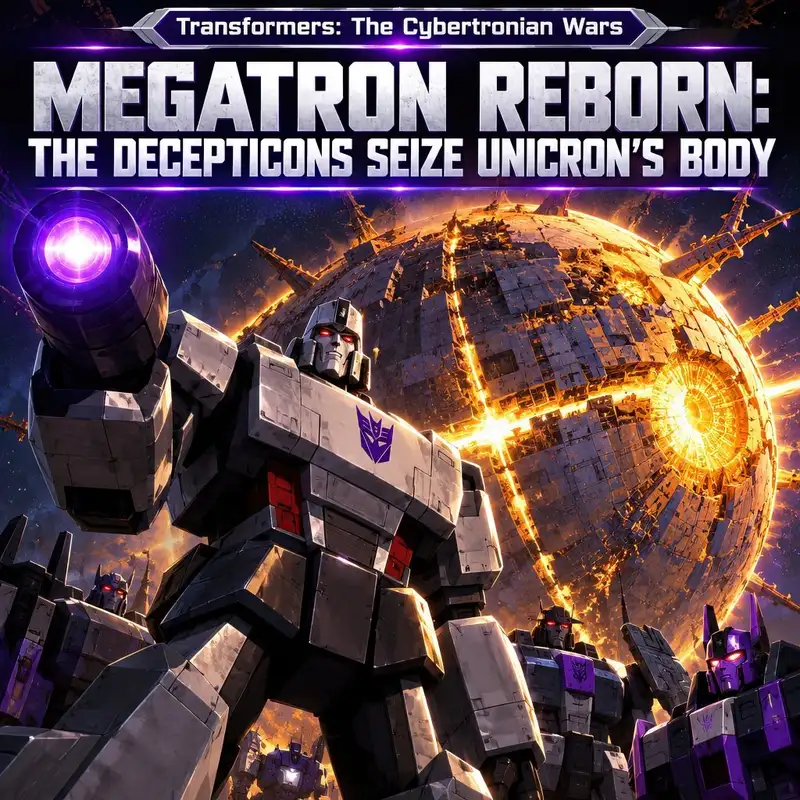
Megatron Reborn: The Decepticons Seize Unicron’s Body
Astrotrain’s cargo bay had become a tribunal without rules. The assault on Autobot City had gone badly enough for the Decepticons to lose their leader in battle, but not cleanly enough to settle what came next. Megatron was damaged almost beyond use after his duel with Optimus Prime. Around him lay other wounded Decepticons, casualties of a battle that had failed to produce the decisive victory their commanders expected. Starscream, never patient with a succession question, made his judgment. He ordered the damaged personnel thrown out into space.
In the American Generation One animated history, set during the year two thousand five, that act was more than battlefield cruelty. It was an attempted transfer of power. Starscream did not wait for a council, a command decision, or confirmation of Megatron’s death. The Decepticon organization had no reliable institution capable of managing the loss of its leader. It had personal loyalties, fear, ambition, and armed followers. So Starscream treated the wounded as unusable cargo and Megatron as a problem best removed before anyone could ask who had the authority to replace him.
The crisis had begun at Autobot City. The Decepticons had launched a major assault while the Autobots were divided among Earth, their city, and the Cybertronian moonbases. Megatron’s objective was more than to inflict damage. He needed to destroy Autobot resistance at its most important Earth stronghold and remove Optimus Prime, whose leadership gave the Autobots coherence across separated fronts. The attack inflicted enormous losses, damaged the city, and killed Optimus after the Autobot leader passed the Matrix of Leadership to Ultra Magnus.
Yet Megatron’s apparent victory over Optimus did not secure his own position. Their duel left him catastrophically damaged. In a more durable military organization, the chain of command might have transferred authority while medics and engineers recovered the wounded. The Decepticons did not appear to have such a system. Their hierarchy depended heavily on Megatron’s personal dominance. Once he could no longer impose that dominance, Starscream moved quickly. The faction’s internal weakness became visible at the exact moment its external enemy had suffered one of its worst defeats.
Megatron and the others drifted away from Astrotrain, abandoned in open space. Their survival was no longer in Decepticon hands. That mattered because the power about to intervene was not a Decepticon resource, an industrial facility, or an ally with shared political interests. Unicron intercepted them. He appeared as a force capable of restoring what the Decepticons had discarded, but his assistance came with a price that would reshape their command structure.
Unicron offered Megatron reconstruction and renewed servants in exchange for service. The offer sounded like a bargain, but it was not a negotiation between equals. Megatron resisted. Unicron answered by taking control of the process directly. He dismantled Megatron and rebuilt him as Galvatron. The former Decepticon leader retained memory, purpose, and a recognizable claim to authority, but he emerged in a different body, with a different weapon system and a new relationship to a being who had demonstrated the power to remake him by force.
Other damaged Decepticons were reformatted into Cyclonus, Scourge, and the Sweeps. The film makes clear that Unicron transformed abandoned Decepticon personnel into a new cadre. It does not make every exact identity relationship between the old bodies and the new forms perfectly clear. That uncertainty is less important than the political effect. Unicron had not simply rescued wounded soldiers. He had created an officer corps whose existence was tied to his intervention and whose new leader was personally indebted to him.
This was extraordinary repair and rearmament, but it was not an industrial recovery program. Unicron did not give the Decepticons mines, refineries, repair depots, trained labor, secure supply routes, or a dependable system for replacing losses. He supplied exceptional bodies through singular power. The distinction is crucial. A faction that can restore one leader through an outside patron has not solved the problem of sustaining an army. It has become dependent on the patron’s continued favor.
Galvatron’s rebirth also created a divided chain of command. Formally, he could claim Megatron’s old position. He had the name, memory, presence, and violence required to lead the Decepticons. In practice, Unicron stood behind him as a superior authority. Unicron could issue orders, inflict pain, alter bodies, and threaten the existence he had granted. Galvatron was more than a lieutenant serving a larger commander. He was a faction leader whose independence had been compromised at the moment of restoration.
The first proof came at Starscream’s coronation. Starscream had already claimed leadership after Megatron’s disposal. His followers gathered around him, and the ceremony attempted to make an improvised seizure of power look settled. Then Galvatron returned. He did not debate the legitimacy of Starscream’s succession or attempt to win recognition through procedure. He killed Starscream in front of the assembled Decepticons and reclaimed command through spectacle.
The tactical effect was immediate. A rival was removed. The Decepticons once again had a central leader with clear military superiority. The political effect was more complicated. Galvatron restored unity through fear, shock, and demonstrated force. He did not create rules for succession, define the authority of his officers, or build a structure that could survive another leadership crisis. The organization returned to a familiar pattern. One leader held the faction together because everyone understood what happened to challengers.
Galvatron inherited Megatron’s followers, insignia, and strategic burdens, but he did not return to a Decepticon recovery plan. His first major mission came from Unicron. The planet-sized machine wanted the Matrix of Leadership, an artifact carried by the Autobots and the only force then shown capable of threatening him. Unicron understood that the Matrix was more than a symbol of Autobot command. It was a strategic danger to his survival.
For Galvatron, the mission created both opportunity and danger. If he captured the Matrix, he could satisfy the force that had rebuilt him. He could also possess the one object Unicron feared. That made the artifact a possible lever. Galvatron pursued Ultra Magnus, who had received the Matrix from Optimus Prime, and eventually seized it. His conduct shows that he was more than obedient. He understood that possession of the Matrix might allow him to renegotiate the relationship imposed on him.
But having an object is not the same as understanding it, activating it, or controlling everyone who wants it. Galvatron attempted to use the Matrix as leverage against Unicron. He did not possess the knowledge or authority needed to make the threat credible. Unicron’s response was direct. He transformed, swallowed Galvatron, and demonstrated the actual balance of power. Galvatron could hold the Matrix in his hands, but Unicron still controlled the environment, the physical force, and the survival of the body he had created.
This was the central command problem in its starkest form. Galvatron had more personal power than Megatron had possessed at the moment of defeat. He had a stronger body, a new weapon, and a cadre of formidable officers. Yet his strategic freedom was narrower. He could not direct the Decepticons toward recovery while Unicron’s demands took priority. He could not bargain effectively with a patron who could physically dominate him. His rebirth increased his battlefield presence while reducing his political independence.
The Matrix changed hands again when Hot Rod took it from Galvatron. The transformation of Hot Rod into Rodimus Prime gave the Autobots a new leader and gave the Matrix an active wielder. Inside Unicron, Rodimus used it to destroy the great machine’s body from within. The immediate planetary threat ended. Unicron’s physical form broke apart, and Galvatron was expelled into space rather than destroyed alongside his patron.
The destruction of Unicron’s body was a decisive tactical and strategic victory for the Autobots. It removed the force threatening Cybertron and ended the immediate attempt to compel the Decepticons into serving as its agents. But it did not restore the Decepticons as a functioning political community, nor did it erase the damage caused by the earlier assault on Autobot City. The city had been attacked, its defenders had suffered severe losses, and the war had moved into a new phase under altered leadership on both sides.
Unicron’s destruction also was not final in every useful sense. His severed head remained in orbit around Cybertron. The body had been broken, but the head retained enough function to matter later. The distinction is important. The Autobots had defeated Unicron’s immediate threat, but they had not reduced every remnant of him to inert debris. In a war shaped by ancient machines, surviving systems, and uncertain repair, a ruined weapon can remain an intelligence asset, a political symbol, or the foundation for another attempt at restoration.
The next phase of the story begins with the Decepticons in exile. In the opening portion of Five Faces of Darkness, the Autobots have reclaimed Cybertron, while the Decepticons have retreated to Chaar. The contrast between Galvatron’s dramatic rebirth and the condition of his faction is severe. They are not shown as an unstoppable army rebuilt by Unicron. They are shown as a damaged force short of energon, divided by scarcity, and trying to survive beyond the world they once sought to rule.
Astrotrain returns to Chaar with a small supply of energon. The arrival does not create relief so much as conflict. Decepticons struggle over distribution because energon is more than fuel for weapons. It supports movement, repair, readiness, and the ability of commanders to maintain discipline. A faction that cannot allocate power fairly or predictably will see every stockpile become a political argument. Scarcity turns rank into a question of access, and access into a test of loyalty.
The scene matters because it strips away the illusion that Decepticon military power is unlimited. Their leaders can threaten worlds, but they are still constrained by supply. Their personnel require energy. Their damaged bodies require repair. Their ships and weapons require sustainment. Chaar is not just a hiding place. It is evidence of defeat. The Decepticons have lost Cybertron, lost easy access to its infrastructure, and lost the stability that comes from controlling major energy and repair systems.
This logistical weakness also deepens the command problem. A leader can demand loyalty, but loyalty becomes difficult to sustain when followers believe they are being asked to starve, remain damaged, or fight for a cause that has no credible path back to power. Galvatron’s return offers the Decepticons a focal point, but it does not create energon. It does not rebuild their industrial base. It does not resolve rivalries that had merely been suppressed by Starscream’s death.
Cyclonus, Scourge, and the Sweeps decide that recovering Galvatron is worth pooling their remaining reserves. It is a high-risk decision. The energon devoted to restoring one leader cannot be used for general repair or immediate distribution among the wider force. Yet the choice is rational within the Decepticons’ political culture. Their organization has no stable alternative command arrangement. Without Galvatron, they have officers and weapons but no accepted center of authority.
The decision shows how bodily dependence, logistical dependence, and political dependence connect. Galvatron had been rebuilt by Unicron. Now the Decepticons must spend scarce energon to revive him after his expulsion from Unicron’s destroyed body. Their survival depends on restoring the same leader whose authority remains personal and brittle. In the short term, that concentration of resources may be necessary. In the long term, it leaves the faction vulnerable whenever its leader is captured, damaged, absent, or simply wrong.
The route to Galvatron runs through Unicron’s surviving head. Cyclonus, Scourge, and the Sweeps enter the wreckage and access records of the final battle. The head functions as more than a monument to disaster. It contains recoverable information. By reviewing what it recorded, the Decepticons identify where Galvatron may have been sent after Unicron’s destruction. They locate him on Thrull, immersed in volcanic material.
This is a limited but important intelligence success. Unicron’s head is not presented as an all-seeing computer that can solve every Decepticon problem. It provides a specific record relevant to Galvatron’s disappearance. Still, it demonstrates that physical destruction has not erased Unicron’s residual strategic value. The head remains a ruin, an archive, and a latent threat. Any force that can access it may recover information unavailable elsewhere.
The Decepticons retrieve Galvatron and use their pooled energon to restore him. The result is a return of centralized leadership, not a return of strategic health. Galvatron can again command Cyclonus, Scourge, the Sweeps, and the scattered Decepticon remnants. He can impose direction where scarcity and rivalry had produced disorder. Yet the underlying condition remains unchanged. The Decepticons are still on Chaar. Their resources remain limited. Their survival still rests on personal loyalty and the continuing capacity of one leader to dominate his subordinates.
The problem becomes more dangerous when Starscream returns. In Ghost in the Machine, he appears not as a normal officer restored to the chain of command, but as a surviving disembodied consciousness. His execution at the coronation had removed his body, but not ended his threat. That distinction exposes another weakness in the Decepticons’ system. They had no institution prepared to address extraordinary survival, contested identity, or a rival who could return outside ordinary military channels.
Starscream possesses Scourge. Through Scourge’s body, he attacks Galvatron and pursues a new source of power. His goal is revenge, but revenge alone cannot provide a body, an army, or durable authority. Like Galvatron before him, Starscream turns to Unicron. He travels to the severed head and seeks restoration from the same force that had transformed Megatron into Galvatron.
Starscream’s bargain is revealing. He does not attempt to rebuild the Decepticons through Chaar’s remaining personnel, acquire a stable energy source, or organize a coalition against Galvatron. He attaches himself to a larger coercive power. Unicron offers him a path toward a new body, but only through service. The pattern repeats. A Decepticon rival seeks freedom by accepting patronage from a force even less accountable than Galvatron.
Unicron gives Starscream a sequence of tasks. First, he must obtain Metroplex’s eyes. Second, he must bring Trypticon to Unicron and remove Trypticon’s transformation cog. Third, these recovered components must support a plan to connect Unicron’s surviving head to Cybertron itself, making Cybertron into Unicron’s replacement body. This is the closest the Decepticons come to seizing Unicron’s power after the film, but it is not permanent possession of his body. It is an attempted reconstruction directed by Unicron and carried out through unstable intermediaries.
The plan is technically ambitious and politically terrifying. Metroplex and Trypticon are more than large combatants. They are city-former systems, assets whose scale gives them strategic and infrastructural importance. Metroplex’s eyes are treated as necessary sensor components. Trypticon’s transformation cog is treated as a critical part of a transformation system Unicron needs for his own restoration. The story does not provide engineering specifications, but it establishes the operational point. Unicron cannot simply will himself back into full capability. He needs particular components taken from unique bodies.
That requirement makes the operation vulnerable. A conventional army can replace some losses through industry, training, and supply. Unicron’s reconstruction program depends on singular assets. There is one Metroplex with the needed eyes. There is one Trypticon whose transformation cog is demanded. There is one planet, Cybertron, envisioned as the replacement body. The plan is not mass production. It is technical recovery under hostile conditions, with no room for a failed step.
Cybertron is the ultimate prize because it is more than terrain. It is the Cybertronian homeworld, a center of political authority, a network of cities and infrastructure, and the place the Autobots have just regained after long war. Turning Cybertron into Unicron’s body would not merely give Unicron a new chassis. It would convert the world itself into an instrument of coercion. The planet’s people, institutions, and strategic geography would be subordinated to the requirements of a resurrected superweapon.
For the Autobots, this threat is therefore both military and political. They are more than protecting a planet from bombardment. They are defending Cybertron from becoming the body of an occupying force. Even if Unicron’s reconstruction had succeeded without immediate destruction, the result would have meant the loss of Cybertronian self-rule. A world could not be politically free if its very transformations, movements, and energy systems were controlled by an entity using it as a body.
Starscream begins by targeting Metroplex. The operation depends on surprise, possession, and the fact that strategic assets can be sabotaged through their vulnerable components. Starscream, acting through Scourge, damages Metroplex’s security systems and steals his eyes. The theft does not destroy Metroplex outright, but it degrades his ability to function safely. A city-former deprived of reliable sight is more than an injured combatant. He becomes a danger to the people and infrastructure around him.
Metroplex transforms despite his impaired visual capability. The result threatens the Autobots because a powerful strategic asset cannot be treated as harmless once its sensors and control are compromised. Bumblebee and Spike interfere with the theft, causing one of Metroplex’s eyes to be dropped and destroyed. Metroplex remains impaired, and the Autobots must disable him with a photon bomb before his compromised condition creates further damage.
This sequence is a useful example of sabotage’s real value. Starscream and Scourge do not need to defeat Metroplex in a direct contest of firepower. They need to remove a component Unicron requires and leave the asset unable to function normally. The immediate tactical effect is confusion and danger within the Autobot defense. The broader lesson is that city-formers and other giant systems still depend on vulnerable subsystems. Scale provides capability, not invulnerability.
The loss of one eye also damages Unicron’s plan. It does not necessarily end it at once, but it reveals the fragility of a program built around irreplaceable components. Starscream has gained partial success while reducing the reliability of the very system he is trying to restore. That is one of the recurring costs of coercive operations. Agents driven by revenge and fear may complete assigned tasks, but they do not necessarily protect the long-term value of the assets they seize.
The next stage requires Trypticon. Starscream uses possession again, taking control of Astrotrain to return to Chaar and continue the operation. He later gains control of Trypticon and brings him toward Unicron’s head. On paper, this is an impressive achievement. A city-former has been moved into position, and a critical transformation component is within reach. But Starscream’s control is not command in the durable sense. It is imposed access through possession.
That distinction becomes decisive. Trypticon has internal personnel. He is not an empty vehicle that can be directed indefinitely by whoever reaches the controls first. His own inhabitants are capable of intervening. They disrupt Starscream’s control, preventing him from completing the removal of Trypticon’s transformation cog. The plan fails because control over a body, a system, or a fortress does not automatically mean control over every person and process within it.
Unicron’s demand for Trypticon’s cog also reveals the limits of his own power. He can rebuild Starscream’s body later in the episode. He can issue commands through his surviving head. Yet he needs external parts to recover a particular capability. His power is immense but not unlimited. That does not make him less dangerous. It makes him strategically legible. He has requirements, dependencies, and chokepoints. The Autobots can oppose him effectively if they identify those points in time.
Scourge becomes the critical source of that information. Initially, he is trapped within Starscream’s scheme because Starscream possesses him. As the reconstruction effort progresses, Scourge recognizes the scale of the danger. He withdraws from the operation and warns Galvatron. This is not an act of simple heroism. It is a calculation made by a subordinate who understands that Unicron’s return would place every Decepticon under an authority far more absolute than Galvatron’s.
Galvatron dismisses the warning. His response is a command failure. It may reflect arrogance, distrust, or a leader accustomed to seeing warnings from subordinates as part of factional rivalry. Whatever the reason, he fails to treat Scourge’s report as intelligence requiring verification. This is especially damaging because the Decepticons have already experienced Unicron’s coercive power firsthand. Galvatron himself was remade by him. He should have understood that a restored Unicron would not be a resource available for Decepticon use.
The dismissal also shows how a culture of betrayal degrades information flow. In an organization where officers expect rivals to scheme, defect, or exploit weakness, truthful warnings can sound like manipulation. Galvatron’s authority rests on fear and personal dominance, but those methods make subordinates less likely to communicate openly and leaders less likely to trust what they hear. The Decepticons do not lack intelligence entirely. They lack a dependable way to evaluate and act on it.
Scourge then approaches the Autobots. His warning gives them information they could not obtain through observation alone. The Autobots also gather evidence from their encounters with Astrotrain and from the disruptions surrounding Metroplex and Trypticon. No single source gives them a complete picture. They do not possess an omniscient view of Unicron’s plan. But the combination is sufficient. They identify the critical node of the operation and move to disrupt it.
Their response is not a conventional campaign against a fully rebuilt Unicron. There is no restored planetary body to besiege and no vast army to defeat in open war. The Autobots conduct a targeted intervention against a technical reactivation effort. Their objective is to prevent the completion of the sequence before Unicron can connect his head to Cybertron and regain a functioning body.
At this point, timely intelligence matters more than raw strength. The Autobots cannot afford to wait until Unicron becomes fully operational. Once Cybertron itself has become his body, the political and military problem would be radically harder. Every Autobot operation might then risk damaging the world they are trying to defend. By acting during the reconstruction phase, they can attack the mechanism rather than confront the completed threat.
The final confrontation takes place at Unicron’s head. Trypticon’s internal personnel have already undermined Starscream’s possession, blocking the effort to remove the transformation cog. That failure leaves the reconstruction sequence incomplete. Unicron nevertheless fulfills part of his bargain. He restores Starscream to a physical body. For Starscream, this should have been the moment when service produced freedom. Instead, it proves that a body granted by a coercive patron does not create loyalty.
Starscream immediately attempts to betray Unicron. The act is consistent with his immediate interests. He has regained physical form and no longer wants to remain subordinate to the being who supplied it. But it also exposes the weakness in Unicron’s entire approach to command. Unicron can compel service through fear, pain, and bodily dependence. He can reformat damaged followers and offer desperate individuals what they want most. What he cannot create is trust.
The same problem had shaped Galvatron’s relationship with Unicron. Galvatron sought to use the Matrix against his patron. Starscream seeks to turn on Unicron once his body is restored. Both cases show that coercive patronage produces obedience only while the threat is immediate and the dependency cannot be escaped. It does not create shared purpose. It does not create durable loyalty. It creates subordinates who wait for an opening.
The Autobots plant energon charges on Unicron’s head. The explosion disrupts the reactivation effort and drives the head back into orbit. Starscream’s restored body is sent tumbling through space. Galvatron orders the Decepticons to fire on him, closing the episode with another attempt to solve a command problem through violence. The Decepticon leader does not recover Starscream, interrogate him, or attempt to understand the surviving threat. He treats the rival as a target to be eliminated.
The immediate tactical result is clear. Unicron’s reconstruction sequence is disrupted. Metroplex’s stolen components have not produced a restored planetary machine. Trypticon’s transformation cog has not been successfully integrated. Cybertron is not converted into Unicron’s replacement body. The Autobots have prevented a catastrophic transformation of their homeworld and protected the strategic systems that would have been absorbed into Unicron’s return.
Across multiple engagements, the failure is equally important. Unicron’s plan required several successful actions in sequence, each dependent on access to unique assets and cooperation among unwilling or unstable agents. The theft from Metroplex created disruption but damaged the plan’s own resources. Possession granted Starscream temporary access to Scourge, Astrotrain, and Trypticon, but not dependable command. Trypticon’s internal personnel could resist. Scourge could defect. Galvatron could dismiss a warning. The operation collapsed because its command relationships were as fragile as its technical dependencies.
Strategically, the Autobots preserve Cybertron, but they do not remove every danger. Unicron’s head remains in orbit, and one of its eyes is still active. The story does not settle his final condition. He is not restored, but neither is every remnant of his power shown to be gone. The Autobots have won time, retained their world, and prevented a political catastrophe. They have not achieved a permanent guarantee that Unicron can never threaten Cybertron again.
For the Decepticons, the outcome is another demonstration that extraordinary weapons cannot substitute for recovery. Galvatron remains their leader, but his authority is still personal. The faction remains weakened by exile, scarcity, and distrust. Chaar’s energon shortage is not solved by Starscream’s defeat. No new industrial base appears. No stable succession process emerges. The Decepticons still depend on damaged institutions and a leader whose command style relies on intimidation more than durable cooperation.
The civilian stakes remain severe even when civilians are not visible in every scene. Autobot City has already shown the cost of Decepticon offensive war. Cybertron now avoids becoming a body controlled by Unicron, but avoidance is not the same as security. Its population remains on a militarized world threatened by surviving wreckage, hostile exiles, and a war that has not been politically resolved. Preserving the planet means preserving the possibility of reconstruction, but reconstruction still requires stability that neither side has fully achieved.
Megatron’s rebirth as Galvatron did not give the Decepticons control over Unicron’s power. It placed their leader inside a hierarchy of coercion that mirrored the faction’s own weaknesses: authority concentrated in one figure, resources too scarce for recovery, rivals managed through violence, and extraordinary weapons mistaken for political solutions. The failed attempt to turn Cybertron into Unicron’s new body shows that command over a weapon, a world, or a rebuilt body means little when the force behind it cannot sustain trust, logistics, or a purpose beyond domination.