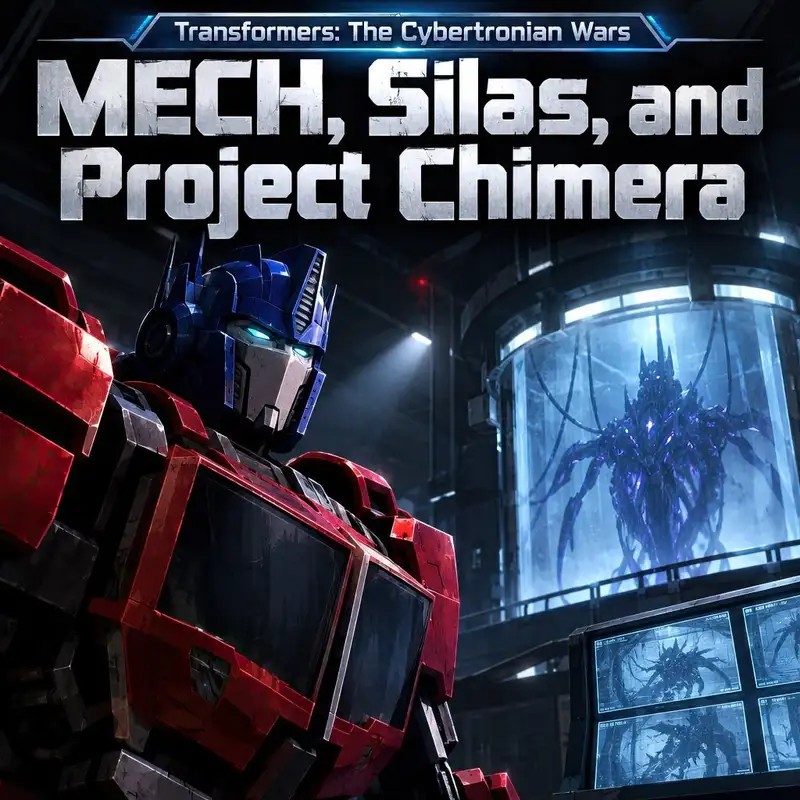
MECH, Silas, and Project Chimera
Breakdown was immobilized on an operating table in a MECH facility on the Kamchatka Peninsula. He had been captured in combat, transported far from any Decepticon support, and reduced from a hostile soldier to a collection of systems that Silas believed could be opened, copied, and repurposed. His pain responses were disabled. An optic was removed. What MECH took was not just scrap from an enemy combatant. It was a functioning part of a sentient being, converted into surveillance equipment and a source of technical intelligence.
In Transformers Prime, that moment reveals the real character of MECH and its leader. MECH was a clandestine human organization operating outside the United States government, not a Decepticon unit and not an authorized military research program. Its leader called himself Silas, though Agent Fowler later identified him as Colonel Leland Bishop, a former special-tactics officer. Silas understood that Cybertronian technology had changed the strategic balance on Earth. He believed that human institutions were too cautious to exploit that change. His answer was to seize the technology for himself.
Project Chimera grew from that belief. Its stated practical goal was simple enough: construct a human-controlled machine with Cybertronian capabilities. But the project’s deeper purpose was political. Silas did not merely want better weapons for human defense. He wanted the power to dictate the terms on which humans, Autobots, Decepticons, and governments would operate. Cybertronian technology was not, in his view, a dangerous foreign presence to be managed. It was the foundation of a new hierarchy.
That ambition carried MECH from theft to captivity, from reverse engineering to impersonation, and finally into an attack on Cybertronian personhood itself. Silas learned that alien technology could be captured. He never learned the difference between possessing a component and mastering the system that made it possible. MECH could steal, dissect, and assemble. It could not demonstrate the industrial depth, energy supply, scientific understanding, political legitimacy, or durable alliances required to become a true equal to either Cybertronian faction.
Silas first entered the war as an independent human actor during the operation surrounding the Dynamic Nuclear Generation System. Agent Fowler was transporting the device when MECH attacked. The target was dangerous enough to justify extraordinary security, but MECH’s intervention created a more complicated battlefield. The Autobots and Decepticons were no longer the only forces seeking decisive technology. A human clandestine organization had entered the contest with aircraft, armed personnel, planning discipline, and a willingness to strike its own government.
The immediate operation did not make MECH a conventional military power. It showed something narrower and, in some ways, more dangerous. MECH could exploit secrecy. It could identify a vulnerable shipment, ambush a convoy, and use the confusion of a Cybertronian conflict to conceal its own role. Silas did not need to defeat the United States military in open battle. He needed to take selected assets, learn from selected encounters, and remain difficult to locate afterward.
During that operation, Silas also saw the Autobots’ vehicle disguises in action. That observation mattered. A Cybertronian alternate mode was not just a technical curiosity. It offered mobility, concealment, access to civilian infrastructure, and the ability to move through a human environment without immediately appearing as an invading force. To a commander already interested in advanced weapons, transformation looked like a force multiplier. A machine that could become a vehicle might enter a base, cross a city, evade surveillance, or place weapons where ordinary armor could not.
But observation is not mastery. MECH could see an Autobot transform without understanding the biological, mechanical, and energy systems that made the transformation possible. That distinction would define Project Chimera from beginning to end. Silas repeatedly mistook a visible capability for a transferable one. He saw a Cybertronian body and imagined a weapons platform. He saw an alternate mode and imagined an engineering problem. He saw a factional war and imagined a market in which superior hardware could purchase influence.
MECH’s early raids were therefore reconnaissance as much as theft. The organization was looking for hardware, but also for vulnerabilities. It needed to know how Cybertronians moved, how they communicated, what damaged them, what kept them functioning, and whether their technology could be separated from the people who used it. Breakdown’s capture gave Silas the opportunity to pursue those questions directly.
Breakdown was a Decepticon, and no one in Team Prime mistook him for an innocent civilian. He was an armed enemy combatant who had fought the Autobots repeatedly. Yet his captivity inside the MECH facility remains an ethical rupture. The fact that the prisoner belonged to a hostile faction did not turn involuntary disassembly into ordinary salvage. MECH did not just disable Breakdown and secure him. It treated his body as available material for experimentation.
The technicians removed his optic and adapted it for surveillance and communications. That decision showed a practical understanding of military intelligence. A Cybertronian optic was not valuable only because it could see. It was connected to a larger system of sensing, data transfer, and battlefield awareness. MECH recognized that a single recovered component could provide information far beyond its immediate physical function. In a war shaped by hidden bases, shifting disguises, and uncertain allegiances, intelligence equipment could be as valuable as a weapon.
The operation also showed the limits of MECH’s knowledge. Silas and his personnel could interfere with Breakdown’s systems, suppress his pain responses, and extract useful hardware. The series does not establish that they fully understood his body, his consciousness, or the total relationship between Cybertronian anatomy and identity. They were working from partial access, not from a mature scientific framework. Their success was real, but it was surgical and opportunistic rather than comprehensive.
Bulkhead’s rescue of Breakdown was therefore a tactical success for the Autobots and a partial strategic failure for MECH. The captive Decepticon was recovered before MECH could keep him as a long-term specimen or dismantle him completely. That mattered. A living prisoner remained a person with knowledge, allegiance, and the possibility of return to his own side. But MECH had already acquired material and data. The optic was gone. The technicians had observed systems no human laboratory had previously been able to study at such close range.
Silas’s methods became clearer in his dealings with Airachnid. In the operation later known as Crisscross, MECH cooperated with the Decepticon hunter because their immediate interests aligned. Airachnid wanted access to Arcee and used information about Jack Darby and June Darby as leverage. Silas wanted access, intelligence, and a chance to observe Cybertronian capabilities more closely. Neither side was entering a lasting alliance. Both expected to use the other and discard the arrangement when it ceased to be useful.
For Silas, Airachnid offered more than operational access. She provided an opportunity to watch transformation in a new context. When she scanned a helicopter and adopted its form, MECH witnessed an aspect of Cybertronian adaptation that could not be learned from a damaged component alone. A transformation system was not simply a set of gears. It involved the acquisition and integration of a new alternate mode. It was responsive to environment, mobility, and mission.
Yet the lesson was again incomplete. MECH could observe Airachnid scan a helicopter. It could not reproduce the process by watching it. It could see the result of Cybertronian adaptation, but not manufacture the underlying capacity. This was the central pattern of Silas’s program. Each observation expanded his ambition while also revealing another layer of dependence on knowledge he did not possess.
Project Chimera eventually required a more direct acquisition. MECH ambushed Bumblebee and removed his transformation cog. In the Prime continuity, the cog is a vital component of a Cybertronian transformation system. Taking it was not just taking an engine part from a vehicle. It was an assault on Bumblebee’s bodily integrity and a deliberate attempt to transfer a defining capability from a living Cybertronian to a human-built prototype.
The first installation failed. That failure was perhaps the most important technical result of the entire program. MECH had acquired a crucial component, but the prototype did not simply awaken as a functioning Transformer. The cog was necessary, but it was not sufficient. The machine required compatible energon and a more complete understanding of how Cybertronian systems worked together. A single stolen device could not substitute for a supply chain, a research tradition, a mature design process, or the accumulated knowledge of a civilization.
Silas had built an organization good at seizure. MECH could identify the part it needed, ambush its owner, and transport the component to a hidden laboratory. Those were real capabilities. But seizure and integration are different military-industrial problems. The first rewards surprise, force protection, secrecy, and aggressive leadership. The second requires expertise, quality control, testing, energy management, replacement parts, and a reliable understanding of failure.
Starscream offered MECH technical assistance because it served his own interests. His involvement did not represent Decepticon approval of Project Chimera. Starscream was acting against both Megatron and the Autobots, looking for advantage wherever he could find it. He recognized that a human organization willing to target Autobots might be useful. Silas, in turn, recognized that Starscream possessed knowledge he lacked. Their relationship was another transaction, this time with a Decepticon commander whose loyalty was always conditional.
The assistance clarified the energon problem. MECH’s prototype needed more than mechanical assembly. It needed the energy source that Cybertronian systems depended upon. That requirement placed MECH in an uncomfortable position. The organization wanted technological independence, but its effort to construct a human-controlled Cybertronian equivalent now depended on alien expertise and alien fuel. The more it learned, the more obvious it became that Cybertronian power was not one invention that could be stolen whole.
Bumblebee recovered his transformation cog, denying MECH the specific component it had taken from him. But the organization later obtained another cog through Starscream. That development allowed Project Chimera to proceed, though it did not change the underlying condition of the program. MECH had not learned how to manufacture transformation cogs. It had acquired one through a chain of coercion, theft, and opportunism. Its prototype remained dependent on rare captured material.
The eventual success of Project Chimera was impressive in the narrowest sense. MECH produced a near-copy of Optimus Prime. It could transform, fight, and present the visual appearance of the Autobot leader. But its value to Silas was not primarily as an independent battlefield soldier. The most important feature of the prototype was that it could commit violence while wearing Optimus Prime’s face.
Nemesis Prime, as the machine came to be known, was remotely controlled by Silas from MECH’s command station. The series does not establish it as a fully autonomous Cybertronian person. It was not presented as a sentient clone with an independent will, nor as evidence that MECH had recreated Cybertronian life. It was a human-controlled artificial body, a powerful platform built to imitate a specific enemy commander.
That made it a false-flag weapon. MECH deployed Nemesis Prime against human military targets in order to make Optimus appear responsible. The tactical action was straightforward enough: a heavily armed Cybertronian-looking attacker struck a military base. The operational and political purpose was more sophisticated. Silas wanted human forces to regard all Transformers as potential threats. If human commanders could be persuaded that Optimus Prime had attacked them, their rules of engagement would change.
The plan exploited a real vulnerability in the relationship between Team Prime and human institutions. The Autobots had allies, especially Agent Fowler, but they had not built a broad public political settlement with humanity. Their presence on Earth was concealed, their war with the Decepticons was only partly understood by human authorities, and their extraordinary capabilities naturally produced fear. MECH did not need to convince every human official of a detailed conspiracy. It only needed enough uncertainty to turn fear into indiscriminate force.
For a brief period, the deception worked. Human military forces received orders to fire on Transformers regardless of faction. That was a major operational effect. MECH had not defeated the Autobots in battle, and it had not destroyed the Decepticons. Instead, it manipulated human authority into becoming another obstacle for both. The prototype had become an instrument of political warfare.
This was Silas at his most dangerous. He understood that technology could shape perception. A machine resembling Optimus Prime could damage more than buildings or vehicles. It could damage trust. In a conflict involving hidden identities and limited communication, the apparent identity of an attacker mattered almost as much as the attack itself. Nemesis Prime was a weaponized accusation.
But the plan also depended on secrecy. False-flag operations require the attacker’s true connection to the violence to remain hidden long enough for the political response to take hold. Once the source was identified, the deception lost its central value. Human commanders might still fear Cybertronians, and the Autobots would still have to repair the damage to their credibility, but MECH could no longer claim that Optimus had acted alone.
The Autobots traced Nemesis Prime back to MECH’s hidden facility. The final confrontation demonstrated why Silas’s apparent breakthrough remained strategically fragile. Optimus Prime faced the duplicate on the battlefield. Agent Fowler infiltrated the control site and disrupted the human command system directing the machine. Neither action would have been enough by itself. Optimus had to neutralize a formidable physical threat, while Fowler had to break the connection that allowed Silas to use the imitation as a controlled weapon.
The result was a combined human-Cybertronian response to a human-made crisis. The Autobots could not resolve the political damage solely through force. Fowler’s role mattered because the false flag had targeted human authority and human trust. He understood the military environment that Silas was trying to manipulate, and he could operate inside the human facility from which that manipulation was being directed.
Nemesis Prime was defeated, but the victory exposed the weakness of Project Chimera. MECH had fielded one decisive prototype, not a sustainable force. Its remote control architecture depended on a hidden command station. Its operational concept depended on surprise. Its leader remained personally involved in directing the machine. The series does not show redundant prototypes, an independent production line, or a distributed control network capable of surviving the loss of one facility.
When Nemesis Prime collapsed onto Silas, it gravely injured him. He was not immediately confirmed dead, but the damage removed him from the position of active personal command that MECH had relied upon. This was not proof that remote warfare is always vulnerable or that a single prototype can never be strategically useful. It showed something more specific. MECH had concentrated too much of its capability in one machine, one control system, one concealed base, and one commander.
The failure also revealed that Silas had been fighting the wrong kind of war. He had treated the conflict as a contest in which an advanced weapon could create political authority. But political authority requires more than a successful deception. It requires institutions that can survive exposure, followers who remain loyal when the plan fails, and a credible answer to the question of what comes next. MECH had secrecy. It had weapons. It had no visible foundation for durable rule.
Agent Fowler later explained more about the man called Silas. He was Colonel Leland Bishop, formerly connected to United States military special tactics. Bishop had been the architect of Project Damocles, a satellite-based weapon system. It was a proposal built around the belief that control of the high ground above Earth could give its operator overwhelming leverage below. The project was judged too dangerous, and Bishop was discharged.
That history does not establish that every concern about Damocles was politically motivated, or that Bishop had no legitimate military insight. Earth had become the battlefield for a war between powerful alien factions. Human governments had reasonable reasons to worry about their vulnerability. The problem was Bishop’s response to institutional restraint. Rather than accept that a weapon system might require oversight, limits, and public accountability, he transferred his loyalty from the institution he had served to his own private technological vision.
MECH was the continuation of that vision. The organization was not shown as a formal branch of the United States military after Bishop’s discharge. Its precise funding, recruitment, and global structure remain unclear. What the series establishes is more important than the missing details. MECH retained military discipline, specialized personnel, aircraft, laboratories, and the ability to strike state targets. It had become a private command structure built around one man’s conviction that normal institutions were too cautious to manage power.
Bishop’s language about a new world order was therefore less a complete ideology than a statement of technological authoritarianism. He did not present a detailed constitution, a social program, or a credible arrangement for public consent. He believed that the side possessing the superior weapon would have the right to shape the world. This is a familiar temptation in military history. A commander begins by arguing that institutions are too slow for danger. Eventually, the commander concludes that institutions themselves are the danger.
After the destruction of Nemesis Prime, MECH applied the same logic of appropriation to its own leader. Bishop’s human body was failing. The organization had access to the remains of Breakdown, the Decepticon whose capture had helped make Project Chimera possible. Rather than accept the death of its commander, MECH surgeons used those remains as the basis for a life-support system and battle body.
The result called itself C Y L A S, a name pronounced Silas, short for Cybernetic Life Augmented by Symbiosis. The transformation was not a normal Cybertronian reformatting. The series does not provide a complete scientific account of how Bishop’s human consciousness, body, and memories were preserved through the procedure. It does not establish a Cybertronian spark transfer, nor does it explain every biological and neurological mechanism involved. What it shows is a forced integration of a dying human leader with the remains of a dead Cybertronian soldier.
That act was the moral endpoint of Project Chimera. MECH had begun by seeking to close a military technology gap. It ended by treating a dead enemy’s body as a replacement body for its own commander. Breakdown had first been a prisoner, then a source of components and information, and finally the material basis for Bishop’s continued survival. The line between reverse engineering and desecration had disappeared.
Silas’s own actions after awakening made clear that MECH was no longer functioning as an independent institution. He killed the personnel who had rebuilt him. The people who had preserved his life were no longer colleagues, technicians, or members of a command structure. They had become witnesses and expendable subordinates. In destroying them, Silas eliminated more than possible opposition. He destroyed the technical and organizational base that had made his transformation possible.
This was the collapse of MECH into personal rule. The organization had always been heavily shaped by Bishop’s will, but it had still required specialists, facilities, planning, and personnel willing to carry out difficult operations. Once Silas turned on the people who sustained him, he no longer possessed a viable human organization capable of developing Project Chimera beyond a single extraordinary prototype. He had a new body, but a weaker institution.
Silas then returned to Project Damocles. The strategic orbital laser system had been his ambition before MECH and before Cybertronian technology transformed the security environment. Now he stole it from a military facility and presented it to Megatron as an offering. Damocles was meant to prove that he could contribute to the Decepticon cause. In Silas’s calculation, control of a strategic weapon would purchase membership in the most powerful hostile faction on Earth.
The proposal revealed how badly he misunderstood Decepticon politics. Silas saw technology as a universal currency. He had a weapon, therefore he expected recognition. But Megatron’s command was not a procurement office. The Decepticons were a military hierarchy shaped by power, loyalty, ideology, fear, and factional identity. A human outsider wearing the remains of a Decepticon soldier was not automatically transformed into a comrade because he arrived with an orbital weapon.
Damocles itself was a serious threat. A satellite-based laser system could strike targets from beyond the immediate reach of ground forces and complicate the Autobots’ ability to defend their base or move openly. But the series does not establish its satellite count, power output, firing rate, range, or long-term resilience. It should be understood as a strategic orbital weapon, not as a fully documented system capable of guaranteeing control over Earth.
As with Nemesis Prime, Damocles depended on control systems and access. Raf was able to intervene through the system’s computer network, undermining Silas’s ability to use the weapon as intended. The episode reinforced a point that MECH had repeatedly failed to learn. A platform is not the same as a capability. Possessing a weapon is not the same as securing it, operating it reliably, defending its controls, or integrating it into a stable command structure.
Megatron rejected Silas as an equal partner. The decision was not just a matter of personal contempt, though contempt was clearly present. Silas was compromised by his history, his human origins, his use of Breakdown’s remains, and the failure of the weapon he had offered. More fundamentally, he had no constituency inside the Decepticons. He had no command of Decepticon forces, no established loyalty network, and no political identity beyond his own hunger for power.
Megatron’s response was especially cruel because it turned Silas over to Knock Out. For Knock Out, the human commander was not merely an opportunist. He was directly tied to the capture, violation, and later use of Breakdown’s body. The series makes the offense clear without requiring a detailed account of every private feeling. Silas had crossed a boundary that mattered deeply within Decepticon society as well as among the Autobots.
The reversal was exact. The man who had reduced Breakdown to usable systems was himself reduced to usable material. He was no longer the commander of MECH, the master of Project Chimera, or a prospective Decepticon officer. He was an experimental subject in a Decepticon laboratory. His technological ambition had not created parity. It had stripped him of bargaining power.
Silas’s final role came during the experiment involving synthetic energon and dark energon. Knock Out and Starscream pursued a dangerous line of research that produced monstrous and uncontrollable consequences. Silas, now held as a captive subject, became part of the chain of events that led to the Terrorcon outbreak. This was not Project Chimera advancing toward a new stage of success. It was the aftermath of MECH’s collapse being absorbed into Decepticon experimentation.
The distinction is important. MECH had tried to copy Cybertronian capability through captured systems. The later experiment did not demonstrate that Silas had mastered energon science or built a human research program capable of producing new life. Instead, it showed him trapped within a Decepticon project whose risks he could not control. He had become dependent on the very faction he hoped to join as an equal.
The experiment spiraled beyond its operators’ control. Synthetic energon and dark energon did not produce a disciplined army or a reliable technological breakthrough. They produced Terrorcons, dangerous beings whose emergence threatened everyone nearby. In a setting already shaped by alien war, hidden bases, and unstable alliances, this was another reminder that experimental power can create new hazards faster than it creates usable military strength.
Airachnid ultimately killed Silas. His death ended the individual story of Leland Bishop and effectively ended MECH as an independent force in the series. There was no surviving human superweapon program shown continuing under another commander. There was no human-controlled Cybertronian army. There was no durable partnership with Megatron. The organization that had once ambushed government convoys and held a Decepticon prisoner disappeared into the consequences of its leader’s ambitions.
MECH achieved several alarming battlefield successes. It captured Breakdown. It removed and repurposed his optic. It stole Bumblebee’s transformation cog. It constructed Nemesis Prime. It briefly manipulated human military forces into treating all Transformers as hostile. It gained control of Project Damocles for a time. These were not trivial achievements, and the Autobots had to take them seriously.
Across the wider campaign, however, MECH repeatedly depended on singular opportunities. A single captive. A stolen cog. Assistance from Starscream. A hidden laboratory. One remote-control system. One orbital weapon. One leader making all major decisions. The organization could generate shocks. It could not demonstrate the redundancy needed to absorb losses, replace its specialized assets, or continue its program after Silas was injured and then transformed.
Strategically, MECH failed completely. It did not create a sustainable human equivalent to Cybertronian power. It did not establish control over Earth’s governments. It did not force the Autobots into permanent isolation. It did not earn a place among the Decepticons. Most importantly, it did not build a political order capable of outlasting the man who created it.
The civilian consequences were still serious, even though the series does not establish a permanent public revelation of Cybertronian activity or a nationwide panic. MECH’s false-flag operation risked turning a secret and limited human-Cybertronian relationship into broad military hostility. Its methods encouraged the idea that any Transformer might be an enemy, any vehicle disguise might conceal an attacker, and any advanced system might justify preemptive seizure. That kind of suspicion can spread faster than technical knowledge.
Silas’s project also demonstrated why the language of technological parity can conceal a deeper assault on personhood. MECH did not treat Cybertronian bodies as the bodies of political beings with rights, loyalties, memories, and claims to dignity. It treated them as repositories of useful functions. An optic became a sensor. A transformation cog became a missing component. Breakdown’s remains became a life-support platform. The person disappeared from the calculation.
That perspective made Project Chimera possible, but it also made it strategically blind. Cybertronian capability was not just metal, energon, or transformation. It was embedded in a civilization, however damaged that civilization had become. It depended on knowledge, energy, repair, adaptation, command, and social identity. Silas could seize fragments of that system. He could not recreate the conditions that produced it.
MECH’s history is therefore a case study in technological imitation without institutional understanding. Silas proved that humans could capture Cybertronian systems and exploit them with frightening effect, especially when deception turned a machine into political leverage. But he could not build the industrial base, scientific comprehension, energy supply, command legitimacy, or durable alliance network needed to sustain that power. His project ended not with human parity, but with a human commander converted into expendable material inside the Decepticon war machine he had hoped to command.