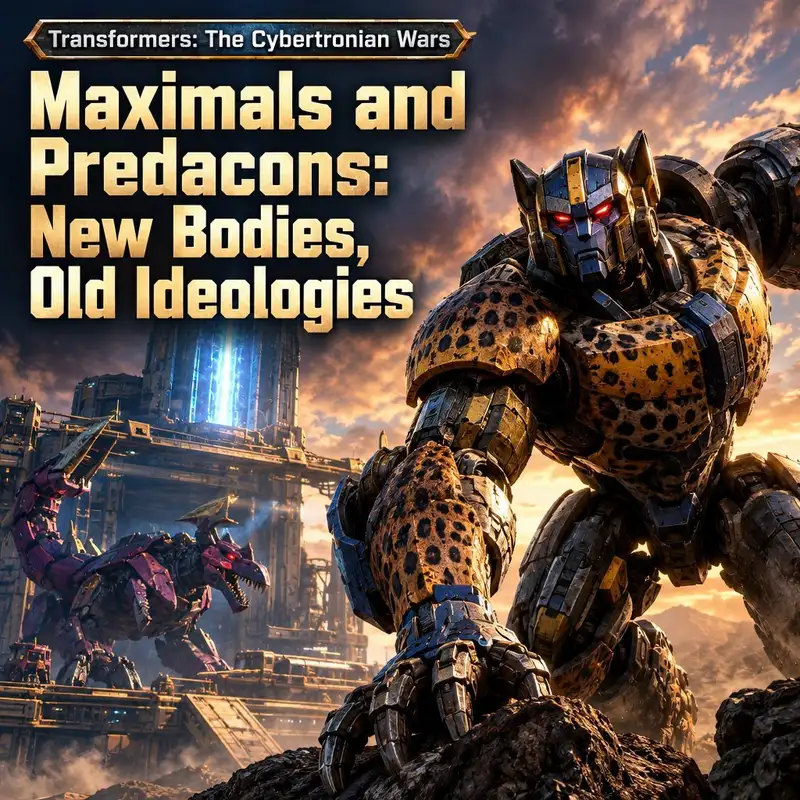
Maximals and Predacons: New Bodies, Old Ideologies
Optimus Primal, Cheetor, Rattrap, and Blackarachnia return to Cybertron expecting a homecoming. Instead, they find a silent planet. Their memories are fractured. Their transformations no longer work. They are trapped in beast bodies that should not exist on Cybertron, while machine patrols move through streets once meant for citizens. The immediate mystery is more than what happened to their bodies. It is why a world that had supposedly outlived the old civil war now treats independent Cybertronians as something to be captured, emptied, reassigned, or erased.
This is the North American Beast Era, the history told in Beast Wars and Beast Machines. Its Maximals and Predacons are successor factions to the older Autobot and Decepticon divide. They are not different biological species. They inherit political symbols, old suspicions, and a long memory of conflict, but they belong to a later Cybertronian society that has supposedly reached a period of peace.
That peace is often called the Pax Cybertronia. The screen record establishes that open war had ended, at least on Cybertron, and that Maximals held the established order. It provides no full treaty text, a detailed constitution, or a reliable social map of every Maximal and Predacon community. We should resist filling those gaps with later comics, toy biographies, or assumptions borrowed from other Transformers histories.
Still, the central weakness is clear enough. A peace settlement can end fighting without settling legitimacy. It can disarm armies without removing factional memory. It can create stability while leaving dissatisfied groups convinced that the system belongs to someone else. That uncertainty gave the Beast Wars Megatron room to operate.
Megatron was a Predacon renegade, not the original Decepticon leader from the ancient war. He drew upon Predacon identity and dissatisfaction, but his own ambitions quickly exceeded any narrow reform program. He did more than want greater influence within the existing order. He wanted leverage over history itself, and he found it in the Golden Disk.
The Golden Disk was valuable because it contained more than information. It offered a path to power through knowledge. In a civilization shaped by a past war, historical intelligence can be a strategic weapon. It can reveal vulnerabilities, identify symbols of legitimacy, and show where an opponent’s political order depends upon a particular remembered event. Megatron stole the Disk and fled aboard the Darksyde, turning a domestic security crisis into an interstellar pursuit.
Optimus Primal led the Axalon after him. At this stage, Primal was not conducting a crusade to remake Cybertronian society. His mission was more limited and more conventional. Recover the stolen asset. Arrest or contain the renegade. Prevent a Predacon splinter group from using sensitive information against the wider order.
That mission rapidly outran its original scale. The Darksyde and Axalon entered transwarp space, and both vessels were thrown off their intended course. The pursuit ended on prehistoric Earth, a world far removed from Cybertronian support, reinforcement, oversight, and repair infrastructure. The established order had sent a security force after a fugitive. It had instead created two stranded expeditionary commands on an undeveloped planet.
The crash changed the war, but not because either faction had suddenly embraced a new ideology. Earth’s ambient energon levels were dangerous to the Cybertronians’ systems. To remain active on the planet, both Maximals and Predacons adopted forms based on local animals. Beast modes were first a survival measure. They shielded or regulated vulnerable systems in an environment that was hazardous to unprotected Cybertronian bodies.
That adaptation also had military value. Animal forms provided concealment in a living landscape. They allowed the combatants to move through forests, rivers, mountains, and open plains without constantly advertising their alien presence. A beast form could scout, stalk, flee, or approach an enemy position in ways that a visibly mechanical body could not. On a planet populated by creatures with no knowledge of Cybertronian war, disguise reduced exposure.
But a beast mode did not dissolve factional allegiance. The Maximals and Predacons retained robot forms, weapons, chains of command, rivalries, and strategic objectives. Optimus Primal still commanded a Maximal crew. Megatron still directed a Predacon force. They did not become apolitical because they resembled animals. They became more capable of surviving the theater in which their political conflict had been stranded.
Technology can alter the way a war is fought without altering the reasons it continues. A new body can change mobility, concealment, instinct, and self-perception. It does not automatically create trust between enemies, establish a peace process, or persuade armed factions to abandon their claims.
The Beast Wars made that point repeatedly. The conflict produced Transmetal bodies, Transmetal Two transformations, altered protoforms, reconstruction, cloning, and unfamiliar combinations of organic and mechanical traits. These changes were not a single, orderly program. The screen record does not support the idea of a universal Beast Era upgrade ladder, nor does it show one institution calmly directing every change.
Instead, bodily transformation often created uncertainty. A new form could offer a tactical advantage, but it could also change how an individual understood their own capabilities. It could introduce unfamiliar instincts or vulnerabilities. It could disrupt an old balance of power within a team. Cybertronian identity was no longer something that could be read simply from a silhouette, an alternate mode, or a faction insignia.
Blackarachnia is especially important here. She began the Beast Wars as a Predacon, but she could not be reduced to a Predacon stereotype. Her decisions, relationships, survival, and later Maximal alignment demonstrate that faction identity was political, not biological destiny. Her body changed during the war, but the more important transformation was her capacity to reassess allegiance.
That did not make Blackarachnia’s path easy, or make her former identity irrelevant. Defection carries memory. It creates suspicion on both sides. A former enemy must decide whether joining a new cause means accepting its authority, merely cooperating with it, or preserving an independent identity within it. The Maximals had room for that ambiguity because they were a small expeditionary force with immediate survival problems. They needed competence more than ideological purity.
Megatron took a different lesson from instability. He saw transformation, identity, and historical knowledge as tools for command. If bodies could change, perhaps history could change as well. If the past could be altered at a decisive point, the society that produced Maximals and Predacons might be erased, replaced, or brought under Predacon control.
The Golden Disk gave Megatron knowledge of the dormant Ark, the ancient Autobot vessel resting on prehistoric Earth. It also gave him knowledge of the original Optimus Prime, whose survival was tied to the inherited history from which Beast Era Cybertron emerged. Megatron’s plan was therefore not merely an attack on an old ship. It was an attempt to strike at the political past itself.
The strategic logic was ruthless. The Maximals and Predacons existed because a particular history had unfolded. Their institutions, identities, and conflicts were shaped by the outcome of the earlier Autobot-Decepticon war. If Megatron could destroy or alter that foundation, he could potentially replace a political order he considered hostile with one built around his own power.
The Maximals fought to preserve the Ark not because they worshipped an antique relic, but because the past had become operational terrain. They were defending the conditions of their own existence. Time conflict has a peculiar cruelty. It makes people responsible for events they did not create, because an enemy has chosen to make those events vulnerable.
The crisis also revealed a more complicated political reality. In the episode involving Ravage, cooperation across old faction lines becomes possible when Megatron’s scheme threatens the larger order. Not every Predacon accepted his program. Not every opponent of Maximal authority supported the destruction of history. That distinction is easy to lose in wartime propaganda, but it is essential to understanding how political movements fracture.
Megatron’s campaign against the Ark failed. The Maximals prevented the alteration of the timeline, and the Nemesis was destroyed during the final struggle. Megatron was captured. From the perspective of the surviving Axalon crew, the Beast Wars appeared to have reached a conclusion. They had preserved history, defeated their enemy, and prepared to return home.
Yet tactical success did not resolve the political problem that had produced Megatron. The Pax Cybertronia had survived, but its vulnerabilities had been exposed. The conflict had shown that one ambitious Predacon could exploit factional grievance, secret intelligence, and strategic mobility to threaten the entire historical order. It had also shown that Maximal victory depended on a handful of survivors operating far beyond normal support.
Between the end of Beast Wars and the beginning of Beast Machines, much remains unexplained. The screen record establishes that Megatron reached or escaped to Cybertron before the returning Maximals. It provides no complete account of every movement, every institutional failure, or every decision that allowed him to seize control. That gap should remain a gap.
What matters is the outcome. Megatron arrived at Cybertron with time, access, and a new political vision. By the time Optimus Primal and his companions returned, the strategic environment had been reversed. On prehistoric Earth, Megatron had been a stranded raider with a small force and limited resources. On Cybertron, he controlled infrastructure, energy systems, automated production, patrol networks, and the public spaces of the planet.
The Maximals, by contrast, returned as a damaged and disoriented cell. Their memories were incomplete. Their transformations were locked. Their beast bodies, once an environmental adaptation on Earth, had become alien and vulnerable on Cybertron. They had no conventional army, no secure base, no clear civilian support network, and no reliable understanding of what had happened to the planet’s population.
This is the sharpest operational divide between Beast Wars and Beast Machines. Beast Wars is a conflict between stranded expeditionary forces. Both sides must improvise. Both are constrained by the planet around them. Beast Machines is an insurgency against a regime that has captured the industrial heartland of Cybertron.
Megatron’s new regime rested on a terrifying proposition. A Cybertronian body could be separated from its spark, its memory, and its political agency. The body could then be reassigned, remade, or used as part of a machine system. The individual could be confined, suppressed, altered, or turned against former allies. In this order, personhood was no longer a protected fact. It was a resource to be managed.
The Vehicons were the visible instruments of that system. Some were drones, built for patrol, enforcement, and mass deployment. Others, especially the generals, showed greater individuality and complexity. It would be inaccurate to call every Vehicon mindless. The deeper problem was that the regime treated autonomy as conditional. A being could possess personality, memory, or tactical talent, but only so long as Megatron’s order could contain and direct it.
Megatron’s hostility toward organic life cannot be separated from his hostility toward independent life. He came to define the organic as instability, contamination, unpredictability, and weakness. But what he actually feared was contingency itself. Organic influence meant bodies that changed, minds that developed, loyalties that shifted, and people who could not be fully reduced to an assigned function.
This made his machine-purity doctrine political as well as technological. He did more than prefer metal to flesh. He wanted a world in which all bodies could be standardized, all energy could be routed through controlled systems, all memories could be monitored or erased, and all disagreement could be converted into silence. His ideal Cybertron had order, but no citizens in any meaningful sense.
The quiet surface of Cybertron was therefore not evidence of peace. It was evidence of removal. Independent Cybertronians had been pushed out of public life through confinement, spark extraction, reprogramming, fear, or disappearance. A city without visible dissent may be secure. It may also be a prison whose inmates have been made invisible.
Megatron possessed significant military advantages. His Vehicon forces could patrol territory, respond through coordinated networks, and draw upon the infrastructure of the planet. His control over production and energy gave him a scale that the Maximals could not match. The resistance could not simply challenge him in open battle and expect to win through courage or superior individual skill.
But centralized systems carry their own weaknesses. Megatron’s authority relied on command networks, controlled identities, automated facilities, and the belief that every person could be made legible to the regime. The more thoroughly he tried to eliminate uncertainty, the more his system became dependent on uninterrupted control. A network that allows no independence must constantly police every return of it.
The Oracle offered the Maximals another path. It was an ancient guiding intelligence connected to Cybertron’s deeper systems, though its full nature, motives, and limits remain uncertain. The Oracle did not provide a complete political program or a convenient explanation for every mystery. It did, however, direct the Maximals toward transformation.
The technorganic reformatting that followed gave Optimus Primal and his allies new bodies that combined mechanical and organic characteristics. This was not a simple upgrade in the military sense. The Maximals did not emerge as effortlessly superior warriors. They had to learn unfamiliar transformations, adapt to altered capabilities, and decide whether they could trust changes they did not fully understand.
For a military unit, that is a serious command problem. A body is more than equipment. It shapes movement, endurance, perception, weapon use, vulnerability, and confidence. A commander who does not understand the limits of a new form cannot deploy it intelligently. A team that does not trust its own transformations may hesitate at the moment when rapid adaptation is necessary.
The technorganic bodies also challenged old assumptions about what Cybertronian life should be. Megatron wanted purity, a clean separation between machine order and organic disorder. The Oracle’s path emphasized balance, adaptation, and coexistence. But balance should not be mistaken for simplicity. Technorganic life did not erase fear, grief, rivalry, or political disagreement. It offered a different material possibility, not an automatic cure.
The Maximals’ resistance depended on that distinction. They did not defeat Megatron because they possessed a single superior body type. They survived because they remained adaptable. They used underground routes, recovered information, salvaged useful components, formed temporary alliances, and exploited the limits of Vehicon control. Their campaign was built from mobility, intelligence, and persistence rather than conventional mass.
Their constraints were severe. They lacked dependable repair facilities. They could not assume that a familiar face meant a reliable ally. Their memories had been compromised. Their understanding of the enemy’s system was incomplete. Even when they recovered a piece of information, they had to ask whether it was current, manipulated, or designed to draw them into a trap.
This made identity an intelligence problem. In an ordinary disguise operation, the question is whether an enemy can recognize your body. Under Megatron’s rule, the question is more difficult. If a body has been reassigned, if a spark has been altered, or if a personality has been buried under programming, then visual recognition is not enough. A friend may wear an enemy’s shell. An enemy may possess a familiar voice. Memory itself may be unreliable evidence.
The resistance gradually proved that Megatron had not converted military control into legitimacy. He could dominate streets and factories, but he could not fully eliminate memory, loyalty, or the desire for self-direction. Every recovered ally, disrupted network, or restored fragment of identity exposed the limits of his claim to total order.
Rhinox and Tankor demonstrate how difficult restoration could be. Tankor was more than an empty enemy shell. The discovery of Rhinox’s identity within that body forced the Maximals to confront the fact that saving someone is not the same as returning them unchanged. Trauma, coercion, altered memory, and a transformed body can reshape a person’s relationship to former friends and former beliefs.
It is tempting to imagine that an authentic spark automatically restores an authentic personality, and that an authentic personality automatically restores an old allegiance. Beast Machines does not support such a comforting formula. Rhinox’s story is a warning against it. Identity persists, but it can be damaged, redirected, and made dangerous. Liberation may require recognition, but recognition alone does not solve what has been done.
Silverbolt’s experience through Jetstorm makes a related point. His recovery shows that programming and reformatting can be contested. Megatron’s control is not metaphysically absolute. Yet Silverbolt’s restoration should not be treated as proof that every victim can be recovered with equal speed or certainty. Resistance movements often survive by rescuing individuals, but no serious historian should confuse a successful rescue with a universal remedy.
Blackarachnia remains important because she had already crossed a factional boundary before Megatron’s regime turned identity into an industrial process. Her history demonstrates that political loyalty can change without bodily coercion. She was not transformed into a Maximal by biological destiny. She made decisions, formed relationships, and accepted consequences. Her life stands against the assumption that a person’s original faction permanently defines their moral capacity.
Megatron’s system failed because it misunderstood this. It treated bodies as containers, sparks as power sources, and memories as files to be edited. Those things matter, but they do not exhaust personhood. Allegiance can survive damage. Memory can return in fragments. Conscience can emerge in an unexpected body. Even fear can become a source of resistance when a regime leaves no lawful space for dissent.
By the final phase of the conflict, Megatron’s objective had expanded beyond mere rule. He sought to absorb or command enormous stores of Cybertronian sparks and use them to impose a fully mechanized planetary order. He wanted not just victory over the Maximals, but victory over the conditions that made Maximal resistance possible.
This was the final form of his ideology. Early in the Beast Wars, he had pursued historical leverage. Later, he pursued control over bodies and minds. At the end, he sought to remove the possibility of unplanned life from Cybertron itself. His project was a campaign against difference, against organic influence, against decentralized memory, and against the political uncertainty that comes with free individuals.
Megatron achieved considerable tactical and operational success. He held territory. He controlled infrastructure. He fielded a powerful enforcement system. He isolated enemies. He converted the surface of Cybertron into an environment hostile to independent movement. But military control is not the same as political success.
A state can seize every visible institution and still fail to build a civic order. It can command production without creating loyalty. It can suppress dissent without resolving the reasons dissent returns. Megatron’s Cybertron could manufacture bodies, move energy, and enforce obedience. It could not generate consent. Its stability depended on continued extraction, surveillance, and coercive control.
Optimus Primal’s objective changed in response. He was no longer simply restoring a previous status quo. The Maximals could not return Cybertron to exactly what it had been, because the old order had already produced unresolved factional division and Megatron had nearly destroyed it. Primal’s task became more difficult. He had to defend the possibility of a future that was neither Megatron’s dictatorship nor a simple repetition of inherited structures.
The final reformatting of Cybertron must be understood in that context. Megatron is defeated, and Cybertron becomes technorganic. The transformation changes the material condition of the planet and rejects Megatron’s demand for machine purity. It makes visible a different relationship between mechanical life, organic life, individuality, and the world that sustains them.
But it does not settle every political question through biology or mysticism. A transformed planet still requires institutions. It still requires leadership, repair, memory, accountability, and a way to live with those who have survived coercion on every side. Reformatting can change the conditions under which society develops. It cannot by itself write a constitution, rebuild trust, or answer every grievance left by war.
The immediate outcomes are nonetheless profound. Tactically, Megatron is defeated. Operationally, Vehicon control collapses. Strategically, Cybertron avoids becoming a permanently standardized machine state. Socially, suppressed individuality has the possibility of returning. Morally, the outcome rejects the idea that sentient beings may be treated as stored energy, replaceable hardware, or raw material for a ruler’s design.
The surviving Maximals awaken restored, and Cheetor is left with an implied responsibility in the new era. That responsibility matters because the final victory is more than Primal’s personal triumph. It is the beginning of a succession problem. A new world cannot depend forever on the commander who saved it. It must develop leaders capable of preserving difference without allowing old factional hatred to become the only language of politics.
The Beast Era’s new bodies did not end old ideologies by themselves. Beast modes allowed Maximals and Predacons to survive a hostile world while continuing the conflict they carried from Cybertron. Vehicon bodies revealed how easily transformation technology could become an instrument of authoritarian control. Technorganic life offered another possibility, but only because the Maximals chose to defend autonomy against Megatron’s demand for uniformity.
That is why the final transformation matters. It is not a magical answer to civil war. It is a rejection of purity, restoration, and domination as the only available futures. The new bodies made a different Cybertron possible, but the peace that followed still depended on whether its people could sustain difference without turning it once again into war.