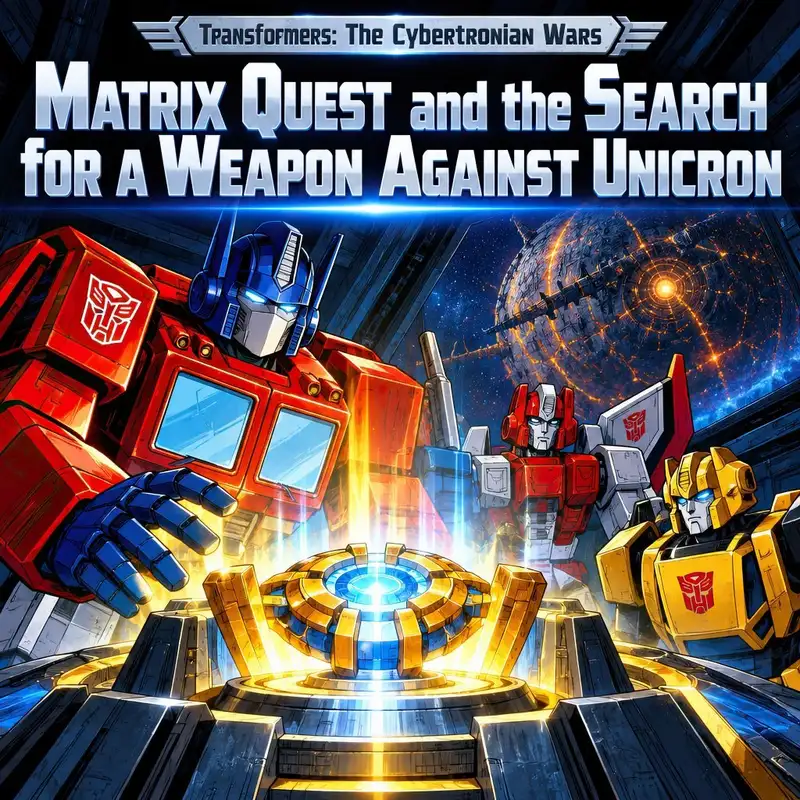
Matrix Quest and the Search for a Weapon Against Unicron [Marvel]
Thunderwing stood in the Ark’s shuttle bay with the Creation Matrix in his possession, and that fact changed the meaning of every weapon aimed at him. The Autobots had spent a desperate search trying to recover the object because they believed it might be their only defense against Unicron. Now their enemy carried it into their own base. Optimus Prime could order fire, but no one could say with confidence what a direct strike would do to the Matrix. Destroying Thunderwing might also destroy the one asset Cybertron could not replace.
That was the central paradox of the Matrix Quest in Marvel’s Generation One comic history. The Autobots succeeded, in a limited sense, at finding their lost inheritance. They did not succeed at controlling it. The Creation Matrix was not just a badge of leadership, and it was not the same object as the Matrix presented in the animated film continuity. In this Marvel story, it carried associations with Cybertronian creation, transformation, and life itself. It was also ancient, poorly understood, and suddenly indispensable.
The crisis in the Ark’s shuttle bay did not begin with Thunderwing’s raid. It began with an alarm that no conventional defense plan could answer. Unicron was moving through space, and Cybertron had effectively announced its own location.
In the preceding events of the Marvel comic, the Keeper told an account of Primus and Unicron as opposed cosmic powers. The account is presented through an in-universe custodian of ancient knowledge, not as a technical manual delivered by an impartial historian. Still, its immediate military implication was unmistakable. Primus had shaped Cybertron and its inhabitants as a defense against Unicron. Cybertronian life was therefore not just caught in an ancient struggle. It had been created, or at least understood itself to have been created, for one.
Then a Decepticon attack disturbed Primus within Cybertron itself. Gunfire ricocheted, Primus awakened, and his cry crossed space. The event did not equip the Autobots with a new weapon. It did the opposite. It told Unicron where to look.
That distinction mattered. The Autobots were not preparing for a distant myth or a hypothetical threat. They faced an adversary whose approach had been triggered by their own world’s awakening. The force available to defend Cybertron was not organized around this problem. There was no demonstrated anti-Unicron fleet doctrine, no industrial program producing a known countermeasure, and no tested plan for fighting something on Unicron’s scale.
Optimus Prime and Xaaron therefore looked toward the Creation Matrix. Their exact division of authority need not be forced into a modern command chart. What matters most is that the senior Autobot leadership recognized the same strategic problem. If the Matrix had any role in Cybertron’s original defense against Unicron, it might be the only available answer.
The complication was that the Matrix was no longer on Cybertron. It had departed with Optimus Prime’s former body after Prime’s earlier death. The body had been launched into space according to Cybertronian funerary practice, carrying with it an object that had become far more than a personal relic. What had been a burial decision now became a strategic liability. The Autobots had placed their most important potential defense beyond their own reach because, at the time, they did not know they would need it.
The decision to search was sensible. It was also a measure of desperation. The Autobots did not know the Matrix’s exact location, its current condition, or how to activate it against Unicron. They could not manufacture another one. They could not test a duplicate. They had no evidence that a laboratory, a repair facility, or a weapons engineer could reproduce its effects. They were trying to recover an irreplaceable ancient system whose capabilities were known mainly through tradition, implication, and hope.
That is not ordinary weapons development. A conventional military can test prototypes, train operators, write procedures, manufacture replacements, and establish custody rules. The Matrix Quest began with none of those advantages. The Autobots had only a presumed strategic requirement. Find the Matrix before Unicron arrived.
Uncertainty about the Matrix’s location shaped the operation. The Autobots could not mass their forces around one confirmed site because there was no confirmed site. Instead, they sent small teams across separate worlds and followed fragmentary signs. This widened the search. It also turned a strategic mission into a dispersed reconnaissance effort conducted far from mutual support.
The comics never establish the full number of search teams, the size of the Autobot fleet, their travel schedules, or the details of resupply. It would be easy to invent a sweeping interstellar search grid. The story never provides one. What it does show is a centrally authorized mission carried out by small, autonomous groups. Each team had enough mobility to reach a distant world and enough independence to investigate strange clues. None had the protection that concentration of force might have provided.
That model had advantages. Small teams could move quickly, enter local environments, and pursue leads without announcing an army’s arrival. But it also created predictable vulnerabilities. Searchers could be captured. Local disputes could consume their time. Incomplete information could be mistaken for a breakthrough. A hostile force did not need to win a general battle against the Autobots. It only needed to identify the search pattern, trail the searchers, and seize the result when they found it.
Thunderwing understood that opportunity. He did not need a planetary occupation force to make the Matrix Quest fail. He needed information, patience, and a chance to turn the Autobots’ own reconnaissance into a guide.
One of the clearest examples came on Pz-Zazz. Nightbeat, Siren, and Hosehead arrived on a world shaped by violent criminal power and competing local interests. They were not walking into an empty ruin where a lost object could be collected without consequence. Pz-Zazz had its own institutions, dangers, and people struggling to survive among them.
The team found a bird-shaped object whose apparent properties resembled the life-restoring potential associated with the Matrix. The resemblance was important as a clue, but it was not proof that the object was the Creation Matrix. It did not establish that the Matrix could be copied, that its power came from a reproducible technology, or that the Autobots had located a substitute weapon.
Nightbeat faced a choice with operational and moral consequences. The object appeared valuable enough that it might help fallen Autobots. Yet its place was not with an expeditionary force treating every extraordinary object as wartime salvage. Nightbeat chose to return it to its original temple.
The decision cost time and gave up a possible advantage. It also protected something the search mission was supposed to defend in the first place: the survival of life beyond Autobot military needs. When the artifact restored vitality to the local environment, it revealed a larger meaning. Life-generating power was not just useful because it might revive soldiers or damage an enemy. It had value to the people and ecosystems already living under its influence.
That restraint was not sentimental decoration around a military mission. It was a form of discipline. A force that treats every local resource, artifact, and population as expendable in pursuit of a strategic objective may gain short-term freedom of action. It also loses legitimacy, local knowledge, and the ability to distinguish protection from appropriation.
But ethical restraint did not make the team safe. Thunderwing’s Decepticons ambushed Nightbeat, Siren, and Hosehead and took them captive. The capture gave Thunderwing a crucial intelligence gain. The Autobots were not conducting an isolated patrol. They were searching across a region for something of unusual importance.
The information did not have to arrive as a complete Autobot operations plan. It was enough for Thunderwing to recognize the pattern. Multiple small Autobot teams were chasing related leads. They were far from one another. Their mission was urgent. And whatever they sought mattered enough that Optimus Prime had committed scarce personnel to the effort.
The Pz-Zazz episode therefore exposed two different truths. Nightbeat showed that a search for a life-giving power could not be separated from moral responsibility. Thunderwing showed that isolated reconnaissance personnel carry intelligence as well as weapons. Once captured, they can compromise an operation even if they never intended to reveal its full design.
Other search teams encountered a different kind of problem. On the desert world of Cheyne, the Triggerbots Override, Dogfight, and Backstreet became involved in a conflict that initially appeared to concern armed riders pursuing a child. The situation was not what it seemed. The world’s apparent human drama concealed psychic predators capable of exploiting emotion and energy.
For a reconnaissance unit, this was more than a strange local encounter. It was a reminder that sensors and firepower cannot solve every threat. A team searching for a powerful artifact may be especially vulnerable to manipulation because its members are already primed to react to suffering, danger, urgency, and mystery. The Triggerbots had to survive an enemy that treated emotional response as an avenue of attack.
Their experience on Cheyne does not mean that humanitarian intervention was a mistake. The Autobots could not just ignore a child under attack because their larger mission was important. The point is harsher. Civilian crises, deception, and local predators do not pause because an outside force has a strategic timetable. Reconnaissance teams carry their mission into a living environment. They cannot expect that environment to become orderly for their convenience.
The search on Pequod exposed a related danger inside the Autobot force itself. Longtooth, Pincher, and Doubleheader investigated reports connected to the Klud, an aquatic creature believed to be extinct. The creature’s return suggested a possible connection to Matrix energy. It was a lead worth examining, but it was also a situation where incomplete evidence could become emotionally overwhelming.
Longtooth lost a leg in the confrontation. After that injury, his relationship to the mission changed. He was no longer simply gathering information about an unusual creature. He increasingly wanted vengeance. The distinction is essential. Anger after injury is understandable. It can also redirect a unit from investigation toward personal retribution.
Pincher and Doubleheader faced a command problem familiar to any force operating under pressure. They had to protect their teammate, assess an uncertain threat, deal with Decepticon interference, and prevent Longtooth’s grievance from becoming the unit’s policy. The Klud might be dangerous. It might also be responding to a situation the Autobots did not fully understand. Killing it would not necessarily explain the phenomenon they had been sent to investigate.
Nightbeat’s choice on Pz-Zazz and Longtooth’s fixation on Pequod form a useful contrast. Nightbeat accepted a strategic cost in order to protect local life. Longtooth risked the mission by allowing personal loss to dominate his judgment. Neither story is merely a detour from the Matrix Quest. Together, they show why a dispersed search operation cannot be understood only in terms of maps and sensors.
The quest required the Autobots to make decisions under uncertainty on worlds they did not control. They encountered local societies, alien life, deception, injury, and Decepticon attacks. Every diversion carried a cost. Yet treating every local obstacle as expendable would have created a different failure, one in which the Autobots found a weapon against Unicron by becoming indifferent to the lives Unicron threatened.
The search narratives should not be read as precisely synchronized reports from the same hour of the same campaign. The comics establish their shared strategic relationship, not an exact timetable. What matters is the operational pattern. The Autobots were dispersed, their information was uneven, and their search could be shadowed and exploited.
Thunderwing was the figure best positioned to exploit it. He was not just an enemy commander waiting at the end of the story for a final battle. He was the rival claimant who recognized the political value of the Matrix. The object represented a possible defense against Unicron, but it also represented authority. Whoever possessed it could challenge Optimus Prime, command fear, inspire followers, and perhaps reshape the balance within the Decepticon cause.
The story gives Thunderwing enough command authority to organize pursuit, seize prisoners, direct followers, and strike at the objective. It never establishes that every Decepticon unit across the galaxy was acting under one detailed plan. His method was more focused than that. He used the Autobots’ search to reduce his own uncertainty.
This is a recurring advantage in intelligence competition. One force may spend resources identifying a target while another waits for the first force to do the difficult work. Once the searchers narrow the field, the pursuer can intercept the discovery. Thunderwing did not need a superior archive of ancient knowledge. He needed access to Autobot movement, captured personnel, and the willingness to follow promising leads.
His approach was efficient in the narrow sense. It was also shaped by personal ambition. Thunderwing did not seek merely to deny the Matrix to Optimus Prime or keep it out of Unicron’s reach. He wanted possession. That desire made him dangerous, because it gave him a clear objective. It also made him unreliable, because a unique artifact can become an obsession.
A commander who wants an asset for a faction may weigh risk, custody, and long-term use. A commander who wants an asset for himself may begin to confuse possession with mastery. Thunderwing’s later conduct shows the consequences of that confusion.
The search reached its most important discovery on the moon VsQs. There, the Autobots found the remains of a Cameron Space Control exploration installation and, crucially, Optimus Prime’s former body. The body confirmed that the search had finally reached the trail’s end. The Creation Matrix was not an abstraction or a legend. It was physically present.
But discovery immediately revealed a new problem. The Matrix was not lying dormant as a sealed device awaiting a qualified operator. It had interacted with the environment around it. Nearby life had been restored, altered, and transformed. The evidence did not look like a clean weapons test. It looked like uncontrolled contact with a force whose effects could not be predicted safely.
A terminally ill droid became Deathbringer, a violent and powerful being shaped by the Matrix’s influence. Another creature was enhanced into a predator. These transformations established that the Matrix could generate extraordinary change. They did not establish that the Autobots knew how to direct that change, reverse it, limit it, or reproduce it.
That is the dividing line between capability and usable military power. An artifact can produce dramatic effects without becoming a weapon system. To use it strategically, a force must know what it does, who can operate it, how it behaves under stress, how to secure it, and what happens when it falls into enemy hands. On VsQs, the Autobots had evidence of power. They did not have procedures.
Grimlock, Jazz, and Bumblebee arrived as the direct investigative and recovery team. Their task was more demanding than locating Prime’s old body. They had to assess the site, survive the Matrix-created dangers, identify the artifact, and secure it before the enemy arrived. Even in favorable circumstances, that would have required time, technical understanding, and protection.
They did not receive favorable circumstances. Thunderwing followed the trail to VsQs and attacked. He defeated the Autobots and overcame the immediate threats created by the Matrix’s influence. Then he seized the Creation Matrix.
On the battlefield, Thunderwing won the encounter. He controlled the site, removed the artifact, and left the Autobot recovery effort broken. At campaign scale, he had turned the Autobot search network into a path to the objective. The Autobots had supplied the reconnaissance effort. Thunderwing had supplied the interception.
Nothing on VsQs suggested that the Matrix’s power could be manufactured at scale. The transformed droid did not prove that an army could be built. The altered predator did not prove that life-generating energy could be safely weaponized. The abandoned installation did not become a factory, a laboratory, or a replacement source. The Matrix remained unique.
That uniqueness made its capture far more serious than the loss of an ordinary weapon. If an Autobot unit loses a conventional blaster, another can be produced or issued. If a unique artifact is lost, the force may have no backup plan at all. The entire defensive concept becomes dependent on recovering the same object again.
Thunderwing, however, had captured something he did not understand. The Matrix’s interaction with Deathbringer and the other transformed beings had already suggested a dark or destructive expression. When Thunderwing took possession, the artifact did not become a obedient extension of his will. It empowered him, but it also began to influence him.
The comic establishes that the Matrix had become corrupted, or at minimum that it expressed a violent and consuming personality through its contact with those around it. The exact mechanism remains unclear. The story never provides a modern explanation involving a named contaminant, a software fault, or a predictable psychological process. It gives us effects. The Matrix magnified destructive potential, drew Thunderwing deeper into obsession, and made possession increasingly hazardous.
That uncertainty is not a minor technical gap. It is the reason neither side could treat the Matrix like normal equipment. Thunderwing gained force, but he lost independence of judgment. He appeared stronger, yet the asset was shaping the commander who held it. A weapon that alters its user’s purpose is not securely under command.
His situation was therefore not a successful acquisition in the full military sense. He had custody, but not control. He had power, but not understanding. He could threaten the Autobots, but he could not demonstrate a stable method for using the Matrix against Unicron. His obsession made the error sharper, but the Autobots had made a related mistake earlier. They had assumed that recovery would produce readiness.
Possession is not employment. A captured device is not an integrated capability. An ancient object may be strategically decisive and still be operationally unusable.
Thunderwing carried the Matrix back to the Ark because the artifact’s political meaning mattered as much as its destructive potential. Bringing it into the Autobot base transformed a search failure into an immediate command crisis. The Autobots were forced to confront the enemy holding their hoped-for defense at close range.
Optimus Prime’s restraint in the shuttle bay was not hesitation born of weakness. It was a rational response to incomplete information. The Autobots did not know whether a direct attack would damage the Matrix, trigger another uncontrolled reaction, or destroy the only apparent means of resisting Unicron. Thunderwing’s presence created a human and Cybertronian shield around the artifact, not through innocence, but through irreplaceability.
That gave Thunderwing freedom of action that ordinary armor could not have provided. The Autobots could fire at him, but every shot became a gamble against their own strategic future. The Matrix had changed the rules of engagement. Firepower was available. The political and existential cost of using it had become unacceptable.
The solution came not from a grand counteroffensive but from the former prisoners of Pz-Zazz. Nightbeat, Siren, and Hosehead escaped captivity, reached the returning shuttle, and assessed the equipment and space around them. Their answer was improvised, local, and physical. They used the shuttle’s grappling gear and the controlled depressurization of the Ark’s shuttle bay to pull Thunderwing and the Matrix out into space.
This was not a fleet engagement. No armada arrived to save Cybertron. The comics never establish a detailed naval battle around the Ark. The decisive action occurred inside a shipboard environment, where doors, pressure, cables, positioning, and timing mattered more than the range of a heavy weapon.
The maneuver also showed the value of decentralized judgment. The Autobots who solved the immediate crisis were not acting from a prewritten Matrix containment doctrine. No such doctrine had been established. They used the knowledge gained through captivity, the mobility provided by the shuttle, and the equipment already at hand.
Their success was real. Thunderwing was removed from the Ark. The Autobots survived the assault. Prime’s force avoided a reckless strike that might have destroyed the Matrix on the spot. In the narrowest tactical sense, the operation worked.
But the result was not a strategic victory. Thunderwing and the Matrix were expelled into deep space. The enemy commander was no longer inside the Ark, but neither he nor the artifact had been reliably neutralized. The Autobots had removed the immediate danger by making the larger problem distant again.
That distinction between tactical survival and strategic success defines the Matrix Quest. The Ark remained intact. Autobot personnel survived. Thunderwing’s attack failed to seize the base. Yet the Matrix was lost once more, and Unicron remained on his course toward Cybertron.
The wider threat was already demonstrating its reality. During these events, Unicron consumed the planet Ghennix. The destruction mattered because it stripped away any remaining sense that the crisis was theoretical. Unicron was not just approaching in the language of prophecy. Worlds were already being destroyed, and new agents were being created from the consequences.
For Cybertron, that meant time was no longer an abstract resource. Every delay in locating, securing, understanding, and employing the Matrix carried a cost beyond Autobot prestige or Decepticon advantage. Other worlds could pay for the failure first.
Politically, Optimus Prime preserved his force and refused to gamble blindly with an irreplaceable object. That restraint protected the Ark in the immediate crisis. It did not provide Cybertron with a ready defense. The Autobots remained dependent on an artifact they could not manufacture, could not safely test, and could not keep out of enemy hands.
Thunderwing’s position was no better in the long term. He had proved that intelligence exploitation and concentrated ambition could defeat a dispersed search effort. He had not proved that he could govern the power he seized. His victory on VsQs became a form of captivity once the Matrix’s destructive influence began consuming his judgment.
The Matrix Quest therefore fails as a conventional military operation because its decisive asset refuses conventional military categories. The Creation Matrix is a weapon only in the broadest and least reliable sense. It is also an inheritance, a source of life, a transformative force, an object of belief, and a prize that can reorganize political authority around whoever holds it.
The Matrix Quest exposes a chain of assumptions that the Autobots never fully solve. Finding the Matrix is not the same as possessing it. Possessing it is not the same as controlling it. Control is not the same as understanding, and understanding still has to be translated into action against Unicron. The Autobots correctly recognize that the threat requires an extraordinary answer, but they treat recovery as though it will automatically produce readiness.
Thunderwing turns that weakness against them by letting the Autobots do the searching and then seizing the result. His own failure completes the lesson. He can carry the Matrix into the Ark and use it to threaten Optimus, but he cannot make it obey him. The quest ends not because the Autobots lacked courage, but because everyone involved tried to treat an ancient power as a weapon before anyone understood the conditions under which it could actually be used. Unicron is still coming, the Matrix is lost again, and Cybertron is more exposed than when the search began.